Table 1From “Your pricing page publishes which buyers you won’t separate.”
Two transparencies, same market, opposite signs
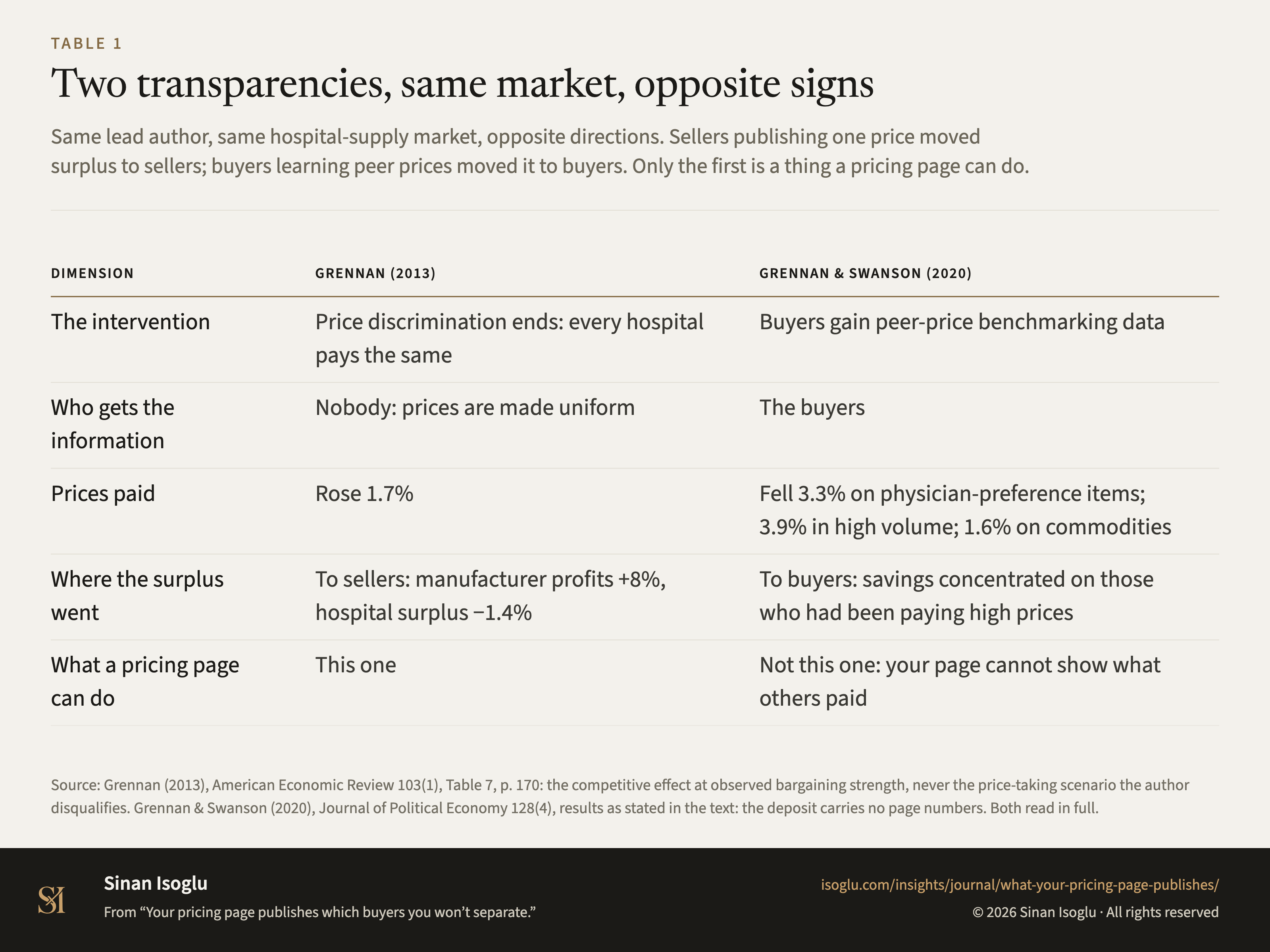
Same lead author, same hospital-supply market, opposite directions. Sellers publishing one price moved surplus to sellers; buyers learning peer prices moved it to buyers. Only the first is a thing a pricing page can do.
Table 1Two transparencies, same market, opposite signs
| Dimension | Grennan (2013) | Grennan & Swanson (2020) |
|---|---|---|
| The intervention | Price discrimination ends: every hospital pays the same | Buyers gain peer-price benchmarking data |
| Who gets the information | Nobody: prices are made uniform | The buyers |
| Prices paid | Rose 1.7% | Fell 3.3% on physician-preference items; 3.9% in high volume; 1.6% on commodities |
| Where the surplus went | To sellers: manufacturer profits +8%, hospital surplus −1.4% | To buyers: savings concentrated on those who had been paying high prices |
| What a pricing page can do | This one | Not this one: your page cannot show what others paid |
Swipe or scroll horizontally if the table is wider than your screen.
Source: Grennan (2013), American Economic Review 103(1), Table 7, p. 170: the competitive effect at observed bargaining strength, never the price-taking scenario the author disqualifies. Grennan & Swanson (2020), Journal of Political Economy 128(4), results as stated in the text: the deposit carries no page numbers. Both read in full.
Source and evidence
Each line names a claim related to this exhibit, its source, and how it was checked.
- A GREN13-C1 The setting and the question, in the author's words: the paper "estimates the welfare effects of different hospitals paying differ"ent prices "in the market for coronary stents", and the headline is that "more uniform pricing works against hospitals by softening competition". Table 7 (p. 170) gives the competitive-effect magnitudes: prices +1.7%, manufacturer profits +8%, hospital surplus −1.4%, total welfare +0.7%Grennan (2013), American Economic Review 103(1), 145–177 · VoR held
- A GS20-C1 Hospitals gaining peer-price benchmarking saved 3.3% on physician-preference items and 3.9% where buying in high volume: "under transparency for hospitals purchasing PPIs at formerly high prices (3.3% savings) and in relatively high quantities (3.9% savings)". The object of study is the information, not the price level: "we empirically examine the effect of transparency in the form of benchmarking information on prices negotiated by hospitals and their suppliers"Grennan & Swanson (2020), Journal of Political Economy 128(4), 1234–1268 · VoR held, no page citations ship
Grades: A, verified against the printed page of the primary source · B, primary source, text layer only · C, authoritative secondary · D, reported.
From the essay
Pricing & revenue architecture
Your pricing page publishes which buyers you won’t separate.
Publish or hide is not the decision anyone is making. Half of pricing pages do both at once, and the choice underneath has been measured exactly once.
Read the essayThis exhibit belongs to an essay: the numbers live here, the argument lives there.
Cite or embed
Related exhibits
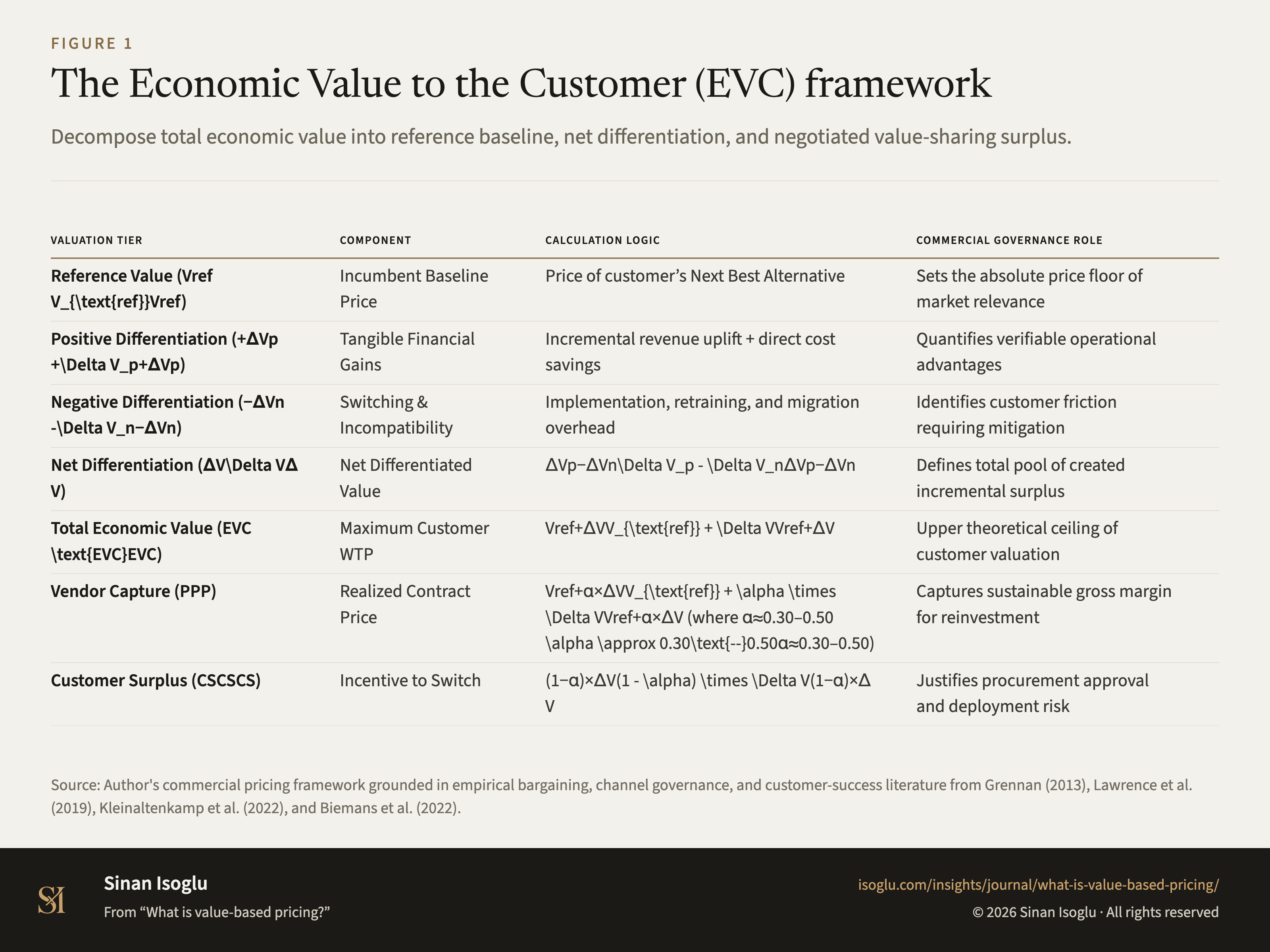
Figure 1Figure
The Economic Value to the Customer (EVC) framework
What is value-based pricing?
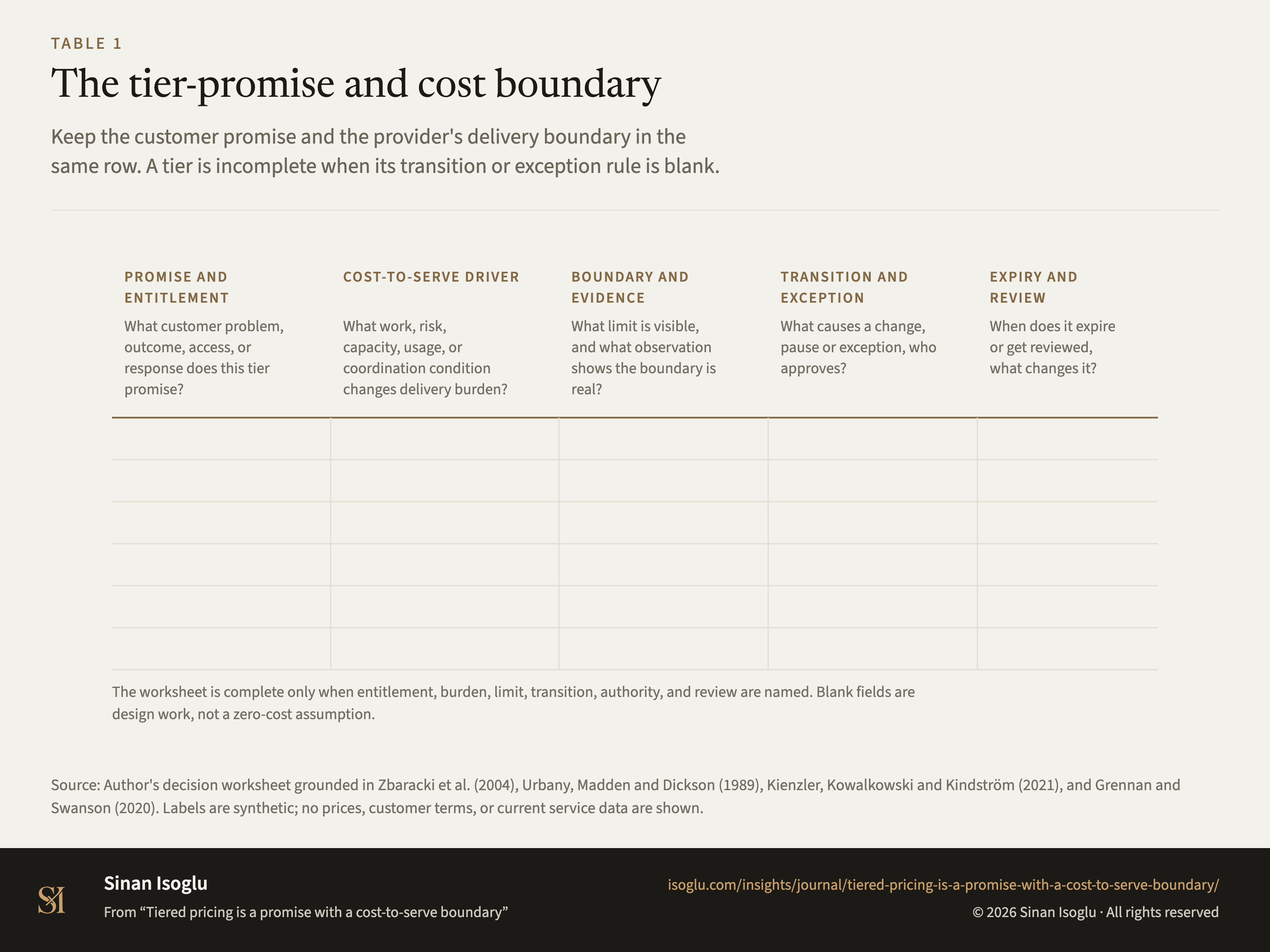
Table 1Table
The tier-promise and cost boundary
Tiered pricing is a promise with a cost-to-serve boundary
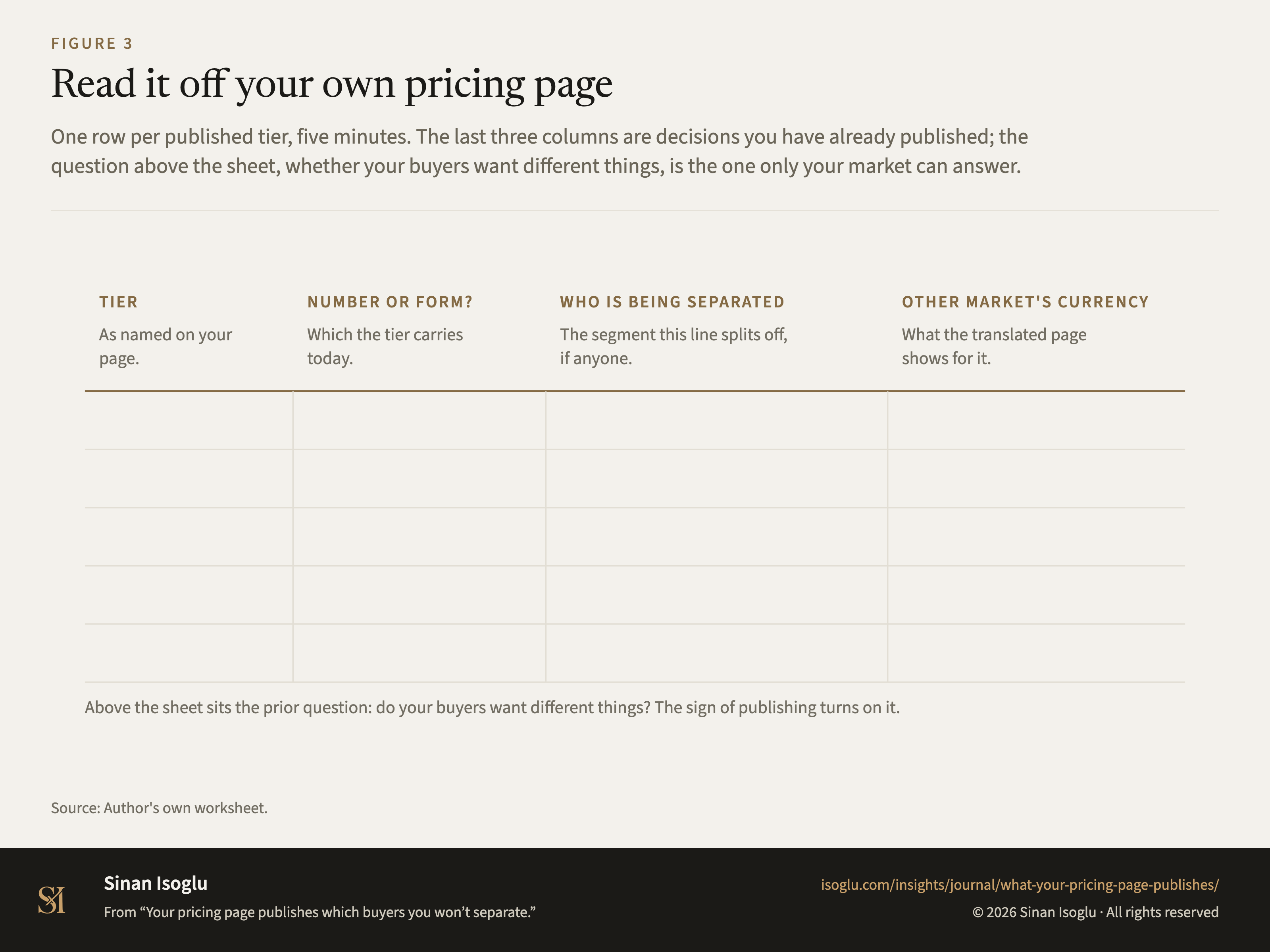
Figure 3Figure
Read it off your own pricing page
Your pricing page publishes which buyers you won’t separate.
Contact
Bring the question you're working on.
Research, a guest lecture, or a commercial question.