Figure 1From “What is value-based pricing?”
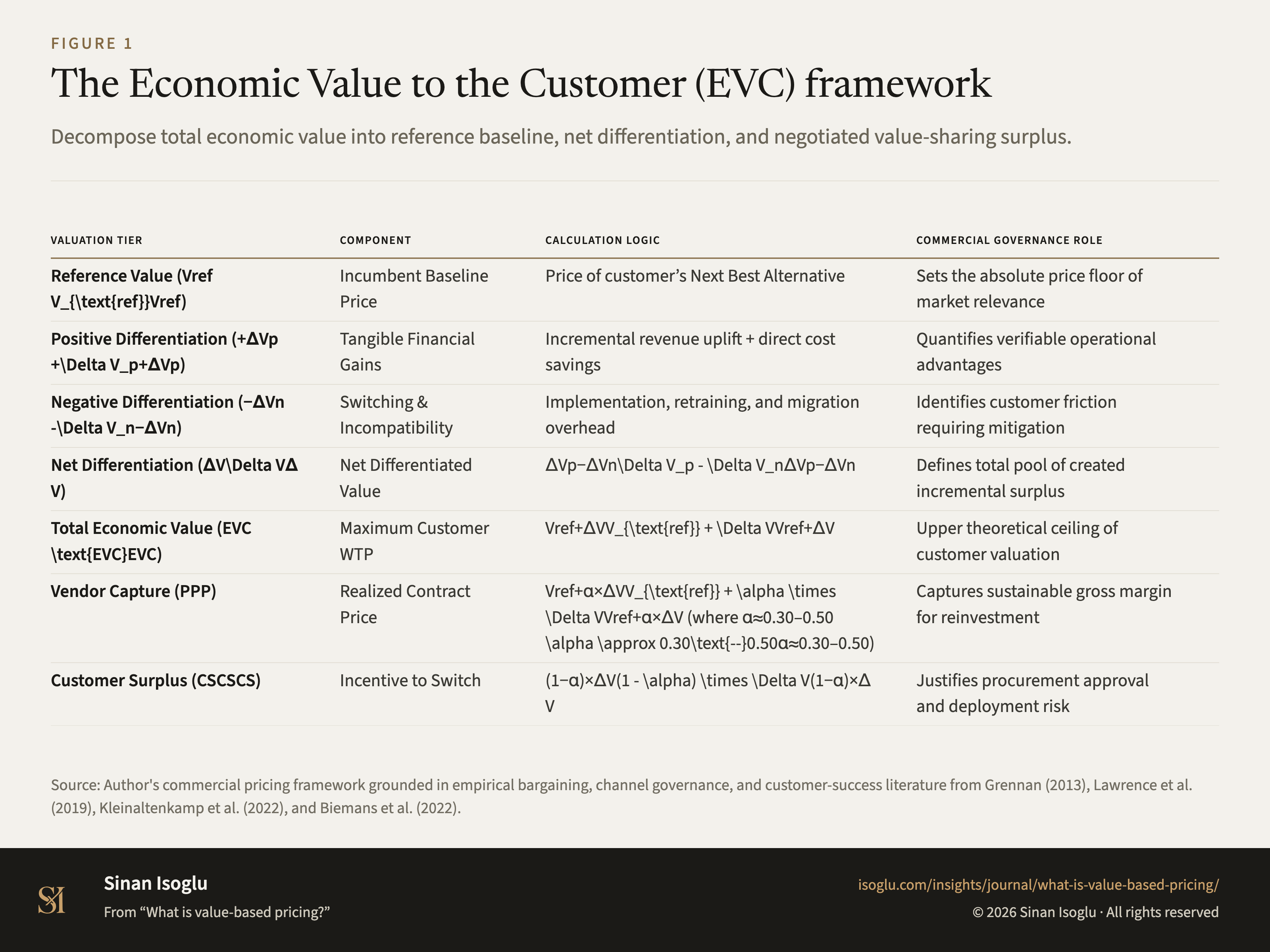
The Economic Value to the Customer (EVC) framework
Decompose total economic value into reference baseline, net differentiation, and negotiated value-sharing surplus.
Figure 1The Economic Value to the Customer (EVC) framework
| Valuation tier | Component | Calculation logic | Commercial governance role |
|---|---|---|---|
| Reference Value ($V_{\text{ref}}$) | Incumbent Baseline Price | Price of customer's Next Best Alternative | Sets the absolute price floor of market relevance |
| Positive Differentiation ($+\Delta V_p$) | Tangible Financial Gains | Incremental revenue uplift + direct cost savings | Quantifies verifiable operational advantages |
| Negative Differentiation ($-\Delta V_n$) | Switching & Incompatibility | Implementation, retraining, and migration overhead | Identifies customer friction requiring mitigation |
| Net Differentiation ($\Delta V$) | Net Differentiated Value | $\Delta V_p - \Delta V_n$ | Defines total pool of created incremental surplus |
| Total Economic Value ($\text{EVC}$) | Maximum Customer WTP | $V_{\text{ref}} + \Delta V$ | Upper theoretical ceiling of customer valuation |
| Vendor Capture ($P$) | Realized Contract Price | $V_{\text{ref}} + \alpha \times \Delta V$ (where $\alpha \approx 0.30\text{--}0.50$) | Captures sustainable gross margin for reinvestment |
| Customer Surplus ($CS$) | Incentive to Switch | $(1 - \alpha) \times \Delta V$ | Justifies procurement approval and deployment risk |
Swipe or scroll horizontally if the table is wider than your screen.
Source: Author's commercial pricing framework grounded in empirical bargaining, channel governance, and customer-success literature from Grennan (2013), Lawrence et al. (2019), Kleinaltenkamp et al. (2022), and Biemans et al. (2022).
Source and evidence
Each line names a claim related to this exhibit, its source, and how it was checked.
- A GREN13-C1 The setting and the question, in the author's words: the paper "estimates the welfare effects of different hospitals paying differ"ent prices "in the market for coronary stents", and the headline is that "more uniform pricing works against hospitals by softening competition". Table 7 (p. 170) gives the competitive-effect magnitudes: prices +1.7%, manufacturer profits +8%, hospital surplus −1.4%, total welfare +0.7%Grennan (2013), American Economic Review 103(1), 145–177 · VoR held
- A LCS19-C1 The sample, verbatim: "Our sample consists of all purchases from January 2014 through March 2015 by 3,653 business customers of the inside sales force of a global U.S.-based industrial seller", and "We analyze 28,909 time-varying observations". One seller, fifteen monthsLawrence, Crecelius, Scheer & Patil. (2019)
- B KPK22-C1 "Based on interviews of 95 representatives of supplier and customers firms", and the output is a set of drivers rather than an effect: "the study reveals eleven drivers for the implementation of customer success management that relate to customer perceived expected, experienced and relationship value"Kleinaltenkamp, Prohl-Schwenke & Keränen. (2022)
- A BMJ22-C1 The review's own count: "we identify 73 articles" about the sales-marketing interface, published 1990 through 2021Biemans, Malshe & Johnson. (2022)
Grades: A, verified against the printed page of the primary source · B, primary source, text layer only · C, authoritative secondary · D, reported.
From the essay
Pricing & revenue architecture
What is value-based pricing?
Value-based pricing aligns transaction prices with quantified customer economic value and willingness to pay rather than cost or competitor parity.
Read the essayThis exhibit belongs to an essay: the numbers live here, the argument lives there.
Cite or embed
Related exhibits
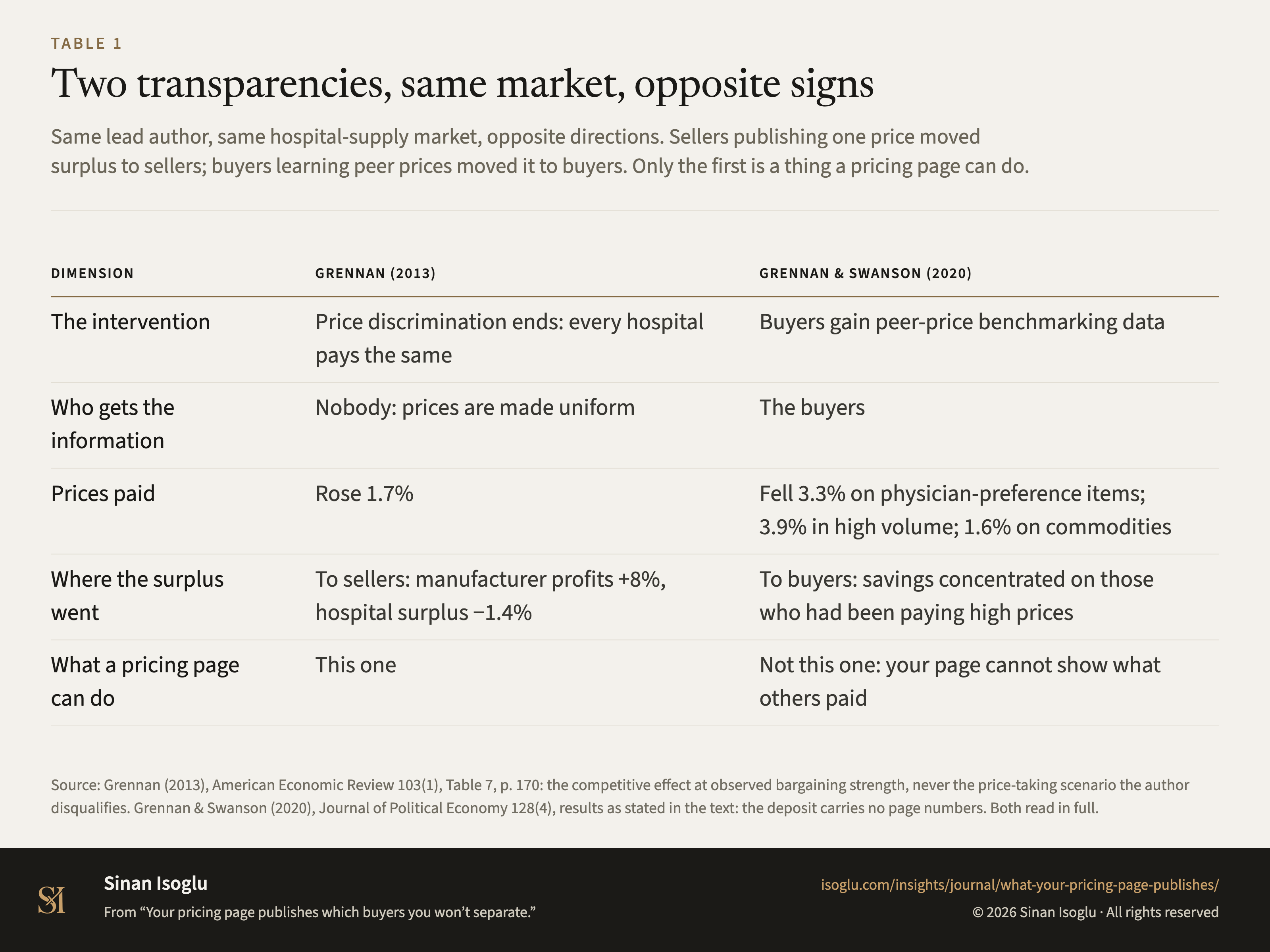
Table 1Table
Two transparencies, same market, opposite signs
Your pricing page publishes which buyers you won’t separate.
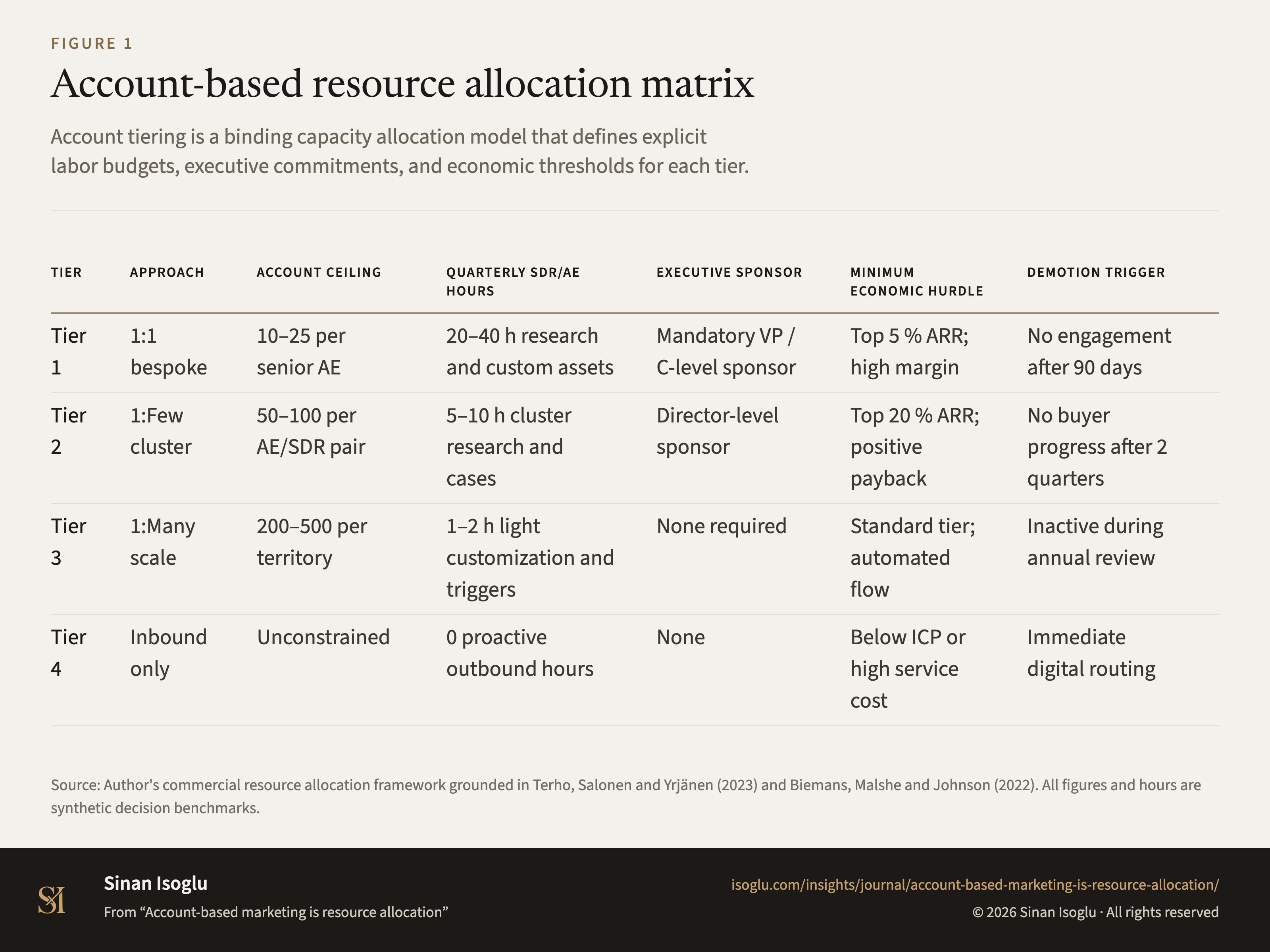
Figure 1Figure
Account-based resource allocation matrix
Account-based marketing is resource allocation
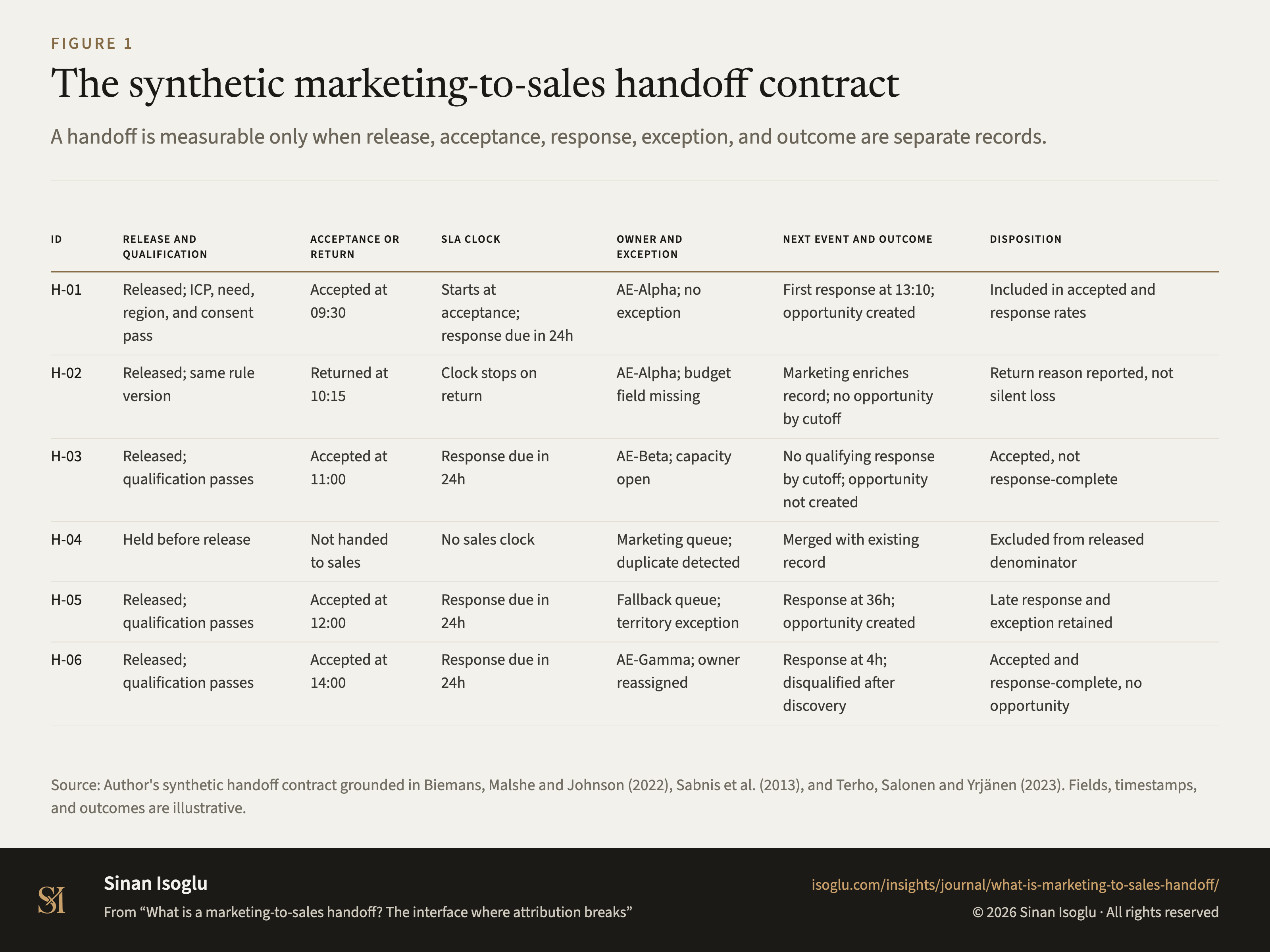
Figure 1Figure
The synthetic marketing-to-sales handoff contract
What is a marketing-to-sales handoff? The interface where attribution breaks
Contact
Bring the question you're working on.
Research, a guest lecture, or a commercial question.