Figure 1From “Account-based marketing is resource allocation”
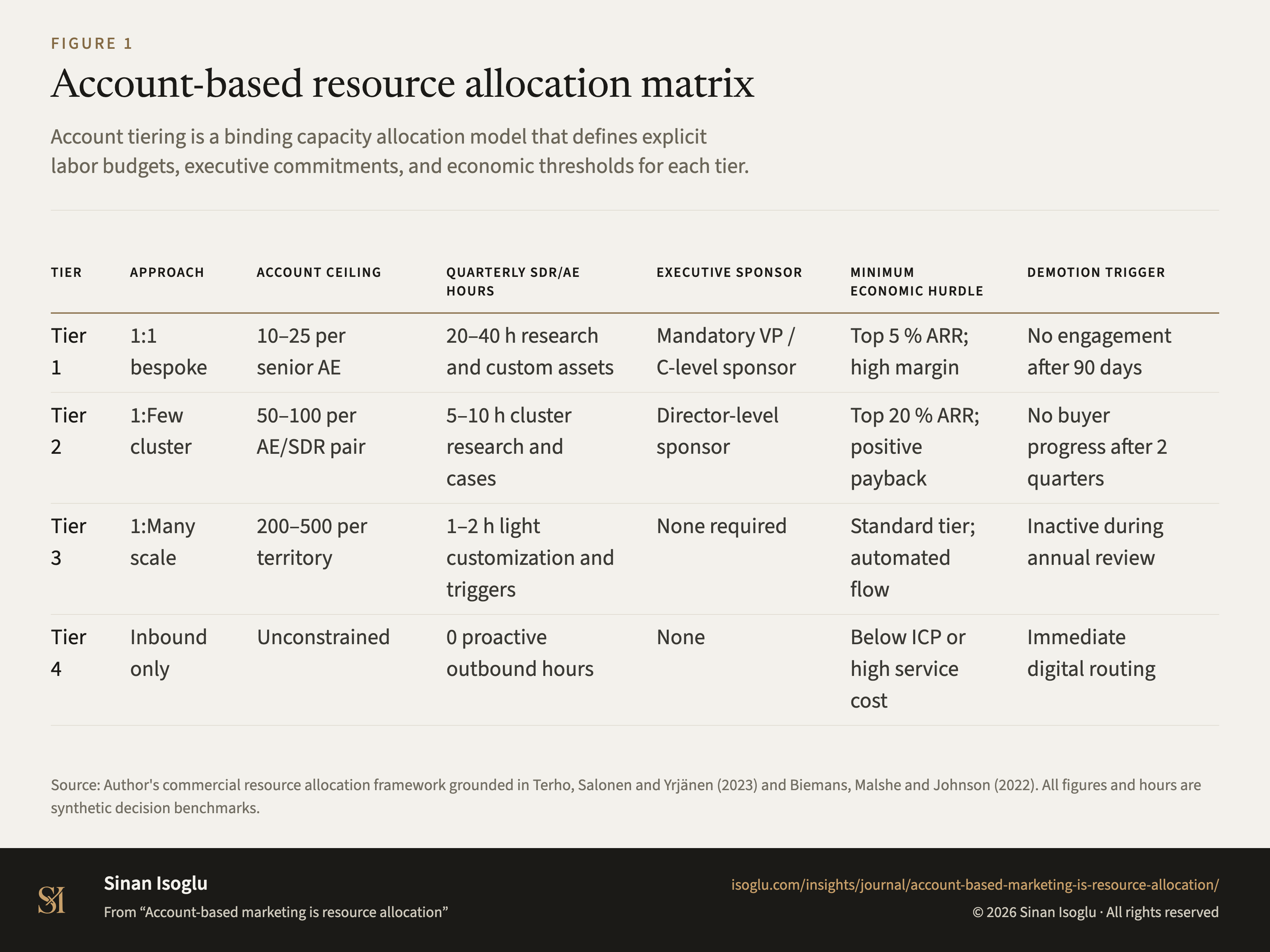
Account-based resource allocation matrix
Account tiering is a binding capacity allocation model that defines explicit labor budgets, executive commitments, and economic thresholds for each tier.
Figure 1Account-based resource allocation matrix
| Tier | Approach | Account ceiling | Quarterly SDR/AE hours | Executive sponsor | Minimum economic hurdle | Demotion trigger |
|---|---|---|---|---|---|---|
| Tier 1 | 1:1 bespoke | 10–25 per senior AE | 20–40 h research and custom assets | Mandatory VP / C-level sponsor | Top 5 % ARR; high margin | No engagement after 90 days |
| Tier 2 | 1:Few cluster | 50–100 per AE/SDR pair | 5–10 h cluster research and cases | Director-level sponsor | Top 20 % ARR; positive payback | No buyer progress after 2 quarters |
| Tier 3 | 1:Many scale | 200–500 per territory | 1–2 h light customization and triggers | None required | Standard tier; automated flow | Inactive during annual review |
| Tier 4 | Inbound only | Unconstrained | 0 proactive outbound hours | None | Below ICP or high service cost | Immediate digital routing |
Swipe or scroll horizontally if the table is wider than your screen.
Source: Author's commercial resource allocation framework grounded in Terho, Salonen and Yrjänen (2023) and Biemans, Malshe and Johnson (2022). All figures and hours are synthetic decision benchmarks.
Source and evidence
Each line names a claim related to this exhibit, its source, and how it was checked.
- A TSY23-C1 "the sales development processes relating to lead research engagement and handover are conducted in four distinct application contexts" to qualify leads for the outside salesforceTerho, Salonen & Yrjänen. (2023)
- A TSY23-C2 The evidence is qualitative and small: "the authors adopted a qualitative field-study approach and interviewed 13 people from eight firms", so the higher research intensity of account-based development is a reported pattern and not a measured effectTerho, Salonen & Yrjänen. (2023)
- A TSY23-C3 The four contexts are named: "sales development processes can be applied in outbound prospect focused outbound account based inbound prospect focused and inbound account based lead management contexts", and the processes "vary depending on the nature of the l"eadTerho, Salonen & Yrjänen. (2023)
- A BMJ22-C1 The review's own count: "we identify 73 articles" about the sales-marketing interface, published 1990 through 2021Biemans, Malshe & Johnson. (2022)
- A BMJ22-C2 The coding scheme, in the review's words: "structural linkages refer to the horizontal platforms or interaction" channels established for interdepartmental activity, alongside role linkages, interactions and perceptionsBiemans, Malshe & Johnson. (2022)
Grades: A, verified against the printed page of the primary source · B, primary source, text layer only · C, authoritative secondary · D, reported.
From the essay
Go-to-market strategy
Account-based marketing is resource allocation
Account-based marketing is not a campaign or personalization tactic; it is an explicit resource decision that allocates scarce sales and SDR capacity.
Read the essayThis exhibit belongs to an essay: the numbers live here, the argument lives there.
Cite or embed
Related exhibits
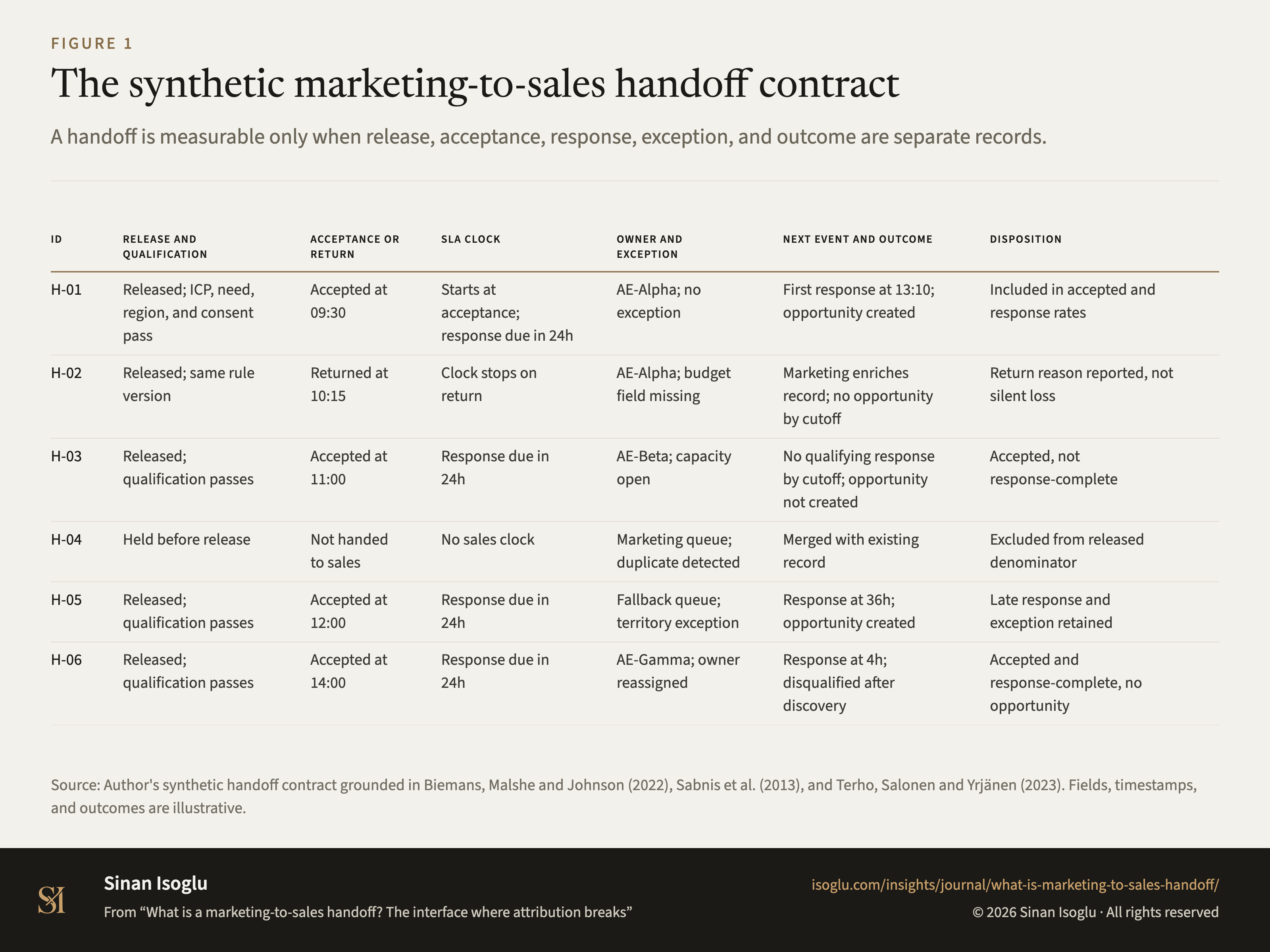
Figure 1Figure
The synthetic marketing-to-sales handoff contract
What is a marketing-to-sales handoff? The interface where attribution breaks
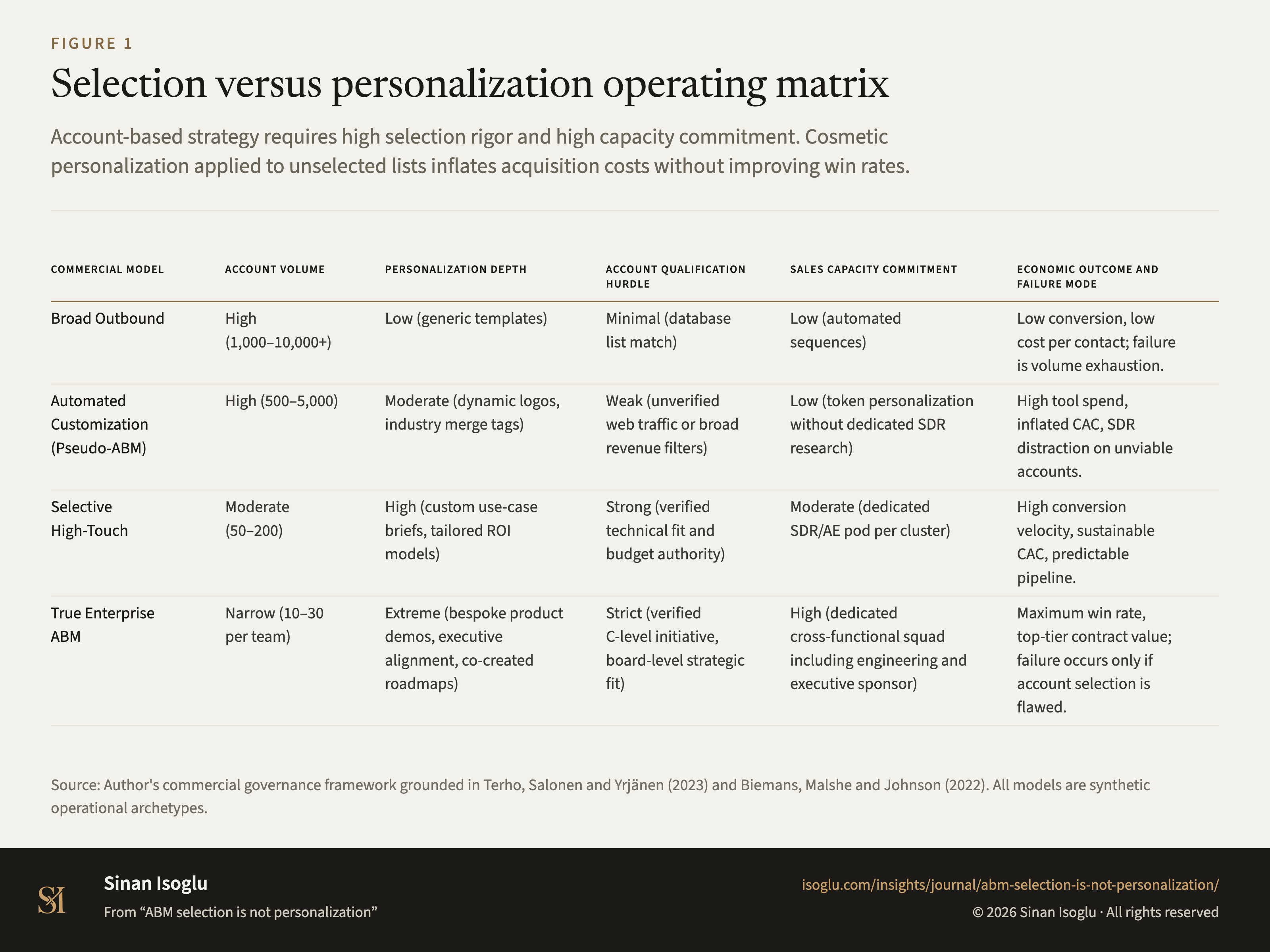
Figure 1Figure
Selection versus personalization operating matrix
ABM selection is not personalization
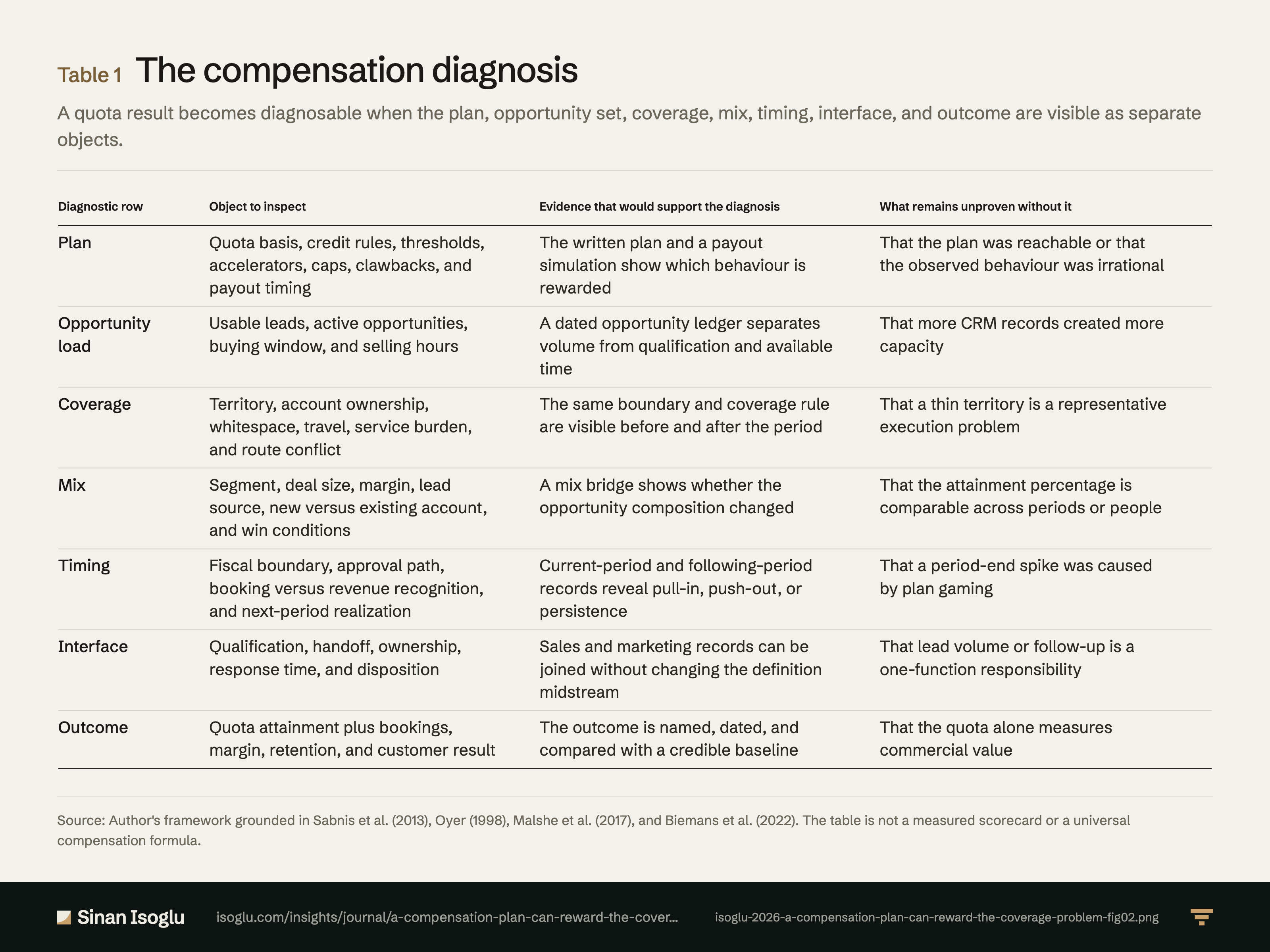
Table 1Table
The compensation diagnosis
A compensation plan can reward the coverage problem it created
Contact
Bring the question you're working on.
Research, a guest lecture, or a commercial question.