Figure 1From “What is a marketing-to-sales handoff? The interface where attribution breaks”
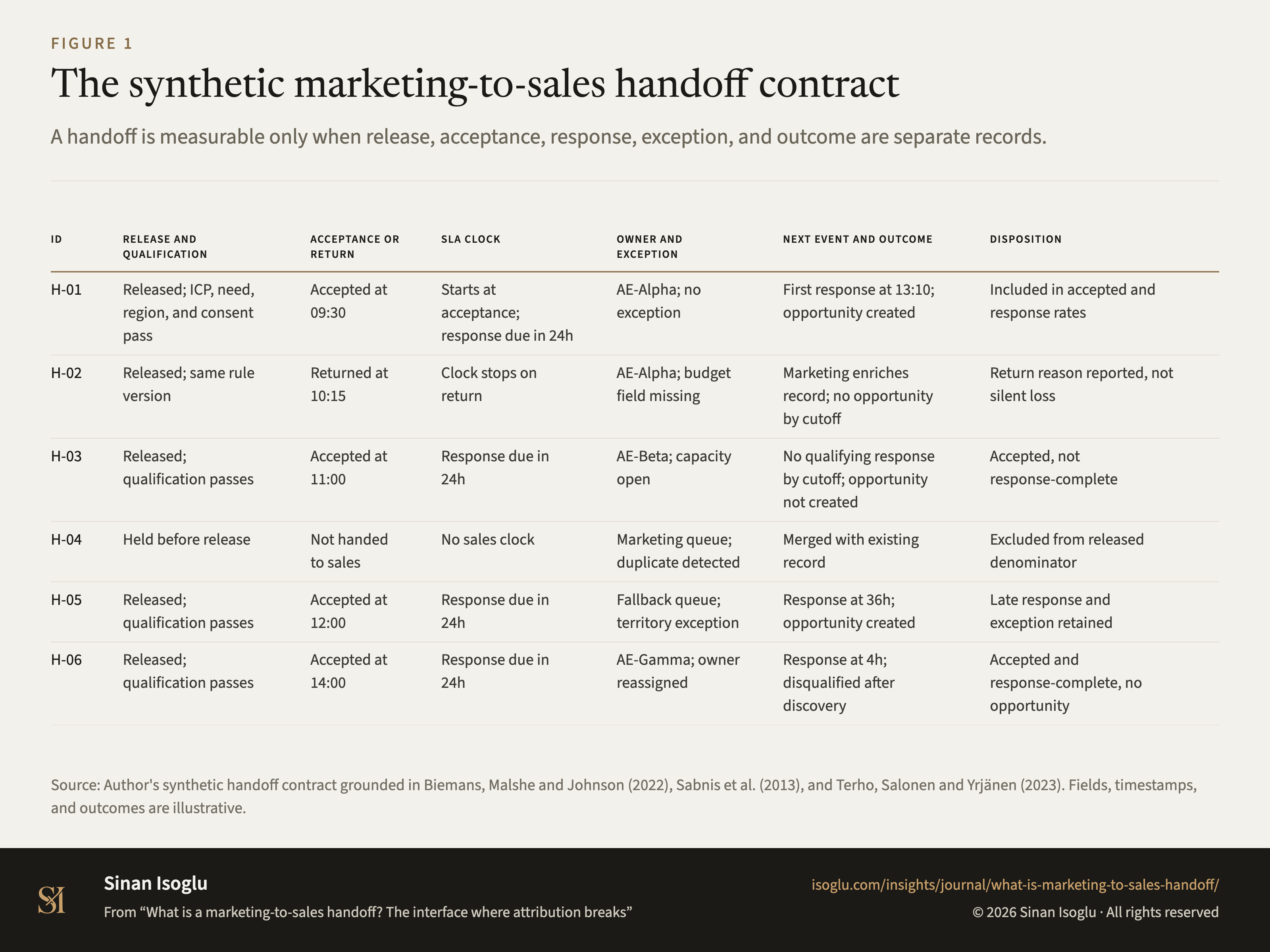
The synthetic marketing-to-sales handoff contract
A handoff is measurable only when release, acceptance, response, exception, and outcome are separate records.
Figure 1The synthetic marketing-to-sales handoff contract
| ID | Release and qualification | Acceptance or return | SLA clock | Owner and exception | Next event and outcome | Disposition |
|---|---|---|---|---|---|---|
| H-01 | Released; ICP, need, region, and consent pass | Accepted at 09:30 | Starts at acceptance; response due in 24h | AE-Alpha; no exception | First response at 13:10; opportunity created | Included in accepted and response rates |
| H-02 | Released; same rule version | Returned at 10:15 | Clock stops on return | AE-Alpha; budget field missing | Marketing enriches record; no opportunity by cutoff | Return reason reported, not silent loss |
| H-03 | Released; qualification passes | Accepted at 11:00 | Response due in 24h | AE-Beta; capacity open | No qualifying response by cutoff; opportunity not created | Accepted, not response-complete |
| H-04 | Held before release | Not handed to sales | No sales clock | Marketing queue; duplicate detected | Merged with existing record | Excluded from released denominator |
| H-05 | Released; qualification passes | Accepted at 12:00 | Response due in 24h | Fallback queue; territory exception | Response at 36h; opportunity created | Late response and exception retained |
| H-06 | Released; qualification passes | Accepted at 14:00 | Response due in 24h | AE-Gamma; owner reassigned | Response at 4h; disqualified after discovery | Accepted and response-complete, no opportunity |
Swipe or scroll horizontally if the table is wider than your screen.
Source: Author's synthetic handoff contract grounded in Biemans, Malshe and Johnson (2022), Sabnis et al. (2013), and Terho, Salonen and Yrjänen (2023). Fields, timestamps, and outcomes are illustrative.
Source and evidence
Each line names a claim related to this exhibit, its source, and how it was checked.
- A BMJ22-C1 The review's own count: "we identify 73 articles" about the sales-marketing interface, published 1990 through 2021Biemans, Malshe & Johnson. (2022)
- A BMJ22-C2 The coding scheme, in the review's words: "structural linkages refer to the horizontal platforms or interaction" channels established for interdepartmental activity, alongside role linkages, interactions and perceptionsBiemans, Malshe & Johnson. (2022)
- A SCCL13-C1 The sample, from the paper: "we received 562 surveys for a response rate of" 21.08%, "we retained 500 usable responses", and the analysis uses "data from 461 sales reps from four firms". The 70% in the same abstract is guarded by FUN-X1 and never travels with this rowSabnis et al. (2013)
- A SCCL13-C5 Time allocation is the mechanism: "the proportion of time that sales reps devote to marketing leads depends on organizational lead prequalification"Sabnis et al. (2013)
- A TSY23-C1 "the sales development processes relating to lead research engagement and handover are conducted in four distinct application contexts" to qualify leads for the outside salesforceTerho, Salonen & Yrjänen. (2023)
- A TSY23-C3 The four contexts are named: "sales development processes can be applied in outbound prospect focused outbound account based inbound prospect focused and inbound account based lead management contexts", and the processes "vary depending on the nature of the l"eadTerho, Salonen & Yrjänen. (2023)
- B V08-OWN-C1 A marketing-to-sales handoff is a dated interface where one owner releases a qualified work object and another owner accepts, returns, or holds itAuthor framework grounded in BMJ22-C1, SCCL13-C1, and TSY23-C1
- B V08-OWN-C3 Handoff acceptance is accepted released records divided by released records under the declared scopeAuthor formula set
- B V08-OWN-C6 Handoff latency and response completion describe interface operation and do not by themselves prove attribution or conversion causalityAuthor negative boundary
- A V08-OWN-C9 Sabnis et al. analyze marketing-lead follow-up in relation to lead quality, volume, tracking, experience, performance, and compensation contextSCCL13-C1 to SCCL13-C5
Grades: A, verified against the printed page of the primary source · B, primary source, text layer only · C, authoritative secondary · D, reported.
From the essay
Revenue operations & AI
What is a marketing-to-sales handoff? The interface where attribution breaks
A marketing-to-sales handoff is a dated release and acceptance interface. Name qualification, owner, SLA clock, exception, and outcome before measuring it.
Read the essayThis exhibit belongs to an essay: the numbers live here, the argument lives there.
Cite or embed
Related exhibits

Contact
Bring the question you're working on.
Research, a guest lecture, or a commercial question.