Figure 1From “What is revealed preference? Observed choice is not willingness to pay”
The revealed-preference choice record
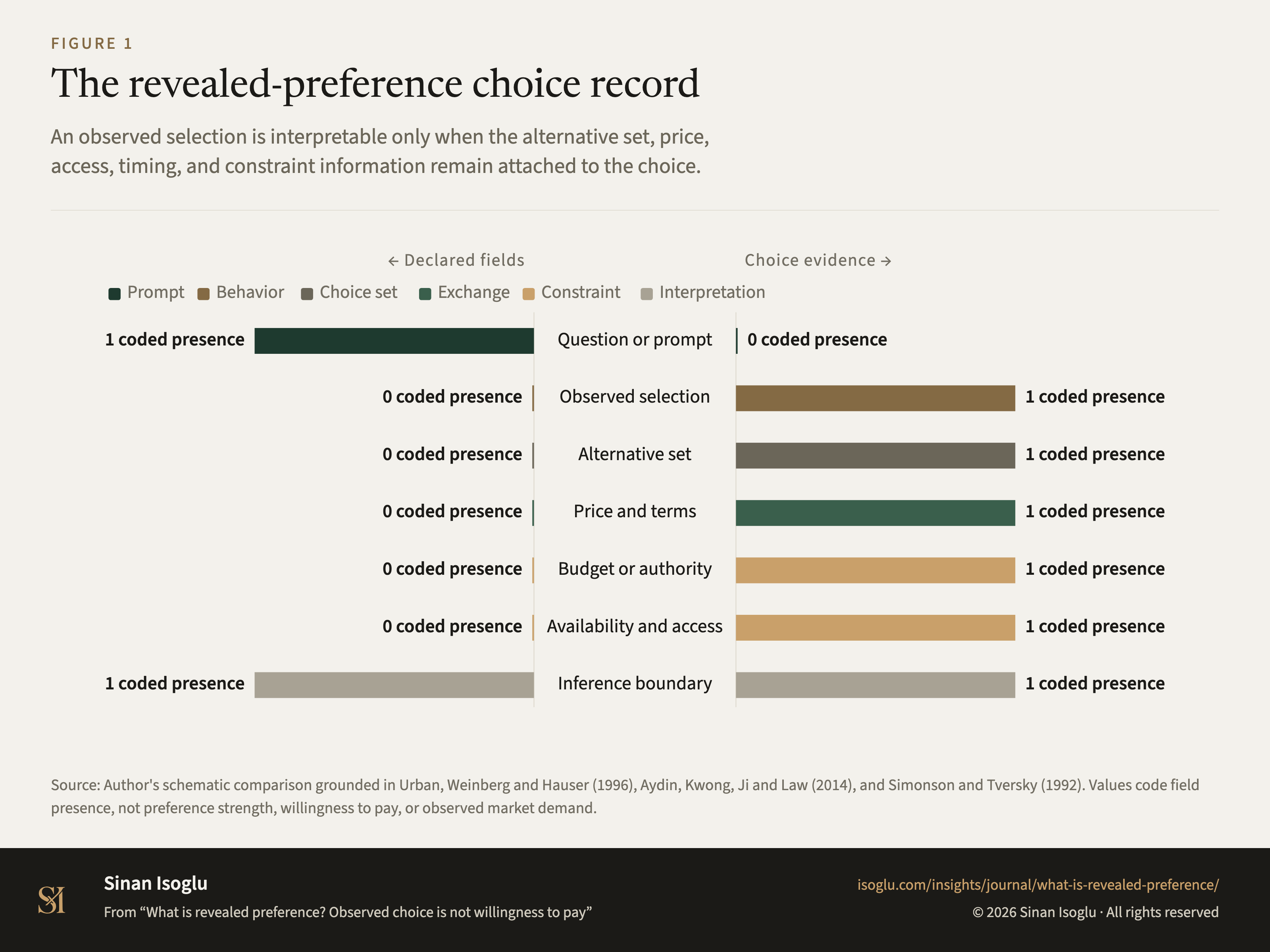
An observed selection is interpretable only when the alternative set, price, access, timing, and constraint information remain attached to the choice.
Figure 1The revealed-preference choice record
Source: Author's schematic comparison grounded in Urban, Weinberg and Hauser (1996), Aydin, Kwong, Ji and Law (2014), and Simonson and Tversky (1992). Values code field presence, not preference strength, willingness to pay, or observed market demand.
Source and evidence
Each line names a claim related to this exhibit, its source, and how it was checked.
- A UWH96-C1 The concern is stated preference inflating under hype: the authors worried that "respondents overstated their willingness to purchase an environmentally sound car" and built the design around it. It is one electric-vehicle case in which "the authors describe how one firm combines managerial judgment" with market measurement, not a general lawUrban, Weinberg & Hauser. (1996)
- A AKJL14-C1 The paper's actual claim is about FUZZINESS, not a survey-versus-choice-model comparison: "a high degree of fuzziness always exists in the data obtained from conjoint surveys" and "ignorance of the fuzziness would lead to the over-estimation of market demands"Aydin, Kwong, Ji & Law. (2014)
- B ST92-C1 Tradeoff contrast, in the authors' words: "the tendency to prefer an alternative is enhanced or hindered depending on whether the tradeoffs within the set under" consideration are favourable or unfavourable to that option. Checked against the PDF, because the extract warns that it mangles hyphenationsimonson-tversky-1992-choice-in-context
- B ST92-C2 Extremeness aversion: "the attractiveness of an option is enhanced if it is an intermediate option in the choice set and is diminished if it is an extreme option". Checked against the PDF for the same reasonsimonson-tversky-1992-choice-in-context
- B T06-OWN-C1 Revealed preference infers preference from observed choice or behavior under a declared choice set, price, constraint, and time boundaryAuthor framework grounded in UWH96-C1 and ST92-C1
- B T06-OWN-C2 Observed choice, stated preference, willingness to pay, transaction price, and demand response are different objectsAuthor taxonomy grounded in AKJL14-C1 and ST92-C2
- B T06-OWN-C4 An observed choice can reflect preference, budget, availability, search, default, switching cost, or constraint rather than price aloneAuthor boundary
- B T06-OWN-C5 Revealed preference is evidence about behavior in the observed environment and does not automatically identify a reservation priceAuthor negative boundary
Grades: A, verified against the printed page of the primary source · B, primary source, text layer only · C, authoritative secondary · D, reported.
From the essay
Pricing & revenue architecture
What is revealed preference? Observed choice is not willingness to pay
Revealed preference infers choice from observed behavior under constraints. Keep price paid, alternatives, budget, access, and stated intent separate.
Read the essayThis exhibit belongs to an essay: the numbers live here, the argument lives there.
Cite or embed
Related exhibits
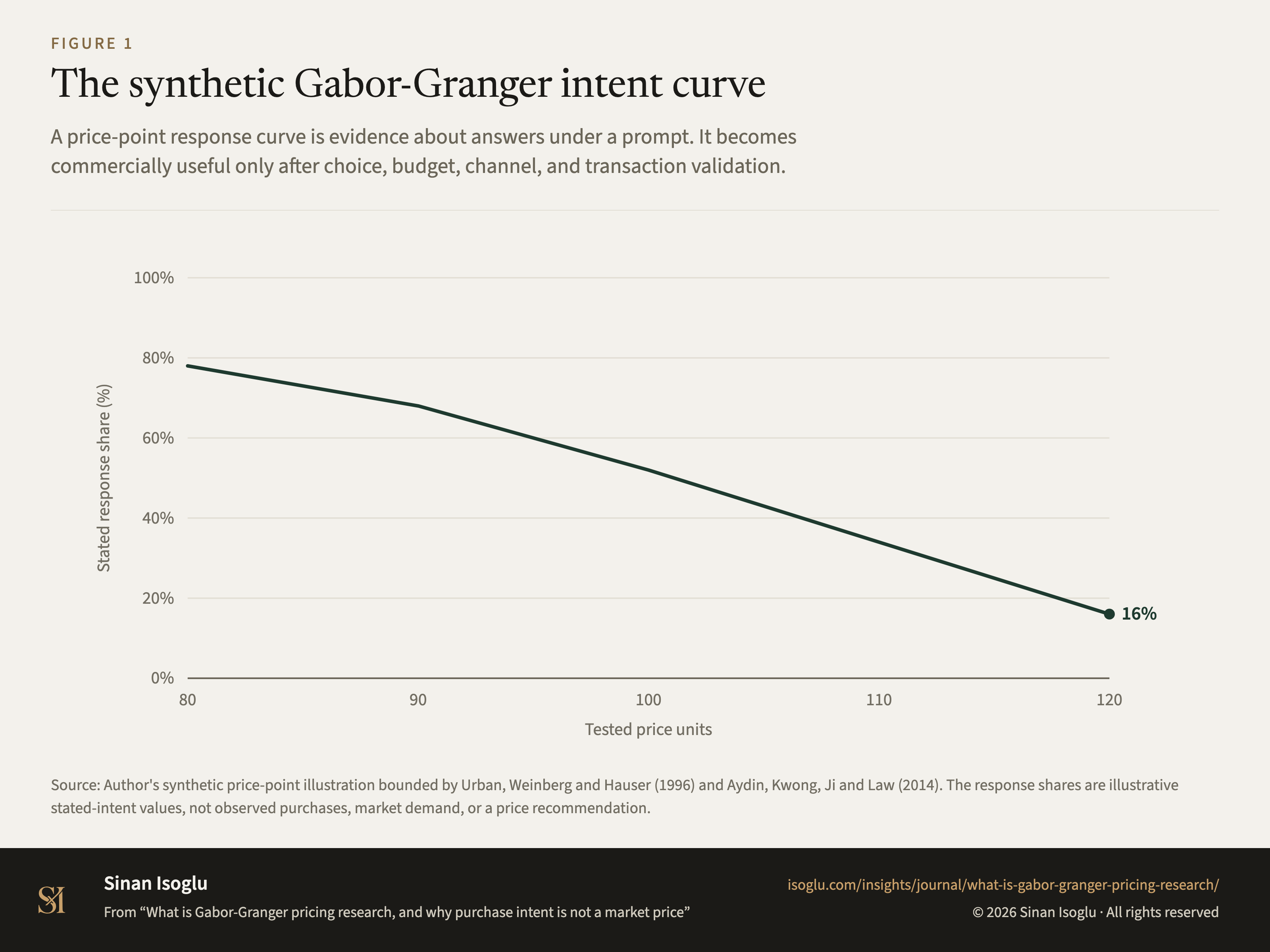
Figure 1Figure
The synthetic Gabor-Granger intent curve
What is Gabor-Granger pricing research, and why purchase intent is not a market price
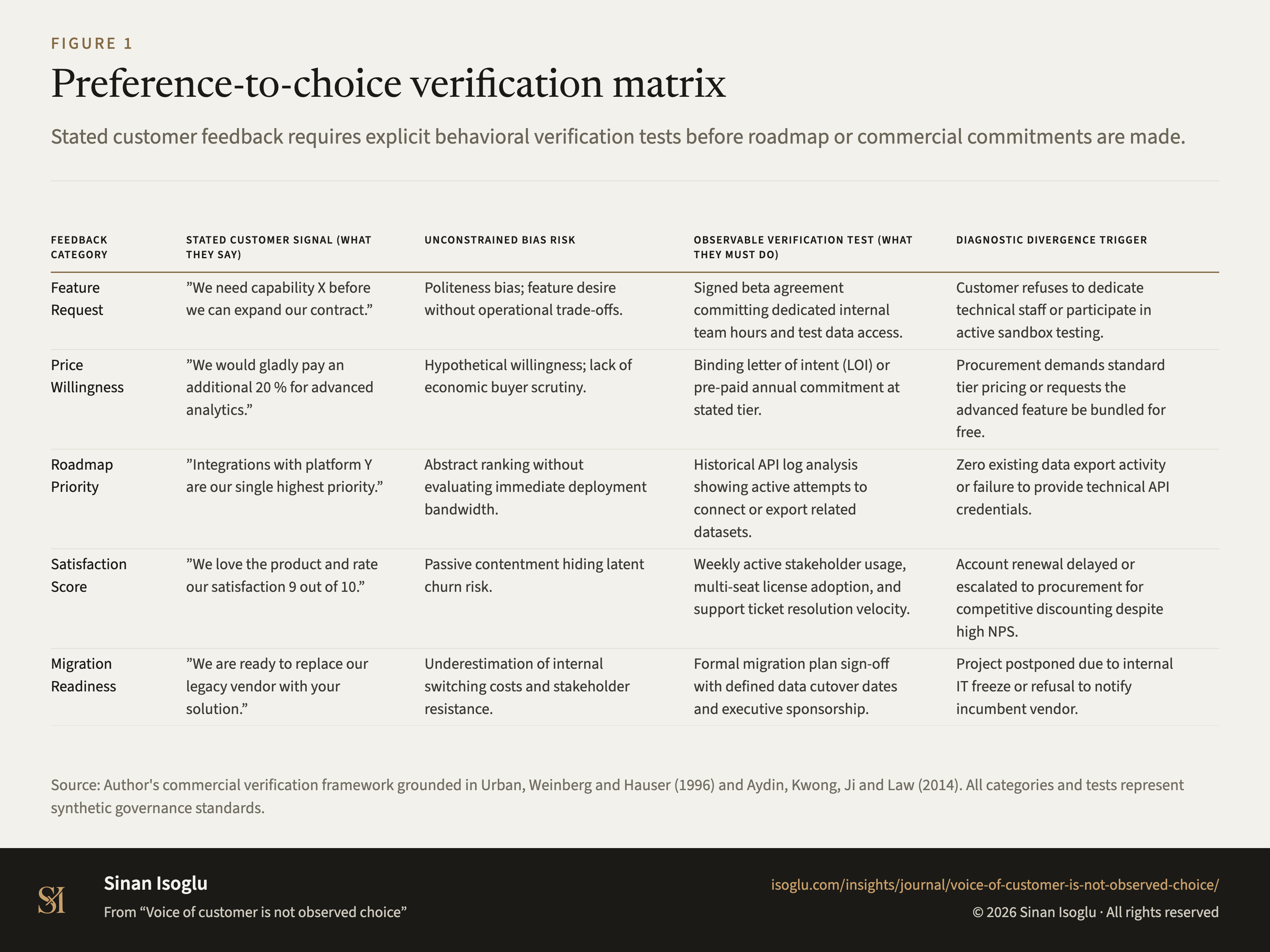
Figure 1Figure
Preference-to-choice verification matrix
Voice of customer is not observed choice
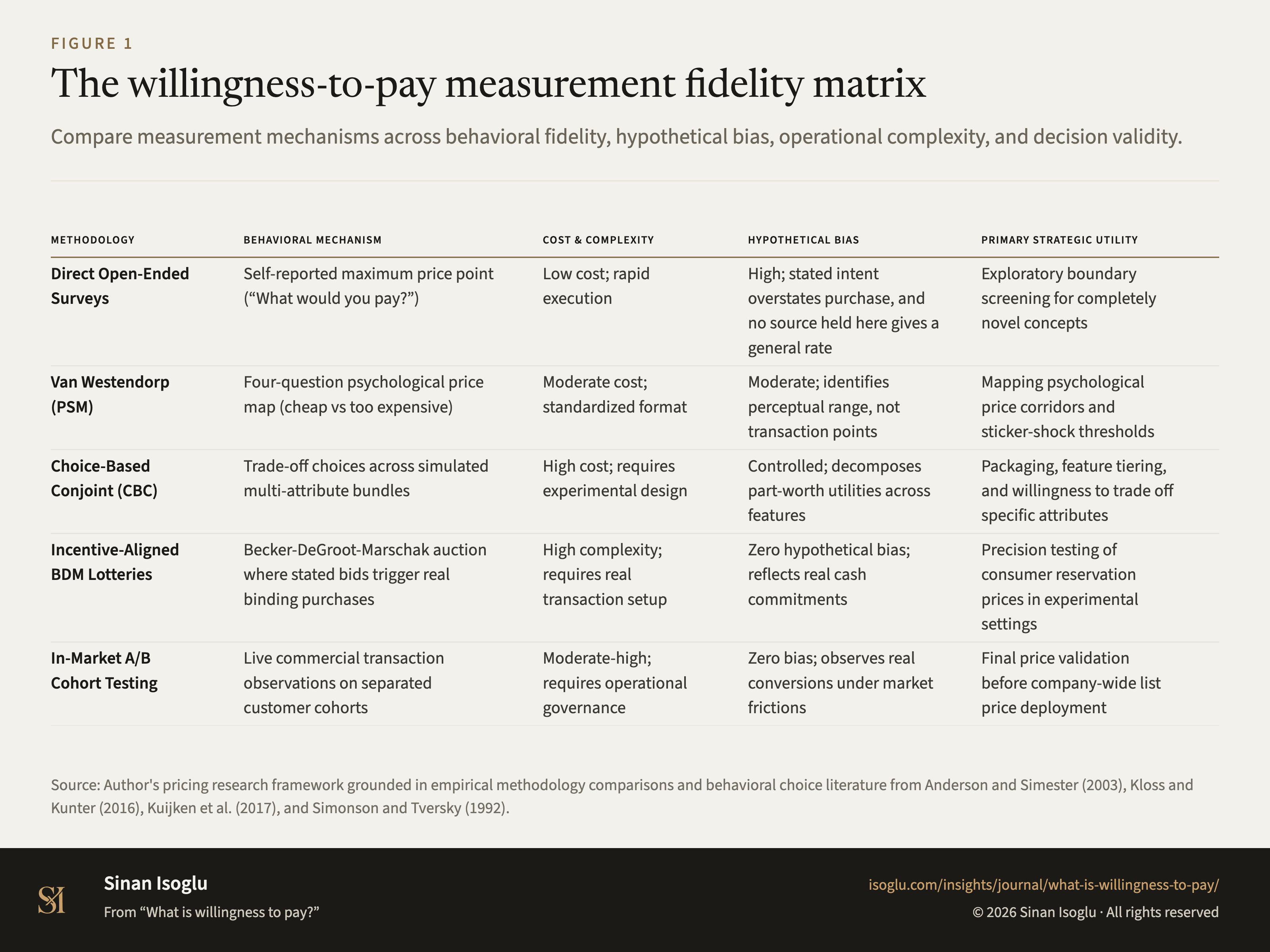
Figure 1Figure
The willingness-to-pay measurement fidelity matrix
What is willingness to pay?
Contact
Bring the question you're working on.
Research, a guest lecture, or a commercial question.