Figure 1From “Voice of customer is not observed choice”
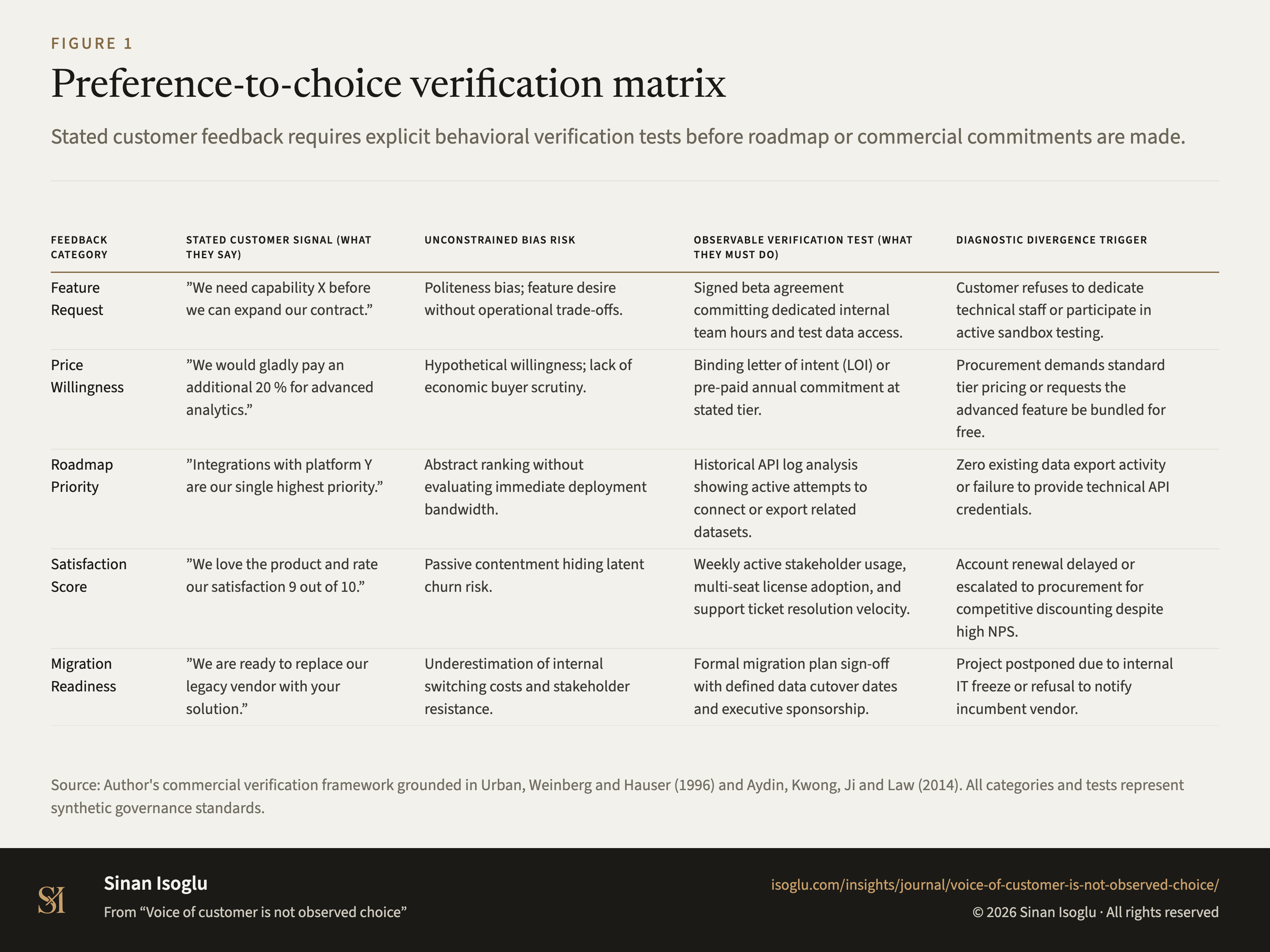
Preference-to-choice verification matrix
Stated customer feedback requires explicit behavioral verification tests before roadmap or commercial commitments are made.
Figure 1Preference-to-choice verification matrix
| Feedback category | Stated customer signal (What they say) | Unconstrained bias risk | Observable verification test (What they must do) | Diagnostic divergence trigger |
|---|---|---|---|---|
| Feature Request | "We need capability X before we can expand our contract." | Politeness bias; feature desire without operational trade-offs. | Signed beta agreement committing dedicated internal team hours and test data access. | Customer refuses to dedicate technical staff or participate in active sandbox testing. |
| Price Willingness | "We would gladly pay an additional 20 % for advanced analytics." | Hypothetical willingness; lack of economic buyer scrutiny. | Binding letter of intent (LOI) or pre-paid annual commitment at stated tier. | Procurement demands standard tier pricing or requests the advanced feature be bundled for free. |
| Roadmap Priority | "Integrations with platform Y are our single highest priority." | Abstract ranking without evaluating immediate deployment bandwidth. | Historical API log analysis showing active attempts to connect or export related datasets. | Zero existing data export activity or failure to provide technical API credentials. |
| Satisfaction Score | "We love the product and rate our satisfaction 9 out of 10." | Passive contentment hiding latent churn risk. | Weekly active stakeholder usage, multi-seat license adoption, and support ticket resolution velocity. | Account renewal delayed or escalated to procurement for competitive discounting despite high NPS. |
| Migration Readiness | "We are ready to replace our legacy vendor with your solution." | Underestimation of internal switching costs and stakeholder resistance. | Formal migration plan sign-off with defined data cutover dates and executive sponsorship. | Project postponed due to internal IT freeze or refusal to notify incumbent vendor. |
Swipe or scroll horizontally if the table is wider than your screen.
Source: Author's commercial verification framework grounded in Urban, Weinberg and Hauser (1996) and Aydin, Kwong, Ji and Law (2014). All categories and tests represent synthetic governance standards.
Source and evidence
Each line names a claim related to this exhibit, its source, and how it was checked.
- A UWH96-C1 The concern is stated preference inflating under hype: the authors worried that "respondents overstated their willingness to purchase an environmentally sound car" and built the design around it. It is one electric-vehicle case in which "the authors describe how one firm combines managerial judgment" with market measurement, not a general lawUrban, Weinberg & Hauser. (1996)
- A AKJL14-C1 The paper's actual claim is about FUZZINESS, not a survey-versus-choice-model comparison: "a high degree of fuzziness always exists in the data obtained from conjoint surveys" and "ignorance of the fuzziness would lead to the over-estimation of market demands"Aydin, Kwong, Ji & Law. (2014)
Grades: A, verified against the printed page of the primary source · B, primary source, text layer only · C, authoritative secondary · D, reported.
From the essay
Go-to-market strategy
Voice of customer is not observed choice
Surveys report stated preferences in unconstrained environments; observed choice reflects actual trade-offs under real budget and adoption friction.
Read the essayThis exhibit belongs to an essay: the numbers live here, the argument lives there.
Cite or embed
Related exhibits
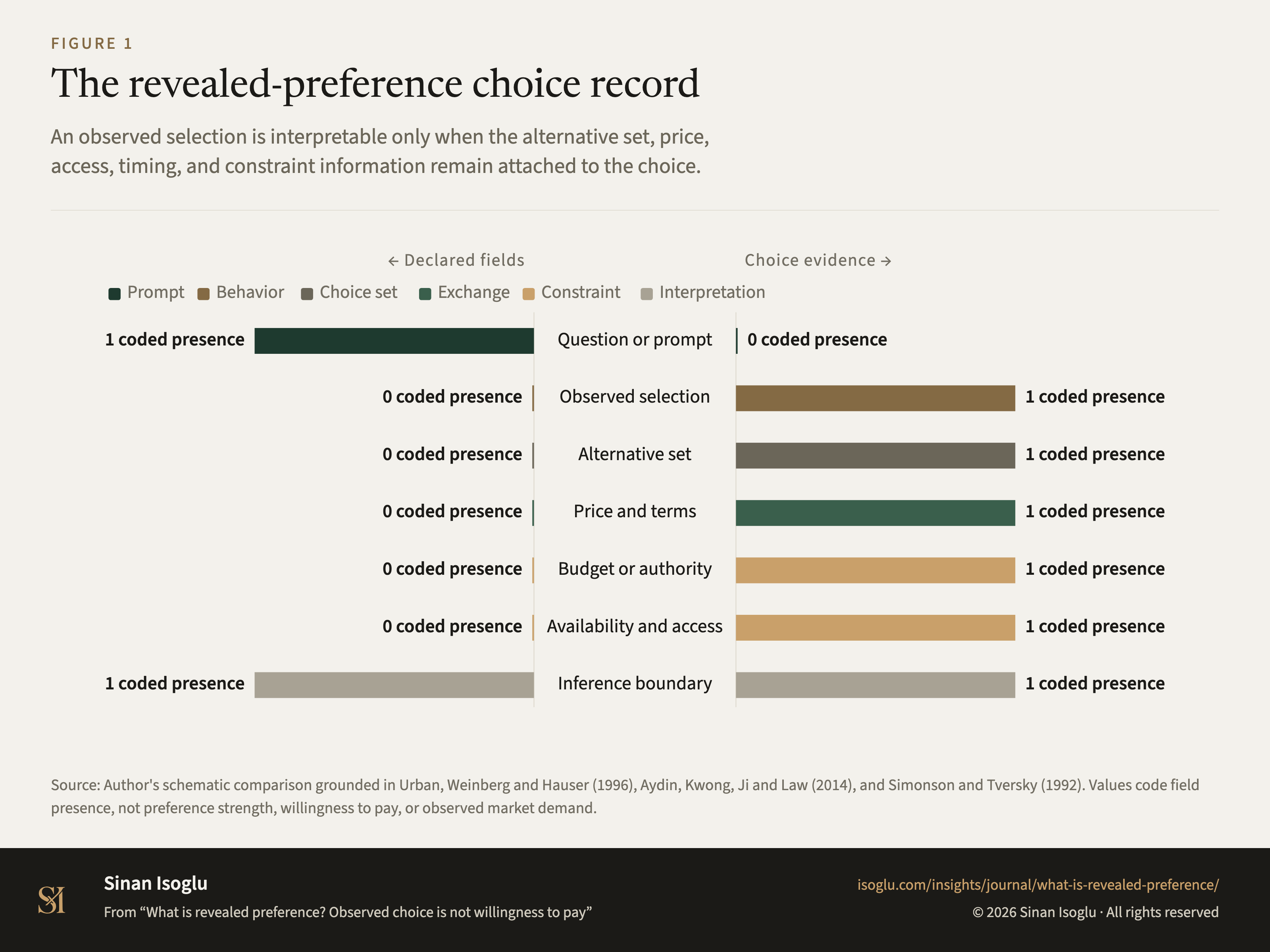
Figure 1Figure
The revealed-preference choice record
What is revealed preference? Observed choice is not willingness to pay
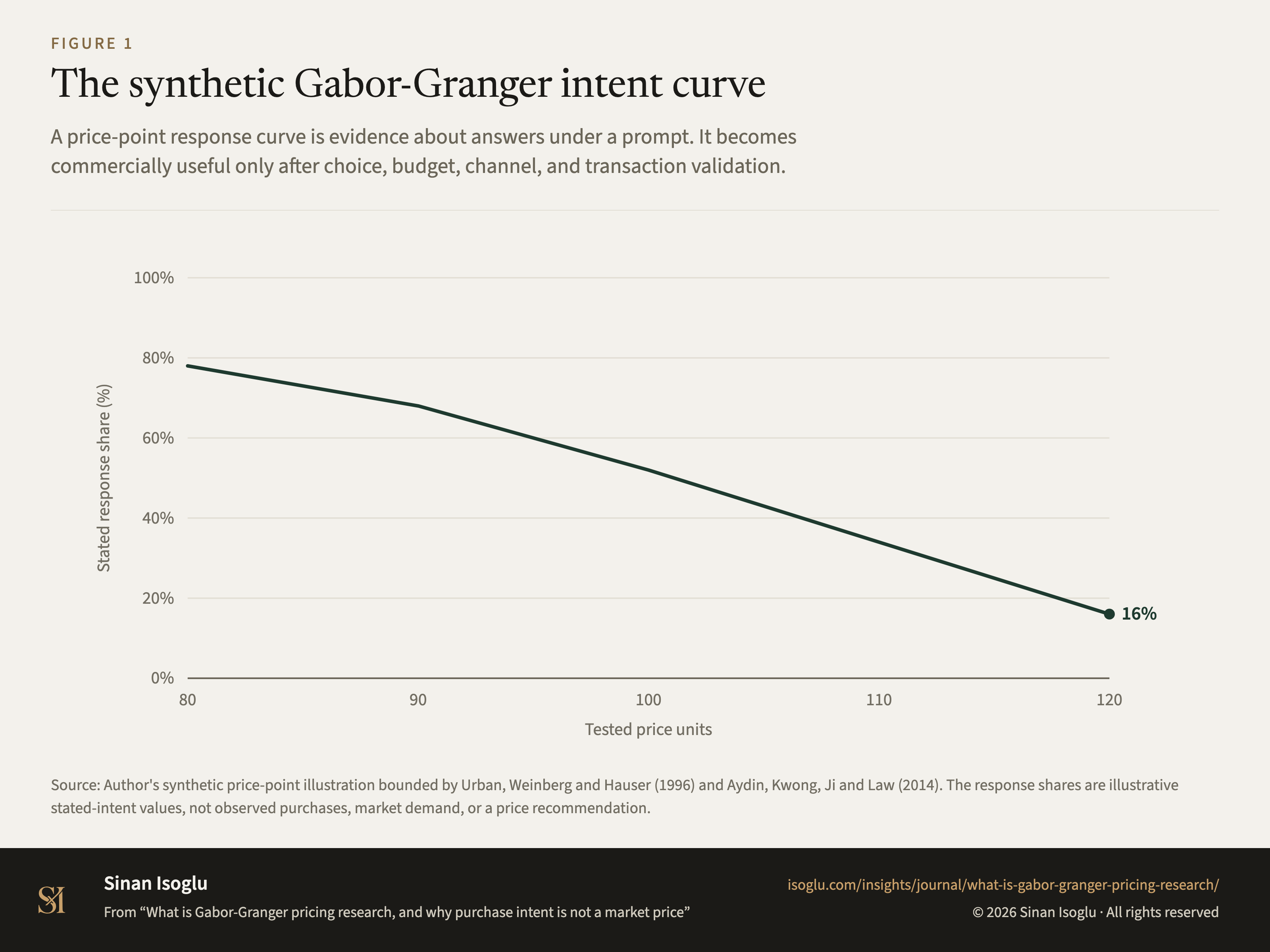
Figure 1Figure
The synthetic Gabor-Granger intent curve
What is Gabor-Granger pricing research, and why purchase intent is not a market price
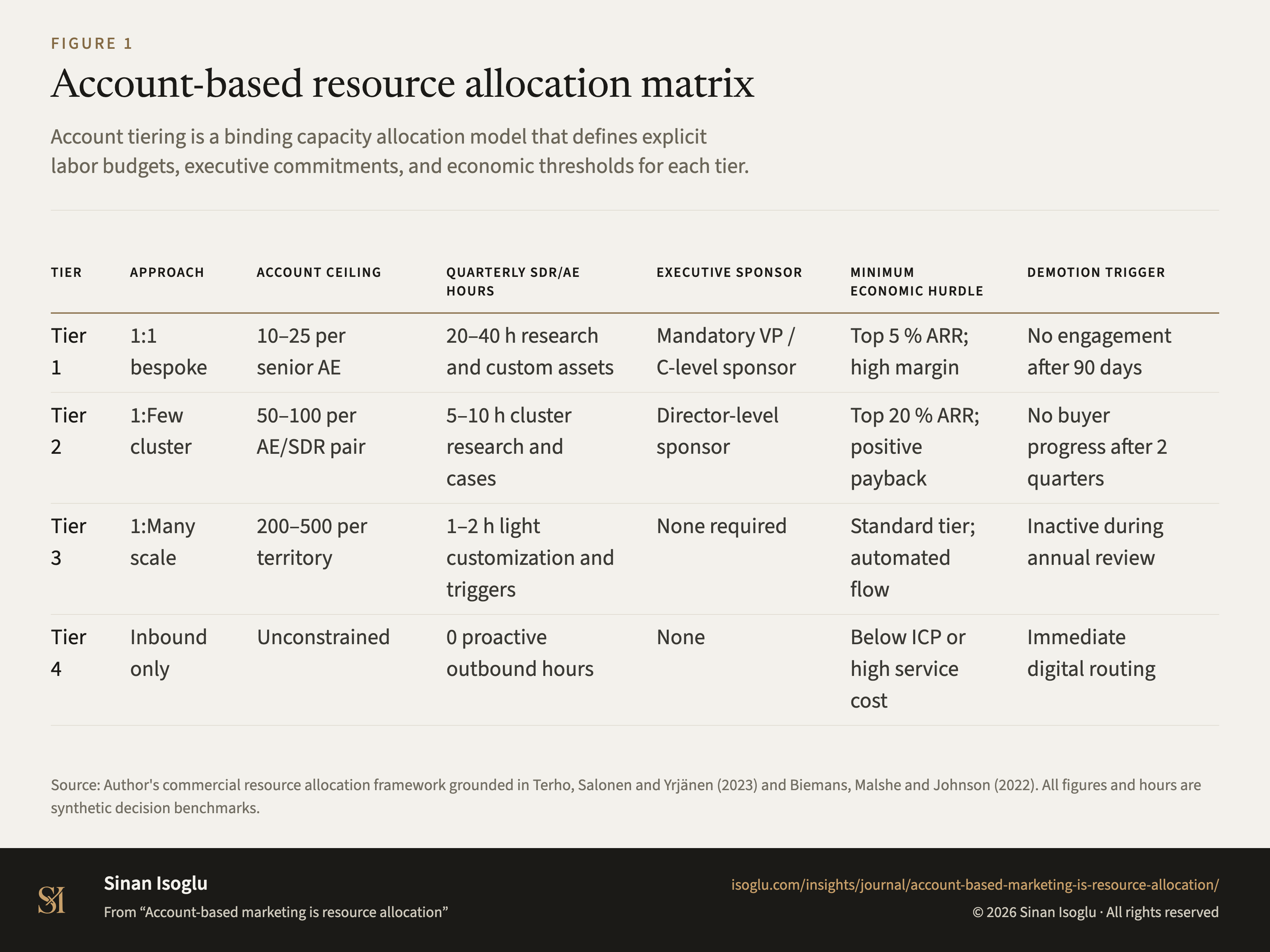
Figure 1Figure
Account-based resource allocation matrix
Account-based marketing is resource allocation
Contact
Bring the question you're working on.
Research, a guest lecture, or a commercial question.