Figure 1From “What is Gabor-Granger pricing research, and why purchase intent is not a market price”
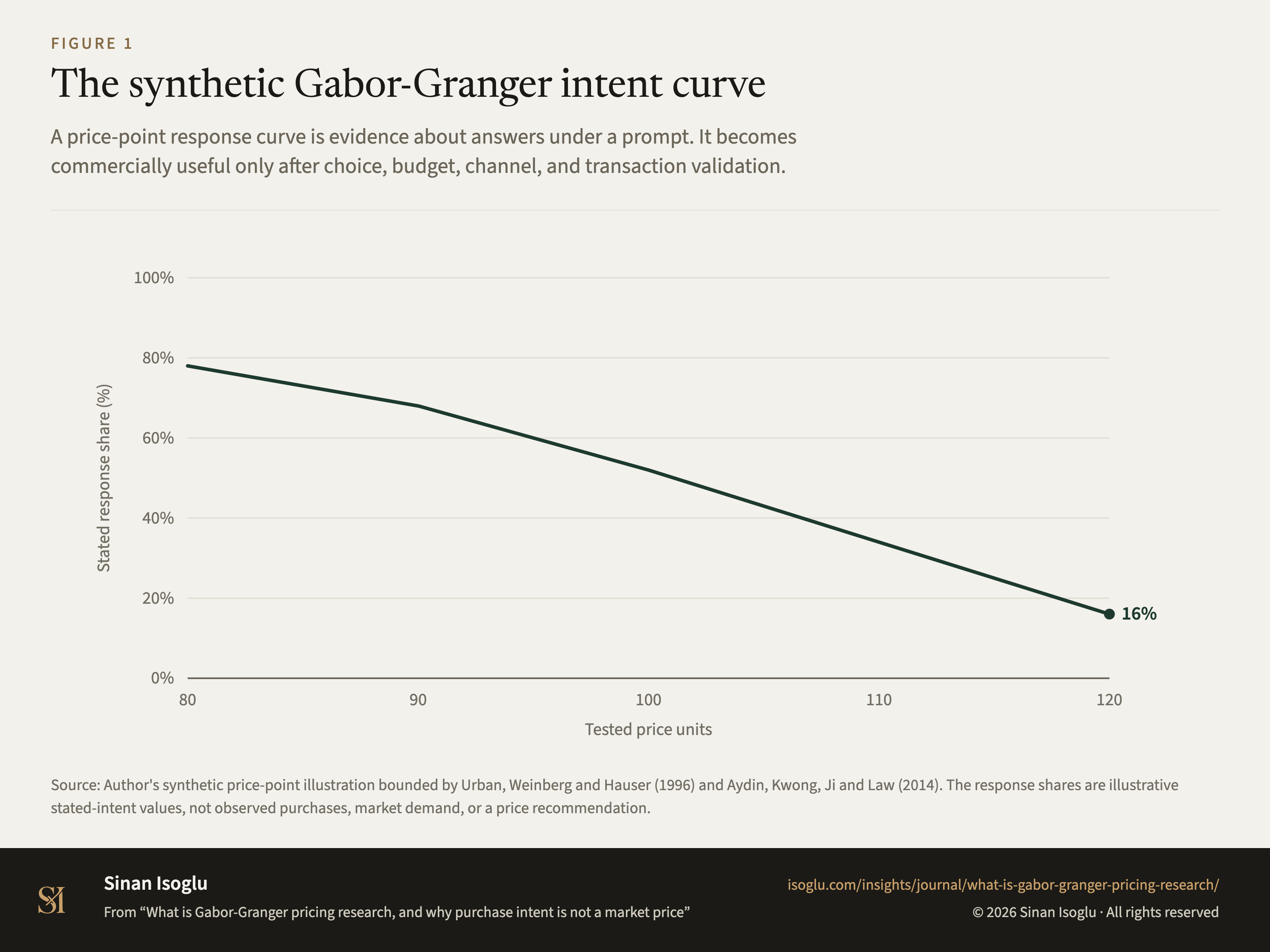
The synthetic Gabor-Granger intent curve
A price-point response curve is evidence about answers under a prompt. It becomes commercially useful only after choice, budget, channel, and transaction validation.
Figure 1The synthetic Gabor-Granger intent curve
Source: Author's synthetic price-point illustration bounded by Urban, Weinberg and Hauser (1996) and Aydin, Kwong, Ji and Law (2014). The response shares are illustrative stated-intent values, not observed purchases, market demand, or a price recommendation.
Source and evidence
Each line names a claim related to this exhibit, its source, and how it was checked.
- A UWH96-C1 The concern is stated preference inflating under hype: the authors worried that "respondents overstated their willingness to purchase an environmentally sound car" and built the design around it. It is one electric-vehicle case in which "the authors describe how one firm combines managerial judgment" with market measurement, not a general lawUrban, Weinberg & Hauser. (1996)
- A AKJL14-C1 The paper's actual claim is about FUZZINESS, not a survey-versus-choice-model comparison: "a high degree of fuzziness always exists in the data obtained from conjoint surveys" and "ignorance of the fuzziness would lead to the over-estimation of market demands"Aydin, Kwong, Ji & Law. (2014)
- B T05-OWN-C1 Gabor-Granger pricing research asks respondents to evaluate purchase intention across a sequence of stated price pointsAuthor framework; direct method source not held
- B T05-OWN-C2 A stated purchase-intent curve is not a market-price observation, transaction price, or revealed willingness to payAuthor boundary grounded in UWH96-C1 and AKJL14-C1
- B T05-OWN-C4 Price-point acceptance, purchase intention, and observed purchase are separate response objectsAuthor taxonomy
- B T05-OWN-C5 The method can compare stated acceptance across price points under its survey design, but cannot by itself estimate realized demand or causal elasticityAuthor negative boundary
Grades: A, verified against the printed page of the primary source · B, primary source, text layer only · C, authoritative secondary · D, reported.
From the essay
Pricing & revenue architecture
What is Gabor-Granger pricing research, and why purchase intent is not a market price
Gabor-Granger asks stated purchase intent at named prices. Treat its curve as a research signal, then validate it against choice and market constraints.
Read the essayThis exhibit belongs to an essay: the numbers live here, the argument lives there.
Cite or embed
Related exhibits
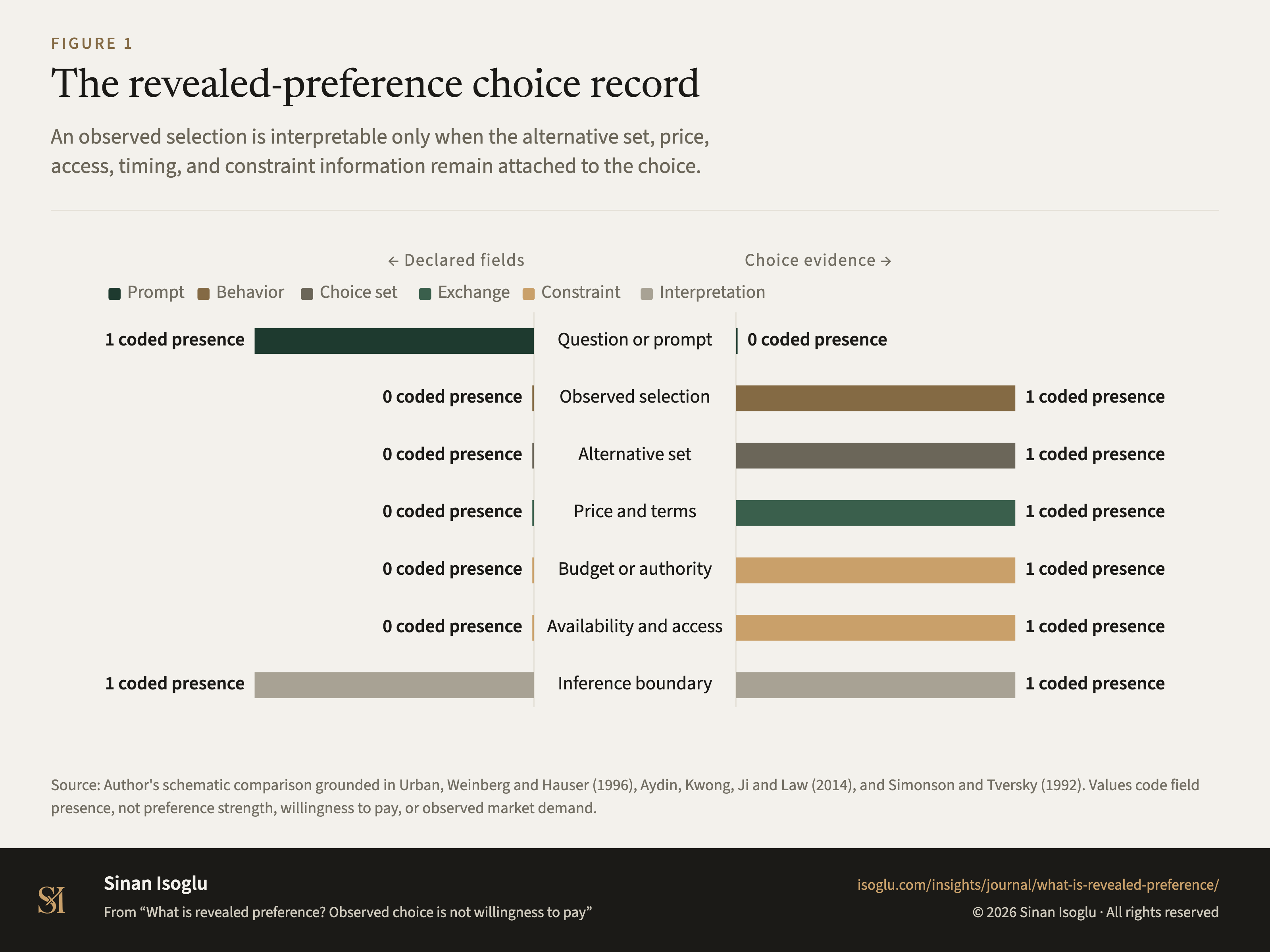
Figure 1Figure
The revealed-preference choice record
What is revealed preference? Observed choice is not willingness to pay
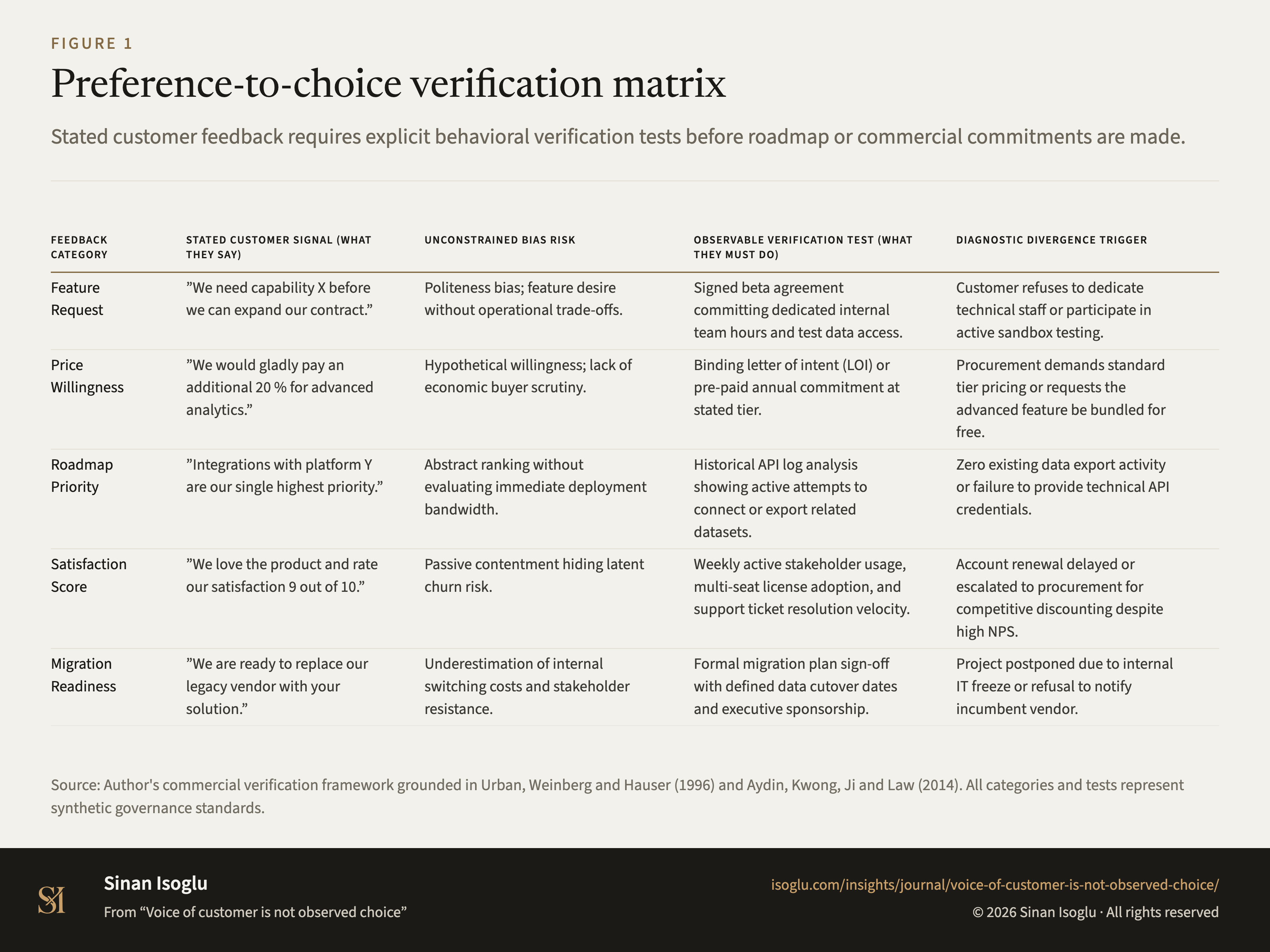
Figure 1Figure
Preference-to-choice verification matrix
Voice of customer is not observed choice
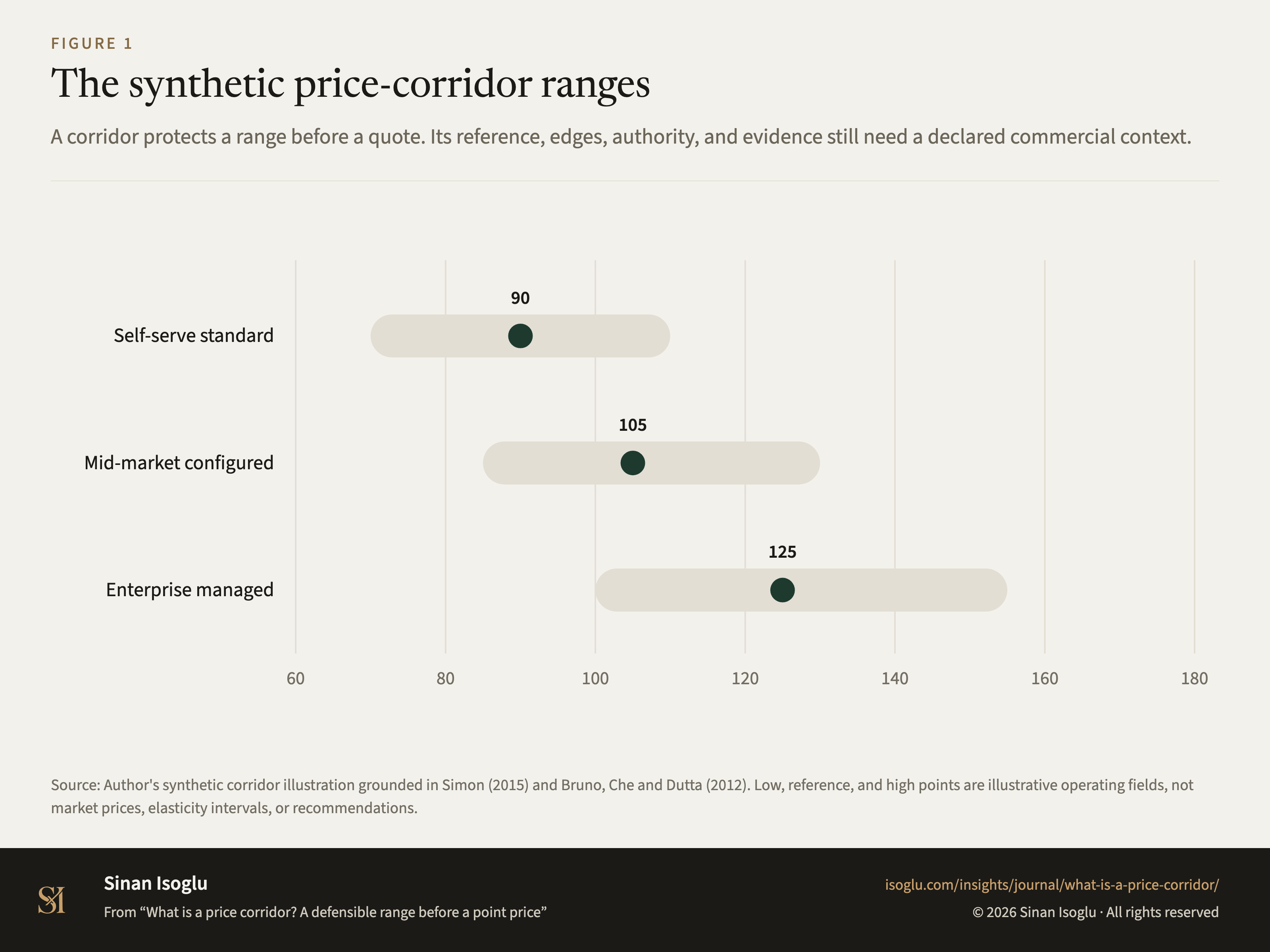
Figure 1Figure
The synthetic price-corridor ranges
What is a price corridor? A defensible range before a point price
Contact
Bring the question you're working on.
Research, a guest lecture, or a commercial question.