Figure 1From “What is psychological pricing?”
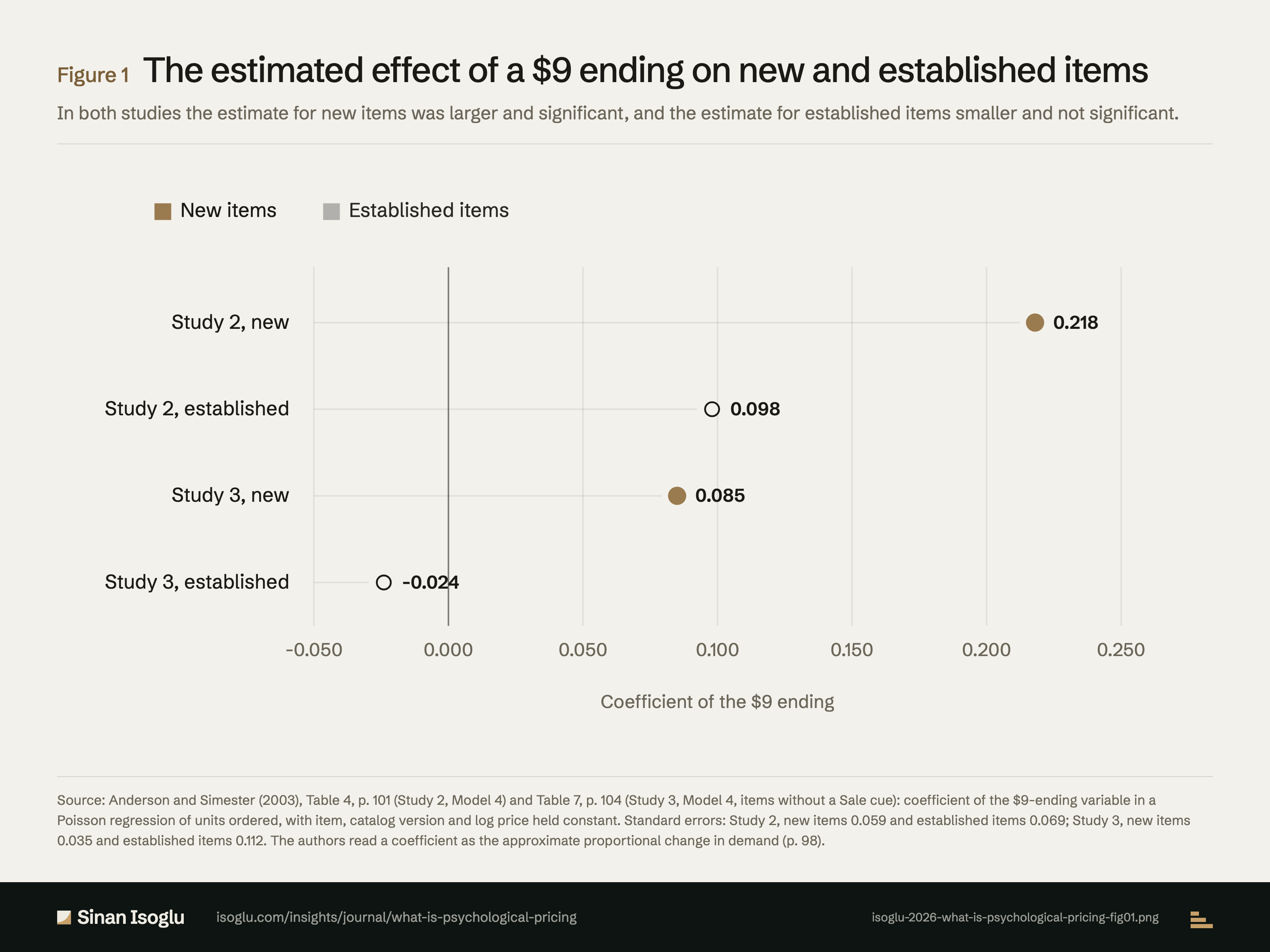
The estimated effect of a $9 ending on new and established items
In both studies the estimate for new items was larger and significant, and the estimate for established items smaller and not significant.
Figure 1The estimated effect of a $9 ending on new and established items
Source: Anderson and Simester (2003), Table 4, p. 101 (Study 2, Model 4) and Table 7, p. 104 (Study 3, Model 4, items without a Sale cue): coefficient of the $9-ending variable in a Poisson regression of units ordered, with item, catalog version and log price held constant. Standard errors: Study 2, new items 0.059 and established items 0.069; Study 3, new items 0.035 and established items 0.112. The authors read a coefficient as the approximate proportional change in demand (p. 98).
Source and evidence
Each line names a claim related to this exhibit, its source, and how it was checked.
- A ASPE03-C4 New against established items (Figure 1): new items were generally introduced in the most recent season, established items in previous seasons; Model 4 coefficients, Table 4 (Study 2): new 0.218 (SE 0.059, p < 0.01), established 0.098 (0.069), footwear -0.397 (0.247), and Table 7 (Study 3, no Sale cue): new 0.085 (0.035, single asterisk), established -0.024 (0.112), footwear 0.077 (0.059), signs read from the page images; 22% against 10% in Study 2; no test of the difference between categories is reported, and approximate 95% intervals from the printed standard errors overlap in both studies (this guide's arithmetic, stated in the Figure 1 caption after G5 F5, where the dek and the conditions sentence now speak of estimates and name the category by season, not by familiarity); the coefficient is read as the proportional change in demand (pp. 93, 98, 100, 101, 104, 108): "the increase in demand was stronger for new items than for items that the retailer had sold in previous years"; "The new items were generally introduced in the most recent season, while established items were offered in previous seasons."; "A $9 ending yielded an estimated increase of 1.8 units or 22% for new items compared to 10% for established items."; "For the footwear items the result was difficult to interpret; the coefficient was negative but not"; "The findings also replicate the evidence in Study 2 that the $9 ending effect is stronger for new items than for established items or footwear"; "the percentage change in demand from using a $9 ending"; "The effect is stronger for new items that customers have seen less frequently in the past."Anderson & Simester (2003), QME · Anderson & Simester. (2003). Effects 9 Price Endings Retail Sales
Grades: A, verified against the printed page of the primary source · B, primary source, text layer only · C, authoritative secondary · D, reported.
From the essay
Pricing & revenue architecture
What is psychological pricing?
Psychological pricing sets a price's ending, often a 9 below a round number. In catalog tests it raised demand, with larger estimates for new items.
Read the essayThis exhibit belongs to an essay: the numbers live here, the argument lives there.
Cite or embed
Contact
Bring the question you're working on.
Research, a guest lecture, or a commercial question.