Figure 2From “What is a two-sided market?”
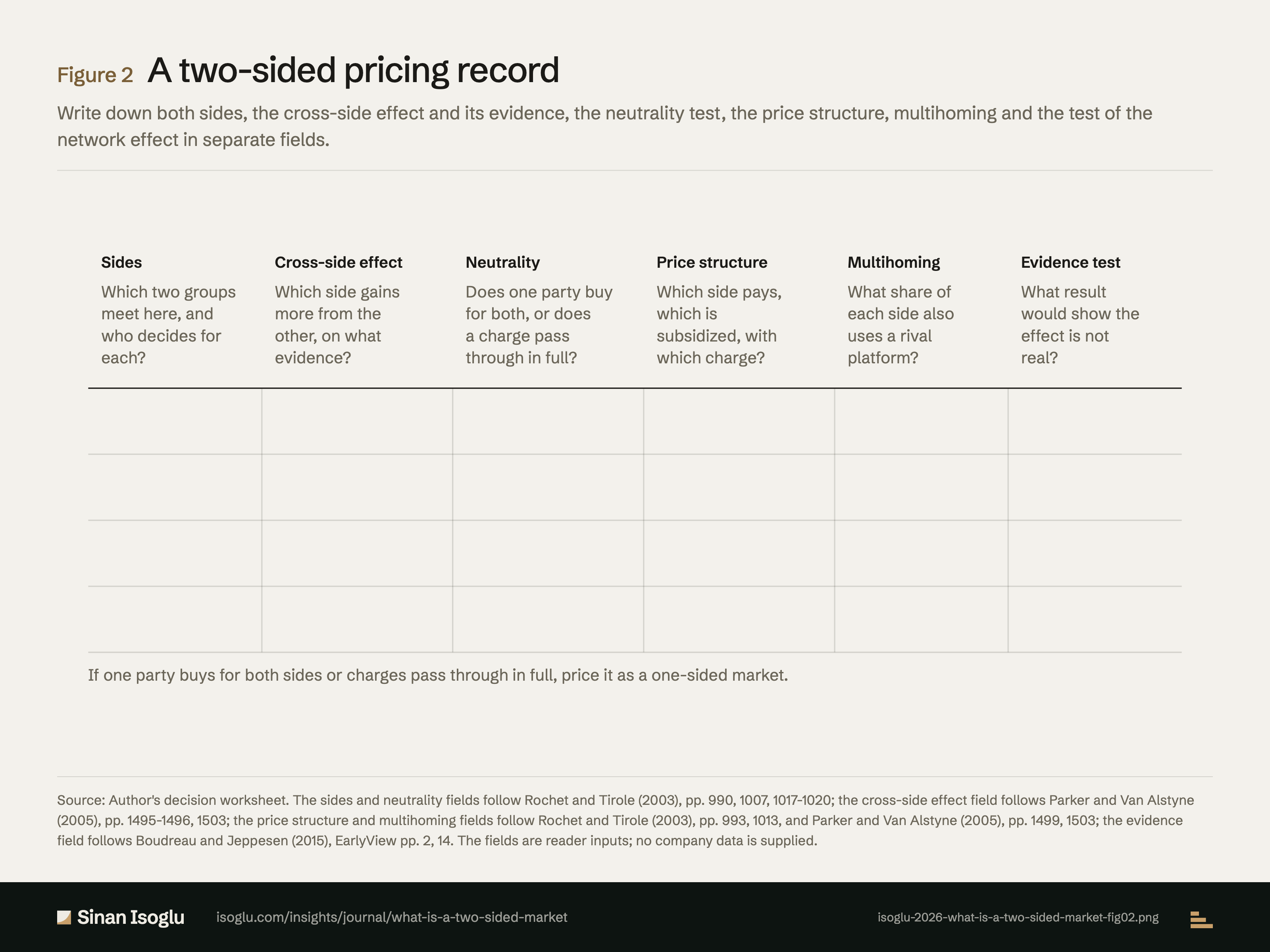
A two-sided pricing record
Write down both sides, the cross-side effect and its evidence, the neutrality test, the price structure, multihoming and the test of the network effect in separate fields.
Figure 2A two-sided pricing record
Source: Author's decision worksheet. The sides and neutrality fields follow Rochet and Tirole (2003), pp. 990, 1007, 1017-1020; the cross-side effect field follows Parker and Van Alstyne (2005), pp. 1495-1496, 1503; the price structure and multihoming fields follow Rochet and Tirole (2003), pp. 993, 1013, and Parker and Van Alstyne (2005), pp. 1499, 1503; the evidence field follows Boudreau and Jeppesen (2015), EarlyView pp. 2, 14. The fields are reader inputs; no company data is supplied.
Source and evidence
Each line names a claim related to this exhibit, its source, and how it was checked.
- B TSM-OWN-C4 A two-sided pricing decision is written down as one record: the sides and who decides, the cross-side effect and its evidence, the neutrality test, the price structure and its charges, multihoming, and a test of the network effect; illustrated with a hypothetical invoicing network in which suppliers mandated by a large customer resemble captive buyers, so the market stays two-sided.Author worksheet grounded in RT03-C8, RT03-C9, RT03-C10, PVA05-C6 and BJ15-C5
Grades: A, verified against the printed page of the primary source · B, primary source, text layer only · C, authoritative secondary · D, reported.
From the essay
Pricing & revenue architecture
What is a two-sided market?
In a two-sided market, a platform serves two linked groups, and the split of the price between them changes trade volume. Its theory is mostly models.
Read the essayThis exhibit belongs to an essay: the numbers live here, the argument lives there.
Cite or embed
Contact
Bring the question you're working on.
Research, a guest lecture, or a commercial question.