Figure 2From “What is psychological pricing?”
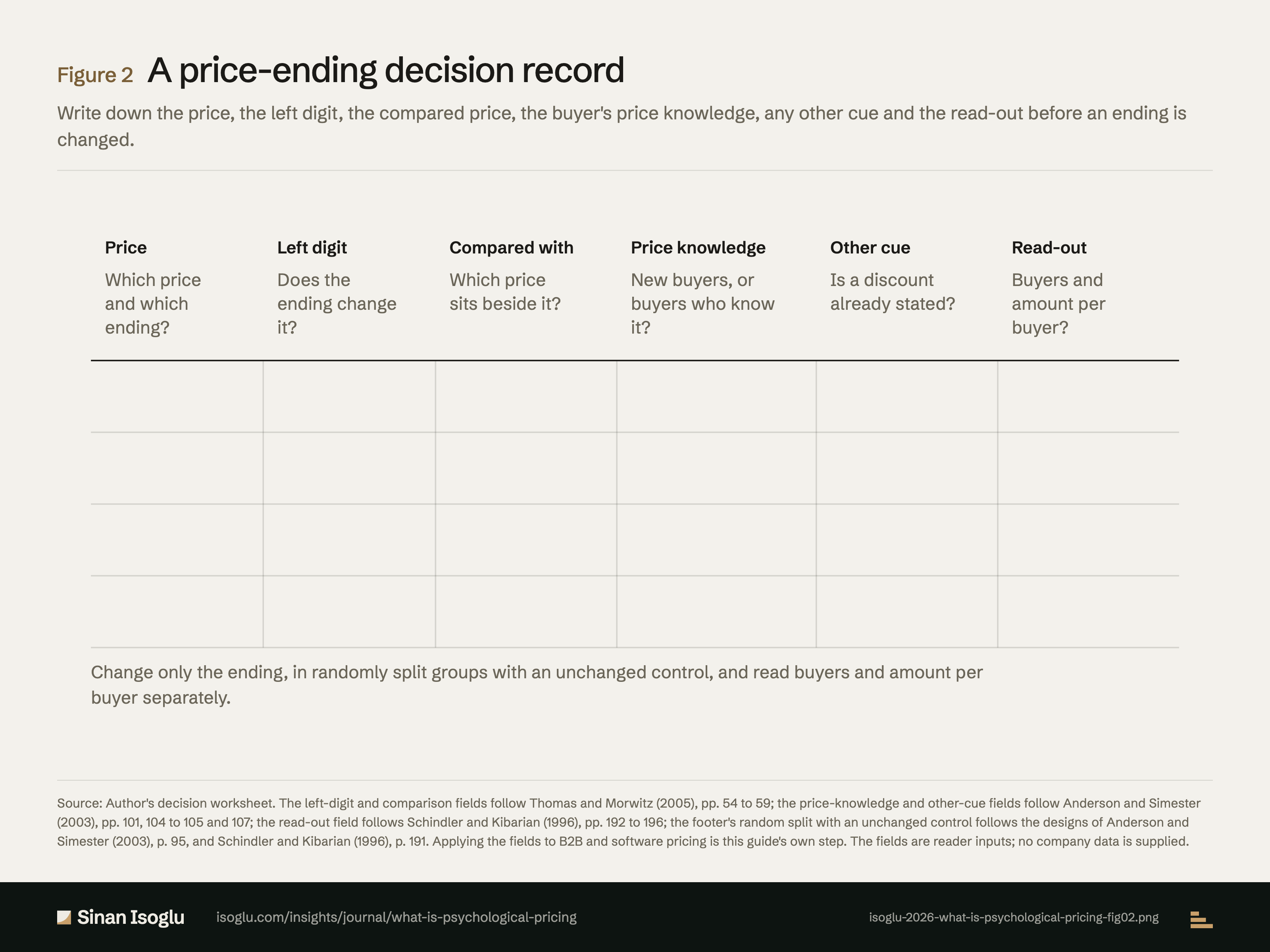
A price-ending decision record
Write down the price, the left digit, the compared price, the buyer's price knowledge, any other cue and the read-out before an ending is changed.
Figure 2A price-ending decision record
Source: Author's decision worksheet. The left-digit and comparison fields follow Thomas and Morwitz (2005), pp. 54 to 59; the price-knowledge and other-cue fields follow Anderson and Simester (2003), pp. 101, 104 to 105 and 107; the read-out field follows Schindler and Kibarian (1996), pp. 192 to 196; the footer's random split with an unchanged control follows the designs of Anderson and Simester (2003), p. 95, and Schindler and Kibarian (1996), p. 191. Applying the fields to B2B and software pricing is this guide's own step. The fields are reader inputs; no company data is supplied.
Source and evidence
Each line names a claim related to this exhibit, its source, and how it was checked.
- B PSP-OWN-C3 For B2B and software pricing, untested: an ending can only work through the left digit if it changes it; the compared price matters (another tier, a competitor, last year's invoice); a buyer who knows the price resembles an established item, so on the information reading the ending matters less to renewal and purchasing buyers; a stated discount resembles the Sale cue; effect sizes from consumer catalogs do not carry over, multi-digit contract values are untested, and a seller with a few hundred new accounts a quarter would be unlikely to detect such effects; the value metric decides the unit, the ending only the digits; the decision record (Figure 2) and the 49-against-50 tier illustration are the author's examples.Author reading of TM05-C3, TM05-C4, TM05-C6, ASPE03-C4, ASPE03-C5, SK96-C3 and SK96-C4; untested
Grades: A, verified against the printed page of the primary source · B, primary source, text layer only · C, authoritative secondary · D, reported.
From the essay
Pricing & revenue architecture
What is psychological pricing?
Psychological pricing sets a price's ending, often a 9 below a round number. In catalog tests it raised demand, with larger estimates for new items.
Read the essayThis exhibit belongs to an essay: the numbers live here, the argument lives there.
Cite or embed
Contact
Bring the question you're working on.
Research, a guest lecture, or a commercial question.