Figure 1From “What is partner-led growth? A channel needs a counterfactual”
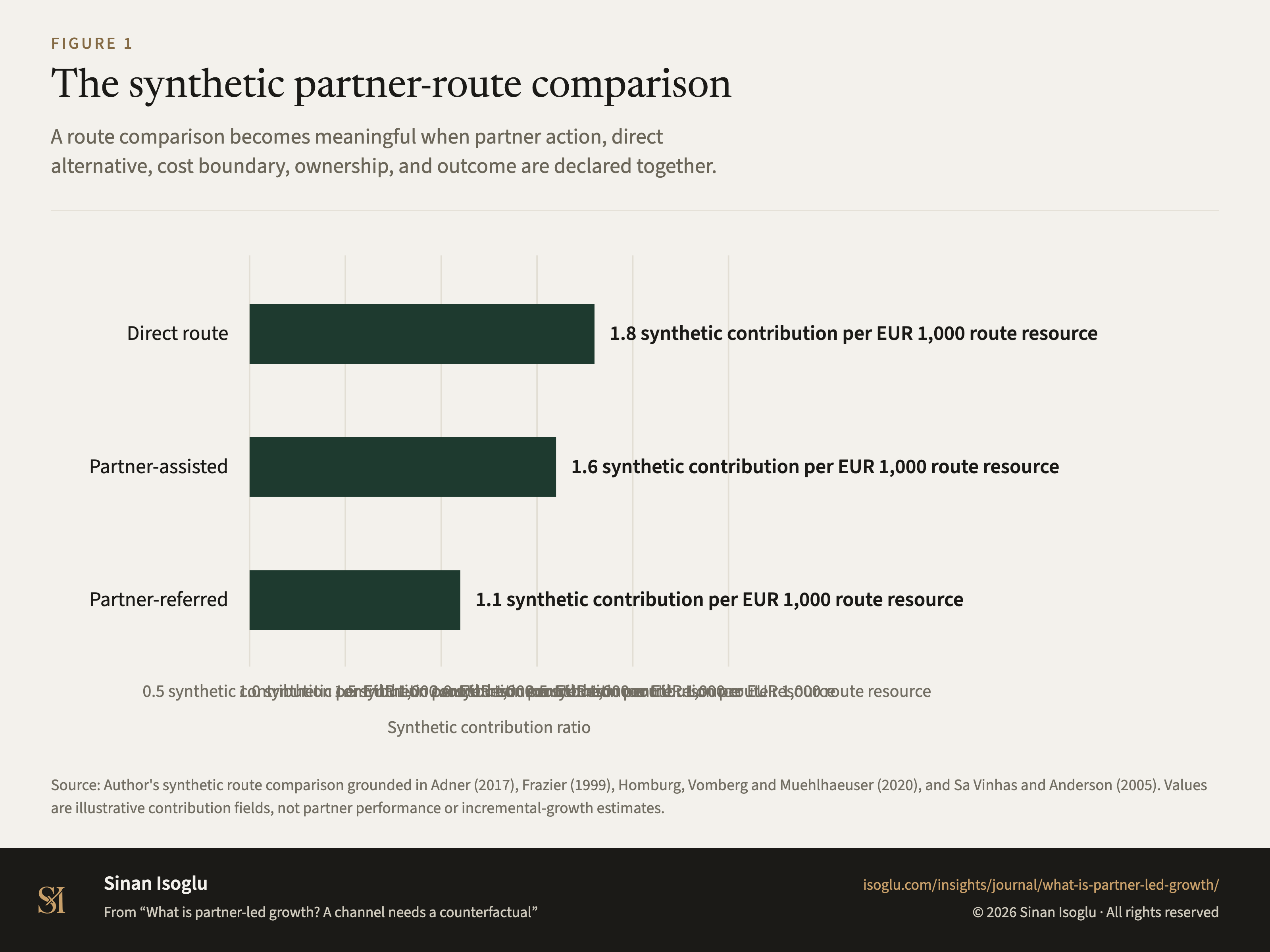
The synthetic partner-route comparison
A route comparison becomes meaningful when partner action, direct alternative, cost boundary, ownership, and outcome are declared together.
Figure 1The synthetic partner-route comparison
Source: Author's synthetic route comparison grounded in Adner (2017), Frazier (1999), Homburg, Vomberg and Muehlhaeuser (2020), and Sa Vinhas and Anderson (2005). Values are illustrative contribution fields, not partner performance or incremental-growth estimates.
Source and evidence
Each line names a claim related to this exhibit, its source, and how it was checked.
- A ADN17-C1 The definition, verbatim: an ecosystem is "the alignment structure of the multilateral set of partners that need to interact in order for a focal value proposition to materialize"adner-2017-ecosystem-as-structure
- A ADN17-C2 Interdependence is the unit: the definition turns on "the multilateral set of partners that need to interact in order for a focal value proposition to materialize", so activities and positions are described relative to that propositionadner-2017-ecosystem-as-structure
- A FR99-C1 The review's own verdict on the field: "we have barely touched the surface of all the managerial issues that need to be addressed"Frazier. (1999)
- A FR99-C2 Prior work exists and is not enough: "a variety of research needs still exist regarding constructs and issues examined in prior channels research"Frazier. (1999)
- A CH1R-C1 The sign flips by route design, in the authors' words: "Whereas direct channel usage predominantly lowers agency conflicts in terms of information asymmetry and sales partner moral hazard, indirect channel usage" amplifies them. So an observed association can differ across direct and indirect route designsHomburg, Vomberg and Muehlhaeuser (2020), publisher PDF pp. 1, 9, and 13-16
- B CH1R-C7 A route-level ledger can assign distinct booking, access, service, economics, renewal, expansion, and learning fields before outcome judgmentAuthor framework grounded in the cited channel sources
- B CH1R-C8 A route comparison needs a design that identifies incremental demand; gross bookings do not supply that comparisonAuthor framework grounded in the cited channel sources and sweep boundary
- B T09-OWN-C1 Partner-led growth is a go-to-market route in which a partner contributes declared access, capability, credibility, delivery, or demand mechanism to an outcomeAuthor framework grounded in ADN17-C1 and ADN17-C2
- B T09-OWN-C2 Partner activity, sourced booking, partner-led motion, channel economics, and incremental growth are separate objectsAuthor taxonomy
- B T09-OWN-C4 Partner-sourced or partner-assisted bookings do not by themselves prove incremental demand or contributionAuthor negative boundary grounded in FR99-C1 and CH1R-C1
Grades: A, verified against the printed page of the primary source · B, primary source, text layer only · C, authoritative secondary · D, reported.
From the essay
Go-to-market strategy
What is partner-led growth? A channel needs a counterfactual
Partner-led growth is a route with access, capability, and economics to test. Count incremental outcomes, not partner names, bookings, or logos.
Read the essayThis exhibit belongs to an essay: the numbers live here, the argument lives there.
Cite or embed
Related exhibits
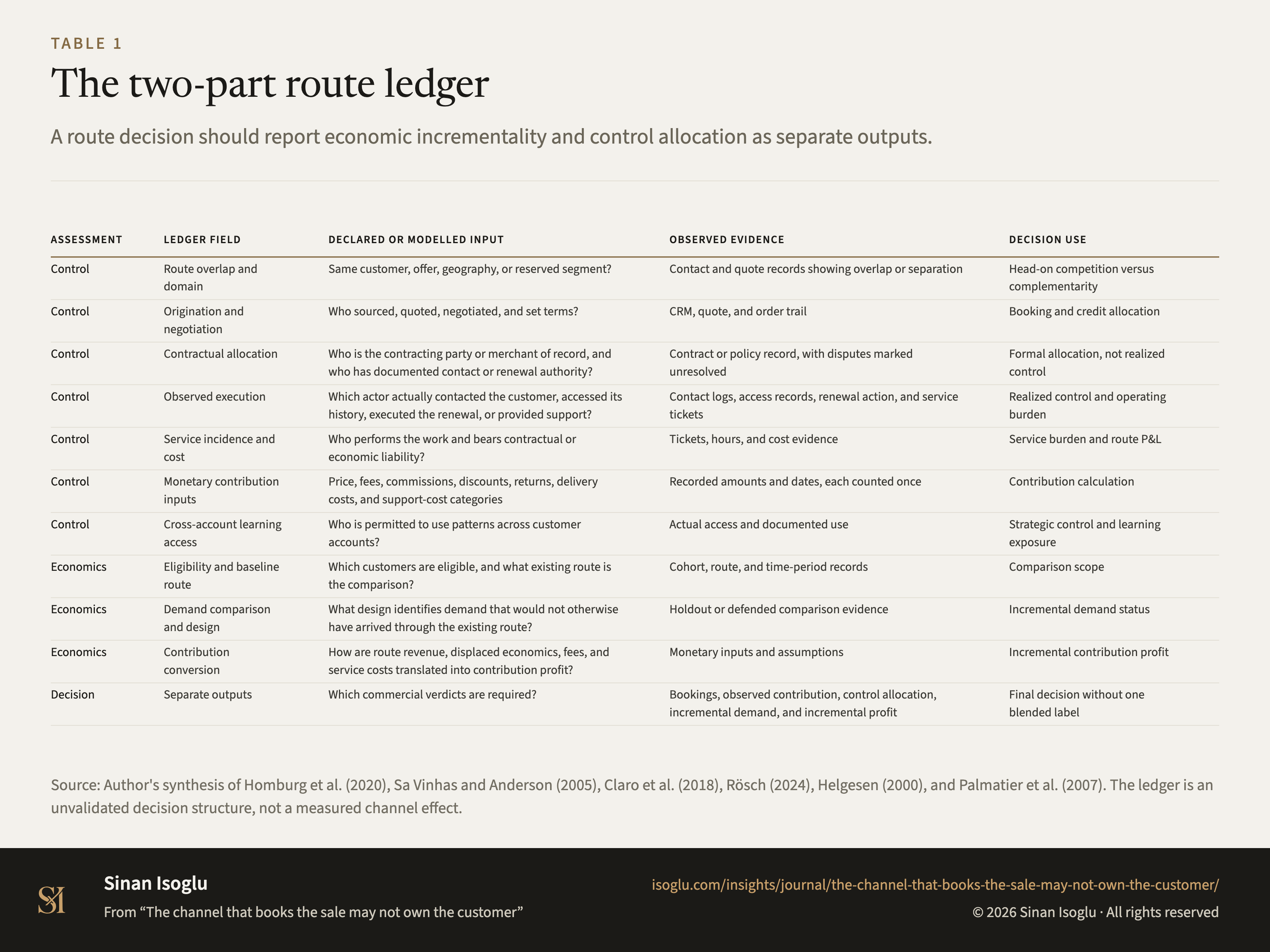
Table 1Table
The two-part route ledger
The channel that books the sale may not own the customer
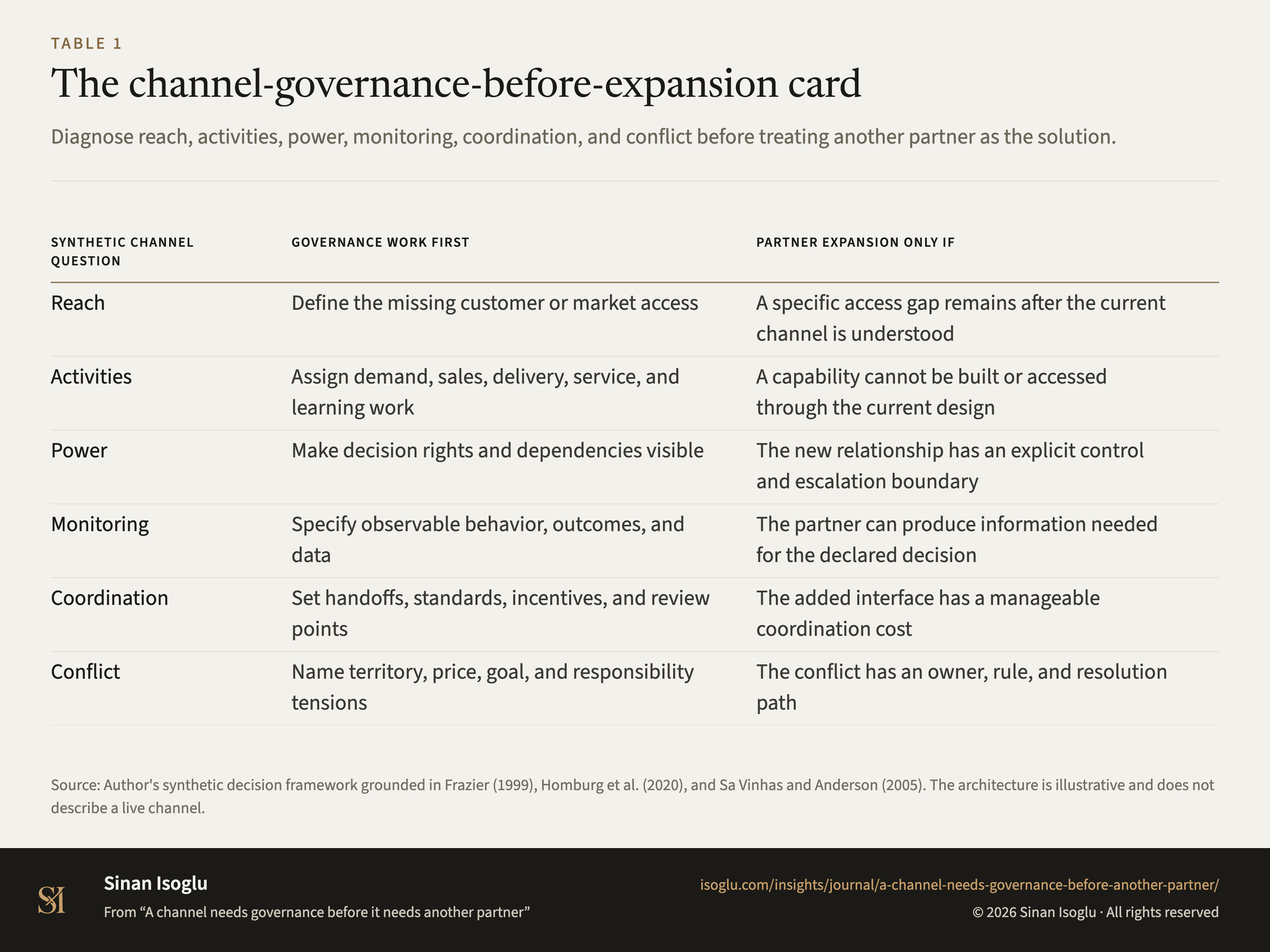
Table 1Table
The channel-governance-before-expansion card
A channel needs governance before it needs another partner
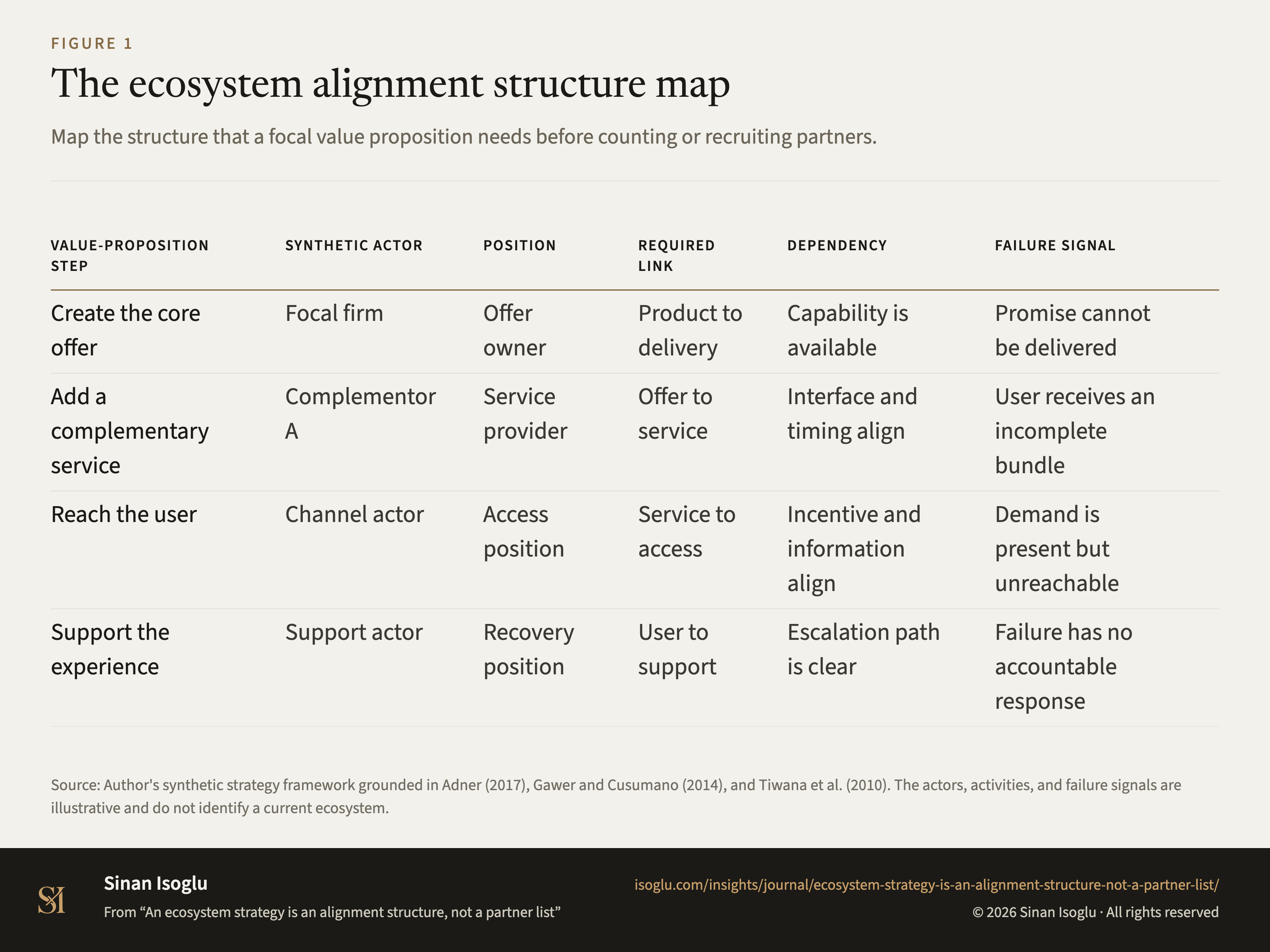
Figure 1Figure
The ecosystem alignment structure map
An ecosystem strategy is an alignment structure, not a partner list
Contact
Bring the question you're working on.
Research, a guest lecture, or a commercial question.