Table 1From “The channel that books the sale may not own the customer”
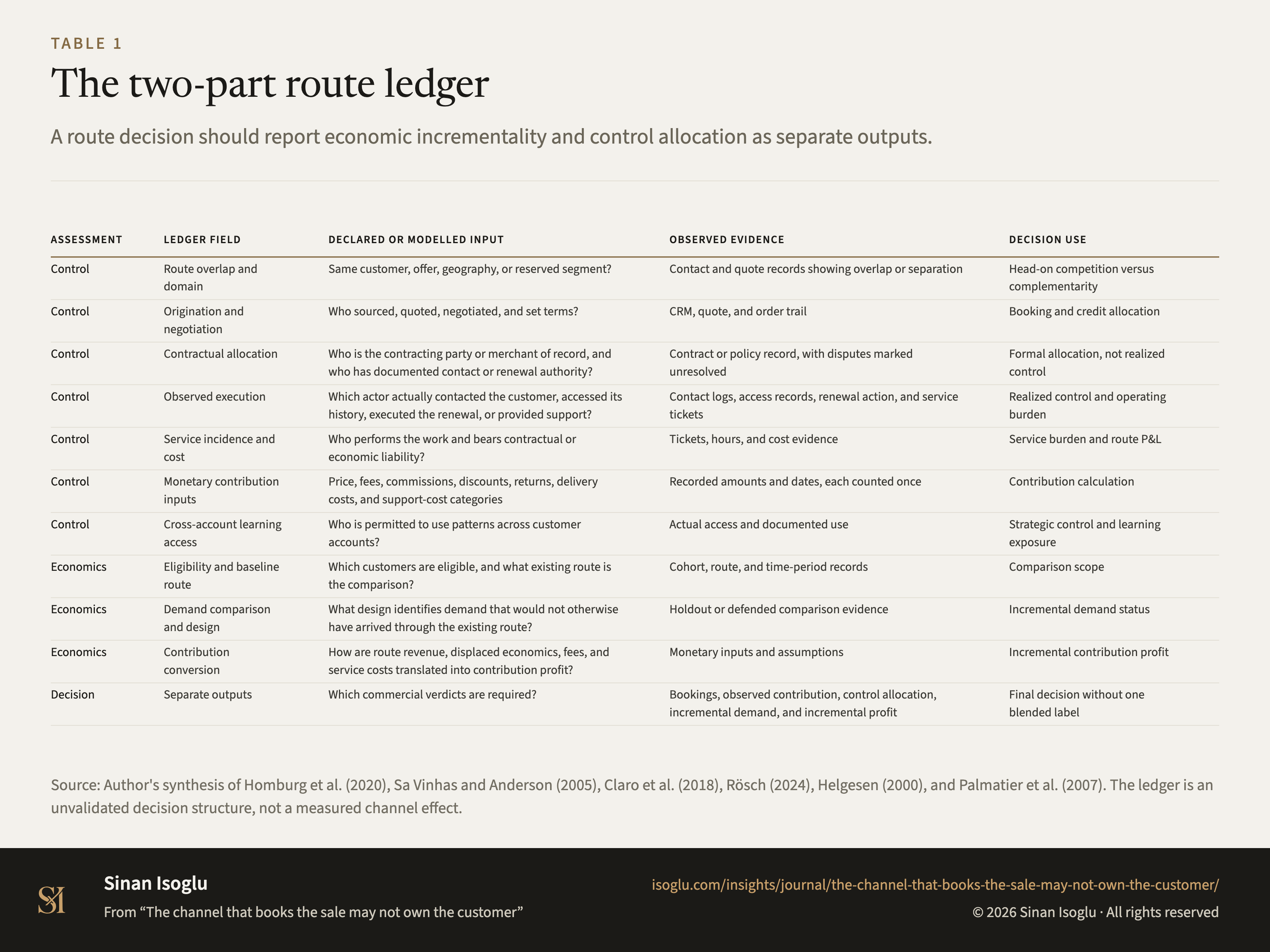
The two-part route ledger
A route decision should report economic incrementality and control allocation as separate outputs.
Table 1The two-part route ledger
| Assessment | Ledger field | Declared or modelled input | Observed evidence | Decision use |
|---|---|---|---|---|
| Control | Route overlap and domain | Same customer, offer, geography, or reserved segment? | Contact and quote records showing overlap or separation | Head-on competition versus complementarity |
| Control | Origination and negotiation | Who sourced, quoted, negotiated, and set terms? | CRM, quote, and order trail | Booking and credit allocation |
| Control | Contractual allocation | Who is the contracting party or merchant of record, and who has documented contact or renewal authority? | Contract or policy record, with disputes marked unresolved | Formal allocation, not realized control |
| Control | Observed execution | Which actor actually contacted the customer, accessed its history, executed the renewal, or provided support? | Contact logs, access records, renewal action, and service tickets | Realized control and operating burden |
| Control | Service incidence and cost | Who performs the work and bears contractual or economic liability? | Tickets, hours, and cost evidence | Service burden and route P&L |
| Control | Monetary contribution inputs | Price, fees, commissions, discounts, returns, delivery costs, and support-cost categories | Recorded amounts and dates, each counted once | Contribution calculation |
| Control | Cross-account learning access | Who is permitted to use patterns across customer accounts? | Actual access and documented use | Strategic control and learning exposure |
| Economics | Eligibility and baseline route | Which customers are eligible, and what existing route is the comparison? | Cohort, route, and time-period records | Comparison scope |
| Economics | Demand comparison and design | What design identifies demand that would not otherwise have arrived through the existing route? | Holdout or defended comparison evidence | Incremental demand status |
| Economics | Contribution conversion | How are route revenue, displaced economics, fees, and service costs translated into contribution profit? | Monetary inputs and assumptions | Incremental contribution profit |
| Decision | Separate outputs | Which commercial verdicts are required? | Bookings, observed contribution, control allocation, incremental demand, and incremental profit | Final decision without one blended label |
Swipe or scroll horizontally if the table is wider than your screen.
Source: Author's synthesis of Homburg et al. (2020), Sa Vinhas and Anderson (2005), Claro et al. (2018), Rösch (2024), Helgesen (2000), and Palmatier et al. (2007). The ledger is an unvalidated decision structure, not a measured channel effect.
Source and evidence
Each line names a claim related to this exhibit, its source, and how it was checked.
- A CH1R-C1 The sign flips by route design, in the authors' words: "Whereas direct channel usage predominantly lowers agency conflicts in terms of information asymmetry and sales partner moral hazard, indirect channel usage" amplifies them. So an observed association can differ across direct and indirect route designsHomburg, Vomberg and Muehlhaeuser (2020), publisher PDF pp. 1, 9, and 13-16
- A CH1R-C2 Concurrent channels mean running both routes at once: "having concurrent channels means doing both this phenomenon is poorly understood even though it has been growing rapidly"Sa Vinhas and Anderson (2005), printed pp. 510 and 513-515
- A CH1R-C3 Both signs sit in one model: functional conflict improves channel performance directly, while "an excessive increase may also amplify the dysfunctional conflict thereby damaging channel performance"Claro, Vojnovskis and Ramos (2018), PDF pp. 16-20
- B CH1R-C4 The asymmetry is structural: each participant sees only their own interactions, while "the marketplace owner can observe and analyze every transaction on the platform"Rösch (2024), version-of-record pp. 533-540
- B CH1R-C5 The object has to be chosen before anything aggregates: profitability images are elaborated "for various objects with respect to the market": "customer category, product, market, market segment, market area, distribution channel, value chain, agent area"Helgesen (2000), full paper
- B CH1R-C7 A route-level ledger can assign distinct booking, access, service, economics, renewal, expansion, and learning fields before outcome judgmentAuthor framework grounded in the cited channel sources
- B CH1R-C8 A route comparison needs a design that identifies incremental demand; gross bookings do not supply that comparisonAuthor framework grounded in the cited channel sources and sweep boundary
Grades: A, verified against the printed page of the primary source · B, primary source, text layer only · C, authoritative secondary · D, reported.
From the essay
Go-to-market strategy
The channel that books the sale may not own the customer
A new route can raise bookings while shifting customer access, service costs, margin, renewal rights, and demand. Audit ownership before calling it growth.
Read the essayThis exhibit belongs to an essay: the numbers live here, the argument lives there.
Cite or embed
Related exhibits
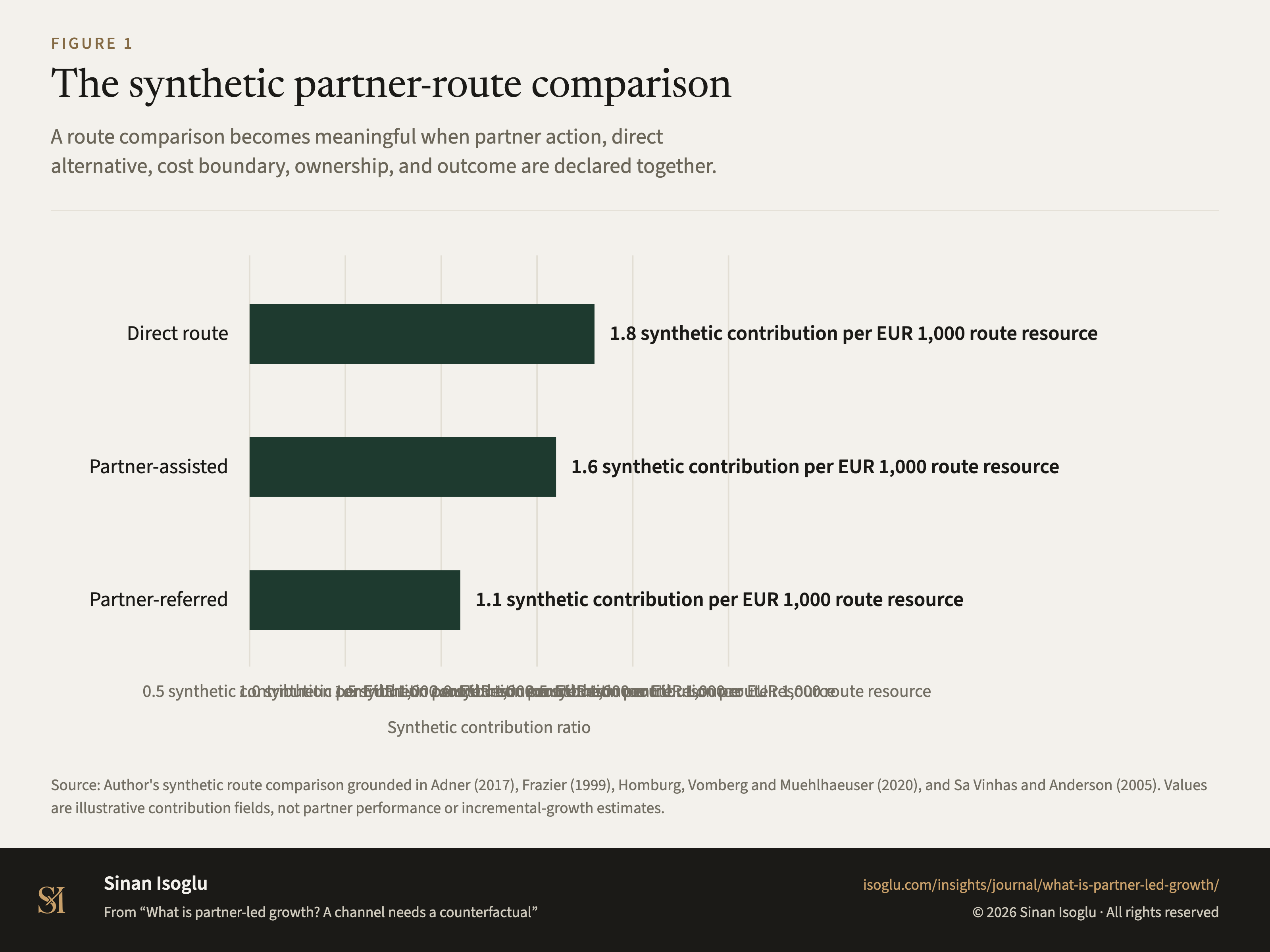
Figure 1Figure
The synthetic partner-route comparison
What is partner-led growth? A channel needs a counterfactual
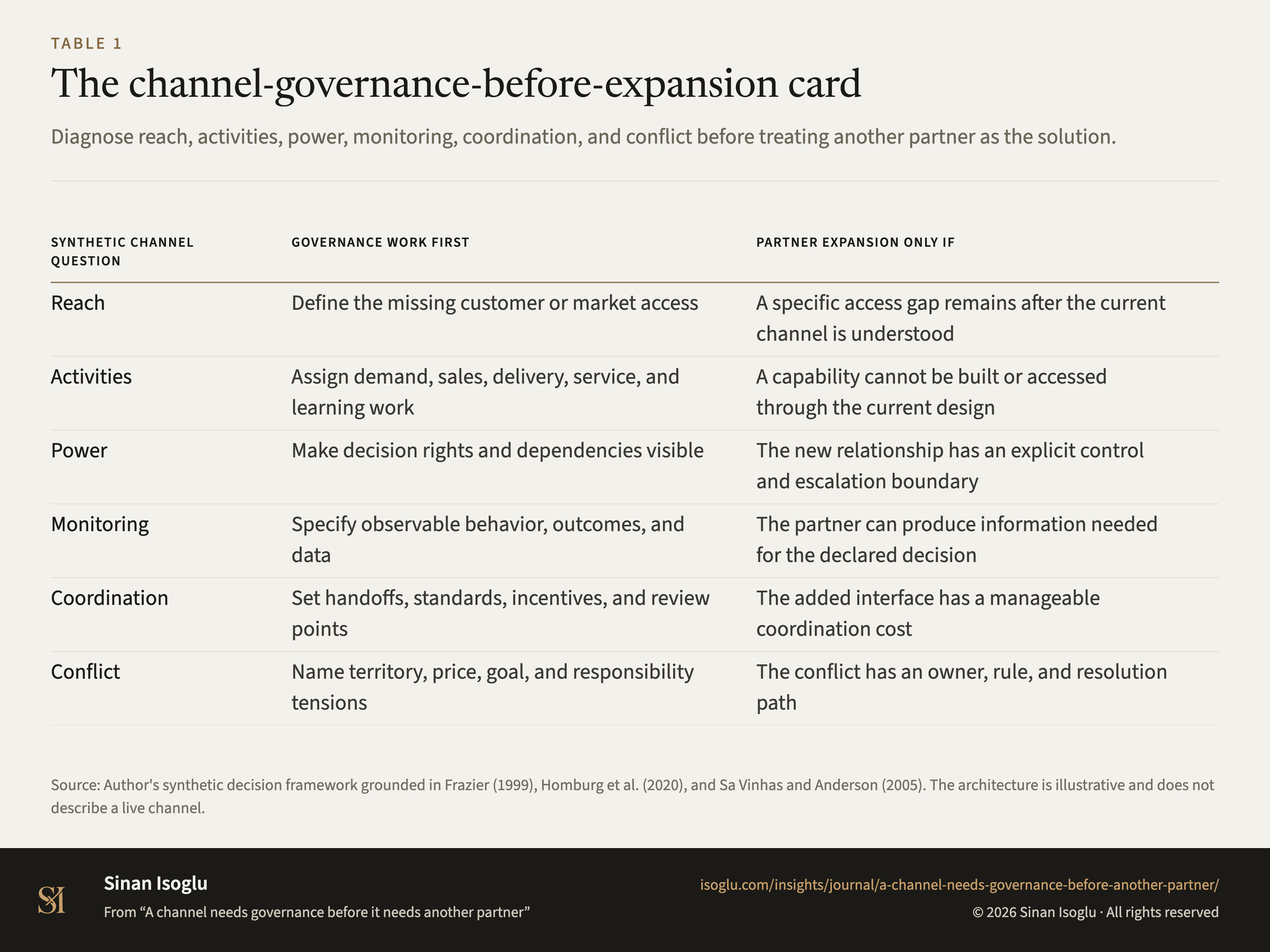
Table 1Table
The channel-governance-before-expansion card
A channel needs governance before it needs another partner
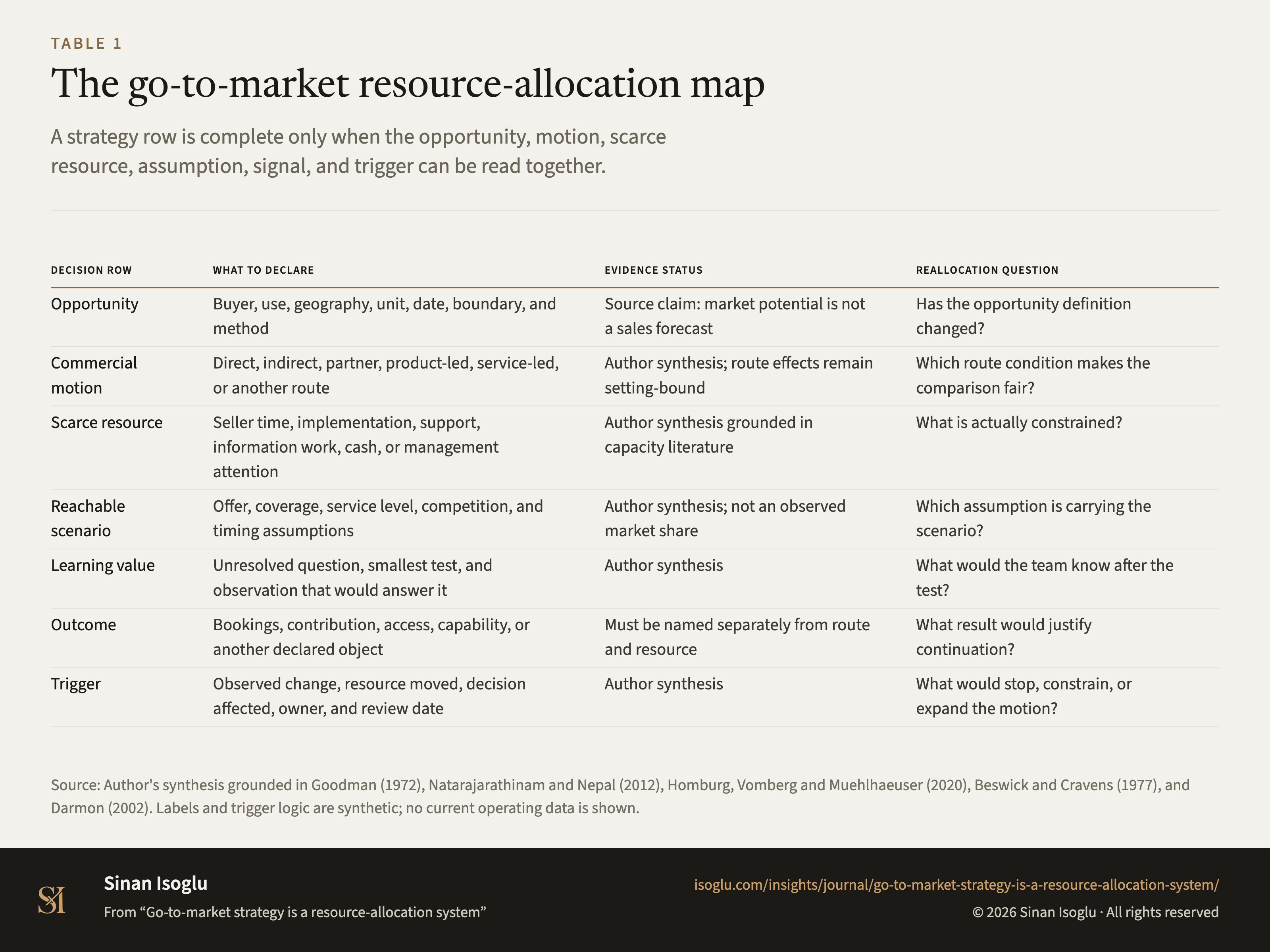
Table 1Table
The go-to-market resource-allocation map
Go-to-market strategy is a resource-allocation system
Contact
Bring the question you're working on.
Research, a guest lecture, or a commercial question.