Table 1From “A channel needs governance before it needs another partner”
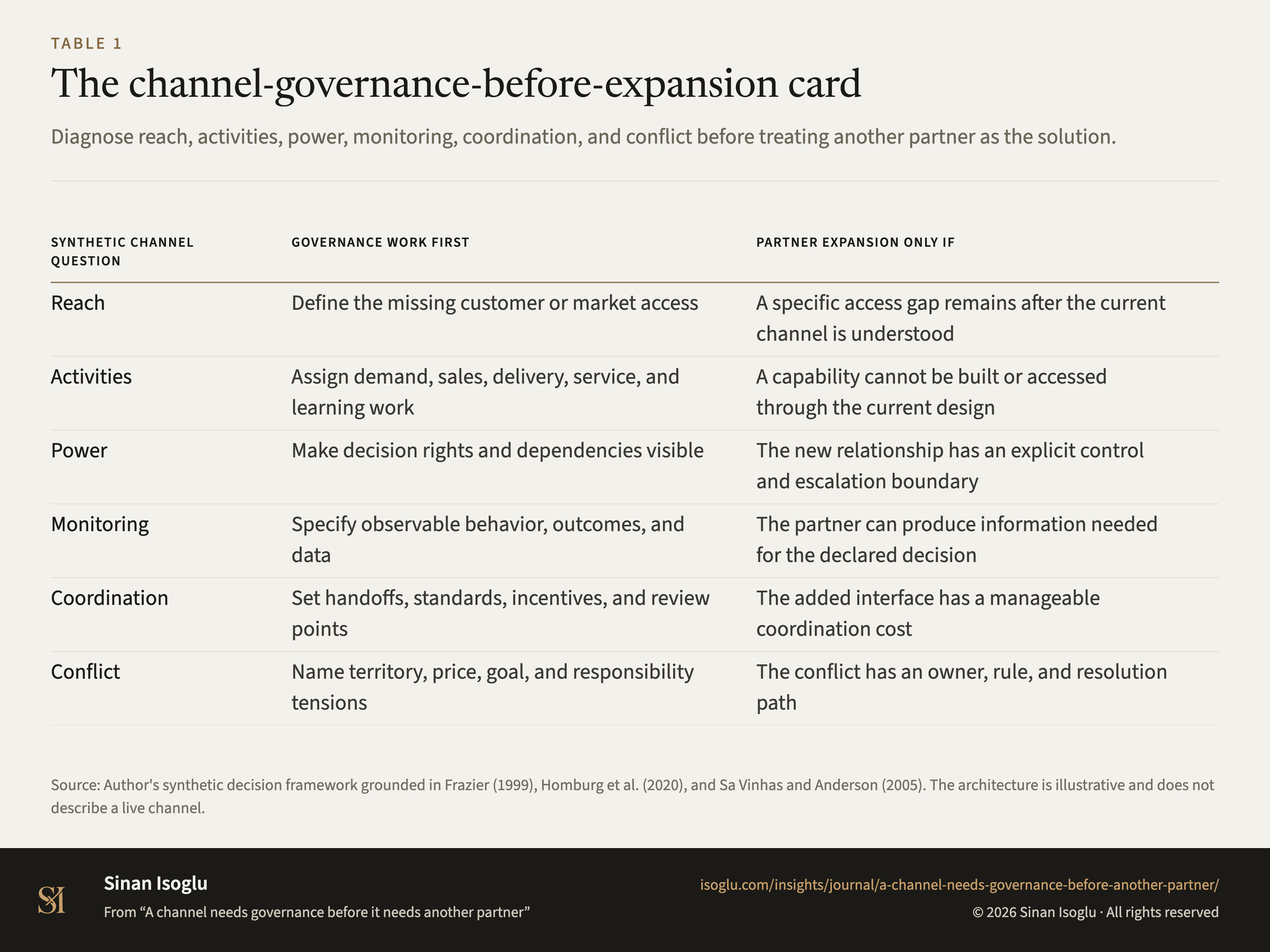
The channel-governance-before-expansion card
Diagnose reach, activities, power, monitoring, coordination, and conflict before treating another partner as the solution.
Table 1The channel-governance-before-expansion card
| Synthetic channel question | Governance work first | Partner expansion only if |
|---|---|---|
| Reach | Define the missing customer or market access | A specific access gap remains after the current channel is understood |
| Activities | Assign demand, sales, delivery, service, and learning work | A capability cannot be built or accessed through the current design |
| Power | Make decision rights and dependencies visible | The new relationship has an explicit control and escalation boundary |
| Monitoring | Specify observable behavior, outcomes, and data | The partner can produce information needed for the declared decision |
| Coordination | Set handoffs, standards, incentives, and review points | The added interface has a manageable coordination cost |
| Conflict | Name territory, price, goal, and responsibility tensions | The conflict has an owner, rule, and resolution path |
Swipe or scroll horizontally if the table is wider than your screen.
Source: Author's synthetic decision framework grounded in Frazier (1999), Homburg et al. (2020), and Sa Vinhas and Anderson (2005). The architecture is illustrative and does not describe a live channel.
Source and evidence
Each line names a claim related to this exhibit, its source, and how it was checked.
- A FR99-C1 The review's own verdict on the field: "we have barely touched the surface of all the managerial issues that need to be addressed"Frazier. (1999)
- A FR99-C2 Prior work exists and is not enough: "a variety of research needs still exist regarding constructs and issues examined in prior channels research"Frazier. (1999)
- A FR99-C3 The agenda is explicit: "many issues of managerial importance relating to the organization and management of channels" remain openFrazier. (1999)
- A CH1R-C1 The sign flips by route design, in the authors' words: "Whereas direct channel usage predominantly lowers agency conflicts in terms of information asymmetry and sales partner moral hazard, indirect channel usage" amplifies them. So an observed association can differ across direct and indirect route designsHomburg, Vomberg and Muehlhaeuser (2020), publisher PDF pp. 1, 9, and 13-16
- A CH1R-C2 Concurrent channels mean running both routes at once: "having concurrent channels means doing both this phenomenon is poorly understood even though it has been growing rapidly"Sa Vinhas and Anderson (2005), printed pp. 510 and 513-515
- B CH1R-C6 Channel routes can be complementary in one outcome and strategically costly in anotherAuthor boundary, drawn in the source-campaign sweep 2026-08-25
Grades: A, verified against the printed page of the primary source · B, primary source, text layer only · C, authoritative secondary · D, reported.
From the essay
Revenue operations & AI
A channel needs governance before it needs another partner
A channel does not need another partner by default: first define power, monitoring, coordination, conflict, and the management question.
Read the essayThis exhibit belongs to an essay: the numbers live here, the argument lives there.
Cite or embed
Related exhibits
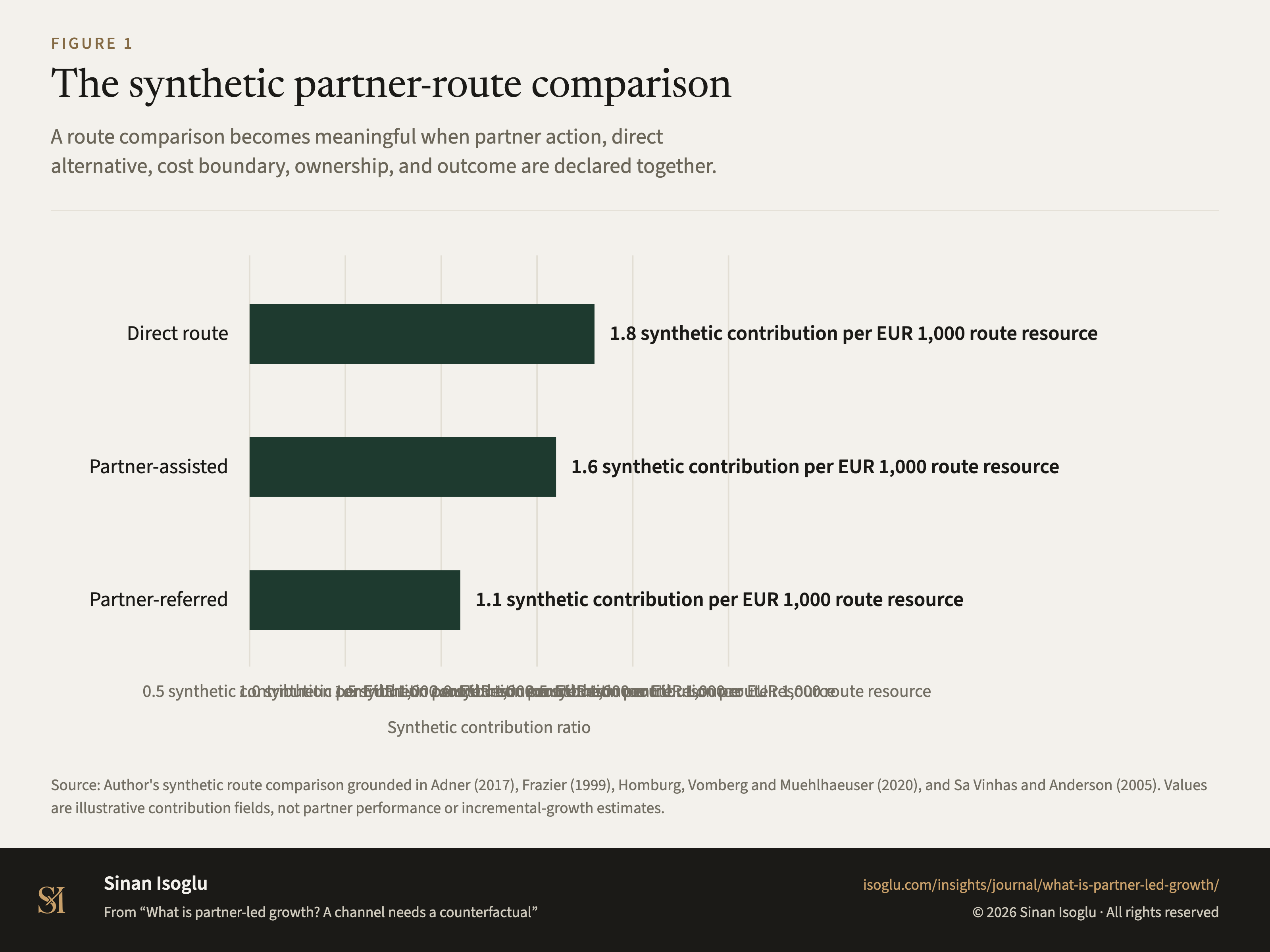
Figure 1Figure
The synthetic partner-route comparison
What is partner-led growth? A channel needs a counterfactual
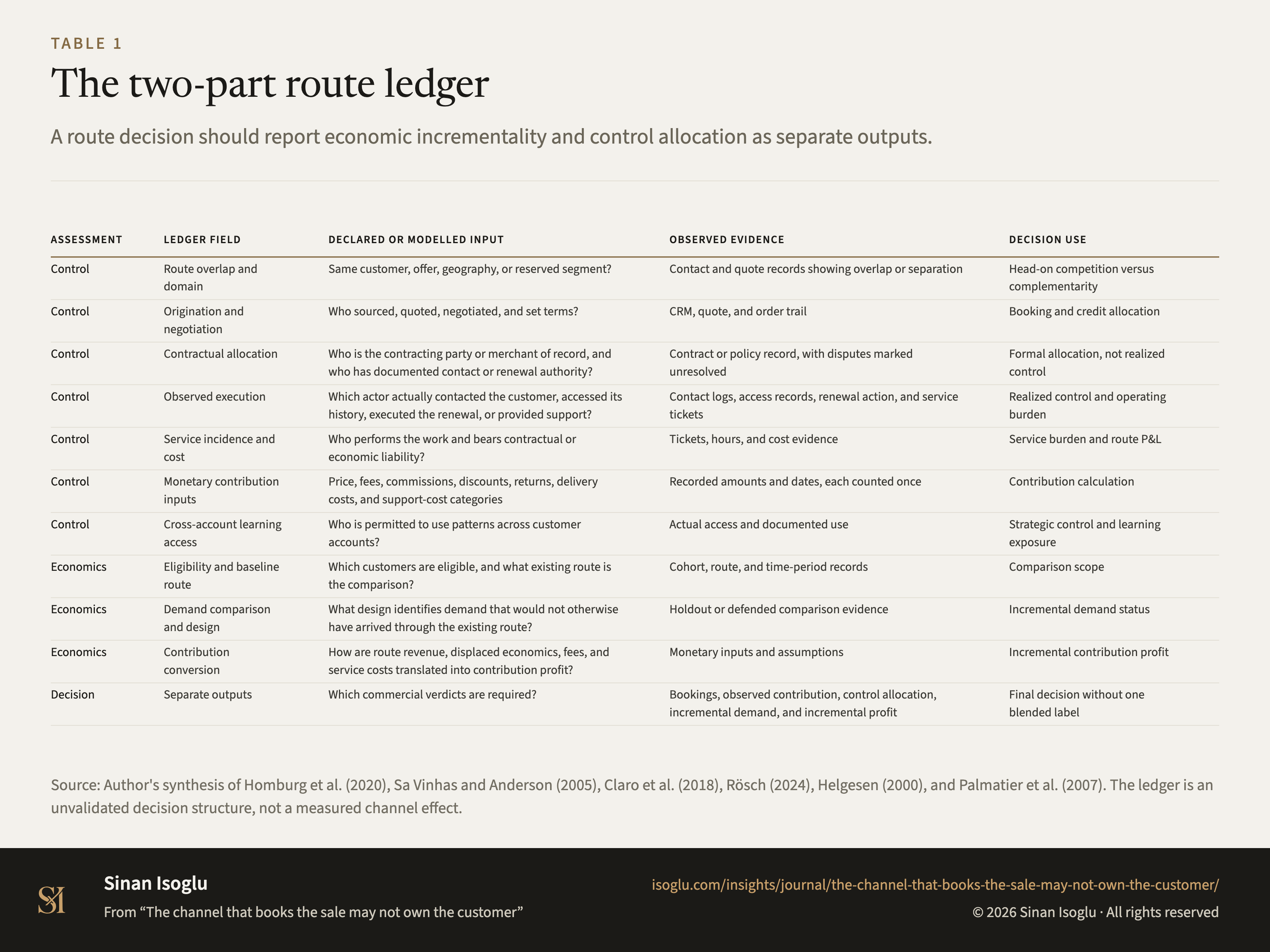
Table 1Table
The two-part route ledger
The channel that books the sale may not own the customer
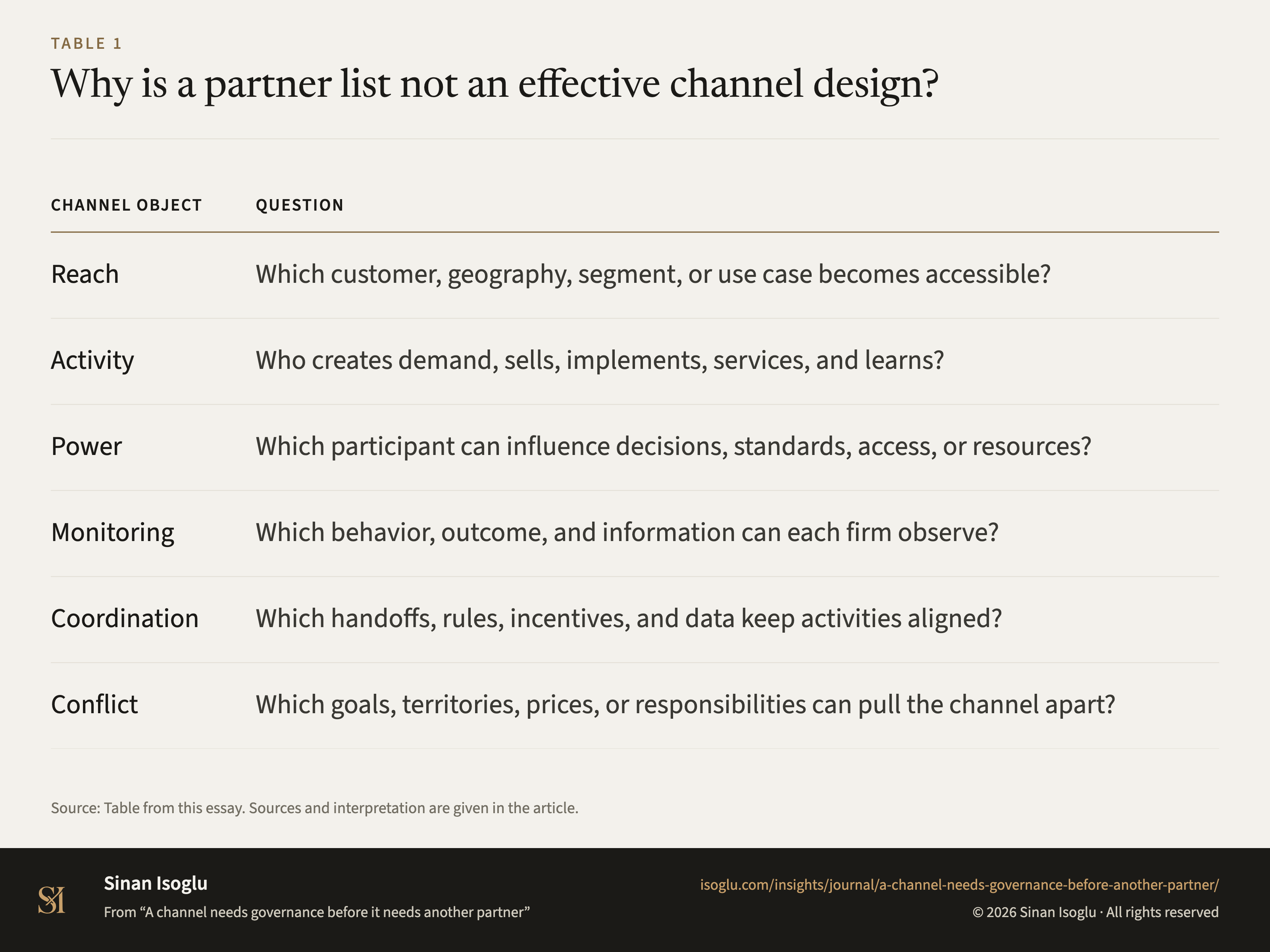
Table 1Table
Why is a partner list not an effective channel design?
A channel needs governance before it needs another partner
Contact
Bring the question you're working on.
Research, a guest lecture, or a commercial question.