Figure 1From “An ecosystem strategy is an alignment structure, not a partner list”
The ecosystem alignment structure map
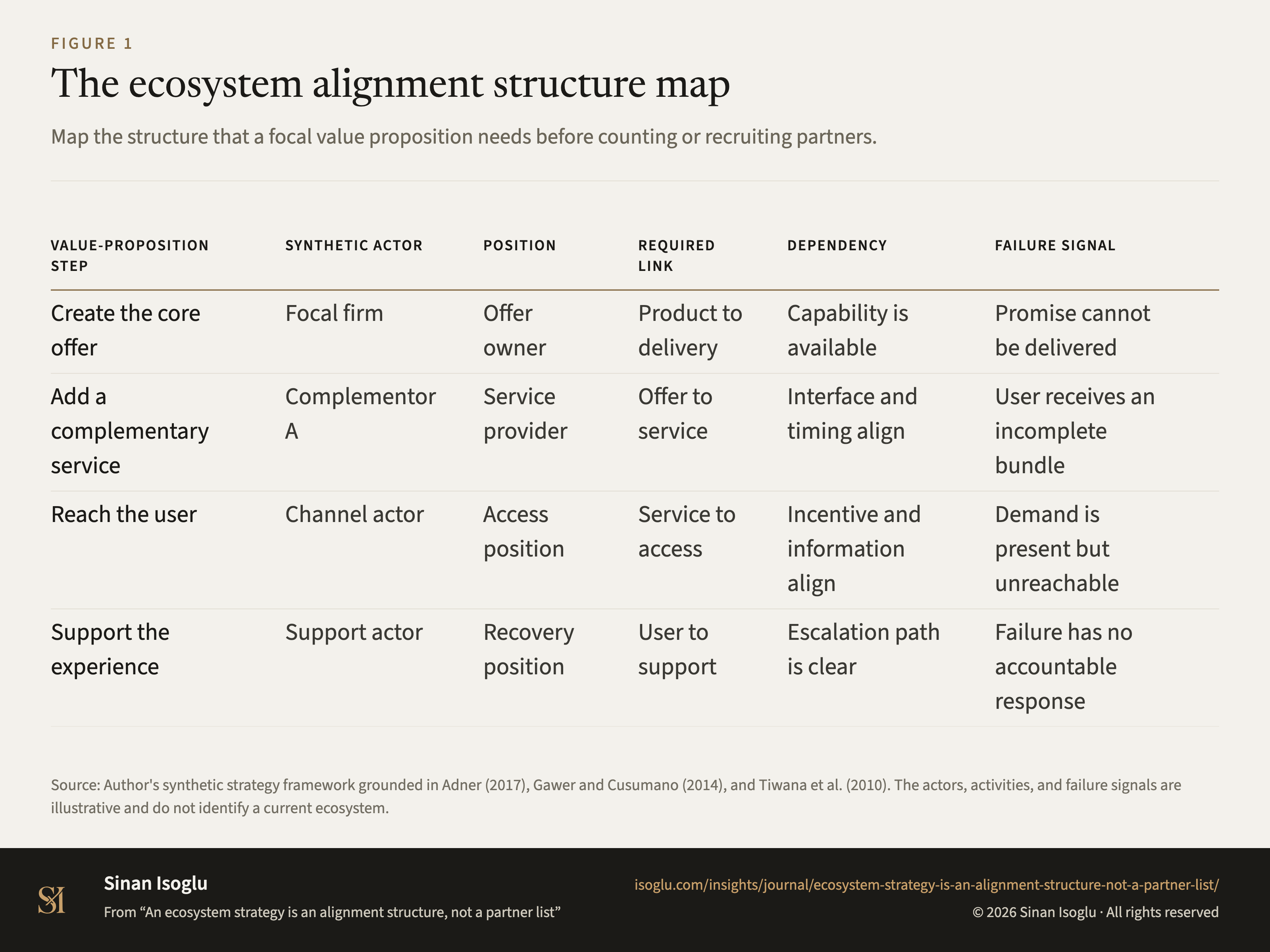
Map the structure that a focal value proposition needs before counting or recruiting partners.
Figure 1The ecosystem alignment structure map
| Value-proposition step | Synthetic actor | Position | Required link | Dependency | Failure signal |
|---|---|---|---|---|---|
| Create the core offer | Focal firm | Offer owner | Product to delivery | Capability is available | Promise cannot be delivered |
| Add a complementary service | Complementor A | Service provider | Offer to service | Interface and timing align | User receives an incomplete bundle |
| Reach the user | Channel actor | Access position | Service to access | Incentive and information align | Demand is present but unreachable |
| Support the experience | Support actor | Recovery position | User to support | Escalation path is clear | Failure has no accountable response |
Swipe or scroll horizontally if the table is wider than your screen.
Source: Author's synthetic strategy framework grounded in Adner (2017), Gawer and Cusumano (2014), and Tiwana et al. (2010). The actors, activities, and failure signals are illustrative and do not identify a current ecosystem.
Source and evidence
Each line names a claim related to this exhibit, its source, and how it was checked.
- A ADN17-C1 The definition, verbatim: an ecosystem is "the alignment structure of the multilateral set of partners that need to interact in order for a focal value proposition to materialize"adner-2017-ecosystem-as-structure
- A ADN17-C2 Interdependence is the unit: the definition turns on "the multilateral set of partners that need to interact in order for a focal value proposition to materialize", so activities and positions are described relative to that propositionadner-2017-ecosystem-as-structure
- A ADN17-C3 Alignment is the strategic problem, not a by-product: an ecosystem IS "the alignment structure of the multilateral set of partners", which makes getting partners aligned the thing to be managedadner-2017-ecosystem-as-structure
- A GC14-C1 Two types, and the paper says only two: "there are two predominant types of platforms internal or company specific platforms and external or industry wide platforms"Gawer & Cusumano. (2014)
- A GC14-C2 Both definitions are the authors' own: an internal platform is "a set of assets organized in a common structure from which a company can efficiently develop and produce a stream of derivative products", an external one "a foundation upon which external innovators organized as an innovative business ecosystem can develop their own complementary products technologies or services"Gawer & Cusumano. (2014)
- A GC14-C3 What the review actually offers: "we summarize from the literature general propositions on the design economics and strategic management of platforms", illustrated through "the case of Intel and other examples" rather than testedGawer & Cusumano. (2014)
- A TKB10-C1 The subject, from the title itself: "platform evolution coevolution of platform architecture governance and environmental dynamics"Tiwana, Konsynski & Bush. (2010)
- A TKB10-C2 A research agenda, not a result: "we identify five broad research questions stemming from this tripartite coevolution perspective", studiable at ecosystem or module levelTiwana, Konsynski & Bush. (2010)
- A TKB10-C3 Design and governance, ongoing: "the coevolution of the design governance and environmental dynamics of such ecosystems influences how they evolve", presented with "five broad research questions"Tiwana, Konsynski & Bush. (2010)
Grades: A, verified against the printed page of the primary source · B, primary source, text layer only · C, authoritative secondary · D, reported.
From the essay
Go-to-market strategy
An ecosystem strategy is an alignment structure, not a partner list
An ecosystem strategy maps the actors, activities, positions, links, and dependencies required for a focal value proposition to materialize.
Read the essayThis exhibit belongs to an essay: the numbers live here, the argument lives there.
Cite or embed
Related exhibits
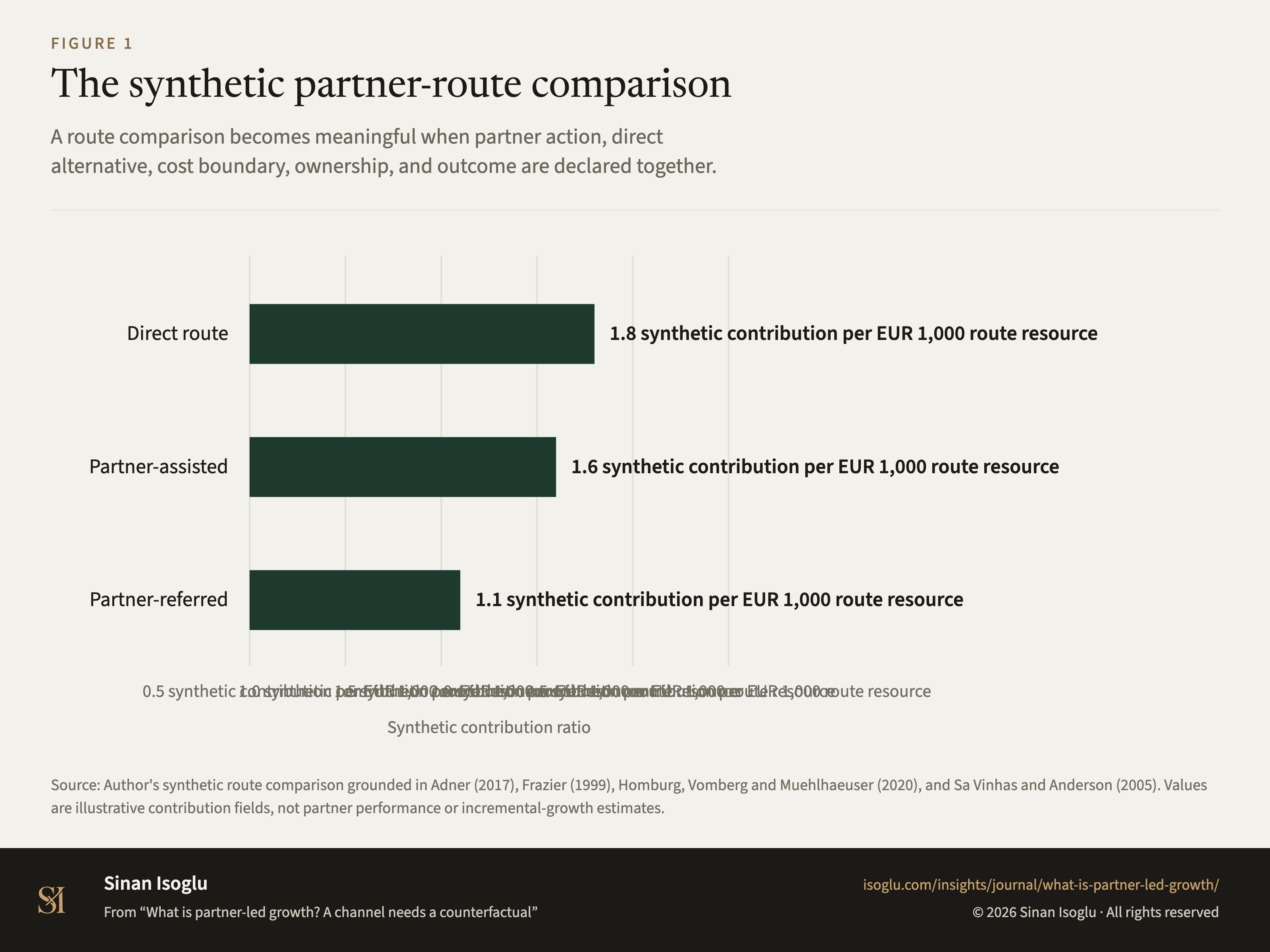
Figure 1Figure
The synthetic partner-route comparison
What is partner-led growth? A channel needs a counterfactual
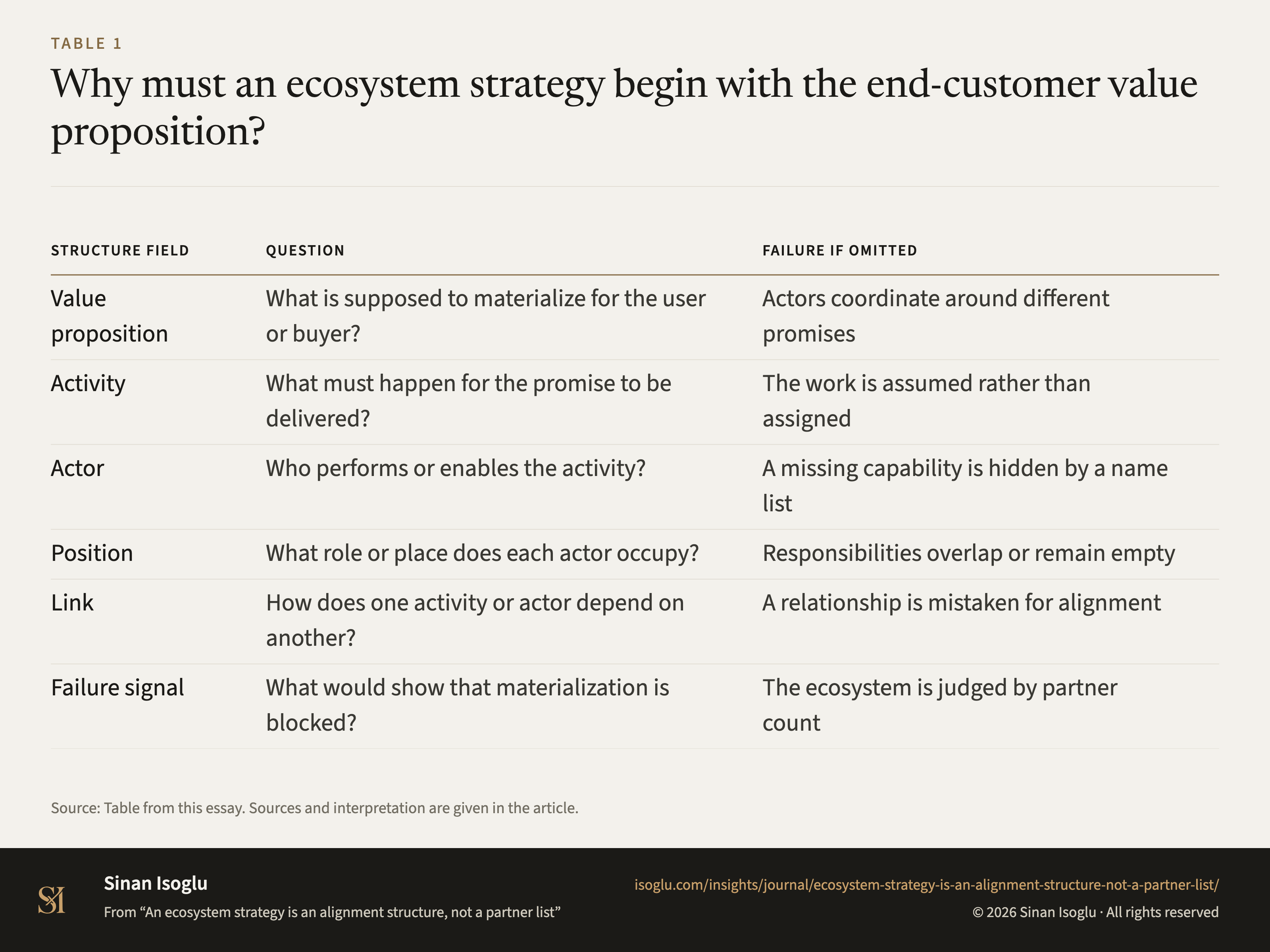
Table 1Table
Why must an ecosystem strategy begin with the end-customer value proposition?
An ecosystem strategy is an alignment structure, not a partner list
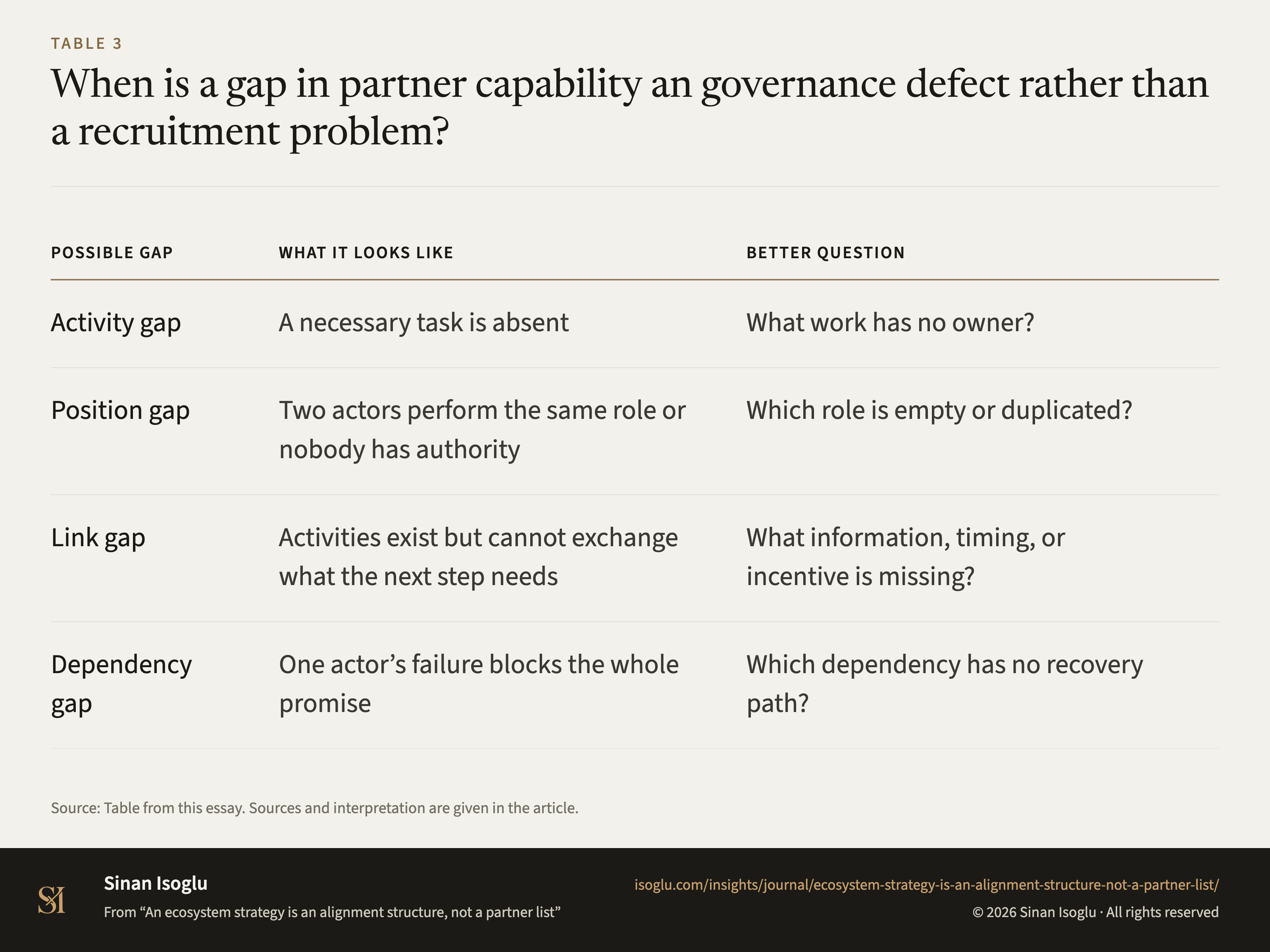
Table 2Table
Why can a value proposition fail even when the partner map looks complete?
An ecosystem strategy is an alignment structure, not a partner list
Contact
Bring the question you're working on.
Research, a guest lecture, or a commercial question.