Figure 6From “What is an earn-out? The part of the price that waits for proof”
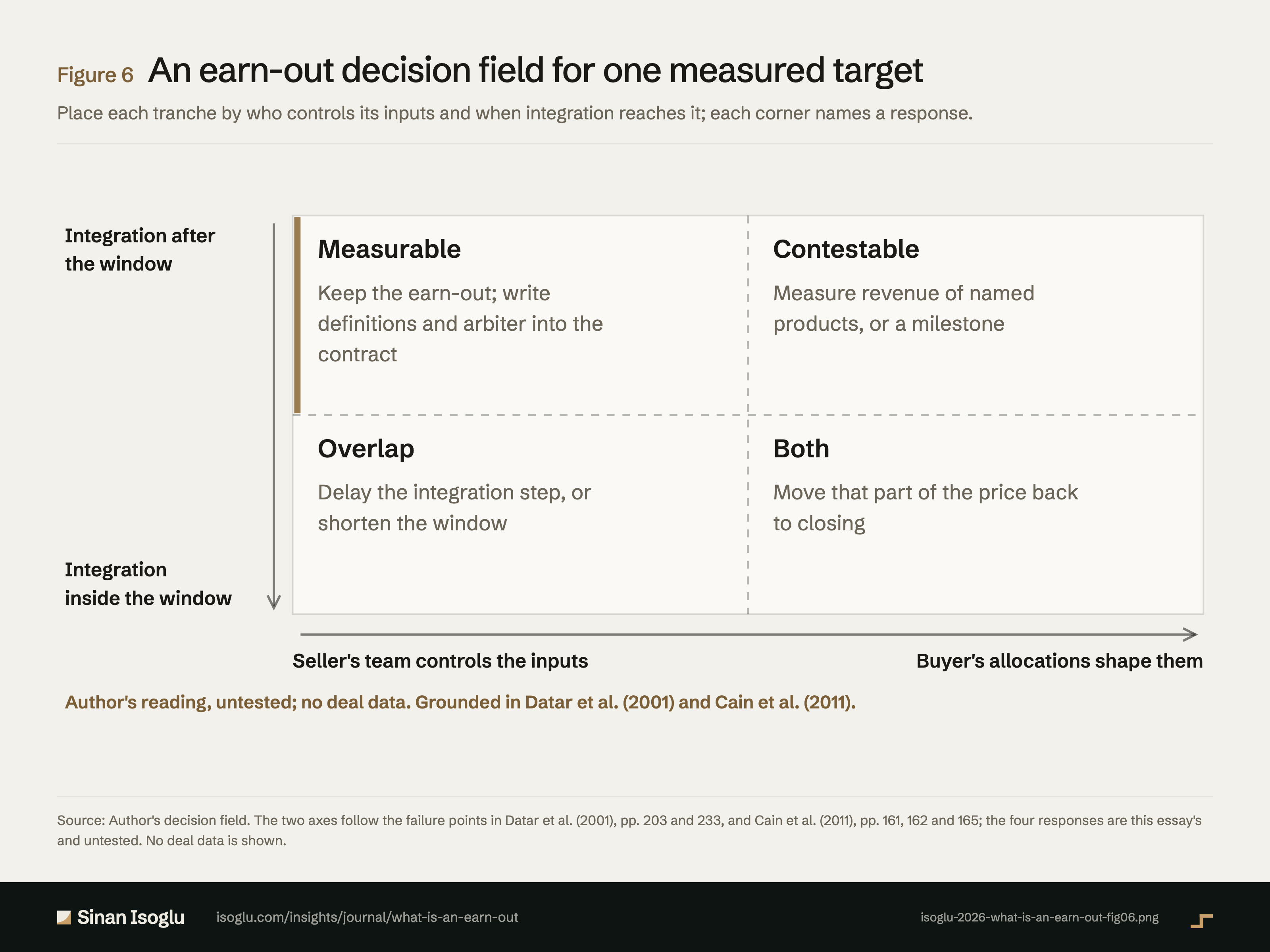
An earn-out decision field for one measured target
Place each tranche by who controls its inputs and when integration reaches it; each corner names a response.
Figure 6An earn-out decision field for one measured target
Source: Author's decision field. The two axes follow the failure points in Datar et al. (2001), pp. 203 and 233, and Cain et al. (2011), pp. 161, 162 and 165; the four responses are this essay's and untested. No deal data is shown.
Source and evidence
Each line names a claim related to this exhibit, its source, and how it was checked.
- B A verified against the printed page of the primary sourceB primary source, text layer onlyC authoritative secondaryD reported The stress test: the invented software unit (10 million revenue; 14 million at closing; up to 6 million at 1 million per million of second-year revenue above 11 million, capped at 17 million; headline price 20 million; 10% growth gives 12.1 million revenue, 1.1 million paid, 15.1 million total; the cap needs 70% growth; the sales team moved in month four, so revenue depends on which salesperson books which deal) the decision field (who controls the measure's inputs after closing against when integration merges the unit, with four responses: measurable, contestable, overlap, both) and the six-column worksheet with its three repairs; untested, no deal data.Author synthesis
- A A verified against the printed page of the primary sourceB primary source, text layer onlyC authoritative secondaryD reported Costs: the seller bears business risk and the acquirer's competence; integration creates joint costs whose allocation leads to disputes; a limited horizon invites short-term actions such as cutting R&D; often the value created will not pay for the seller's risk (p. 203): "an earnout requires the target owners to bear risk"; "the uncertainty associated with the competence of the acquiring company in managing the operations of the target"; "As the firms become more integrated, joint costs arise whose allocation can lead to disputes by creating measurement problems"; "its limited horizon may give the seller/manager an incentive to take actions"; "which maximize short-term profits at the expense of long-run profits"; "will not be sufficient to pay the target owners for bearing risk"Datar, Frankel and Wolfson (2001)
- A A verified against the printed page of the primary sourceB primary source, text layer onlyC authoritative secondaryD reported Stock follows financing motives, earn-outs agency and adverse selection motives; earn-outs are rarer in industries with much M&A activity; the authors close by naming disputes over payoffs and the need to measure the target separately, which may constrain integration, as practical difficulties for further research (pp. 201, 231 to 233): "financing considerations are a more important factor in the use of stock"; "earnout use is motivated by agency and adverse selection concerns, as opposed to tax and financial reporting concerns"; "Earnouts are less likely in industries marked by a large amount of merger and acquisition activity"; "These problems may include disputes about the calculation of earnout payoffs"; "The existence of an earnout may also constrain the acquirer's ability to obtain benefits from integrating the target and acquirer operations"Datar, Frankel and Wolfson (2001)
- A A verified against the printed page of the primary sourceB primary source, text layer onlyC authoritative secondaryD reported Terms track verifiability: periods are shorter where the acquirer can more easily distort the measure, a conclusion resting on the negative coefficient of target-industry return volatility in Table 4, read as noise in the performance signal; cross-industry status is not the proxy; the authors also conjecture greater acquirer discretion over cost allocations in same-industry deals (pp. 152, 160 to 162, 165): "the choice of performance measure in earnout contracts is associated with proxies for the amount of information conveyed by that performance measure and the verifiability of that measure"; "The coefficient on the target industry standard deviation of daily returns is negative and significant"; "the impact of additional noise in the performance signal outweighs the potential benefits of contract length"; "we conjecture that acquirers have greater discretion over cost allocations"; "earnout periods are shorter when it is more likely that acquiring firms have the ability to distort the performance measure on which the earnout is based"Cain, Denis and Denis (2011)
From the essay
Go-to-market strategy
What is an earn-out? The part of the price that waits for proof
An earn-out pays part of the price only if the acquired business hits agreed targets. Studies find it in hard-to-value deals; integration can strain it.
Read the essayThis exhibit belongs to an essay: the numbers live here, the argument lives there.
Cite or embed
Related exhibits
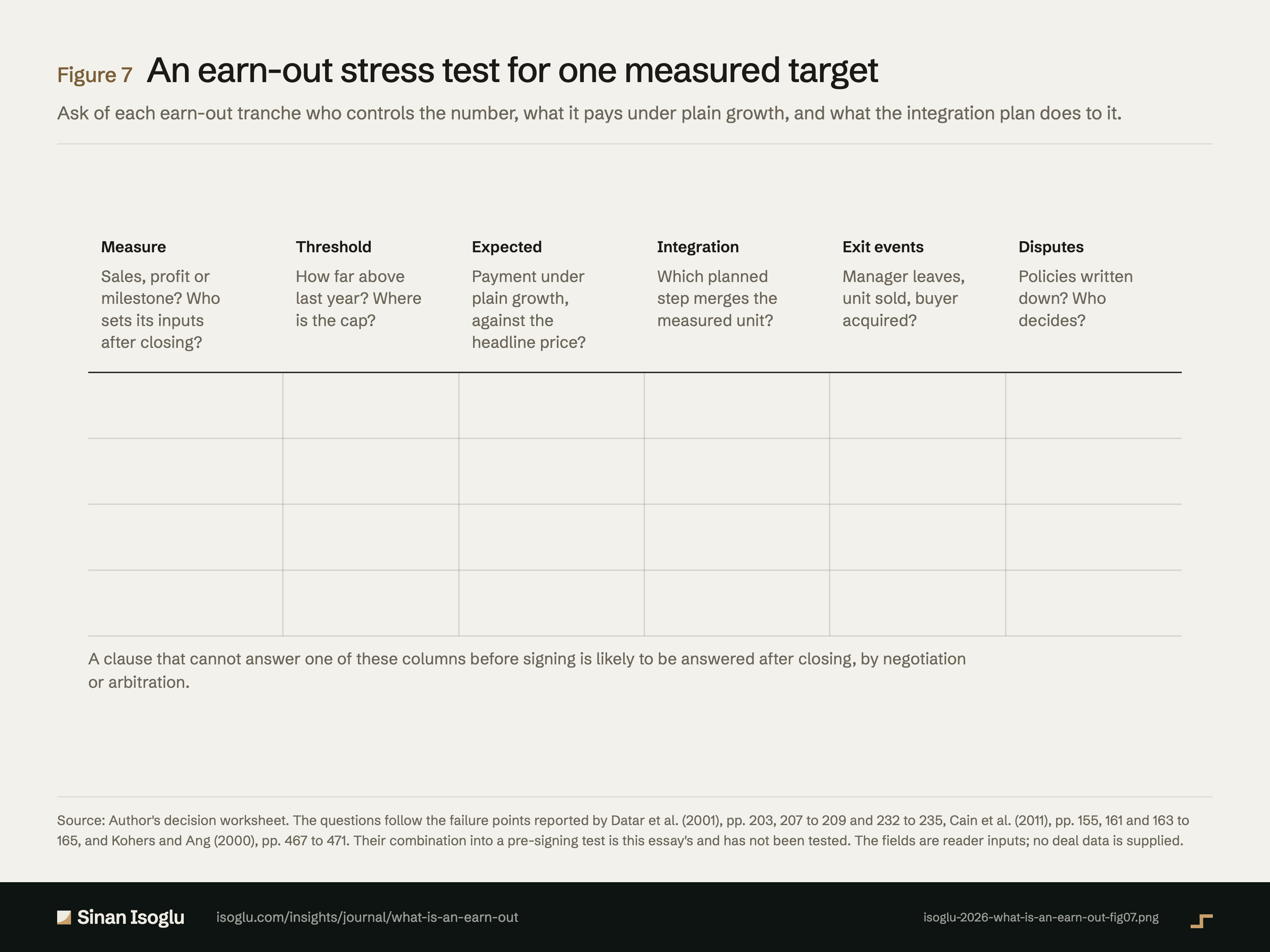
Figure 7Figure
An earn-out stress test for one measured target
What is an earn-out? The part of the price that waits for proof
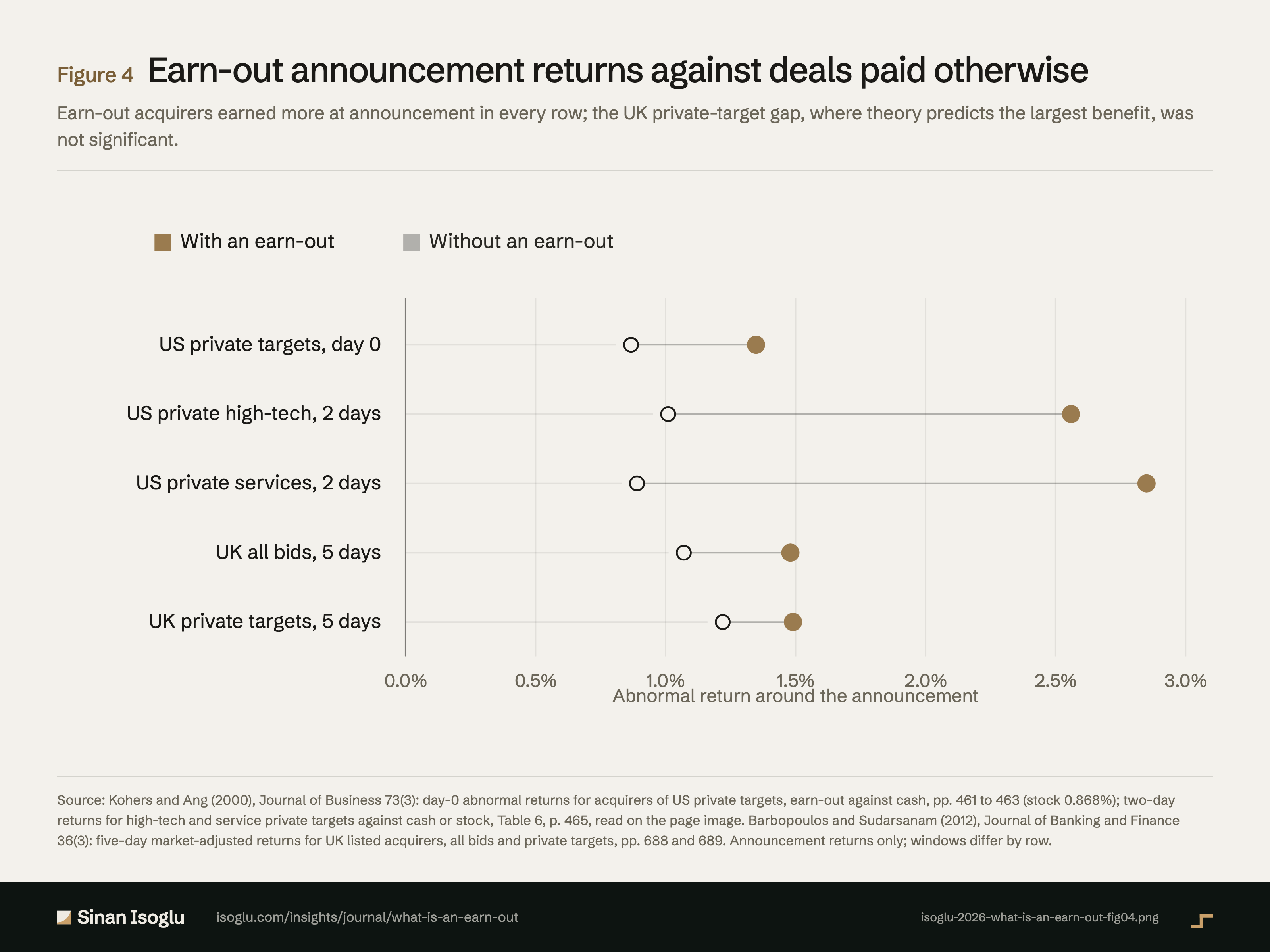
Figure 4Figure
Earn-out announcement returns against deals paid otherwise
What is an earn-out? The part of the price that waits for proof
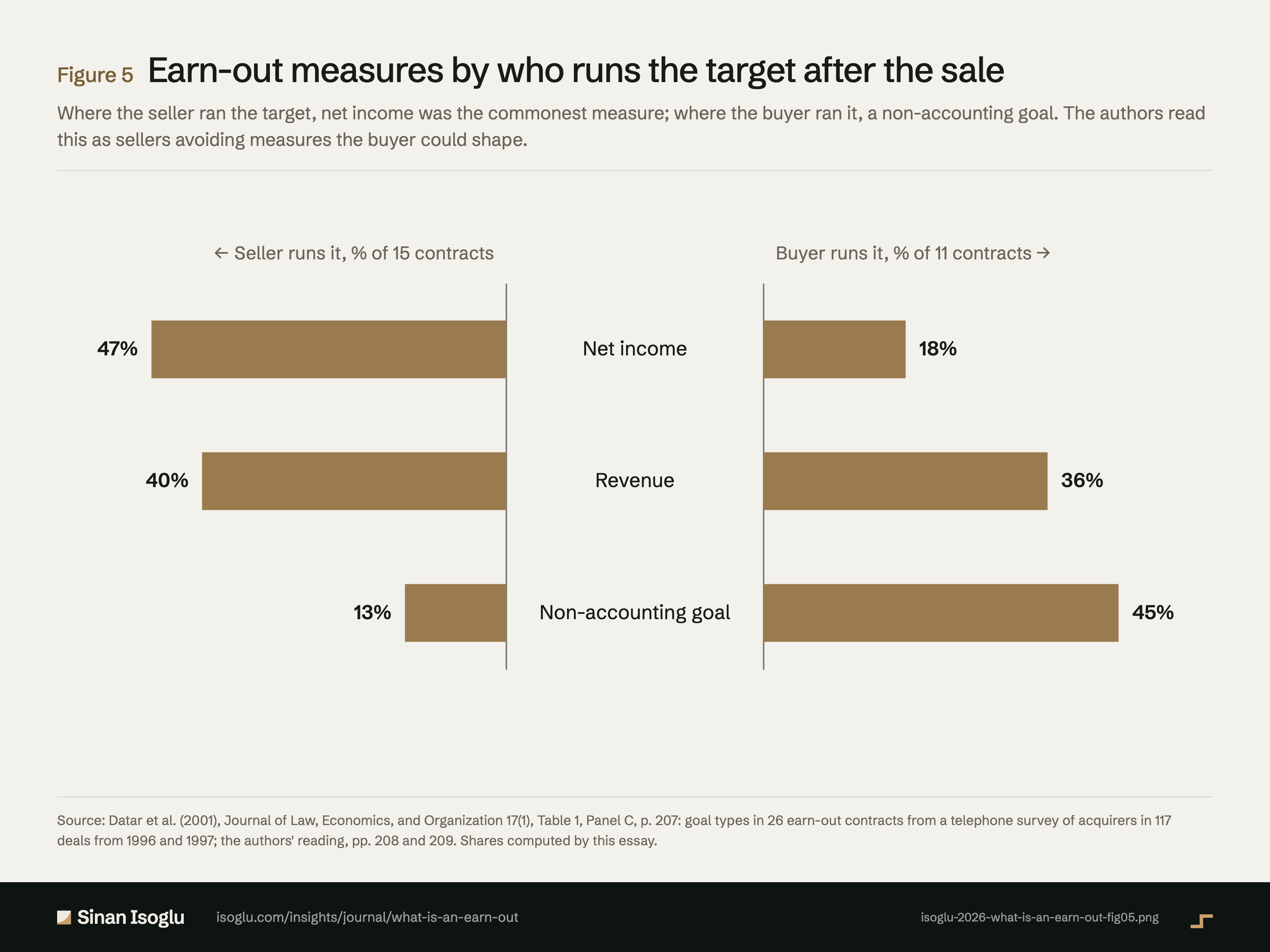
Figure 5Figure
Earn-out measures by who runs the target after the sale
What is an earn-out? The part of the price that waits for proof
Contact
Bring the question you're working on.
Research, a guest lecture, or a commercial question.