Abbildung 6Aus „Was ist ein Earn-Out? Der Preisteil, der sich erst beweisen muss“
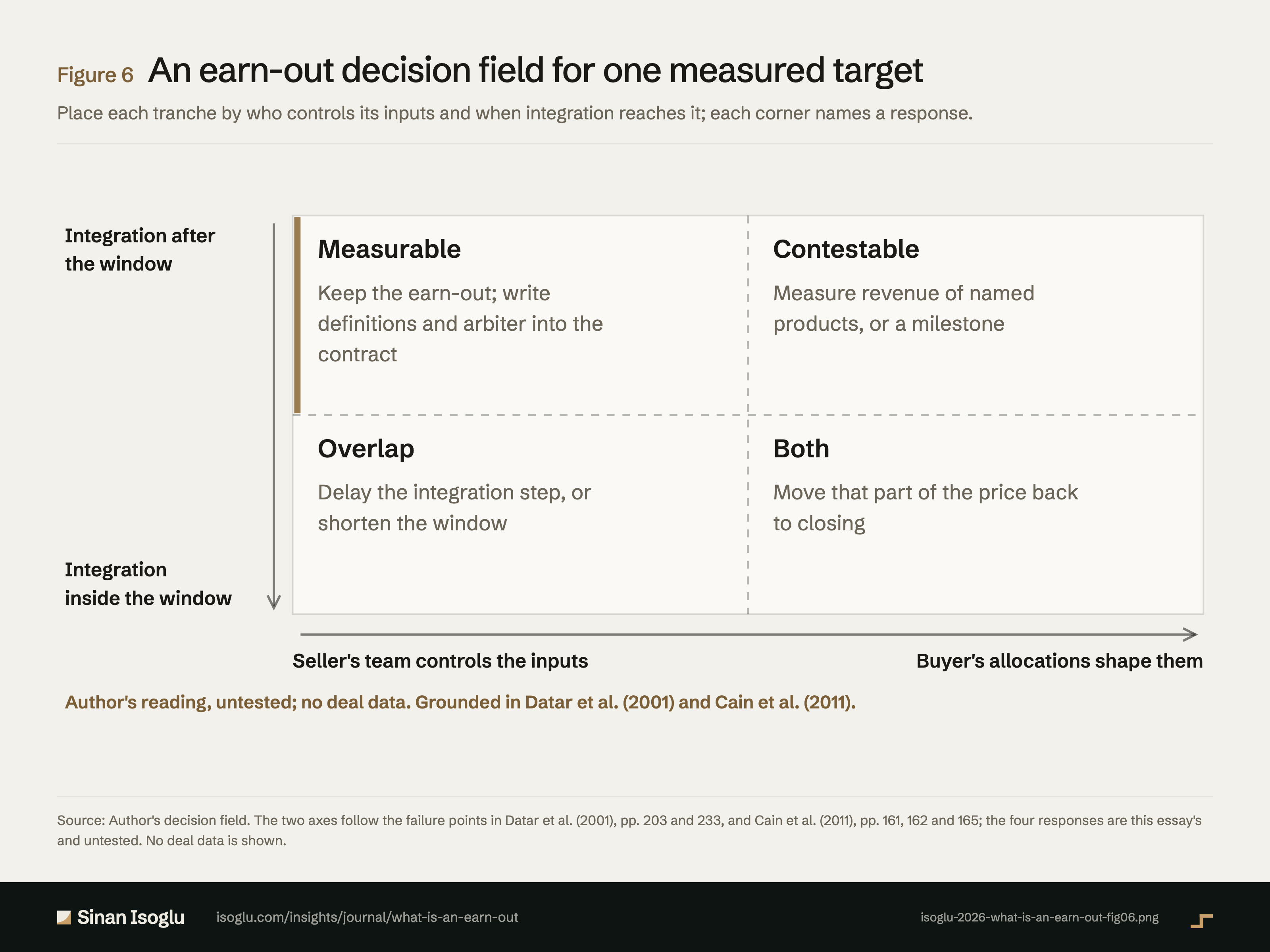
Ein Earn-Out-Entscheidungsfeld für die gemessene Einheit
Ordnen Sie jede Tranche danach ein, wer ihre Eingaben steuert und wann die Integration sie erreicht; jede Ecke nennt eine Antwort.
Abbildung 6Ein Earn-Out-Entscheidungsfeld für die gemessene Einheit
Quelle: Entscheidungsfeld des Autors. Die beiden Achsen folgen den Schwachstellen bei Datar u. a. (2001), S. 203 und 233, sowie Cain u. a. (2011), S. 161, 162 und 165; die vier Antworten stammen aus diesem Beitrag und sind ungeprüft. Es werden keine Deal-Daten gezeigt.
Quelle und Evidenz
Jede Zeile nennt eine Aussage zu dieser Abbildung, ihre Quelle und die Art ihrer Prüfung.
- B A gegen die gedruckte Seite der Primärquelle geprüftB Primärquelle, nur TextebeneC belastbare SekundärquelleD berichtet The stress test: the invented software unit (10 million revenue; 14 million at closing; up to 6 million at 1 million per million of second-year revenue above 11 million, capped at 17 million; headline price 20 million; 10% growth gives 12.1 million revenue, 1.1 million paid, 15.1 million total; the cap needs 70% growth; the sales team moved in month four, so revenue depends on which salesperson books which deal) the decision field (who controls the measure's inputs after closing against when integration merges the unit, with four responses: measurable, contestable, overlap, both) and the six-column worksheet with its three repairs; untested, no deal data.Author synthesis
- A A gegen die gedruckte Seite der Primärquelle geprüftB Primärquelle, nur TextebeneC belastbare SekundärquelleD berichtet Costs: the seller bears business risk and the acquirer's competence; integration creates joint costs whose allocation leads to disputes; a limited horizon invites short-term actions such as cutting R&D; often the value created will not pay for the seller's risk (p. 203): "an earnout requires the target owners to bear risk"; "the uncertainty associated with the competence of the acquiring company in managing the operations of the target"; "As the firms become more integrated, joint costs arise whose allocation can lead to disputes by creating measurement problems"; "its limited horizon may give the seller/manager an incentive to take actions"; "which maximize short-term profits at the expense of long-run profits"; "will not be sufficient to pay the target owners for bearing risk"Datar, Frankel and Wolfson (2001)
- A A gegen die gedruckte Seite der Primärquelle geprüftB Primärquelle, nur TextebeneC belastbare SekundärquelleD berichtet Stock follows financing motives, earn-outs agency and adverse selection motives; earn-outs are rarer in industries with much M&A activity; the authors close by naming disputes over payoffs and the need to measure the target separately, which may constrain integration, as practical difficulties for further research (pp. 201, 231 to 233): "financing considerations are a more important factor in the use of stock"; "earnout use is motivated by agency and adverse selection concerns, as opposed to tax and financial reporting concerns"; "Earnouts are less likely in industries marked by a large amount of merger and acquisition activity"; "These problems may include disputes about the calculation of earnout payoffs"; "The existence of an earnout may also constrain the acquirer's ability to obtain benefits from integrating the target and acquirer operations"Datar, Frankel and Wolfson (2001)
- A A gegen die gedruckte Seite der Primärquelle geprüftB Primärquelle, nur TextebeneC belastbare SekundärquelleD berichtet Terms track verifiability: periods are shorter where the acquirer can more easily distort the measure, a conclusion resting on the negative coefficient of target-industry return volatility in Table 4, read as noise in the performance signal; cross-industry status is not the proxy; the authors also conjecture greater acquirer discretion over cost allocations in same-industry deals (pp. 152, 160 to 162, 165): "the choice of performance measure in earnout contracts is associated with proxies for the amount of information conveyed by that performance measure and the verifiability of that measure"; "The coefficient on the target industry standard deviation of daily returns is negative and significant"; "the impact of additional noise in the performance signal outweighs the potential benefits of contract length"; "we conjecture that acquirers have greater discretion over cost allocations"; "earnout periods are shorter when it is more likely that acquiring firms have the ability to distort the performance measure on which the earnout is based"Cain, Denis and Denis (2011)
Aus dem Beitrag
Go-to-Market-Strategie
Was ist ein Earn-Out? Der Preisteil, der sich erst beweisen muss
Ein Earn-Out zahlt Teile des Kaufpreises erst, wenn das gekaufte Unternehmen Ziele erreicht. Häufig bei schwer bewertbaren Firmen, heikel bei Integration.
Den Beitrag lesenDiese Abbildung gehört zu einem Essay: Die Zahlen stehen hier, das Argument dort.
Zitieren oder einbetten
Verwandte Abbildungen
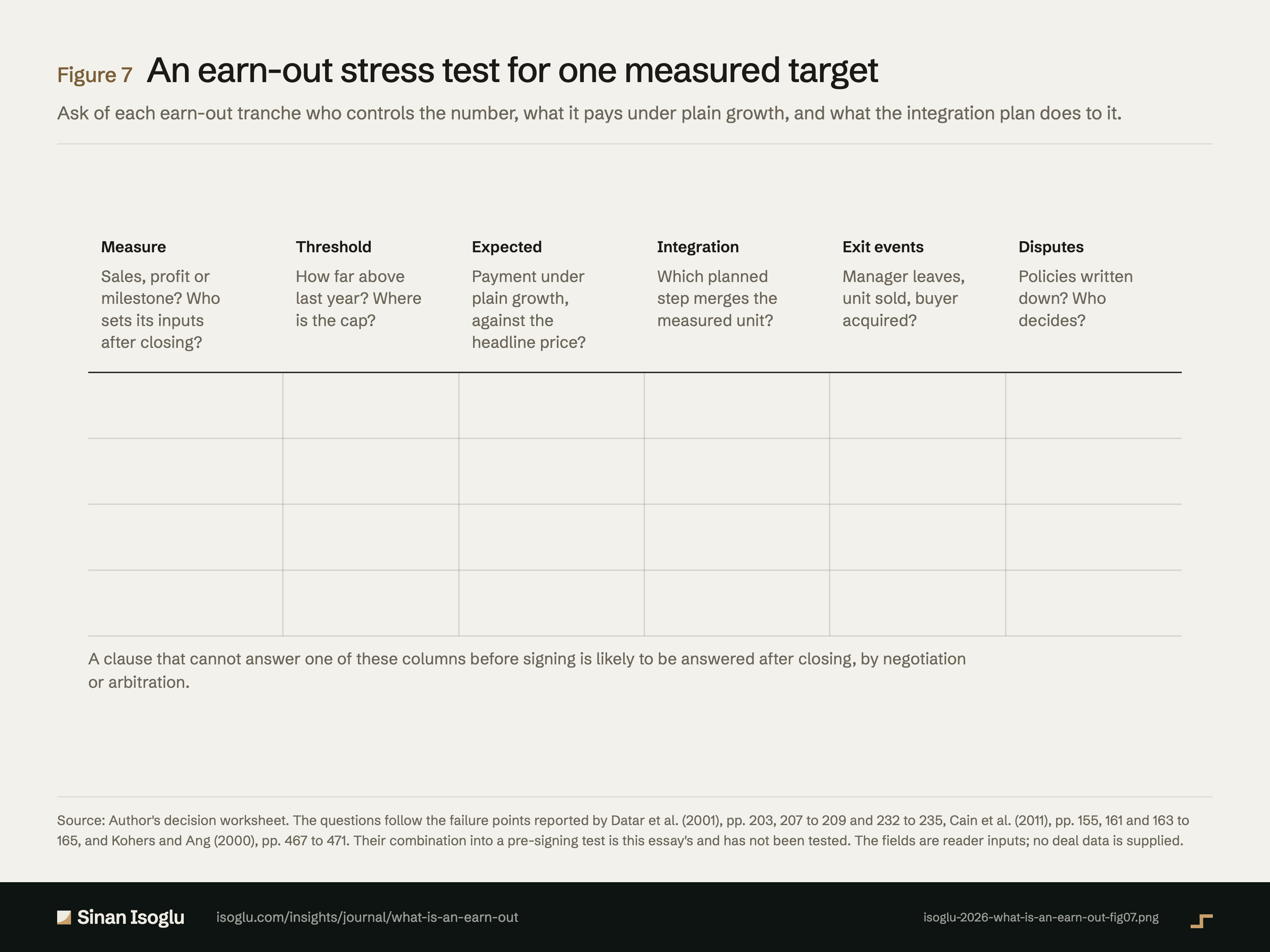
Abbildung 7Grafik
Ein Earn-Out-Stresstest für die gemessene Einheit
Was ist ein Earn-Out? Der Preisteil, der sich erst beweisen muss
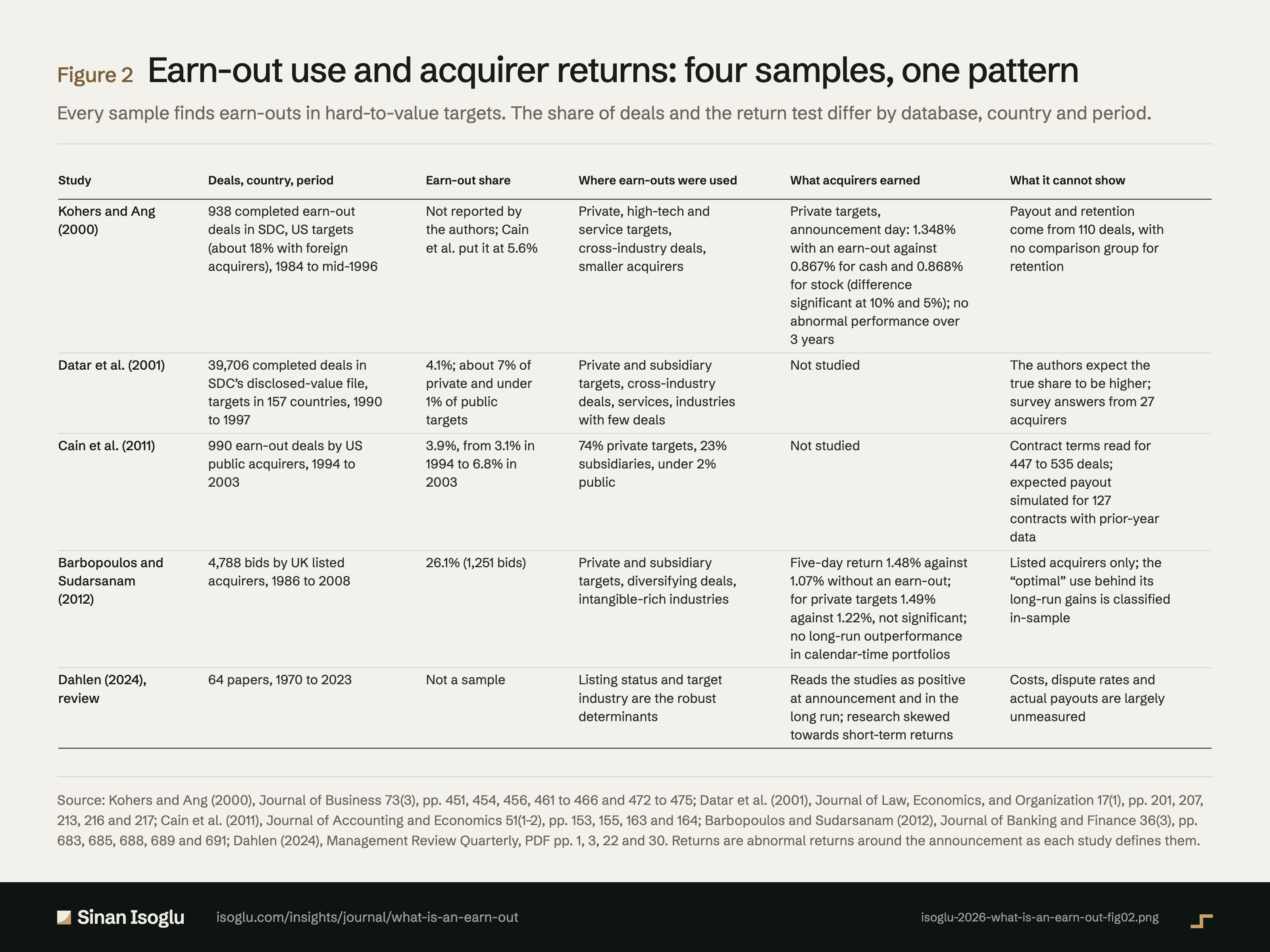
Abbildung 2Grafik
Earn-Out-Nutzung und Käuferrenditen: vier Stichproben, ein Muster
Was ist ein Earn-Out? Der Preisteil, der sich erst beweisen muss
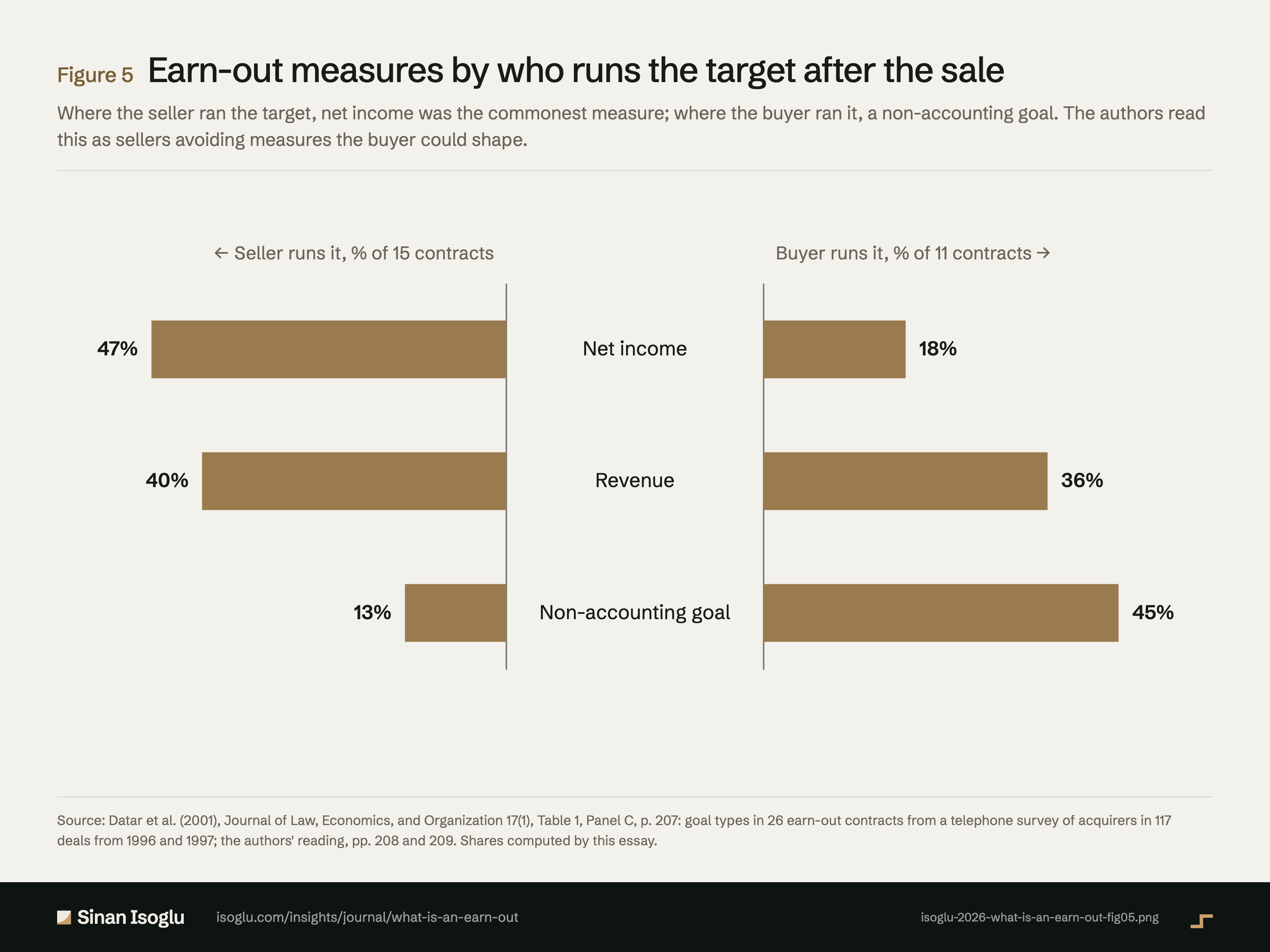
Abbildung 5Grafik
Earn-Out-Bemessungsgrößen danach, wer das Zielunternehmen nach dem Verkauf führt
Was ist ein Earn-Out? Der Preisteil, der sich erst beweisen muss
Kontakt
Schicken Sie die Frage, an der Sie arbeiten.
Forschung, ein Gastvortrag oder eine Frage aus der Praxis.