Figure 1From “What is an earn-out? The part of the price that waits for proof”
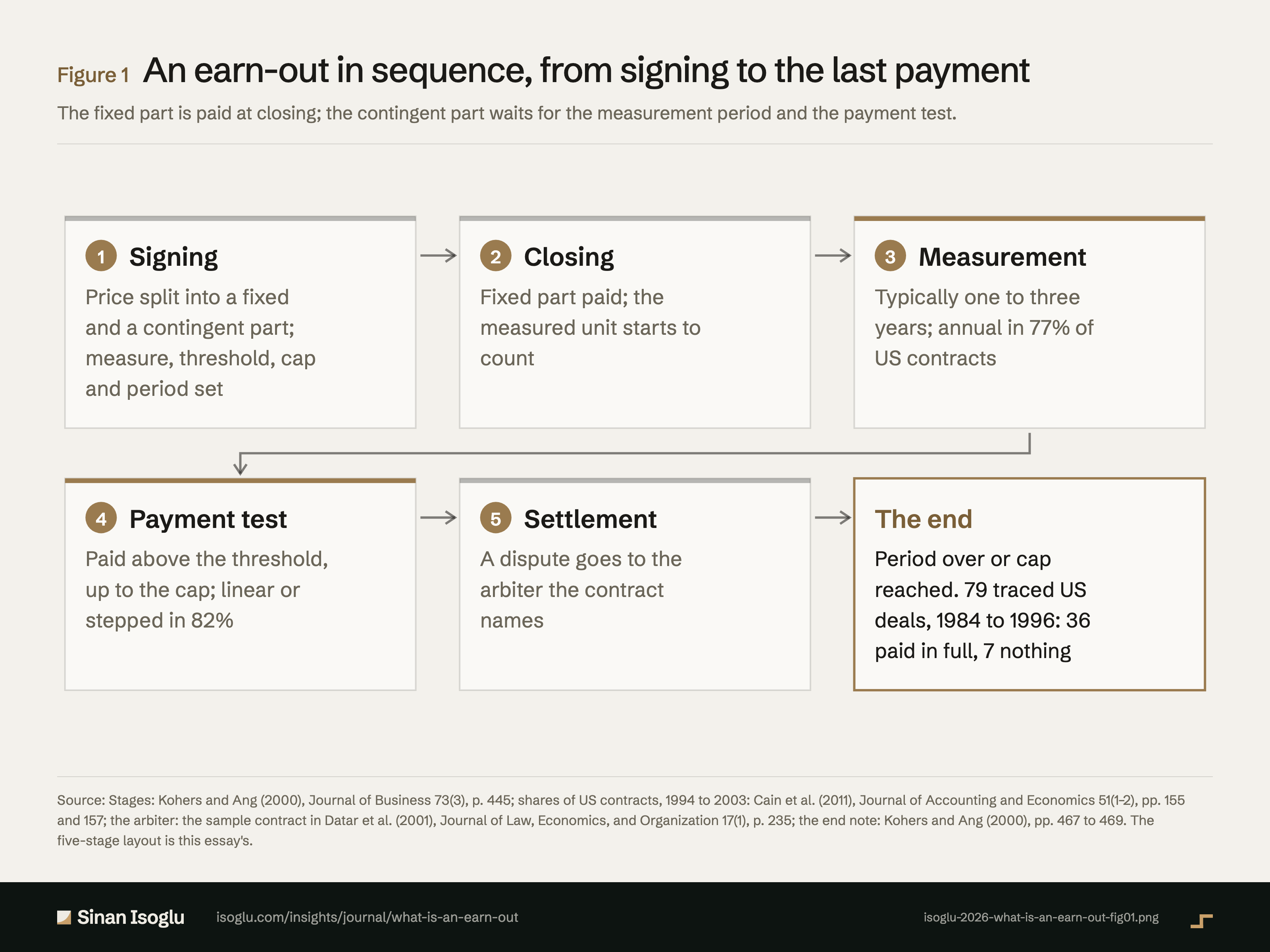
An earn-out in sequence, from signing to the last payment
The fixed part is paid at closing; the contingent part waits for the measurement period and the payment test.
Figure 1An earn-out in sequence, from signing to the last payment
Source: Stages: Kohers and Ang (2000), Journal of Business 73(3), p. 445; shares of US contracts, 1994 to 2003: Cain et al. (2011), Journal of Accounting and Economics 51(1–2), pp. 155 and 157; the arbiter: the sample contract in Datar et al. (2001), Journal of Law, Economics, and Organization 17(1), p. 235; the end note: Kohers and Ang (2000), pp. 467 to 469. The five-stage layout is this essay's.
Source and evidence
Each line names a claim related to this exhibit, its source, and how it was checked.
- A A verified against the printed page of the primary sourceB primary source, text layer onlyC authoritative secondaryD reported An earn-out is the deferred part of a two-part payment, contingent on the target meeting measurable, prespecified performance standards (p. 445): "a two-part payment contract"; "a front-end payment at the time of the merger, and a deferred payment, or earnout, which is contingent on the target's ability to achieve certain measurable prespecified performance standards"Kohers and Ang (2000)
- A A verified against the printed page of the primary sourceB primary source, text layer onlyC authoritative secondaryD reported Contract size and shape: maximum earn-out $21 million on average, median $5 million; 33% of transaction value on average if paid in full (median 28%; Table 2, p. 156, read on the page image: 447 deals, mean 33.4%, median 27.7%; SDC-reported 990 deals, mean 32.7%, median 28.6%); 90% contingent on the target alone; linear (42%) or stepwise (40%) to a cap; the median target must grow 18% before any payment and over a quarter need no growth (pp. 152, 154 to 156): "the maximum earnout that could be paid per acquisition is $21 million, with a median of $5 million"; "Conditional on the maximum being paid, the earnout constitutes 33% of the total transaction value"; "the earnout is contingent on the performance of the target firm only"; "a linear function of the target's performance subject to a maximum (42% of the sample)"; "a stepwise function of the target's performance subject to a maximum (40% of the sample)"; "the median target must improve its performance by 18% relative to the prior year's level"; "over 25% of the targets need not improve performance at all"Cain, Denis and Denis (2011)
- A A verified against the printed page of the primary sourceB primary source, text layer onlyC authoritative secondaryD reported Measures, period and form: accounting profit in 52%, sales in 32%, non-financial milestones in 12.2%; average period 2.57 years with an interquartile range of one to three years, measured annually in 77%; paid in cash only 39%, stock only 29%, both 26% (pp. 155, 157): "is used to measure performance in 261 of the 498 (52%) cases"; "In another 157 cases (32%), a measure of sales is used"; "non-financial measures are used in 61 (12.2%) cases"; "the interquartile range for the earnout period is from one to three years"; "performance is measured annually in 77% of the cases"; "cash only (39% of the cases), common stock only (29% of the cases)"Cain, Denis and Denis (2011)
- A A verified against the printed page of the primary sourceB primary source, text layer onlyC authoritative secondaryD reported The sample contract: $957,000 cash and a $750,000 note at closing; up to $1,350,000 more, as 60% of pretax income above a yearly minimum with yearly caps; pretax income set by the company's accountants, net of interest and of direct costs the buyer incurs on behalf of and for the benefit of the company; cancellation on material breach of named employment terms, felony conviction, suspension or debarment from US government contracts, or dismissal for wilful refusal; arbitration by three CPAs (pp. 233 to 235): "$957,000 in immediately available funds and $750,000 evidenced by the Purchaser's promissory note"; "up to a maximum aggregate amount of $1,350,000"; "Sellers shall receive annually sixty percent (60%) of the amount by which the Pretax Income"; "The Pretax Income shall be determined by the Company's certified public accountants"; "a reasonable charge representing direct costs incurred by the Purchaser on behalf of and for the benefit of the Company"; "shall be cancelable at the option of Purchaser"; "willful failure or refusal, after not less than thirty (30) days written notice"; "by three certified public accountants in accordance with the Rules of American Arbitration Association"Datar, Frankel and Wolfson (2001)
- A A verified against the printed page of the primary sourceB primary source, text layer onlyC authoritative secondaryD reported In 110 deals of at least $5 million, payment information was found for 79: 72 paid something, 36 in full, 7 nothing; with 30% assumed for untraceable amounts, about 62% of stated amounts were paid; measures are almost always profit or revenue, with one outside-risk benchmark; no standard reporting; the seven unpaid deals had a 2-day announcement CAR of −1.75%, not significant (Table 8, p. 472, read on the page image), against 3.98% where all was paid (pp. 467 to 472): "we narrow our focus to 110 mergers involving earnouts"; "we are able to find some information on earnout payments in 79 of the 110 deals"; "36 targets received the full amount of contingent payments"; "in only seven of the 79 cases with some earnout information disclosure"; "we make a conservative assumption that the average portion of earnouts paid in these cases is 30%"; "approximately 62% of the stated earnout amounts are actually received by targets"; "almost always profit-related measures for the target"; "we find only one case in which the performance benchmark is based on external risk"; "earnouts are not commonly used for hedging exogenous risk factors"; "there is no standard method for reporting earnout payments"; "for those seven cases in which no earnout is received"Kohers and Ang (2000)
From the essay
Go-to-market strategy
What is an earn-out? The part of the price that waits for proof
An earn-out pays part of the price only if the acquired business hits agreed targets. Studies find it in hard-to-value deals; integration can strain it.
Read the essayThis exhibit belongs to an essay: the numbers live here, the argument lives there.
Cite or embed
Related exhibits
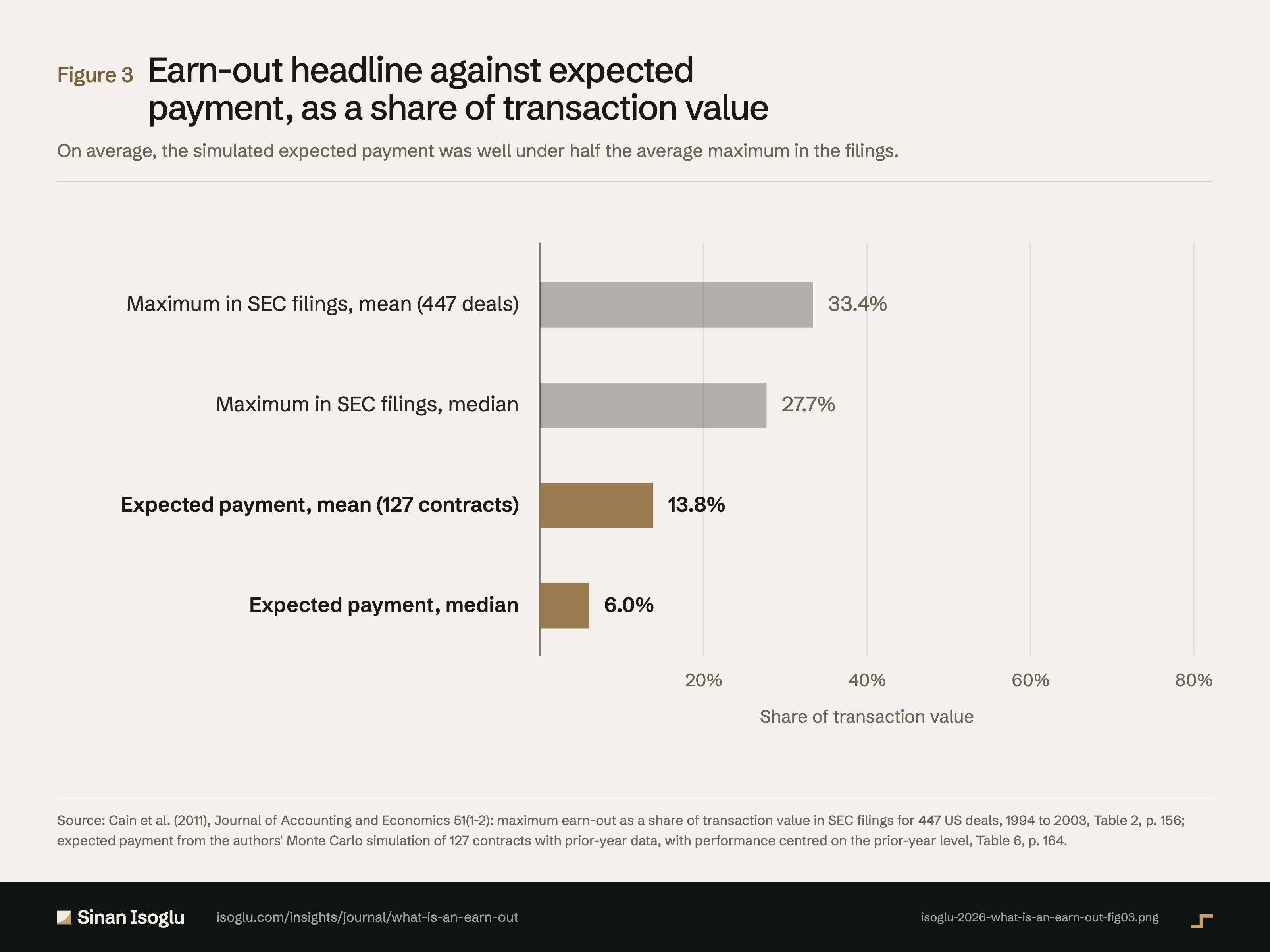
Figure 3Figure
Earn-out headline against expected payment, as a share of transaction value
What is an earn-out? The part of the price that waits for proof
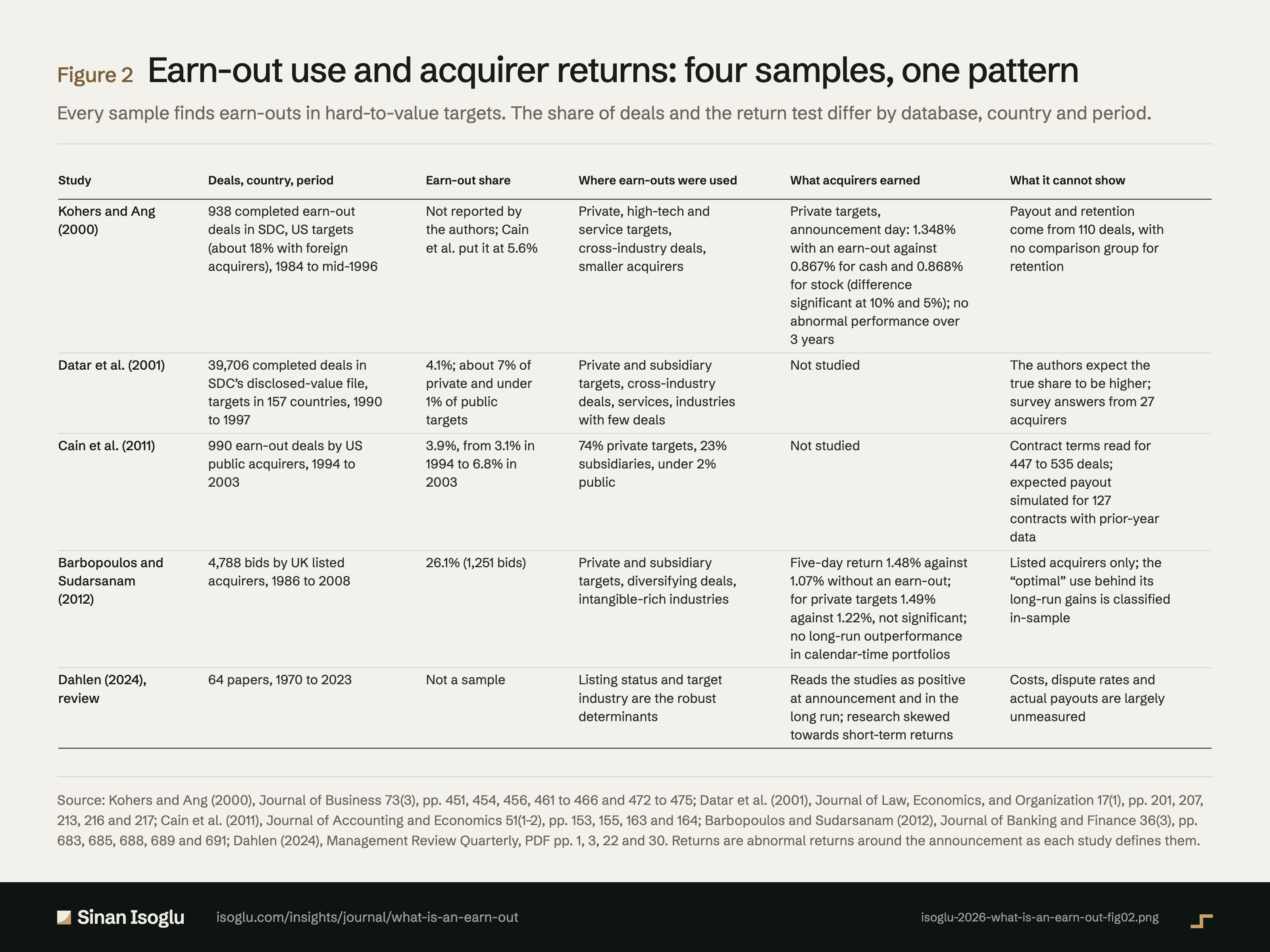
Figure 2Figure
Earn-out use and acquirer returns: four samples, one pattern
What is an earn-out? The part of the price that waits for proof
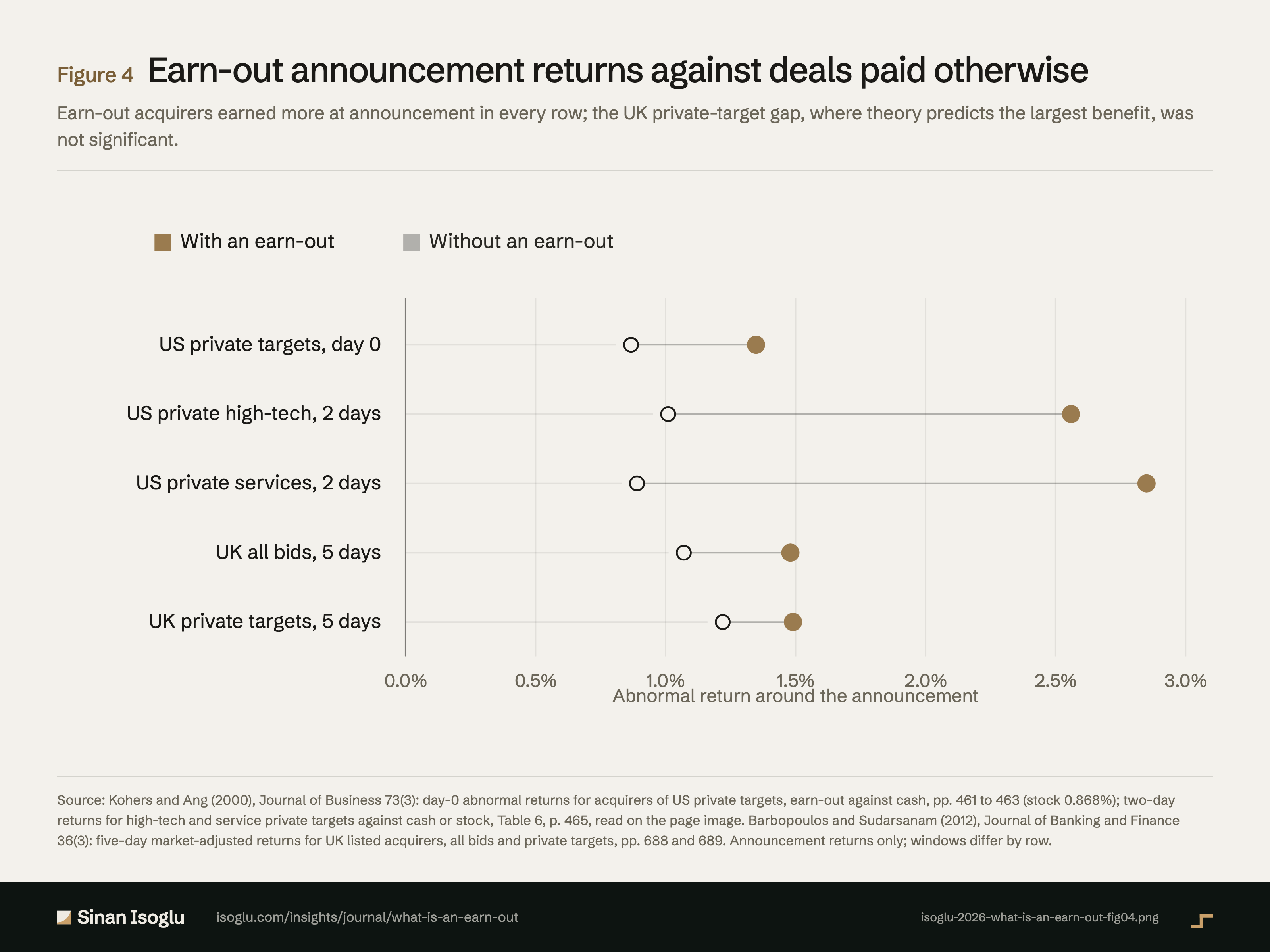
Figure 4Figure
Earn-out announcement returns against deals paid otherwise
What is an earn-out? The part of the price that waits for proof
Contact
Bring the question you're working on.
Research, a guest lecture, or a commercial question.