Abbildung 1Aus „Was ist ein Earn-Out? Der Preisteil, der sich erst beweisen muss“
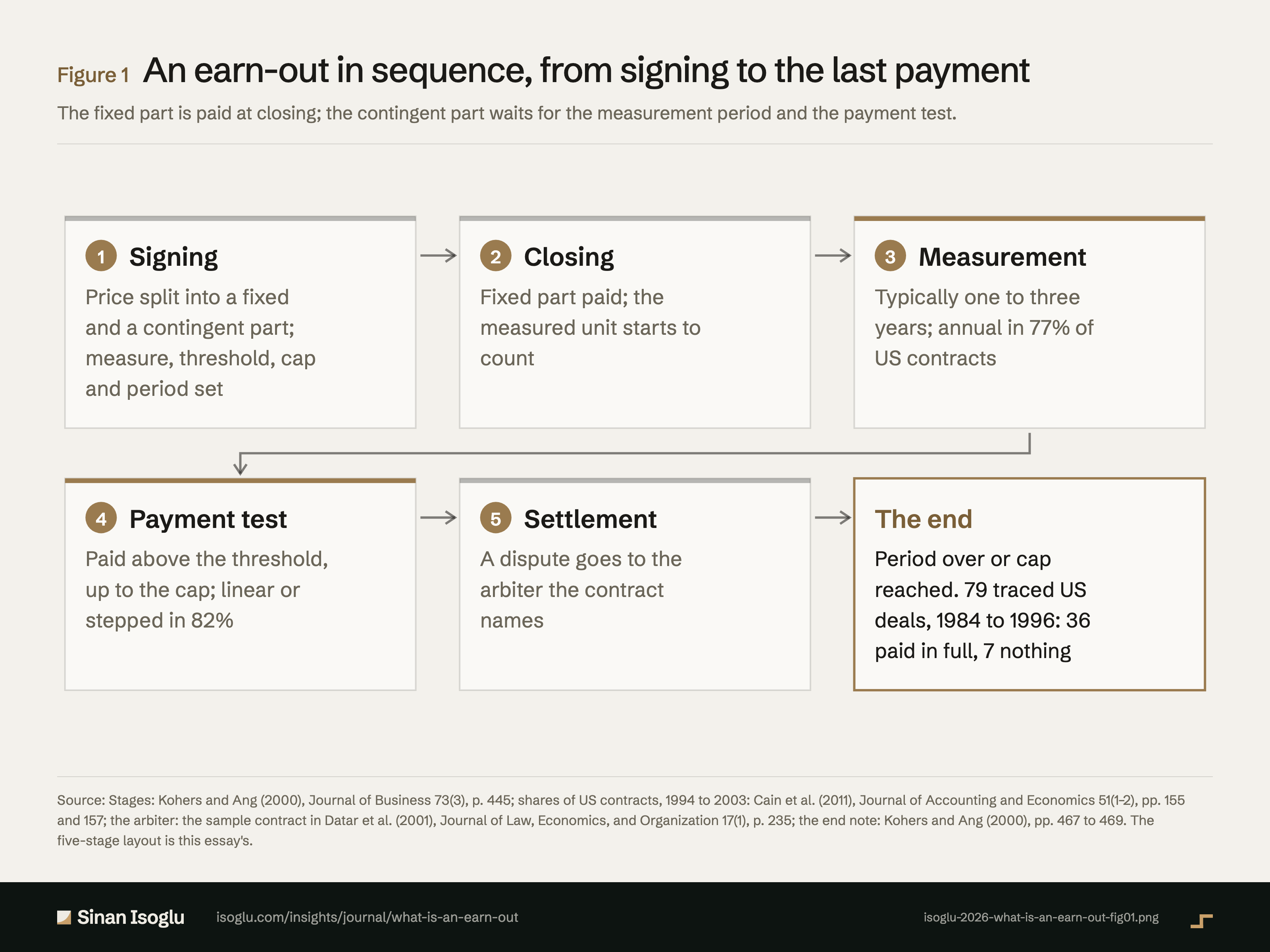
Ein Earn-Out im Ablauf, von der Unterzeichnung bis zur letzten Zahlung
Der feste Teil wird beim Closing gezahlt; der bedingte Teil wartet auf den Messzeitraum und den Zahlungstest.
Abbildung 1Ein Earn-Out im Ablauf, von der Unterzeichnung bis zur letzten Zahlung
Quelle: Stufen: Kohers und Ang (2000), Journal of Business 73(3), S. 445; Anteile in US-Verträgen von 1994 bis 2003: Cain u. a. (2011), Journal of Accounting and Economics 51(1–2), S. 155 und 157; die Schiedsstelle: der Mustervertrag bei Datar u. a. (2001), Journal of Law, Economics, and Organization 17(1), S. 235; der Schlusssatz: Kohers und Ang (2000), S. 467 bis 469. Die Darstellung in fünf Stufen stammt aus diesem Beitrag.
Quelle und Evidenz
Jede Zeile nennt eine Aussage zu dieser Abbildung, ihre Quelle und die Art ihrer Prüfung.
- A A gegen die gedruckte Seite der Primärquelle geprüftB Primärquelle, nur TextebeneC belastbare SekundärquelleD berichtet An earn-out is the deferred part of a two-part payment, contingent on the target meeting measurable, prespecified performance standards (p. 445): "a two-part payment contract"; "a front-end payment at the time of the merger, and a deferred payment, or earnout, which is contingent on the target's ability to achieve certain measurable prespecified performance standards"Kohers and Ang (2000)
- A A gegen die gedruckte Seite der Primärquelle geprüftB Primärquelle, nur TextebeneC belastbare SekundärquelleD berichtet Contract size and shape: maximum earn-out $21 million on average, median $5 million; 33% of transaction value on average if paid in full (median 28%; Table 2, p. 156, read on the page image: 447 deals, mean 33.4%, median 27.7%; SDC-reported 990 deals, mean 32.7%, median 28.6%); 90% contingent on the target alone; linear (42%) or stepwise (40%) to a cap; the median target must grow 18% before any payment and over a quarter need no growth (pp. 152, 154 to 156): "the maximum earnout that could be paid per acquisition is $21 million, with a median of $5 million"; "Conditional on the maximum being paid, the earnout constitutes 33% of the total transaction value"; "the earnout is contingent on the performance of the target firm only"; "a linear function of the target's performance subject to a maximum (42% of the sample)"; "a stepwise function of the target's performance subject to a maximum (40% of the sample)"; "the median target must improve its performance by 18% relative to the prior year's level"; "over 25% of the targets need not improve performance at all"Cain, Denis and Denis (2011)
- A A gegen die gedruckte Seite der Primärquelle geprüftB Primärquelle, nur TextebeneC belastbare SekundärquelleD berichtet Measures, period and form: accounting profit in 52%, sales in 32%, non-financial milestones in 12.2%; average period 2.57 years with an interquartile range of one to three years, measured annually in 77%; paid in cash only 39%, stock only 29%, both 26% (pp. 155, 157): "is used to measure performance in 261 of the 498 (52%) cases"; "In another 157 cases (32%), a measure of sales is used"; "non-financial measures are used in 61 (12.2%) cases"; "the interquartile range for the earnout period is from one to three years"; "performance is measured annually in 77% of the cases"; "cash only (39% of the cases), common stock only (29% of the cases)"Cain, Denis and Denis (2011)
- A A gegen die gedruckte Seite der Primärquelle geprüftB Primärquelle, nur TextebeneC belastbare SekundärquelleD berichtet The sample contract: $957,000 cash and a $750,000 note at closing; up to $1,350,000 more, as 60% of pretax income above a yearly minimum with yearly caps; pretax income set by the company's accountants, net of interest and of direct costs the buyer incurs on behalf of and for the benefit of the company; cancellation on material breach of named employment terms, felony conviction, suspension or debarment from US government contracts, or dismissal for wilful refusal; arbitration by three CPAs (pp. 233 to 235): "$957,000 in immediately available funds and $750,000 evidenced by the Purchaser's promissory note"; "up to a maximum aggregate amount of $1,350,000"; "Sellers shall receive annually sixty percent (60%) of the amount by which the Pretax Income"; "The Pretax Income shall be determined by the Company's certified public accountants"; "a reasonable charge representing direct costs incurred by the Purchaser on behalf of and for the benefit of the Company"; "shall be cancelable at the option of Purchaser"; "willful failure or refusal, after not less than thirty (30) days written notice"; "by three certified public accountants in accordance with the Rules of American Arbitration Association"Datar, Frankel and Wolfson (2001)
- A A gegen die gedruckte Seite der Primärquelle geprüftB Primärquelle, nur TextebeneC belastbare SekundärquelleD berichtet In 110 deals of at least $5 million, payment information was found for 79: 72 paid something, 36 in full, 7 nothing; with 30% assumed for untraceable amounts, about 62% of stated amounts were paid; measures are almost always profit or revenue, with one outside-risk benchmark; no standard reporting; the seven unpaid deals had a 2-day announcement CAR of −1.75%, not significant (Table 8, p. 472, read on the page image), against 3.98% where all was paid (pp. 467 to 472): "we narrow our focus to 110 mergers involving earnouts"; "we are able to find some information on earnout payments in 79 of the 110 deals"; "36 targets received the full amount of contingent payments"; "in only seven of the 79 cases with some earnout information disclosure"; "we make a conservative assumption that the average portion of earnouts paid in these cases is 30%"; "approximately 62% of the stated earnout amounts are actually received by targets"; "almost always profit-related measures for the target"; "we find only one case in which the performance benchmark is based on external risk"; "earnouts are not commonly used for hedging exogenous risk factors"; "there is no standard method for reporting earnout payments"; "for those seven cases in which no earnout is received"Kohers and Ang (2000)
Aus dem Beitrag
Go-to-Market-Strategie
Was ist ein Earn-Out? Der Preisteil, der sich erst beweisen muss
Ein Earn-Out zahlt Teile des Kaufpreises erst, wenn das gekaufte Unternehmen Ziele erreicht. Häufig bei schwer bewertbaren Firmen, heikel bei Integration.
Den Beitrag lesenDiese Abbildung gehört zu einem Essay: Die Zahlen stehen hier, das Argument dort.
Zitieren oder einbetten
Verwandte Abbildungen
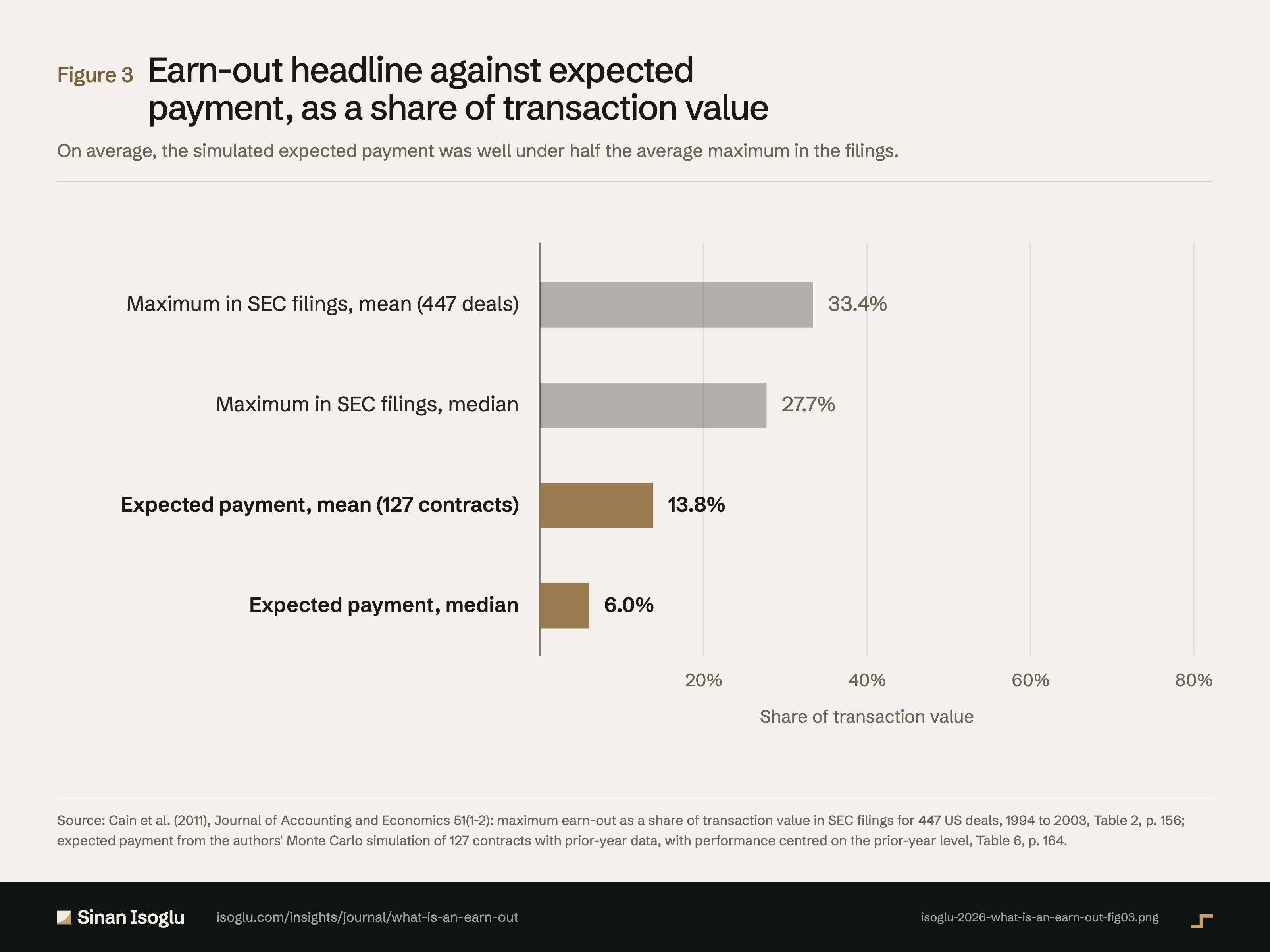
Abbildung 3Grafik
Earn-Out-Nominalbetrag gegenüber erwarteter Zahlung, als Anteil am Transaktionswert
Was ist ein Earn-Out? Der Preisteil, der sich erst beweisen muss
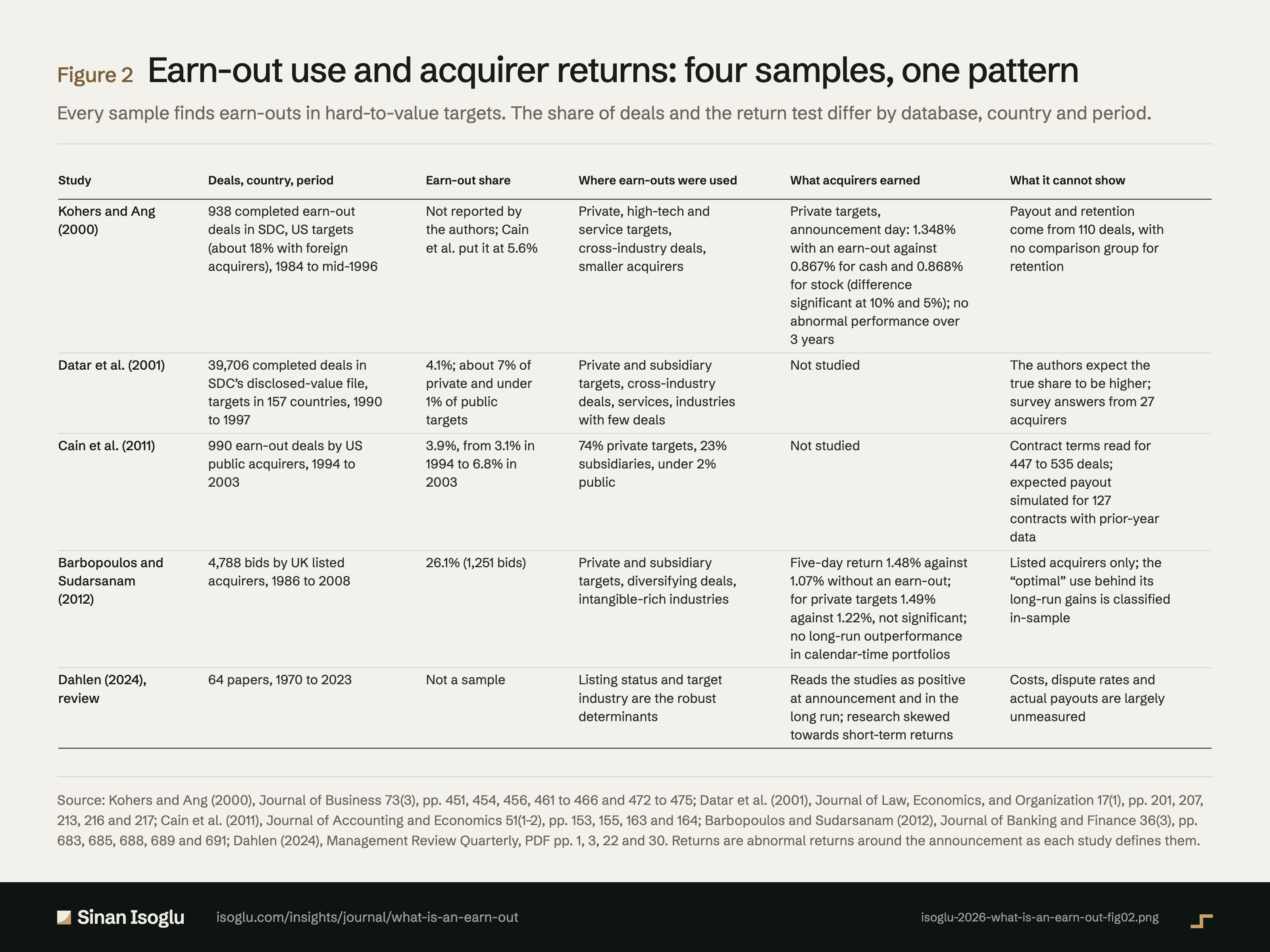
Abbildung 2Grafik
Earn-Out-Nutzung und Käuferrenditen: vier Stichproben, ein Muster
Was ist ein Earn-Out? Der Preisteil, der sich erst beweisen muss
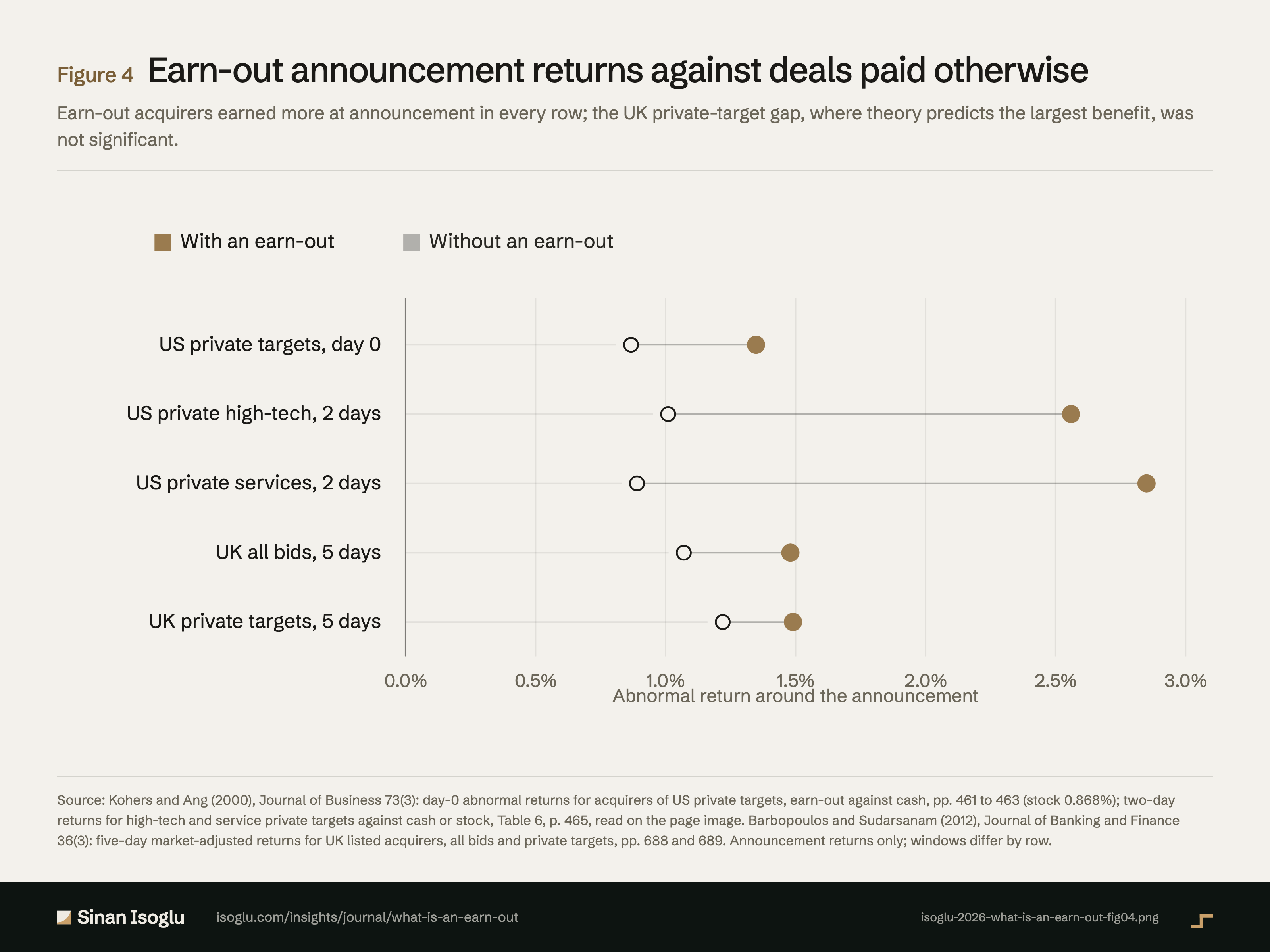
Abbildung 4Grafik
Earn-Out-Ankündigungsrenditen gegenüber anders bezahlten Übernahmen
Was ist ein Earn-Out? Der Preisteil, der sich erst beweisen muss
Kontakt
Schicken Sie die Frage, an der Sie arbeiten.
Forschung, ein Gastvortrag oder eine Frage aus der Praxis.