Figure 1From “What is a two-sided market?”
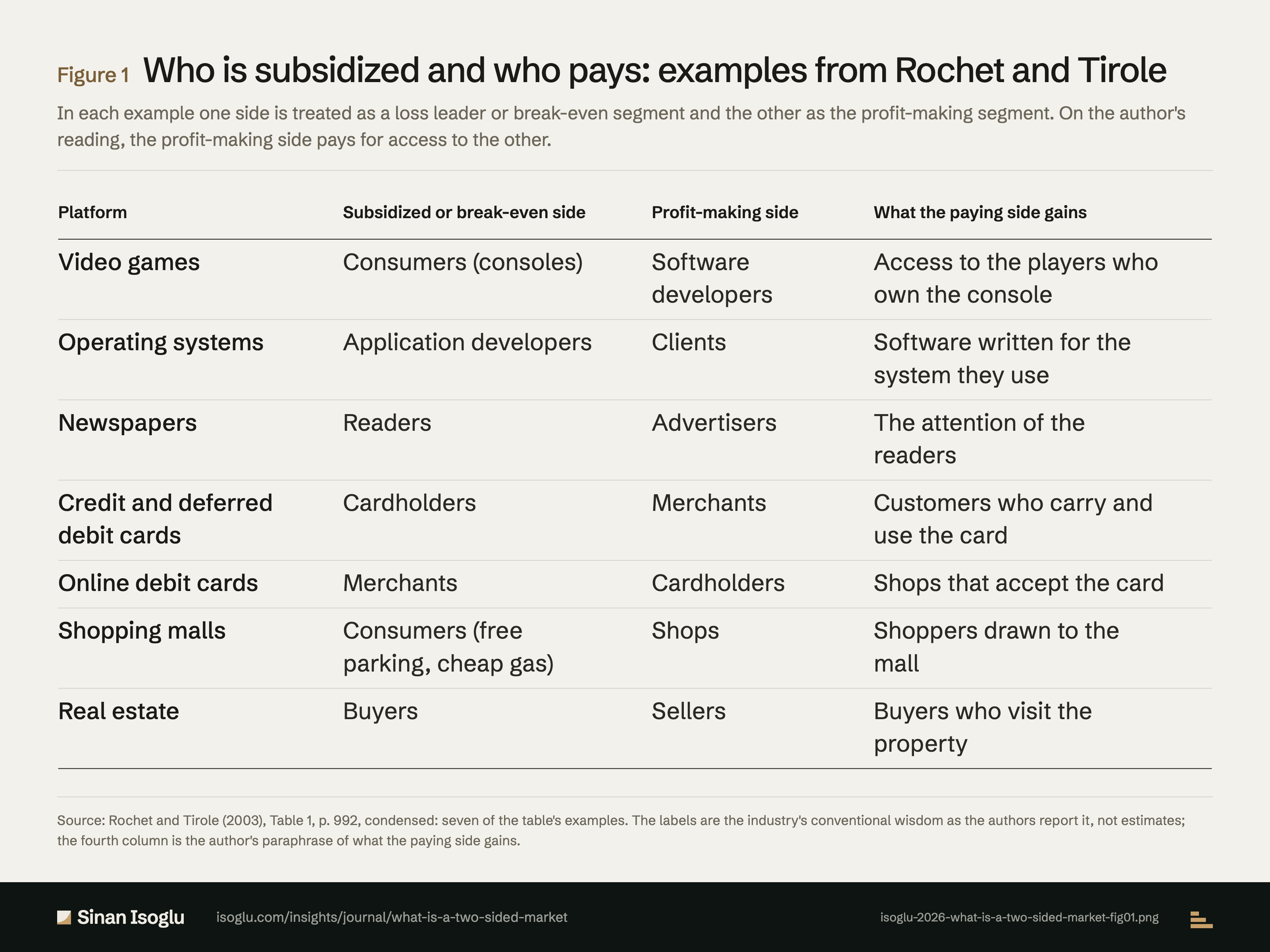
Who is subsidized and who pays: examples from Rochet and Tirole
In each example one side is treated as a loss leader or break-even segment and the other as the profit-making segment. On the author's reading, the profit-making side pays for access to the other.
Figure 1Who is subsidized and who pays: examples from Rochet and Tirole
| Platform | Subsidized or break-even side | Profit-making side | What the paying side gains |
|---|---|---|---|
| Video games | Consumers (consoles) | Software developers | Access to the players who own the console |
| Operating systems | Application developers | Clients | Software written for the system they use |
| Newspapers | Readers | Advertisers | The attention of the readers |
| Credit and deferred debit cards | Cardholders | Merchants | Customers who carry and use the card |
| Online debit cards | Merchants | Cardholders | Shops that accept the card |
| Shopping malls | Consumers (free parking, cheap gas) | Shops | Shoppers drawn to the mall |
| Real estate | Buyers | Sellers | Buyers who visit the property |
Swipe or scroll horizontally if the table is wider than your screen.
Source: Rochet and Tirole (2003), Table 1, p. 992, condensed: seven of the table's examples. The labels are the industry's conventional wisdom as the authors report it, not estimates; the fourth column is the author's paraphrase of what the paying side gains.
Source and evidence
Each line names a claim related to this exhibit, its source, and how it was checked.
- A RT03-C5 Platforms often treat one side as a profit centre and the other as a loss leader or break-even (Table 1); this conventional wisdom is open to criticism and in profit-centre reasoning costs are often allocated intuitively but arbitrarily, yet it points at a more fundamental logic the paper unveils; console makers such as Sony, Sega and Nintendo make money on game developers, operating systems reverse that model and make money on consumers; the US online debit market courts merchants because consumers need not be courted; Microsoft courted developers with a free Xbox Prototype kit while planning to earn on royalties (pp. 990 to 992, 1014, 1016): "platforms often treat one side as a profit center and the other as a loss leader, or, at best, as financially neutral"; "Such conventional wisdom about business models found in the trade press and summarized in Table 1 is of course subject to criticism."; "To reason in terms of profit centers, costs are often"; "but arbitrarily allocated to either side of the market"; "points at some more fundamental logic related to prices and surpluses on both sides of the market"; "video game platforms such as Sony, Sega and Nintendo make money on game"; "Interestingly, operating system platforms for the PC and handheld devices have adopted the opposite business model and aim at making money on consumers."; "The online debit card market in the United States has adopted an entirely different business model."; "One key difference with credit and differed debit cards is that consumers indeed do not need to be courted"; "by not charging for the Xbox Prototype kit"; "intends to draw revenue from royalties"Rochet & Tirole. (2003)
- B TSM-OWN-C2 Figure 1 condenses seven rows of Rochet and Tirole's Table 1 (subsidized side, profit-making side) and adds the author's paraphrase of what the paying side gains; the labels are the conventional wisdom the authors report, not estimates.Author condensation of RT03-C5
Grades: A, verified against the printed page of the primary source · B, primary source, text layer only · C, authoritative secondary · D, reported.
From the essay
Pricing & revenue architecture
What is a two-sided market?
In a two-sided market, a platform serves two linked groups, and the split of the price between them changes trade volume. Its theory is mostly models.
Read the essayThis exhibit belongs to an essay: the numbers live here, the argument lives there.
Cite or embed
Contact
Bring the question you're working on.
Research, a guest lecture, or a commercial question.