Figure 1From “What is packaging strategy?”
Five positions for a packaging choice
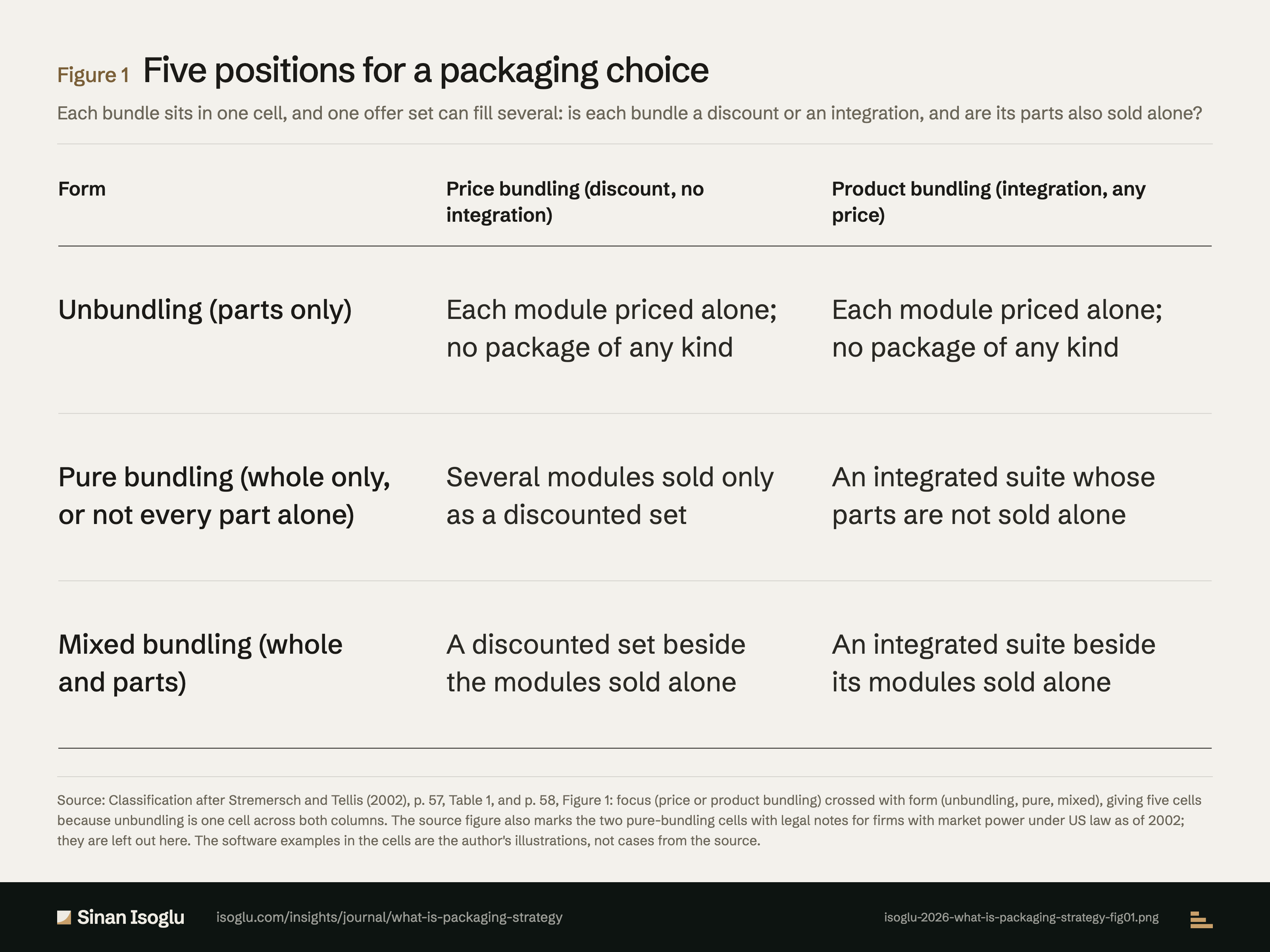
Each bundle sits in one cell, and one offer set can fill several: is each bundle a discount or an integration, and are its parts also sold alone?
Figure 1Five positions for a packaging choice
| Form | Price bundling (discount, no integration) | Product bundling (integration, any price) |
|---|---|---|
| Unbundling (parts only) | Each module priced alone; no package of any kind | Each module priced alone; no package of any kind |
| Pure bundling (whole only, or not every part alone) | Several modules sold only as a discounted set | An integrated suite whose parts are not sold alone |
| Mixed bundling (whole and parts) | A discounted set beside the modules sold alone | An integrated suite beside its modules sold alone |
Swipe or scroll horizontally if the table is wider than your screen.
Source: Classification after Stremersch and Tellis (2002), p. 57, Table 1, and p. 58, Figure 1: focus (price or product bundling) crossed with form (unbundling, pure, mixed), giving five cells because unbundling is one cell across both columns. The source figure also marks the two pure-bundling cells with legal notes for firms with market power under US law as of 2002; they are left out here. The software examples in the cells are the author's illustrations, not cases from the source.
From the essay
Pricing & revenue architecture
What is packaging strategy?
Packaging strategy decides what a firm sells together, what it sells alone, how a bundle's price relates to its parts, and why that structure fits.
Read the essayThis exhibit belongs to an essay: the numbers live here, the argument lives there.
Cite or embed
Related exhibits
Contact
Bring the question you're working on.
Research, a guest lecture, or a commercial question.