Figure 2From “What is pricing strategy?”
Four pricing situations, ten strategies
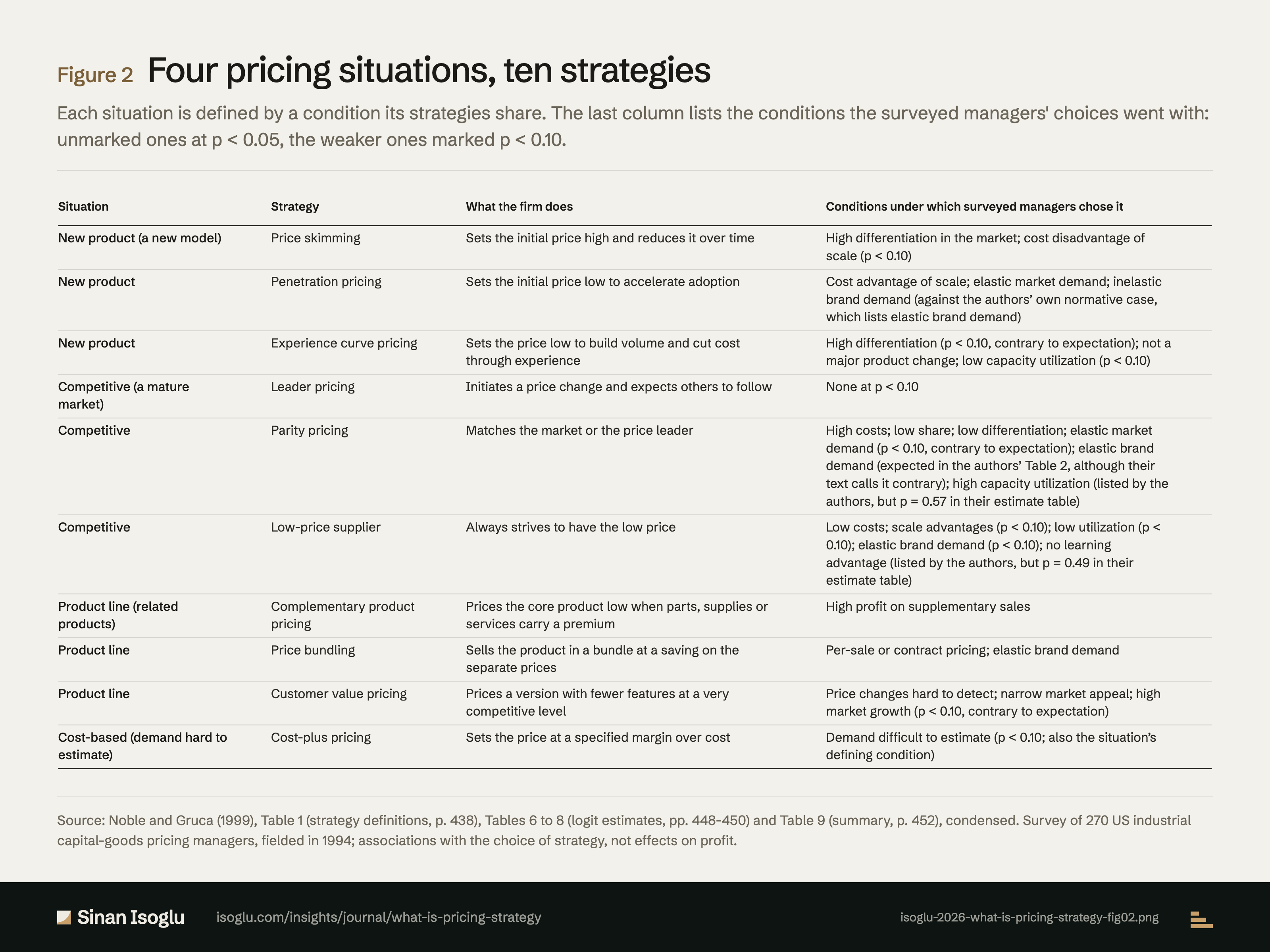
Each situation is defined by a condition its strategies share. The last column lists the conditions the surveyed managers' choices went with: unmarked ones at p < 0.05, the weaker ones marked p < 0.10.
Figure 2Four pricing situations, ten strategies
| Situation | Strategy | What the firm does | Conditions under which surveyed managers chose it |
|---|---|---|---|
| New product (a new model) | Price skimming | Sets the initial price high and reduces it over time | High differentiation in the market; cost disadvantage of scale (p < 0.10) |
| New product | Penetration pricing | Sets the initial price low to accelerate adoption | Cost advantage of scale; elastic market demand; inelastic brand demand (against the authors' own normative case, which lists elastic brand demand) |
| New product | Experience curve pricing | Sets the price low to build volume and cut cost through experience | High differentiation (p < 0.10, contrary to expectation); not a major product change; low capacity utilization (p < 0.10) |
| Competitive (a mature market) | Leader pricing | Initiates a price change and expects others to follow | None at p < 0.10 |
| Competitive | Parity pricing | Matches the market or the price leader | High costs; low share; low differentiation; elastic market demand (p < 0.10, contrary to expectation); elastic brand demand (expected in the authors' Table 2, although their text calls it contrary); high capacity utilization (listed by the authors, but p = 0.57 in their estimate table) |
| Competitive | Low-price supplier | Always strives to have the low price | Low costs; scale advantages (p < 0.10); low utilization (p < 0.10); elastic brand demand (p < 0.10); no learning advantage (listed by the authors, but p = 0.49 in their estimate table) |
| Product line (related products) | Complementary product pricing | Prices the core product low when parts, supplies or services carry a premium | High profit on supplementary sales |
| Product line | Price bundling | Sells the product in a bundle at a saving on the separate prices | Per-sale or contract pricing; elastic brand demand |
| Product line | Customer value pricing | Prices a version with fewer features at a very competitive level | Price changes hard to detect; narrow market appeal; high market growth (p < 0.10, contrary to expectation) |
| Cost-based (demand hard to estimate) | Cost-plus pricing | Sets the price at a specified margin over cost | Demand difficult to estimate (p < 0.10; also the situation's defining condition) |
Swipe or scroll horizontally if the table is wider than your screen.
Source: Noble and Gruca (1999), Table 1 (strategy definitions, p. 438), Tables 6 to 8 (logit estimates, pp. 448-450) and Table 9 (summary, p. 452), condensed. Survey of 270 US industrial capital-goods pricing managers, fielded in 1994; associations with the choice of strategy, not effects on profit.
From the essay
Pricing & revenue architecture
What is pricing strategy?
A pricing strategy is how a firm means to reach its pricing objective. Which one fits depends on the situation, costs and rivals included, not on habit.
Read the essayThis exhibit belongs to an essay: the numbers live here, the argument lives there.
Cite or embed
Contact
Bring the question you're working on.
Research, a guest lecture, or a commercial question.