Table 2From “The incrementality illusion”
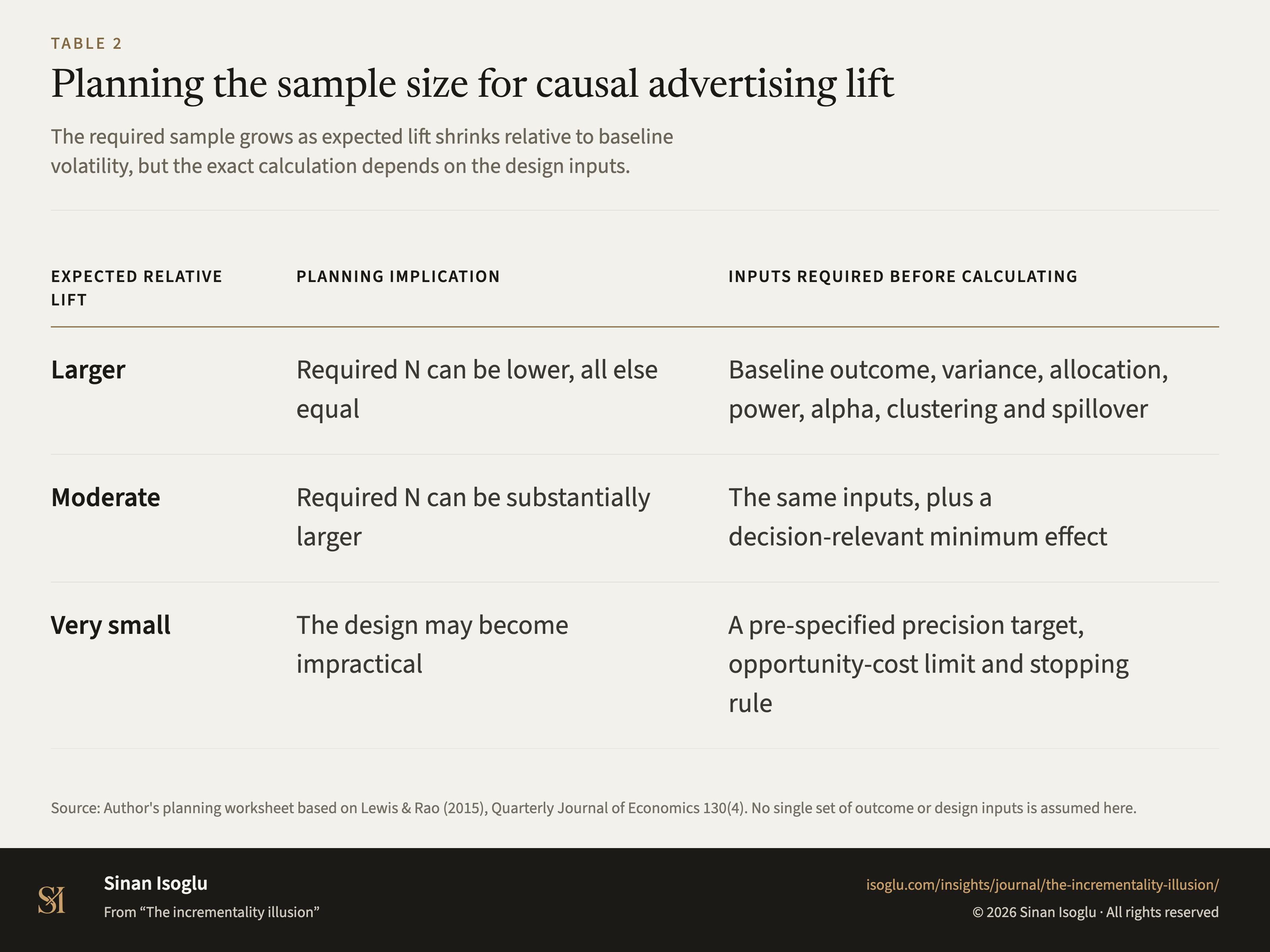
Planning the sample size for causal advertising lift
The required sample grows as expected lift shrinks relative to baseline volatility, but the exact calculation depends on the design inputs.
Table 2Planning the sample size for causal advertising lift
| Expected relative lift | Planning implication | Inputs required before calculating |
|---|---|---|
| Larger | Required N can be lower, all else equal | Baseline outcome, variance, allocation, power, alpha, clustering and spillover |
| Moderate | Required N can be substantially larger | The same inputs, plus a decision-relevant minimum effect |
| Very small | The design may become impractical | A pre-specified precision target, opportunity-cost limit and stopping rule |
Swipe or scroll horizontally if the table is wider than your screen.
Source: Author's planning worksheet based on Lewis & Rao (2015), Quarterly Journal of Economics 130(4). No single set of outcome or design inputs is assumed here.
From the essay
Growth that compounds
The incrementality illusion
Why attribution dashboards can report phantom returns while holdout tests find little or no lift, and how to size causal measurement.
Read the essayThis exhibit belongs to an essay: the numbers live here, the argument lives there.
Cite or embed
Related exhibits
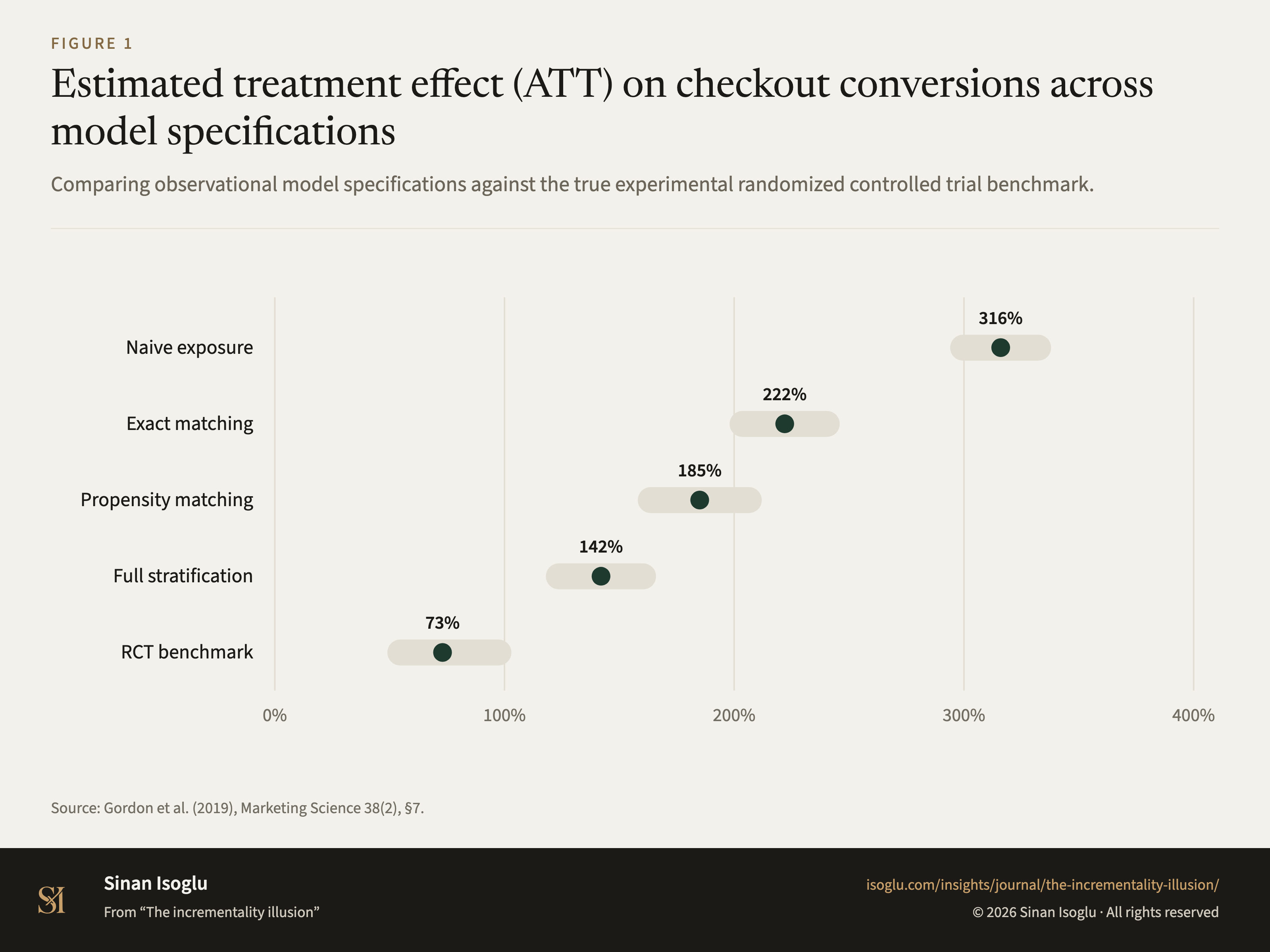
Figure 1Figure
Estimated treatment effect (ATT) on checkout conversions in study 4, by method
The incrementality illusion
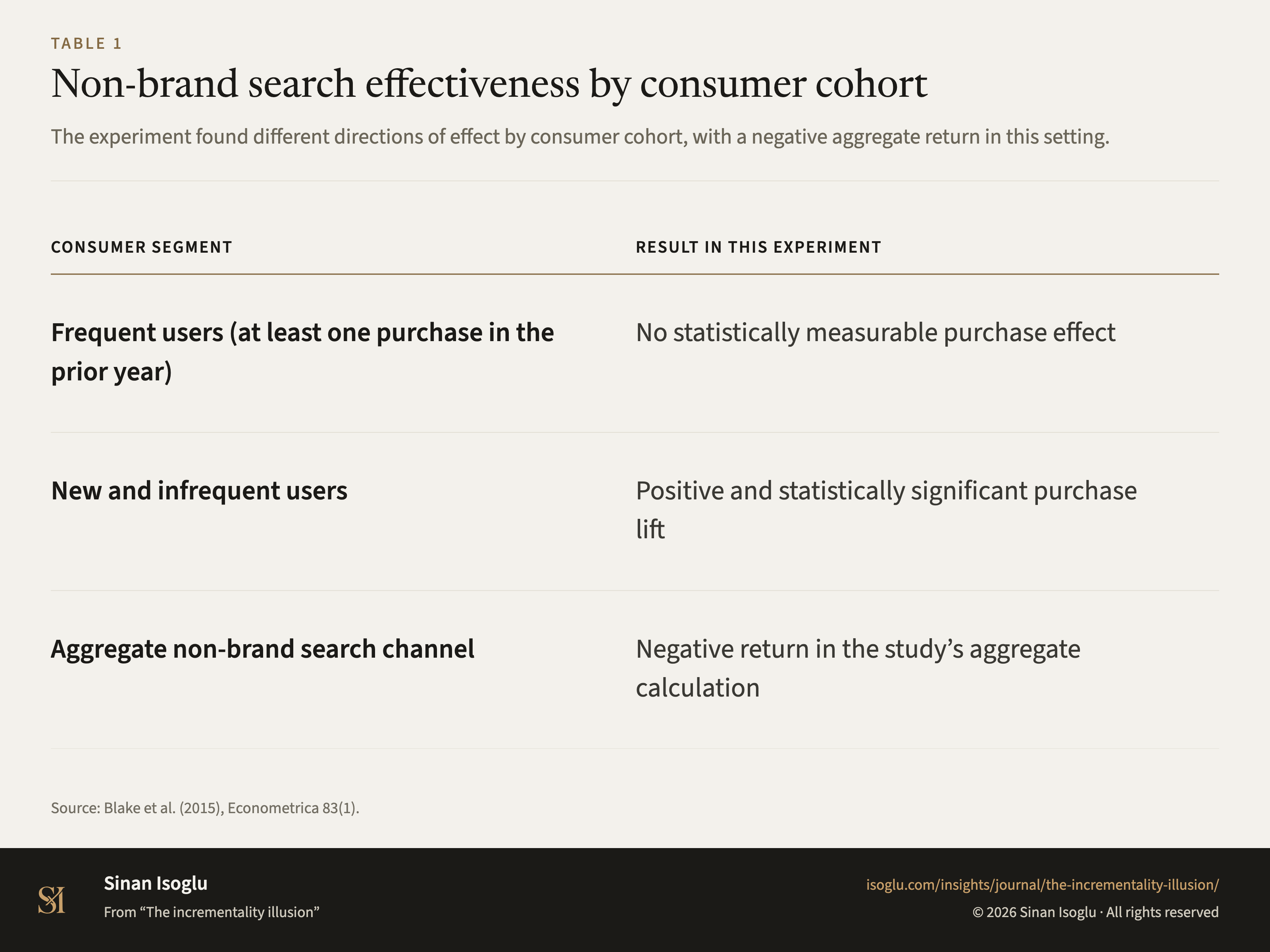
Table 1Table
Non-brand search effectiveness by consumer cohort
The incrementality illusion
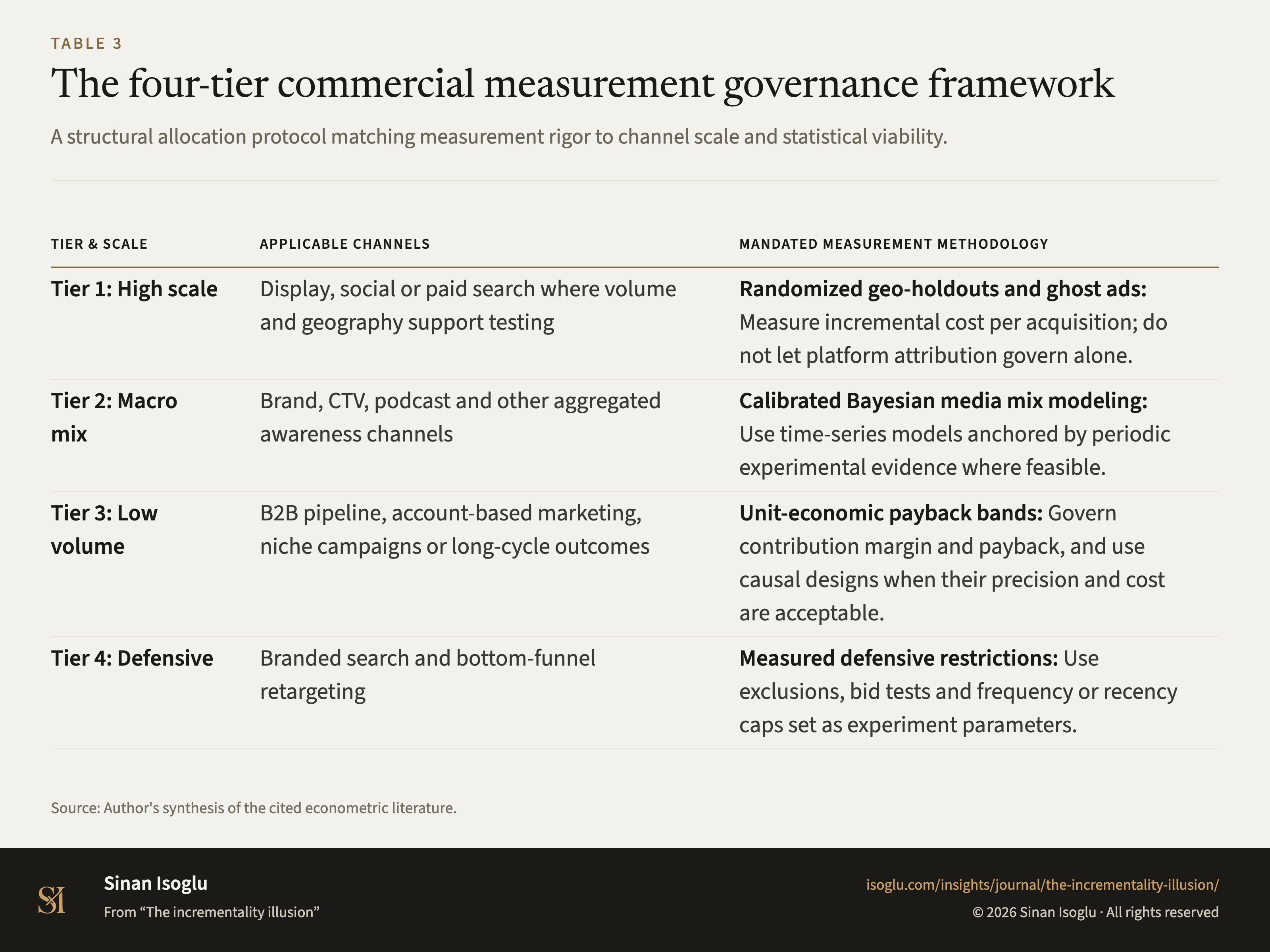
Table 3Table
The four-tier commercial measurement governance framework
The incrementality illusion
Contact
Bring the question you're working on.
Research, a guest lecture, or a commercial question.