Table 1From “The incrementality illusion”
Non-brand search effectiveness by consumer cohort
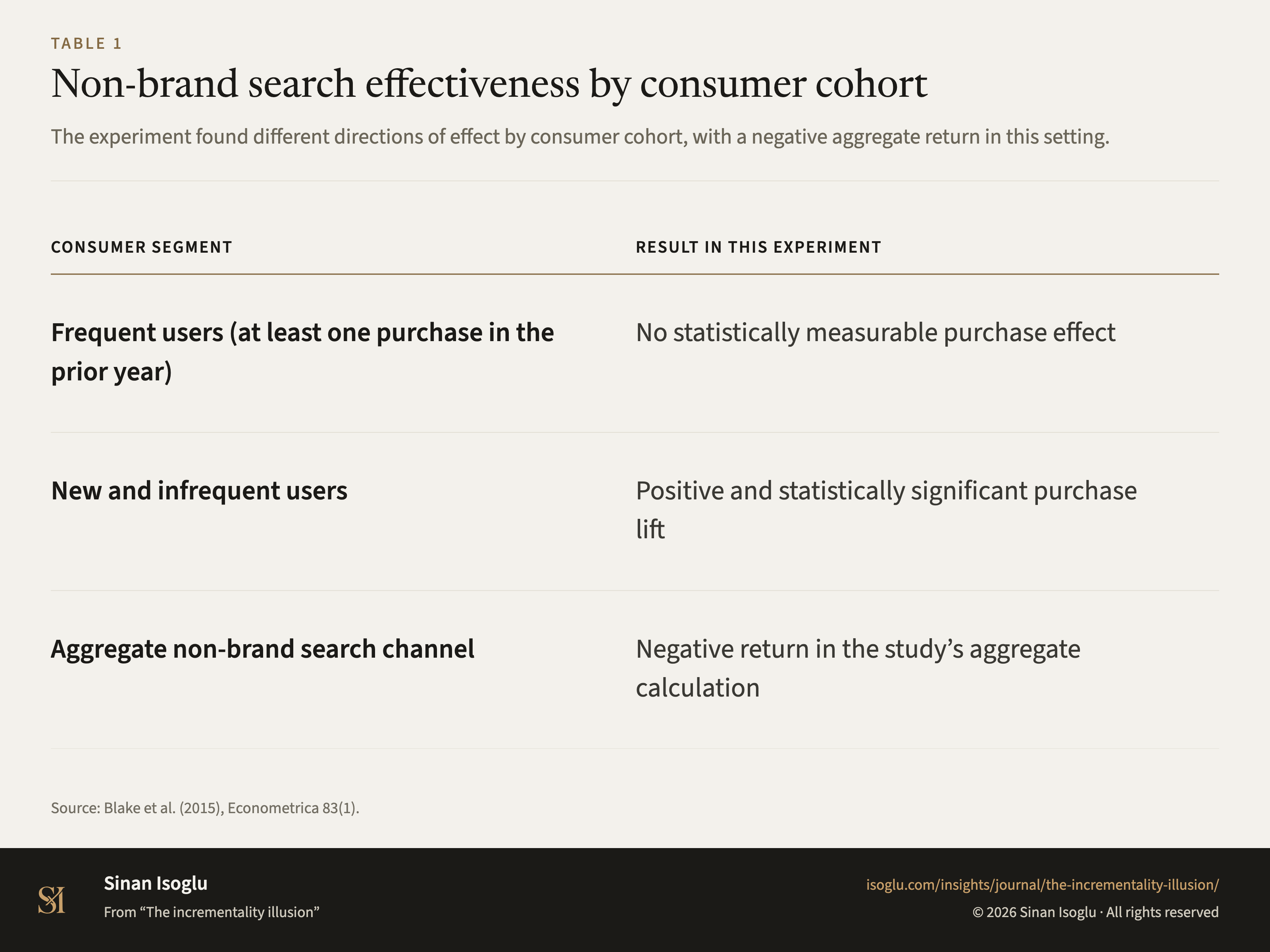
The experiment found different directions of effect by consumer cohort, with a negative aggregate return in this setting.
Table 1Non-brand search effectiveness by consumer cohort
| Consumer segment | Result in this experiment |
|---|---|
| Frequent users (at least one purchase in the prior year) | No statistically measurable purchase effect |
| New and infrequent users | Positive and statistically significant purchase lift |
| Aggregate non-brand search channel | Negative return in the study's aggregate calculation |
Swipe or scroll horizontally if the table is wider than your screen.
Source: Blake et al. (2015), Econometrica 83(1).
Source and evidence
Each line names a claim related to this exhibit, its source, and how it was checked.
- B BNT15-C2 The strongest result is stated as an extreme case, not a rule: "as an extreme case, we show that brand keyword ads have no measurable short-term bene"fitsBlake, Nosko & Tadelis (2015), abstract
- B BNT15-C3 Who the spend goes to: "more frequent users whose purchasing behavior is not influenced by ads account for most of the advertising expenses, resulting in average returns that are negative"Blake, Nosko & Tadelis (2015), abstract
- B BNT15-C4 And the half usually dropped: "for non-brand keywords, we find that new and infrequent users are positively influenced by ads"Blake, Nosko & Tadelis (2015), abstract
- B BNT15-C5 The experimental non-brand ROI, and the contrast that makes it worth quoting: OLS "which result in a ROI of over 4,100% without time and geographic controls", while "We then used our experimental methods to control for endogeneity and found a ROI of" -63%, "rejecting the hypothesis that the channel yields any short-run positive returns"Blake, Nosko & Tadelis (2015), section 3.1
Grades: A, verified against the printed page of the primary source · B, primary source, text layer only · C, authoritative secondary · D, reported.
From the essay
Growth that compounds
The incrementality illusion
Why attribution dashboards can report phantom returns while holdout tests find little or no lift, and how to size causal measurement.
Read the essayThis exhibit belongs to an essay: the numbers live here, the argument lives there.
Cite or embed
Related exhibits


Contact
Bring the question you're working on.
Research, a guest lecture, or a commercial question.