Table 2From “Programmatic M&A: the claim that outlived its test”
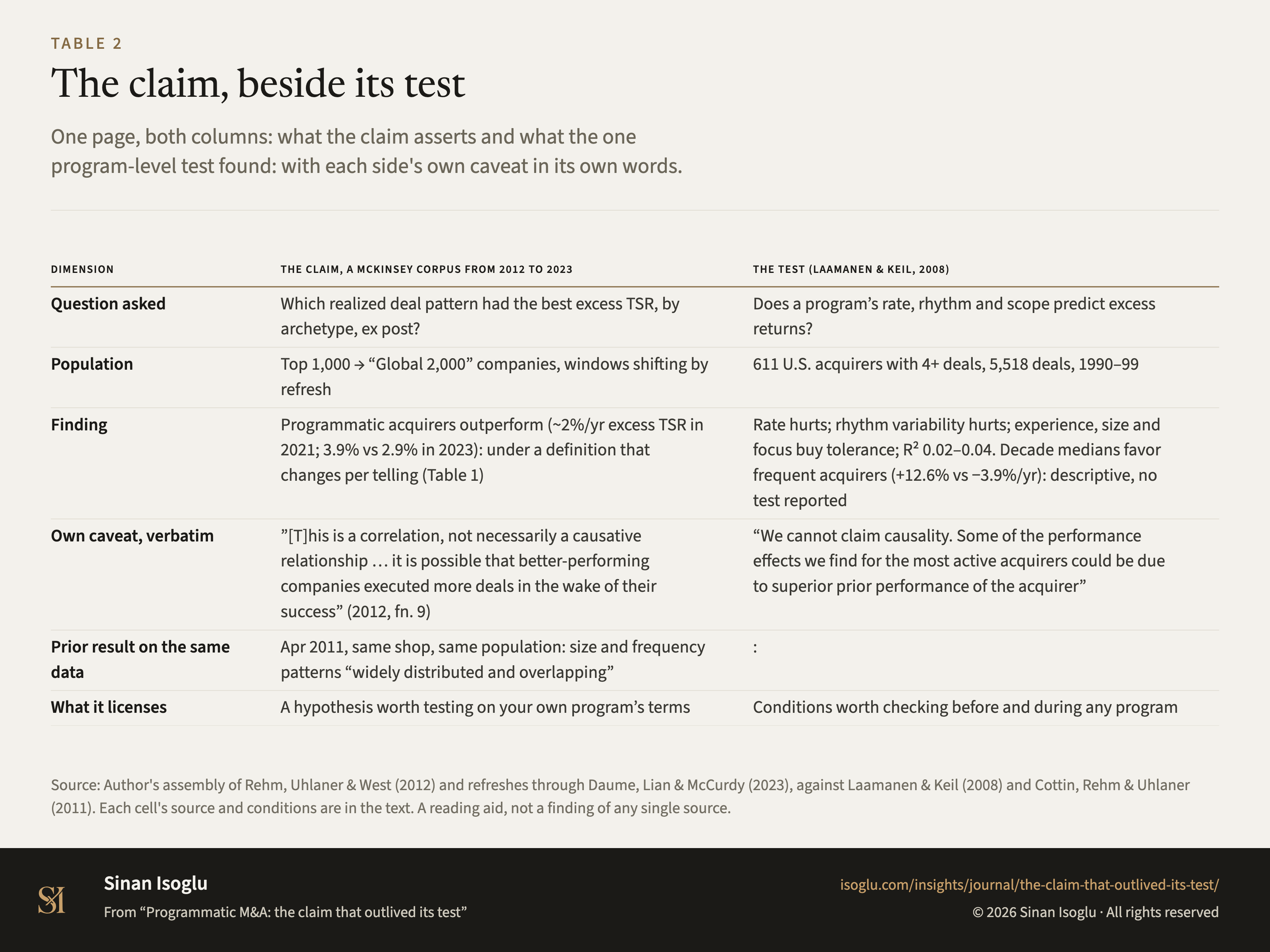
The claim, beside its test
One page, both columns: what the claim asserts and what the one program-level test found: with each side's own caveat in its own words.
Table 2The claim, beside its test
| Dimension | The claim, a McKinsey corpus from 2012 to 2023 | The test (Laamanen & Keil, 2008) |
|---|---|---|
| Question asked | Which realized deal pattern had the best excess TSR, by archetype, ex post? | Does a program's rate, rhythm and scope predict excess returns? |
| Population | Top 1,000 → "Global 2,000" companies, windows shifting by refresh | 611 U.S. acquirers with 4+ deals, 5,518 deals, 1990–99 |
| Finding | Programmatic acquirers outperform (~2%/yr excess TSR in 2021; 3.9% vs 2.9% in 2023): under a definition that changes per telling (Table 1) | Rate hurts; rhythm variability hurts; experience, size and focus buy tolerance; R² 0.02–0.04. Decade medians favor frequent acquirers (+12.6% vs −3.9%/yr): descriptive, no test reported |
| Own caveat, verbatim | "[T]his is a correlation, not necessarily a causative relationship … it is possible that better-performing companies executed more deals in the wake of their success" (2012, fn. 9) | "We cannot claim causality. Some of the performance effects we find for the most active acquirers could be due to superior prior performance of the acquirer" |
| Prior result on the same data | Apr 2011, same shop, same population: size and frequency patterns "widely distributed and overlapping" | : |
| What it licenses | A hypothesis worth testing on your own program's terms | Conditions worth checking before and during any program |
Swipe or scroll horizontally if the table is wider than your screen.
Source: Author's assembly of Rehm, Uhlaner & West (2012) and refreshes through Daume, Lian & McCurdy (2023), against Laamanen & Keil (2008) and Cottin, Rehm & Uhlaner (2011). Each cell's source and conditions are in the text. A reading aid, not a finding of any single source.
From the essay
Growth that compounds
Programmatic M&A: the claim that outlived its test
Every banker deck says the winners do many small deals. The claim's own shop published the null first, and the nearest test answers with conditions.
Read the essayThis exhibit belongs to an essay: the numbers live here, the argument lives there.
Cite or embed
Related exhibits
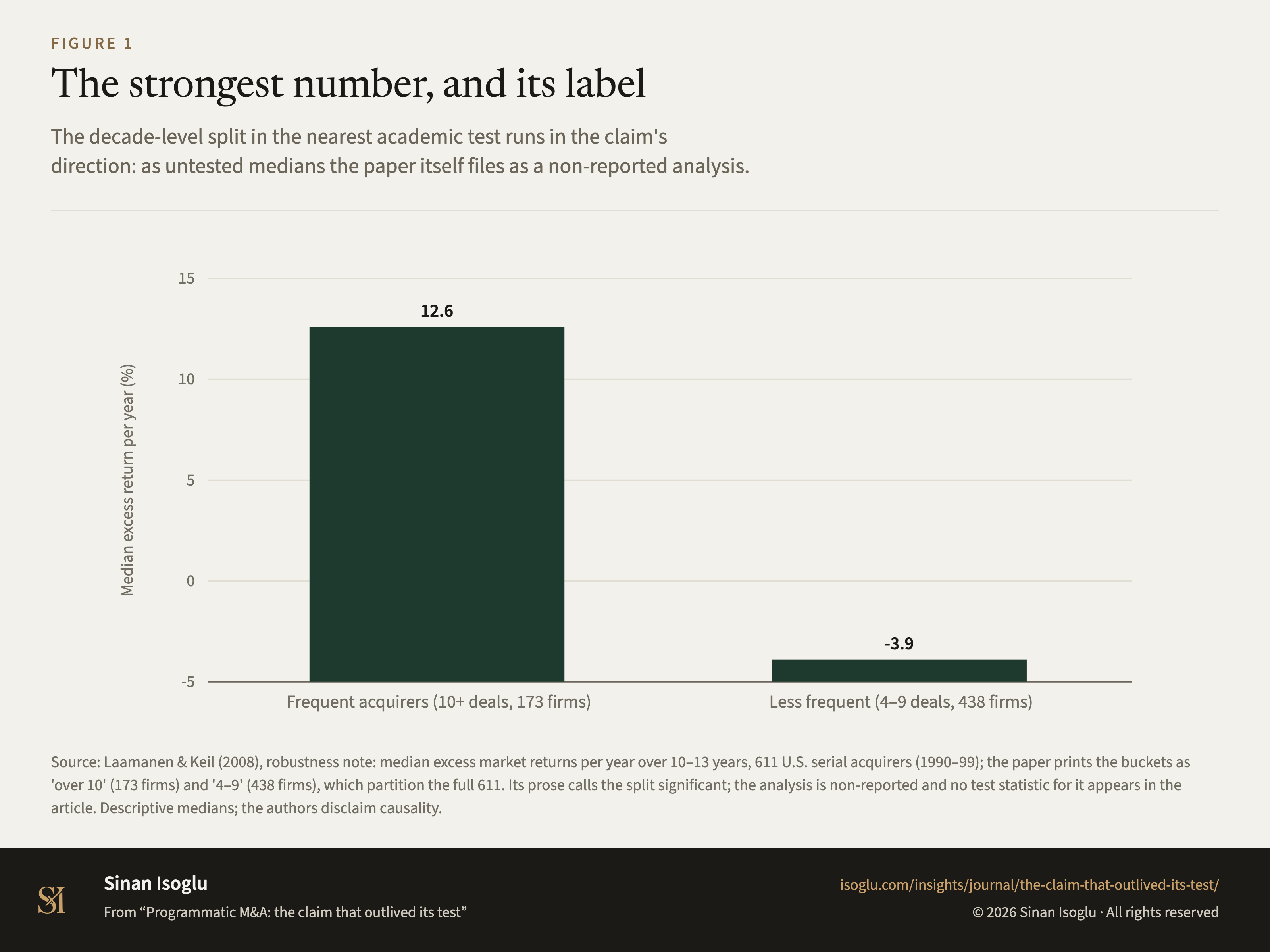
Figure 1Figure
The strongest number, and its label
Programmatic M&A: the claim that outlived its test
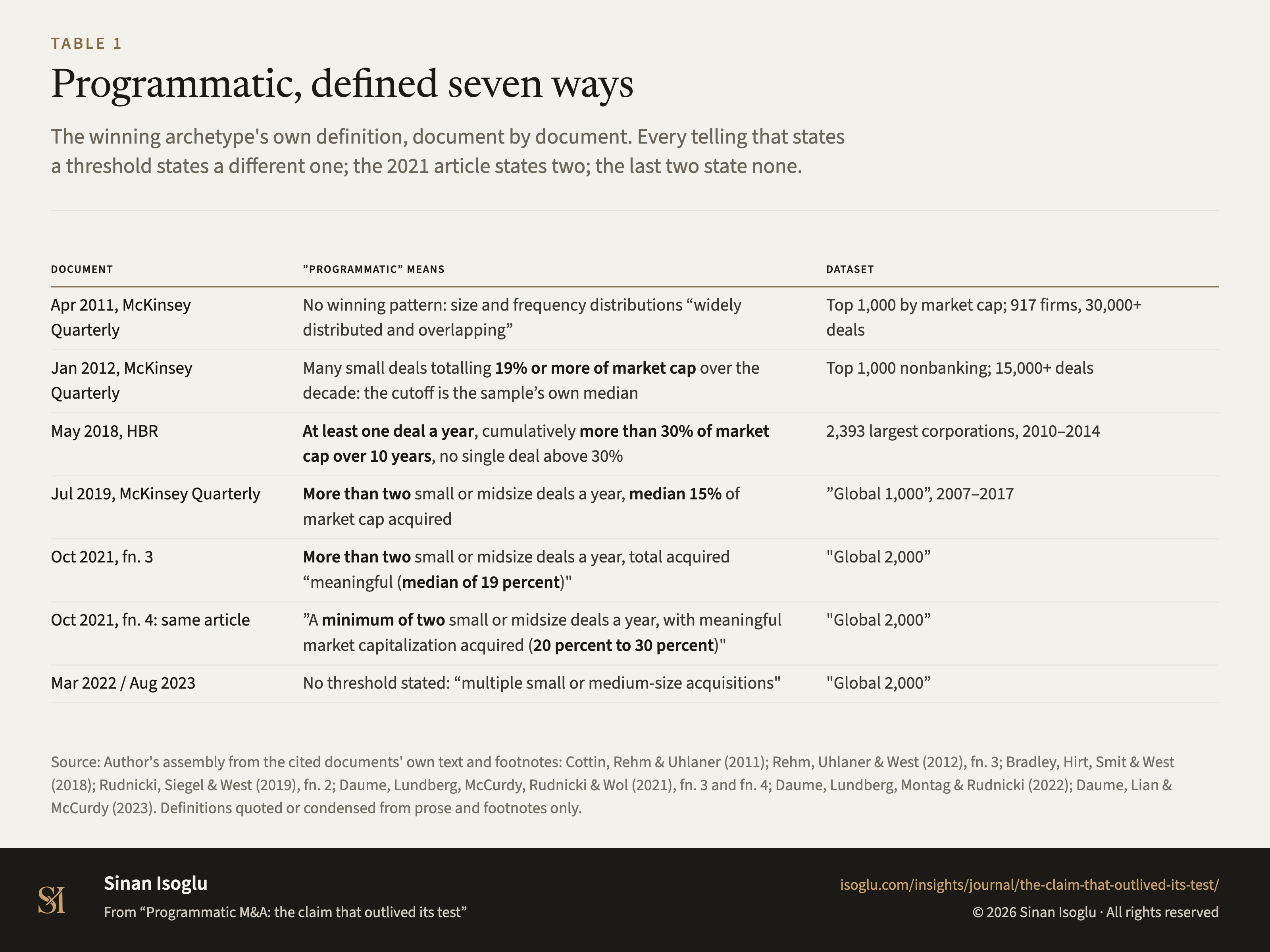
Table 1Table
Programmatic, defined seven ways
Programmatic M&A: the claim that outlived its test
Table 1Table
The two-horizon growth portfolio card
Growth needs an exploration-exploitation portfolio
Contact
Bring the question you're working on.
Research, a guest lecture, or a commercial question.