Table 1From “Growth needs an exploration-exploitation portfolio”
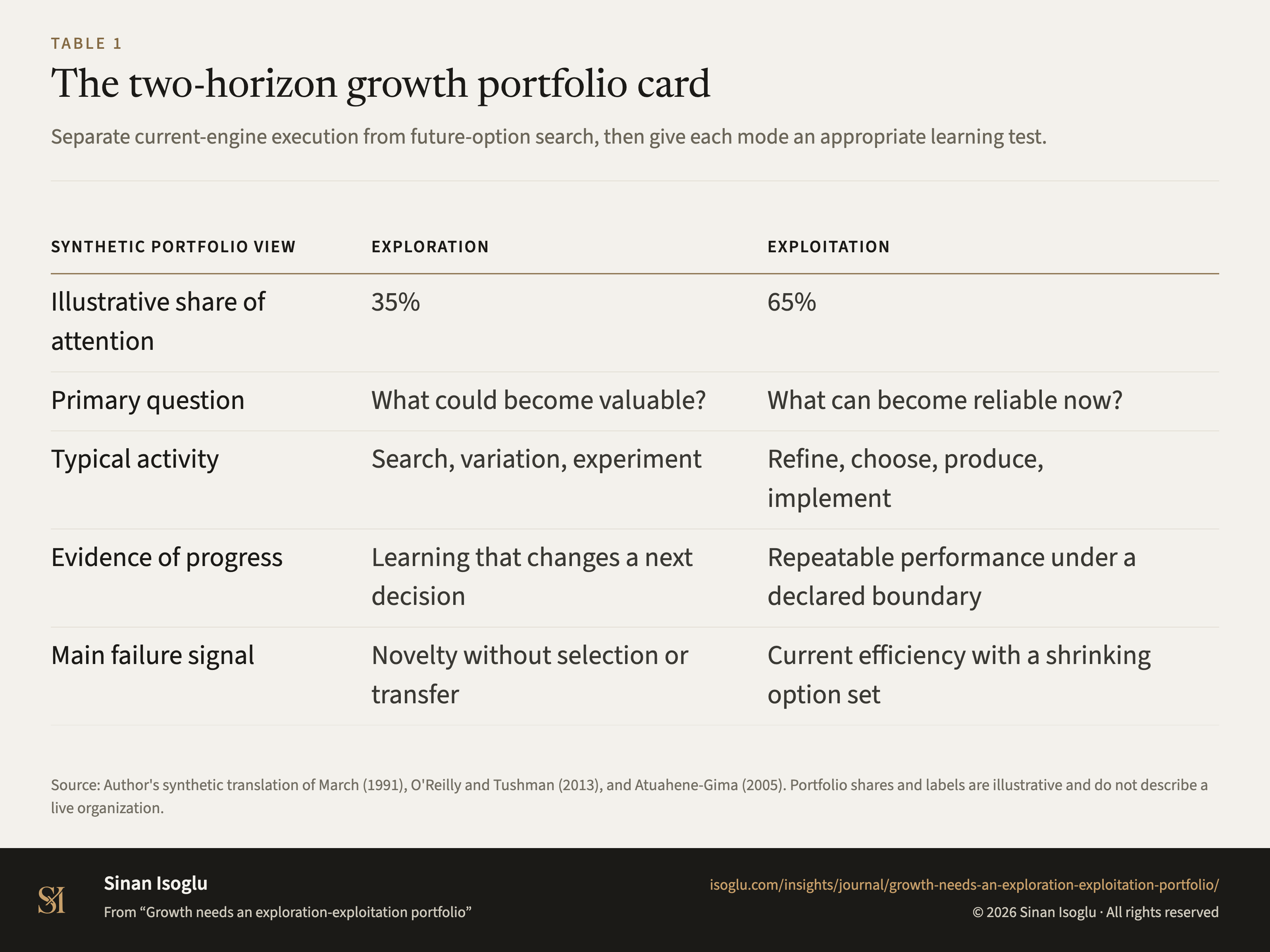
The two-horizon growth portfolio card
Separate current-engine execution from future-option search, then give each mode an appropriate learning test.
Table 1The two-horizon growth portfolio card
| Synthetic portfolio view | Exploration | Exploitation |
|---|---|---|
| Illustrative share of attention | 35% | 65% |
| Primary question | What could become valuable? | What can become reliable now? |
| Typical activity | Search, variation, experiment | Refine, choose, produce, implement |
| Evidence of progress | Learning that changes a next decision | Repeatable performance under a declared boundary |
| Main failure signal | Novelty without selection or transfer | Current efficiency with a shrinking option set |
Swipe or scroll horizontally if the table is wider than your screen.
Source: Author's synthetic translation of March (1991), O'Reilly and Tushman (2013), and Atuahene-Gima (2005). Portfolio shares and labels are illustrative and do not describe a live organization.
Source and evidence
Each line names a claim related to this exhibit, its source, and how it was checked.
- A MAR91-C1 Exploration involves search, variation, experimentation, and innovation, while exploitation involves refinement, choice, production, and implementation.March. (1991)
- A MAR91-C2 Organizational learning faces a tension because systems that favor exploitation can improve current returns while reducing long-run adaptability, whereas excessive exploration can undermine competence and returns.March. (1991)
- A MAR91-C3 The balance between exploration and exploitation is shaped by feedback, socialization, competition, and the time horizon over which learning is evaluated.March. (1991)
- A OT13-C1 The definition, verbatim: ambidexterity is "the ability of an organization to both explore and exploit"O'Reilly & Tushman. (2013)
- A OT13-C2 The two regimes are named in the same sentence: mature markets "where efficiency control and incremental improvement are prized" against new ones "where flexibility autonomy and experimentation are needed"O'Reilly & Tushman. (2013)
- A ATU05-C1 The dilemma in the author's words: "how to exploit existing product innovation competencies competence exploitation while avoiding their dysfunctional rigidity effects by renewing and replacing them with entirely new competencies competence exploration"Atuahene-Gima. (2005)
- A ATU05-C2 The proposed resolution: "customer and competitor orientations ensure simultaneous investments in exploiting existing product innovation competencies and exploring new ones"Atuahene-Gima. (2005)
- A ATU05-C3 And the outcome side, including the moderator: "competence exploitation and exploration have opposing relationships with incremental and radical innovation performance", while "the relationship between competence exploration and radical innovation performance is positively moderated by interfunctional coordination"Atuahene-Gima. (2005)
Grades: A, verified against the printed page of the primary source · B, primary source, text layer only · C, authoritative secondary · D, reported.
From the essay
Growth that compounds
Growth needs an exploration-exploitation portfolio
Growth needs two time horizons: exploration searches and experiments; exploitation refines and implements what already works.
Read the essayThis exhibit belongs to an essay: the numbers live here, the argument lives there.
Cite or embed
Related exhibits
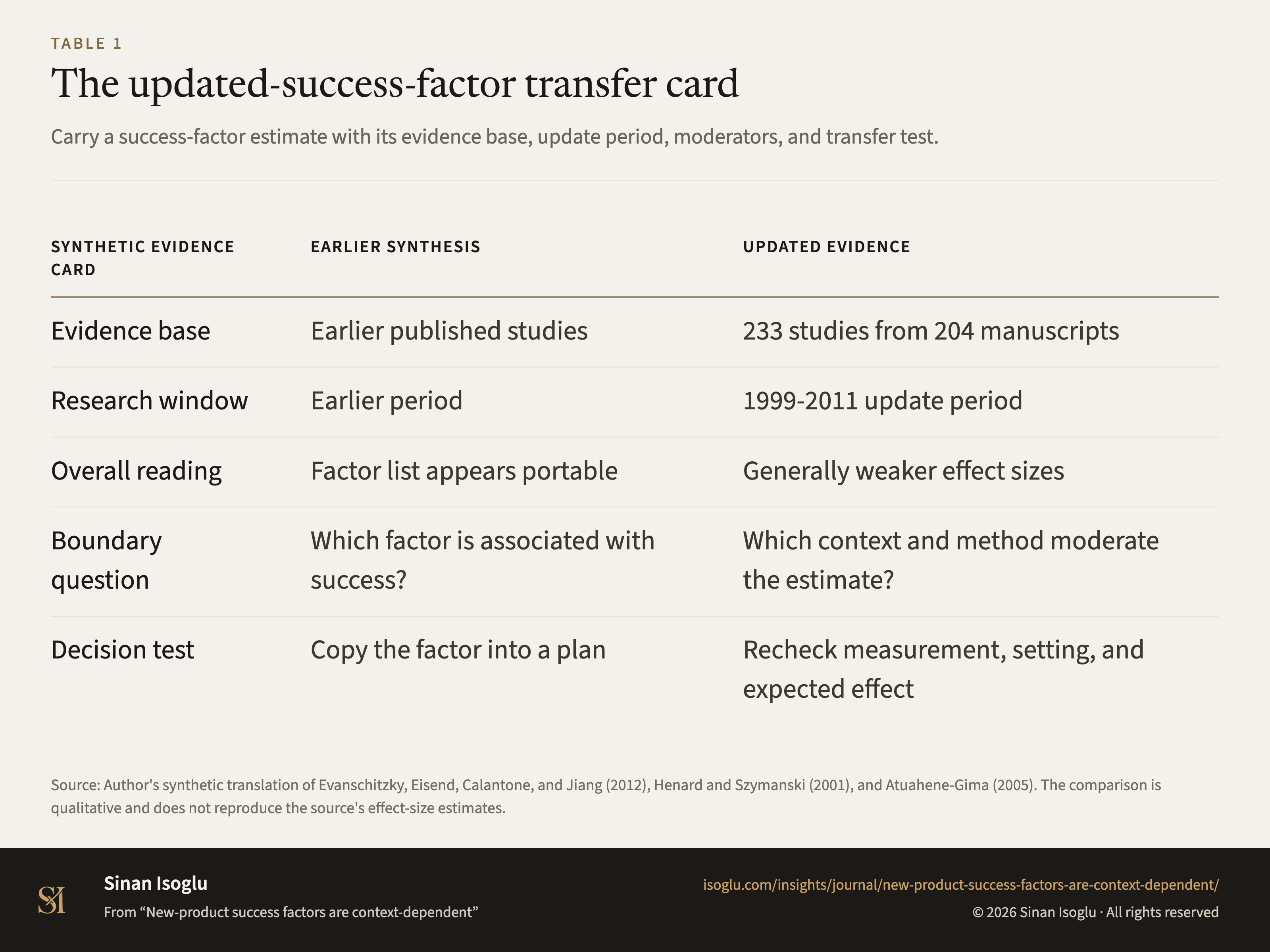
Table 1Table
The updated-success-factor transfer card
New-product success factors are context-dependent
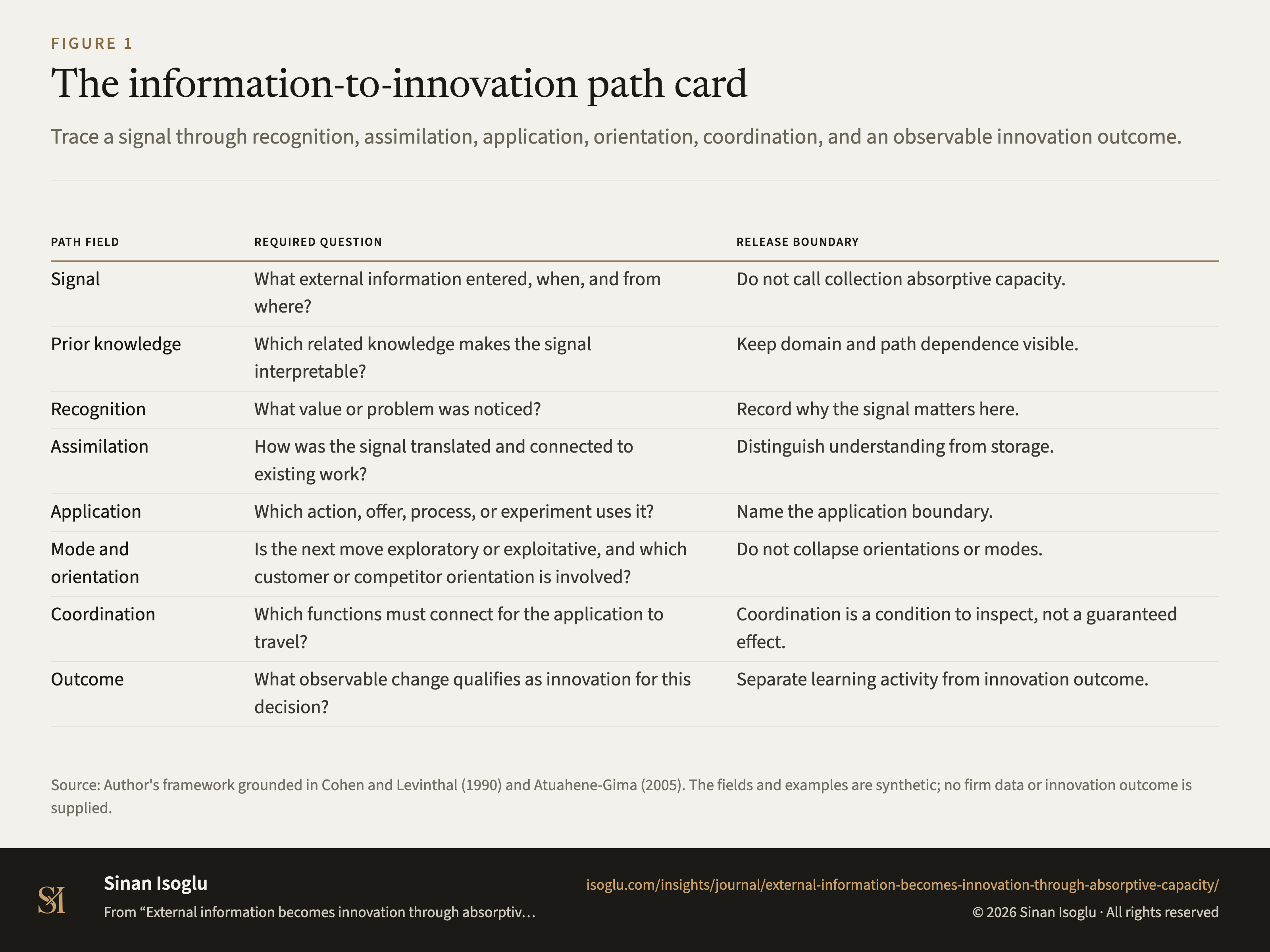
Figure 1Figure
The information-to-innovation path card
External information becomes innovation through absorptive capacity
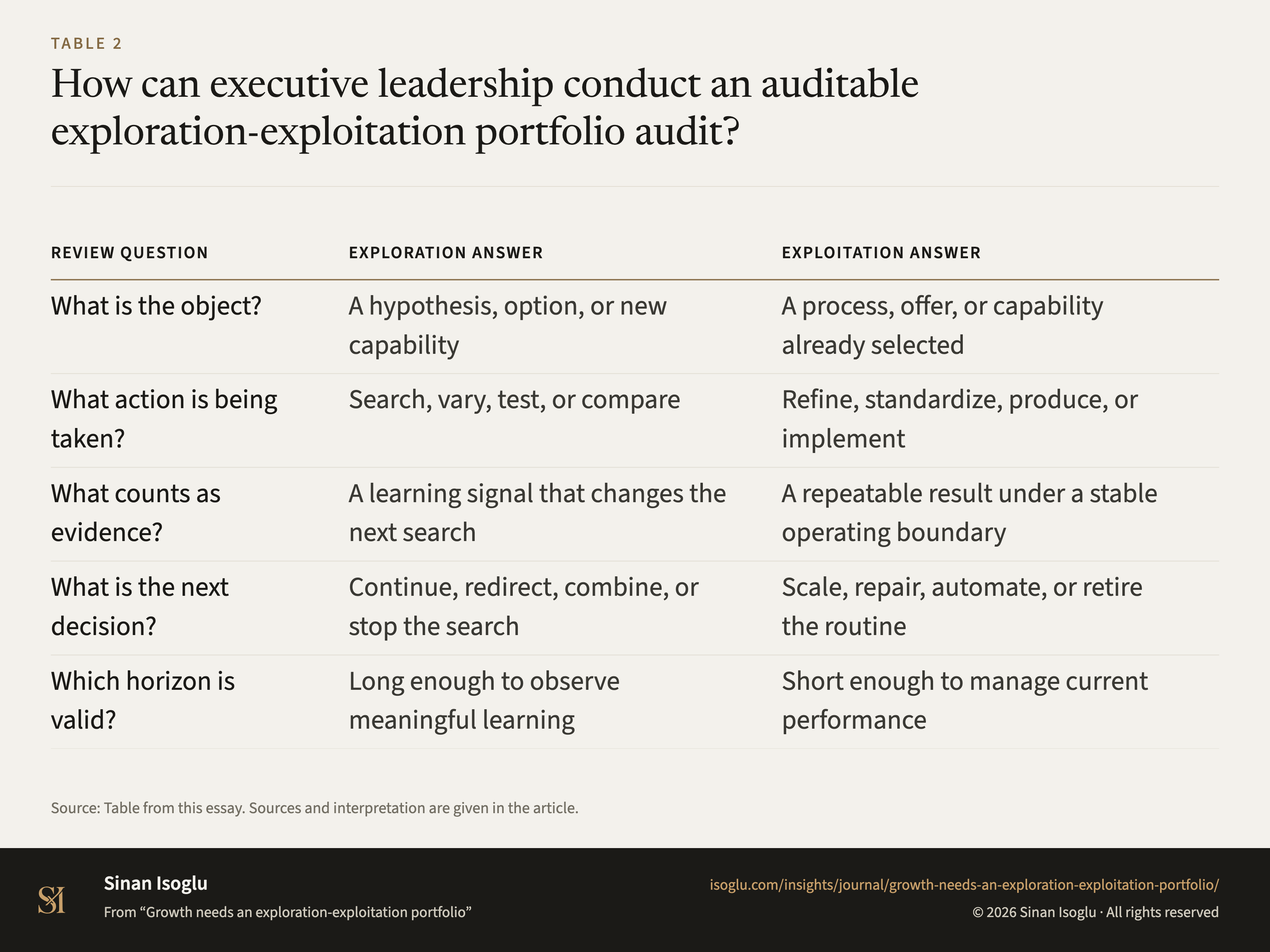
Table 2Table
How can executive leadership conduct an auditable exploration-exploitation portfolio audit?
Growth needs an exploration-exploitation portfolio
Contact
Bring the question you're working on.
Research, a guest lecture, or a commercial question.