Table 2From “Marketing mix modeling is a calibration problem”
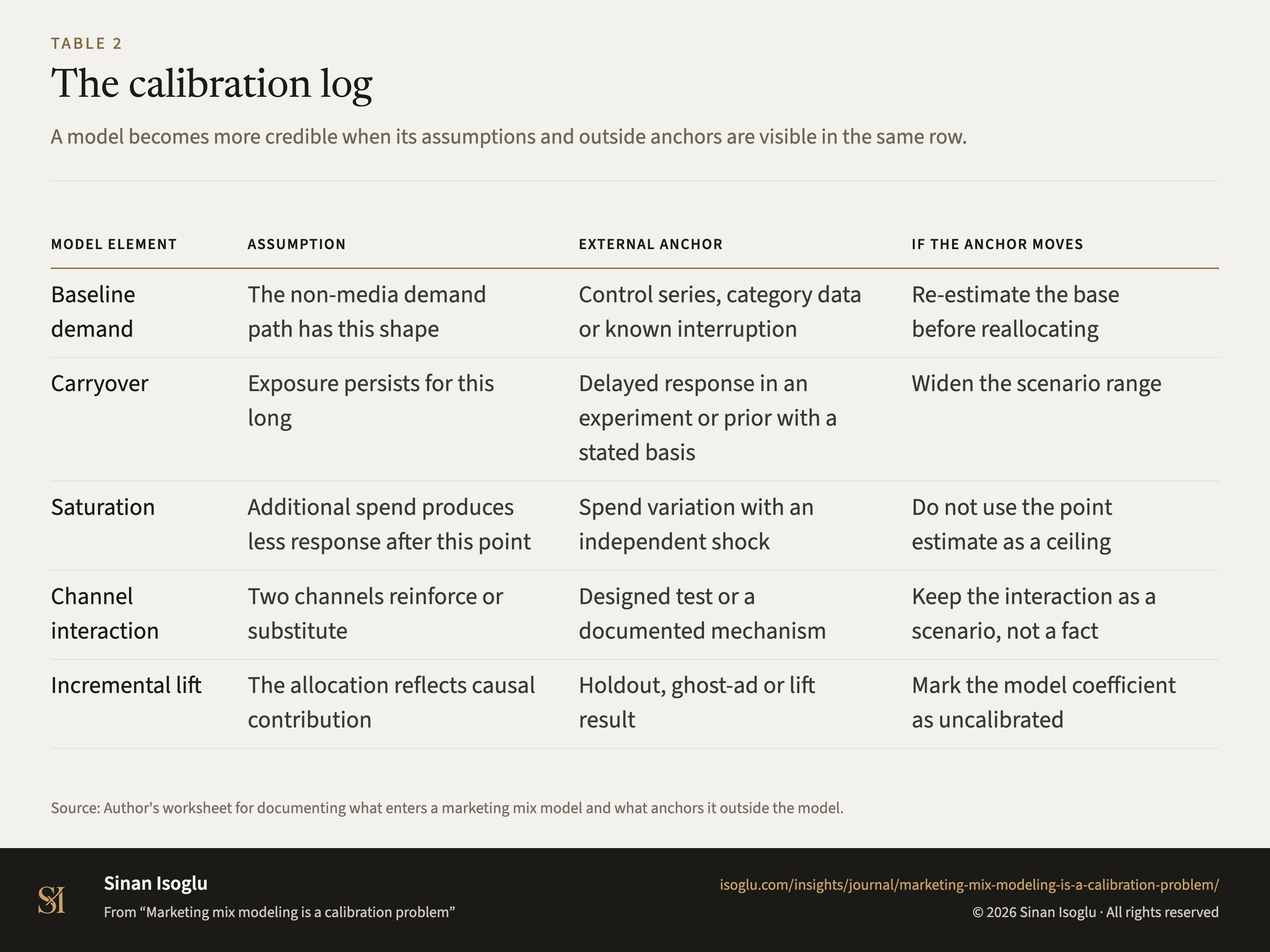
The calibration log
A model becomes more credible when its assumptions and outside anchors are visible in the same row.
Table 2The calibration log
| Model element | Assumption | External anchor | If the anchor moves |
|---|---|---|---|
| Baseline demand | The non-media demand path has this shape | Control series, category data or known interruption | Re-estimate the base before reallocating |
| Carryover | Exposure persists for this long | Delayed response in an experiment or prior with a stated basis | Widen the scenario range |
| Saturation | Additional spend produces less response after this point | Spend variation with an independent shock | Do not use the point estimate as a ceiling |
| Channel interaction | Two channels reinforce or substitute | Designed test or a documented mechanism | Keep the interaction as a scenario, not a fact |
| Incremental lift | The allocation reflects causal contribution | Holdout, ghost-ad or lift result | Mark the model coefficient as uncalibrated |
Swipe or scroll horizontally if the table is wider than your screen.
Source: Author's worksheet for documenting what enters a marketing mix model and what anchors it outside the model.
From the essay
Growth that compounds
Marketing mix modeling is a calibration problem
Marketing mix modeling can organise an aggregate budget, but it cannot certify causality by itself. Calibrate the model before trusting the allocation.
Read the essayThis exhibit belongs to an essay: the numbers live here, the argument lives there.
Cite or embed
Related exhibits
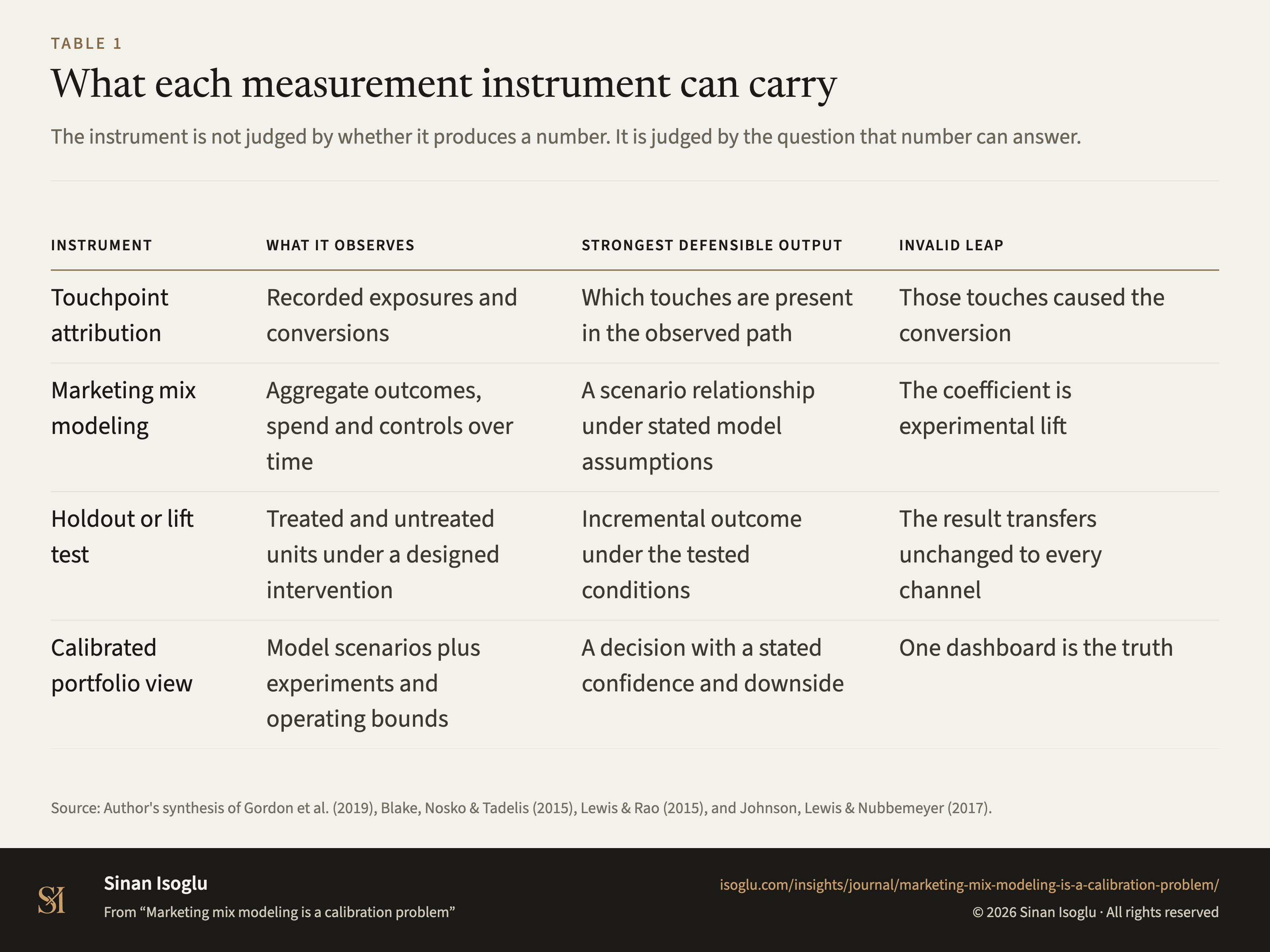
Table 1Table
What each measurement instrument can carry
Marketing mix modeling is a calibration problem
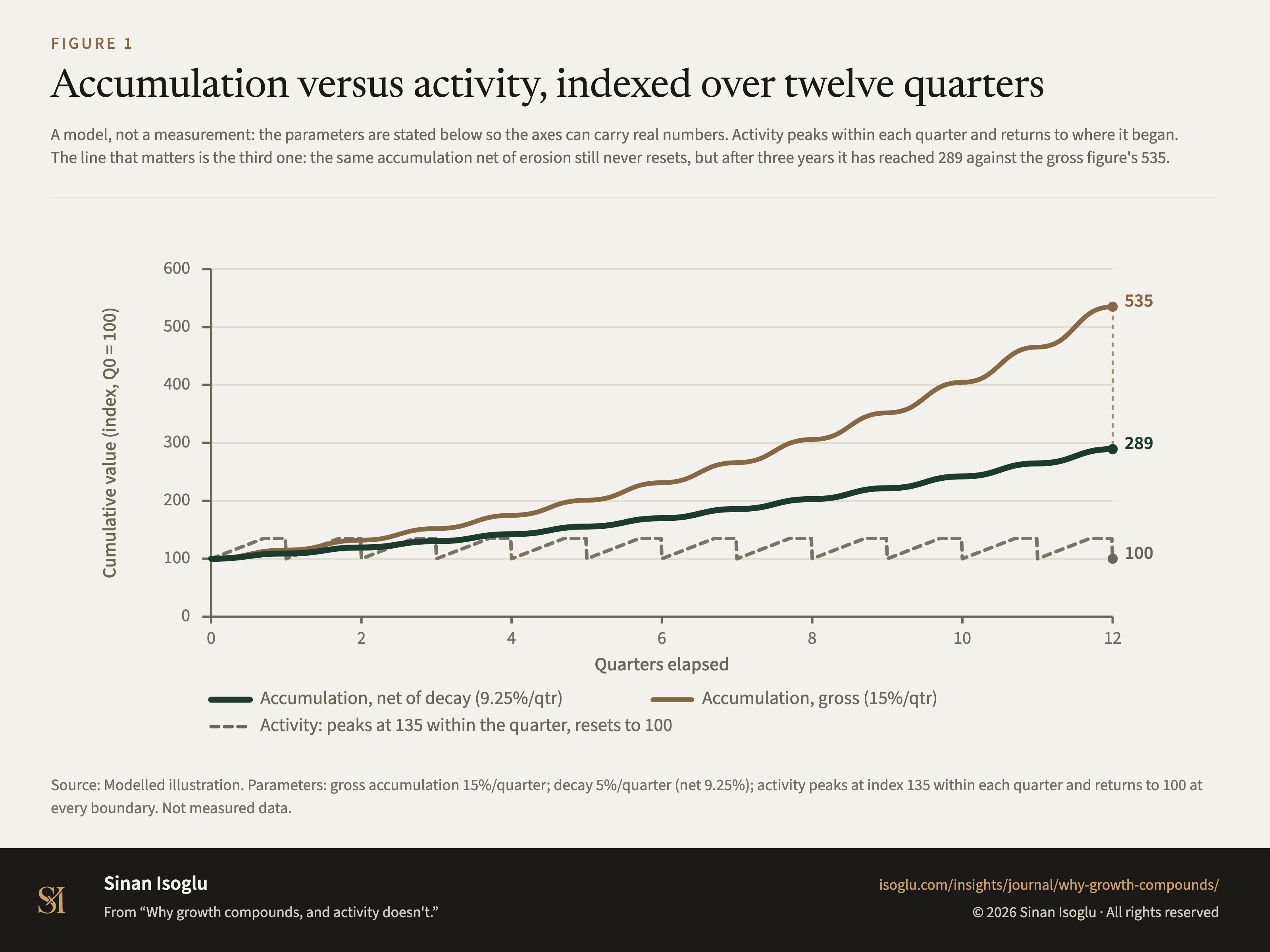
Figure 1Figure
Accumulation versus activity, indexed over twelve quarters
Why growth compounds, and activity doesn't.
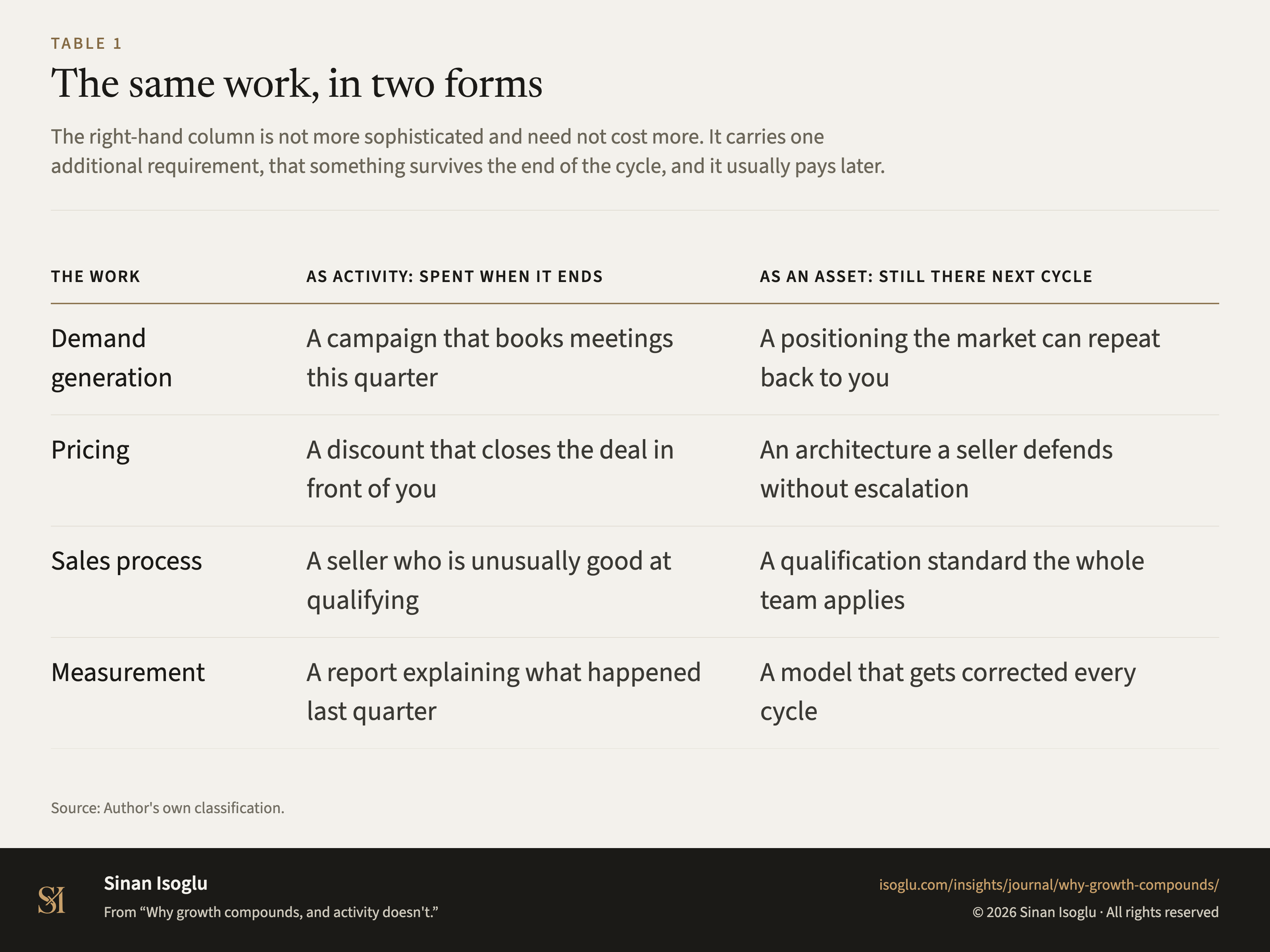
Table 1Table
The same work, in two forms
Why growth compounds, and activity doesn't.
Contact
Bring the question you're working on.
Research, a guest lecture, or a commercial question.