← Every exhibit
Table 1From “Marketing mix modeling is a calibration problem”
What each measurement instrument can carry
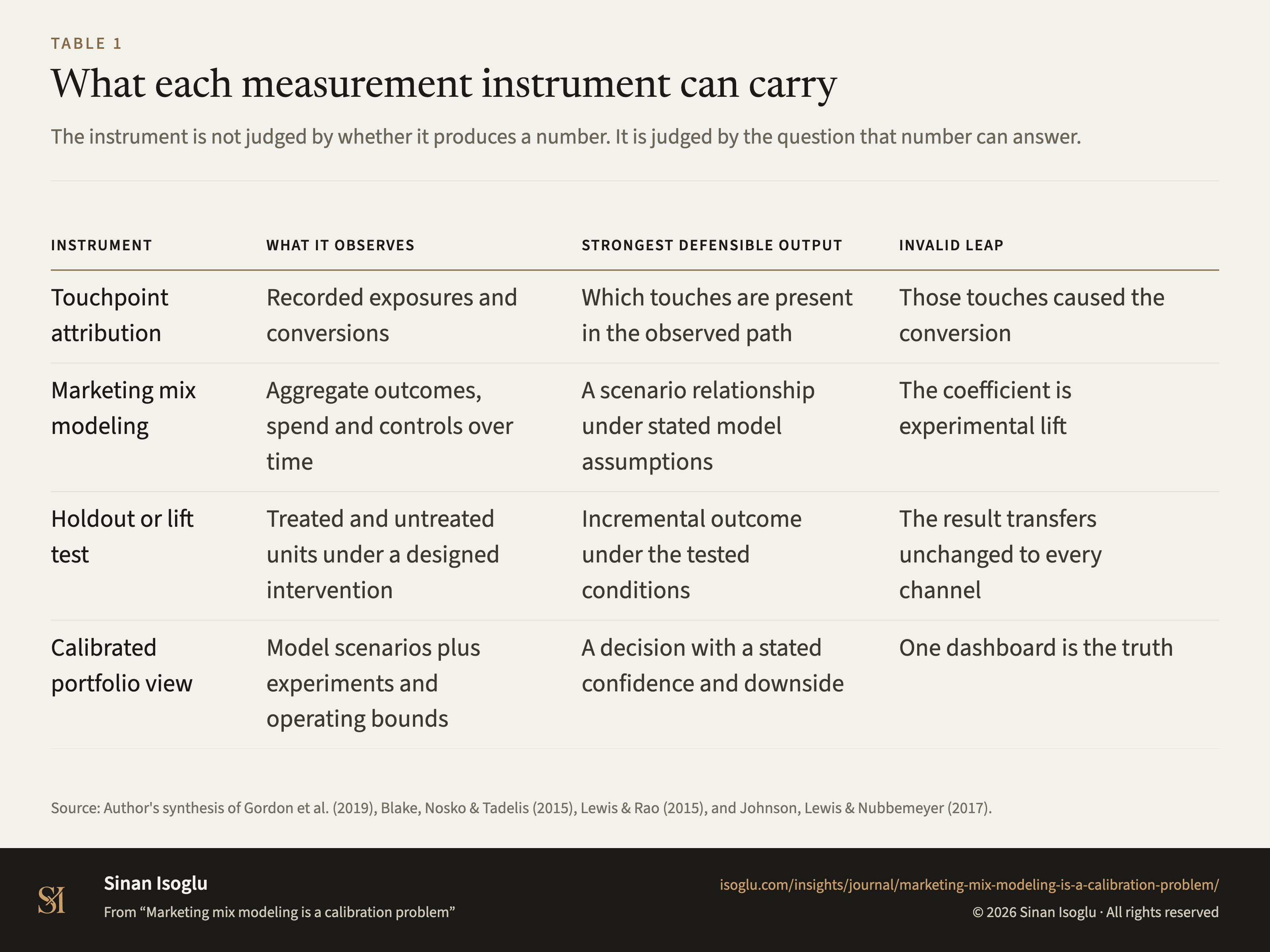
The instrument is not judged by whether it produces a number. It is judged by the question that number can answer.
Table 1What each measurement instrument can carry
| Instrument | What it observes | Strongest defensible output | Invalid leap |
|---|---|---|---|
| Touchpoint attribution | Recorded exposures and conversions | Which touches are present in the observed path | Those touches caused the conversion |
| Marketing mix modeling | Aggregate outcomes, spend and controls over time | A scenario relationship under stated model assumptions | The coefficient is experimental lift |
| Holdout or lift test | Treated and untreated units under a designed intervention | Incremental outcome under the tested conditions | The result transfers unchanged to every channel |
| Calibrated portfolio view | Model scenarios plus experiments and operating bounds | A decision with a stated confidence and downside | One dashboard is the truth |
Swipe or scroll horizontally if the table is wider than your screen.
Source: Author's synthesis of Gordon et al. (2019), Blake, Nosko & Tadelis (2015), Lewis & Rao (2015), and Johnson, Lewis & Nubbemeyer (2017).
PNG4:3, 1600 × 1200, with the title, the source line and the attribution set in the image isoglu-2026-marketing-mix-modeling-is-a-calibration-problem-fig01.png
From the essay
Growth that compounds
Marketing mix modeling is a calibration problem
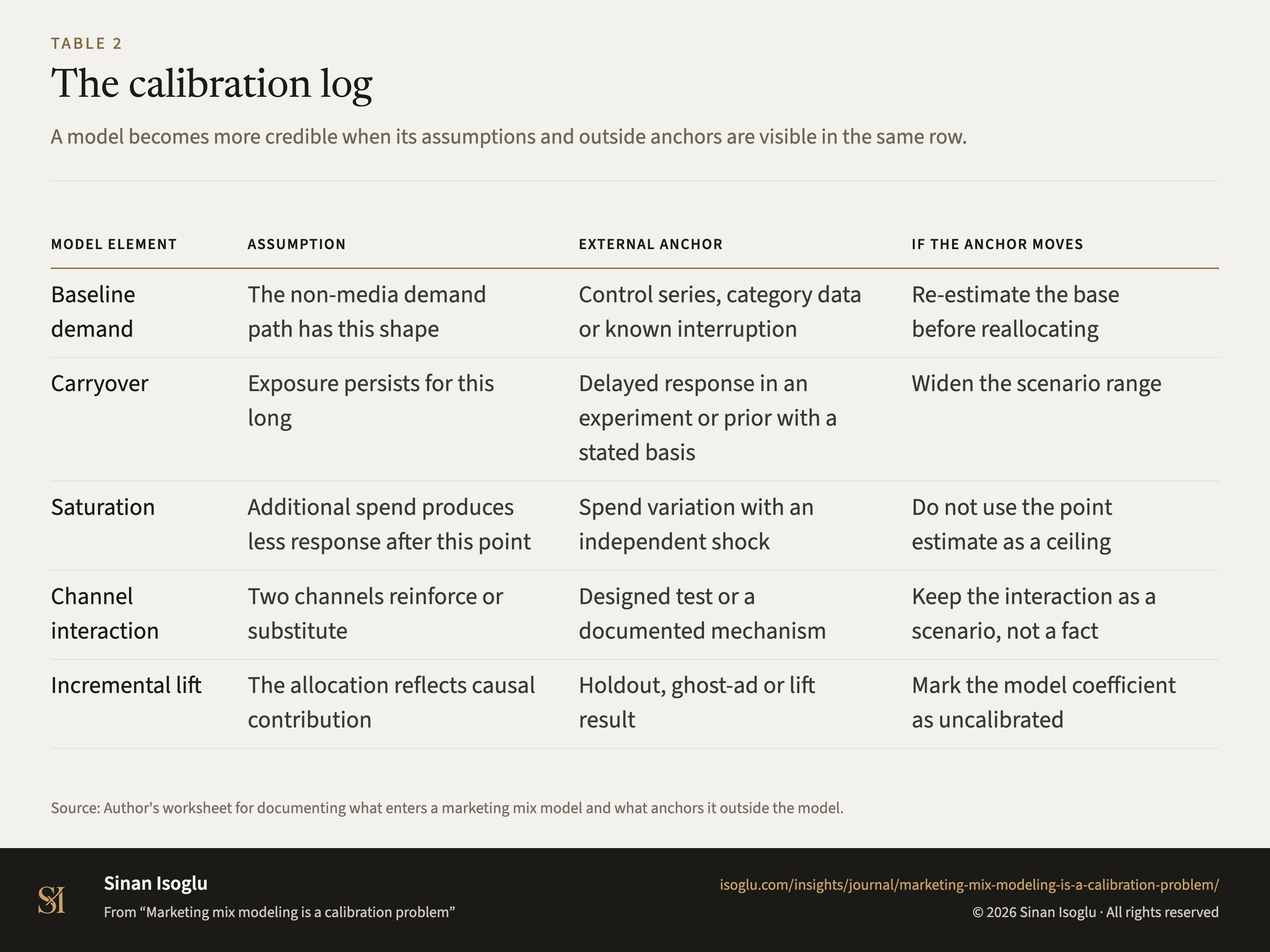
Marketing mix modeling can organise an aggregate budget, but it cannot certify causality by itself. Calibrate the model before trusting the allocation.
Read the essayThis exhibit belongs to an essay: the numbers live here, the argument lives there.
Cite or embed
Related exhibits

Contact
Bring the question you're working on.
Research, a guest lecture, or a commercial question.