Figure 2From “What is customer satisfaction?”
A satisfaction reading record
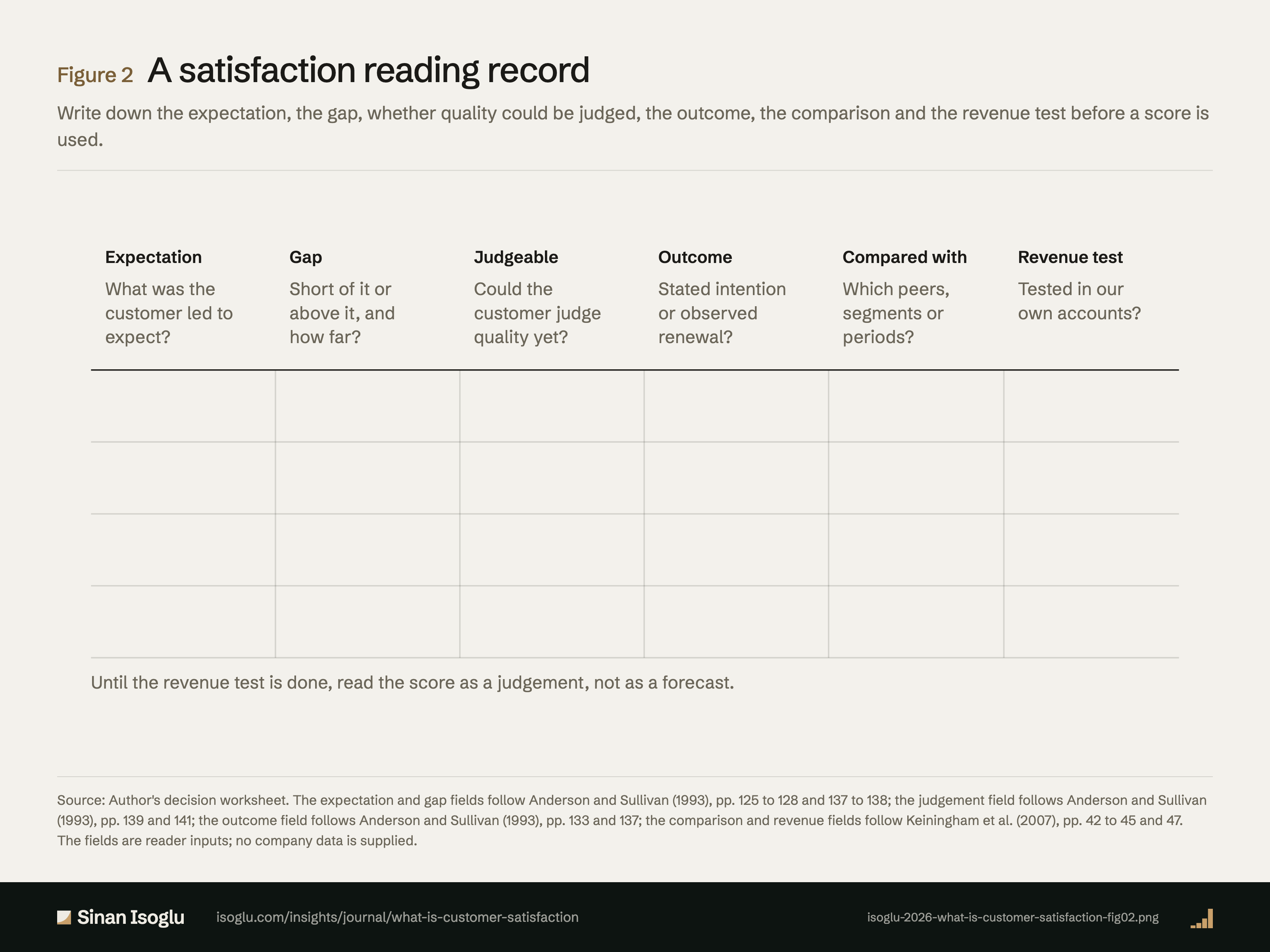
Write down the expectation, the gap, whether quality could be judged, the outcome, the comparison and the revenue test before a score is used.
Figure 2A satisfaction reading record
Source: Author's decision worksheet. The expectation and gap fields follow Anderson and Sullivan (1993), pp. 125 to 128 and 137 to 138; the judgement field follows Anderson and Sullivan (1993), pp. 139 and 141; the outcome field follows Anderson and Sullivan (1993), pp. 133 and 137; the comparison and revenue fields follow Keiningham et al. (2007), pp. 42 to 45 and 47. The fields are reader inputs; no company data is supplied.
Source and evidence
Each line names a claim related to this exhibit, its source, and how it was checked.
- B CSAT-OWN-C2 A satisfaction score is read with one record: the expectation set, the gap below or above it, whether the customer could judge quality yet, whether the outcome is a stated intention or an observed renewal, the comparison, and whether the link to revenue has been tested in the firm's own accounts; illustrated with a hypothetical subscription software firm surveying administrators after quarterly releases, reading shortfalls apart from surpluses and checking renewal intentions against renewals before any revenue use; the account-level revenue test is the guide's application inside one firm of Keiningham et al.'s closing caution about testing measures before widespread adoption.Author worksheet grounded in AS93-C1, AS93-C3, AS93-C4, AS93-C5, KCAA07-C3 and KCAA07-C5
Grades: A, verified against the printed page of the primary source · B, primary source, text layer only · C, authoritative secondary · D, reported.
From the essay
Growth that compounds
What is customer satisfaction?
Customer satisfaction is a judgement of the quality received against the quality expected. In one large survey, shortfalls weighed more than surpluses.
Read the essayThis exhibit belongs to an essay: the numbers live here, the argument lives there.
Cite or embed
Contact
Bring the question you're working on.
Research, a guest lecture, or a commercial question.