Table 1From “A marketing attribution model needs a counterfactual”
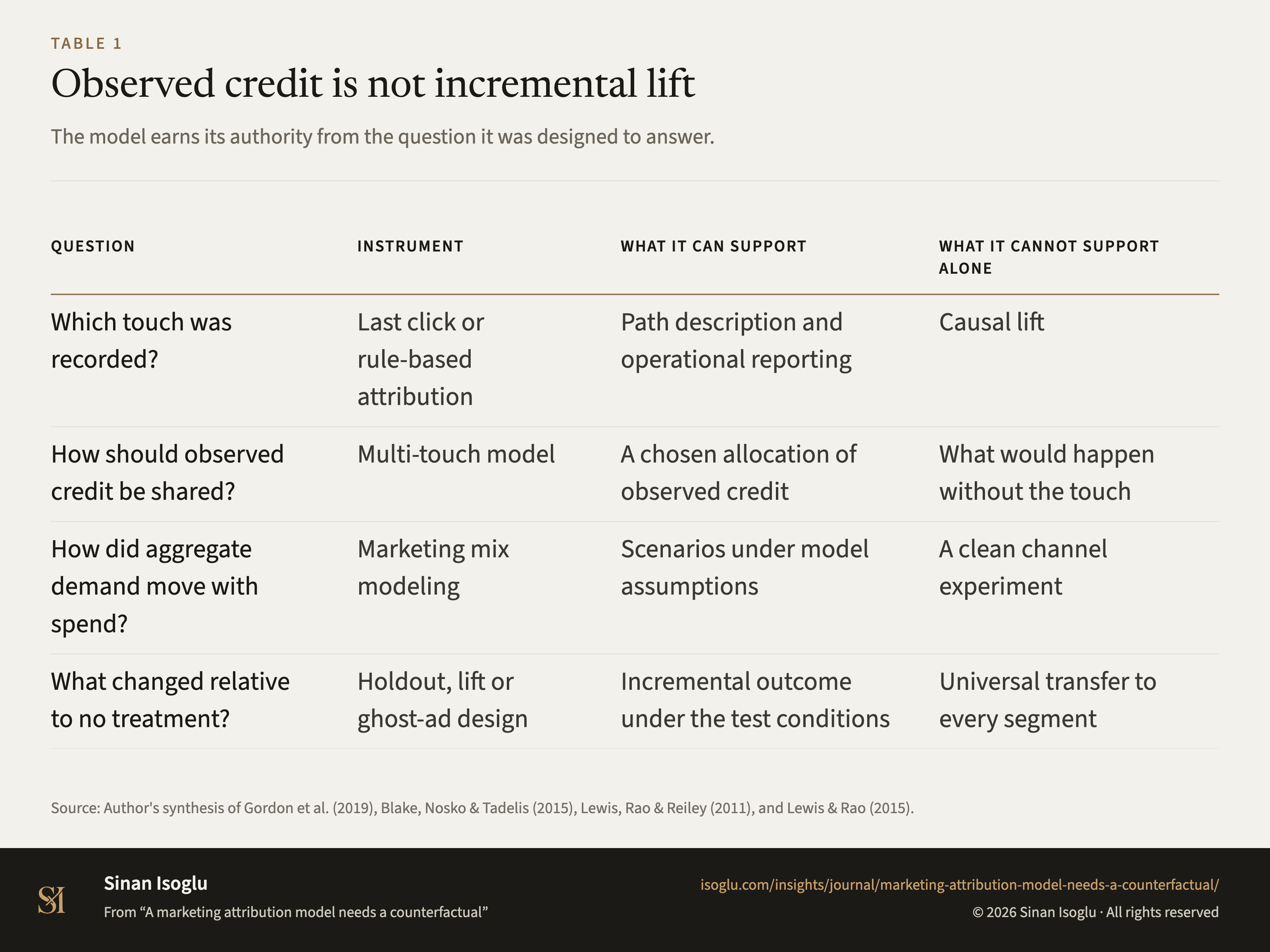
Observed credit is not incremental lift
The model earns its authority from the question it was designed to answer.
Table 1Observed credit is not incremental lift
| Question | Instrument | What it can support | What it cannot support alone |
|---|---|---|---|
| Which touch was recorded? | Last click or rule-based attribution | Path description and operational reporting | Causal lift |
| How should observed credit be shared? | Multi-touch model | A chosen allocation of observed credit | What would happen without the touch |
| How did aggregate demand move with spend? | Marketing mix modeling | Scenarios under model assumptions | A clean channel experiment |
| What changed relative to no treatment? | Holdout, lift or ghost-ad design | Incremental outcome under the test conditions | Universal transfer to every segment |
Swipe or scroll horizontally if the table is wider than your screen.
Source: Author's synthesis of Gordon et al. (2019), Blake, Nosko & Tadelis (2015), Lewis, Rao & Reiley (2011), and Lewis & Rao (2015).
From the essay
Growth that compounds
A marketing attribution model needs a counterfactual
A marketing attribution model can describe observed touches. It cannot prove incremental demand unless the decision includes a credible counterfactual.
Read the essayThis exhibit belongs to an essay: the numbers live here, the argument lives there.
Cite or embed
Related exhibits
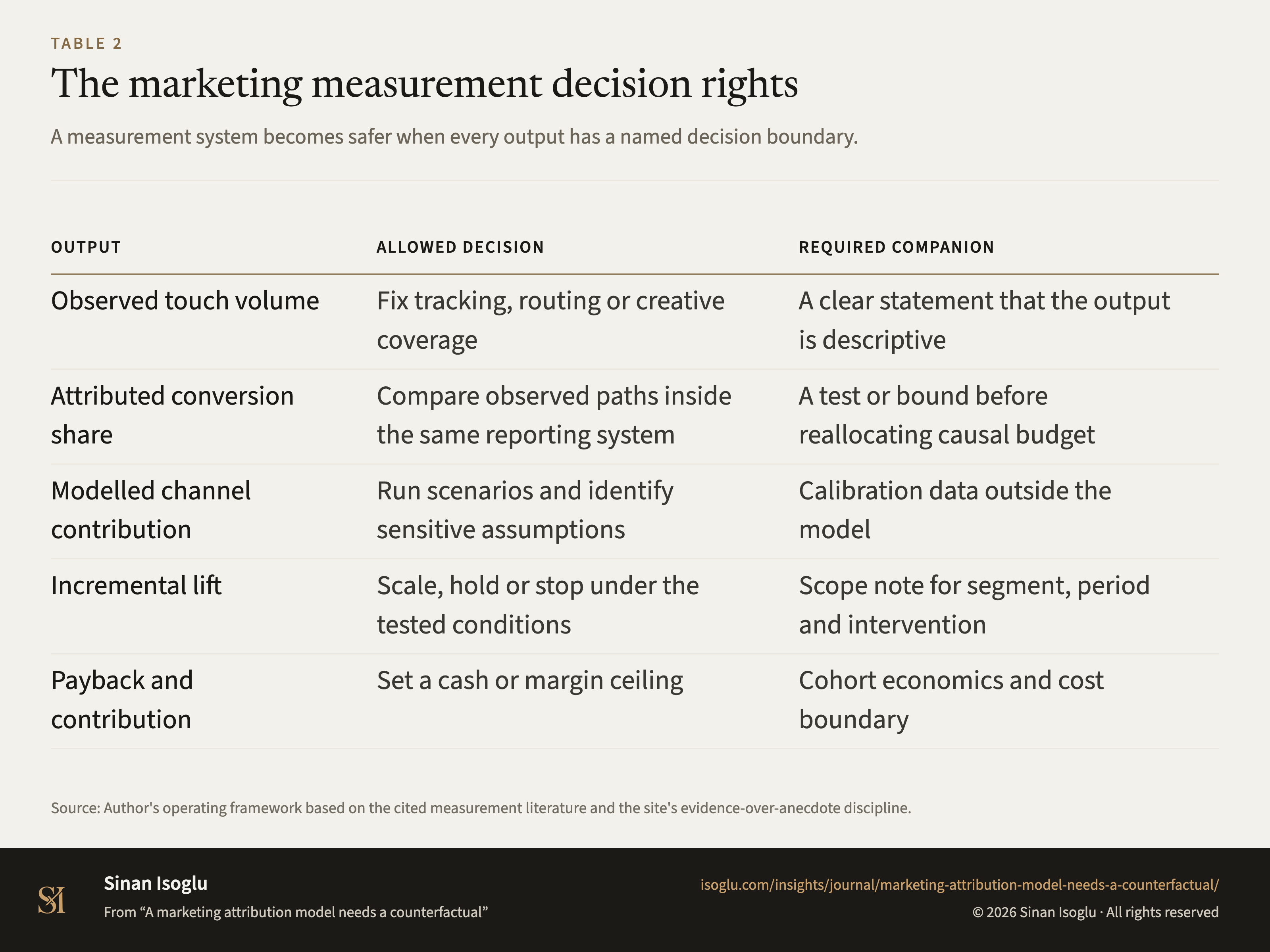
Table 2Table
The marketing measurement decision rights
A marketing attribution model needs a counterfactual
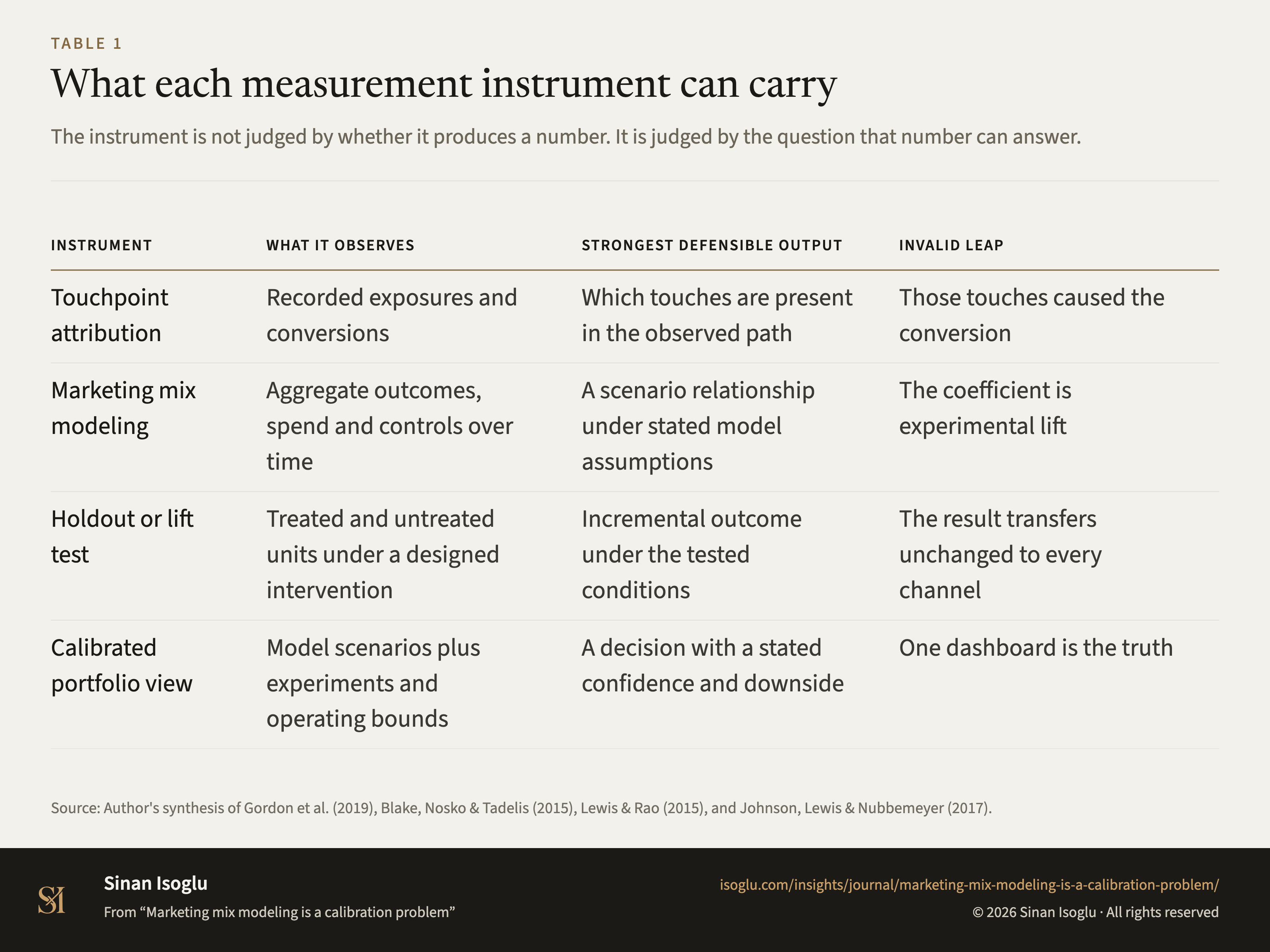
Table 1Table
What each measurement instrument can carry
Marketing mix modeling is a calibration problem

Table 2Table
Activation rate vs retention rate: which metric answers which question?
What is activation rate? The first value event must be observable
Contact
Bring the question you're working on.
Research, a guest lecture, or a commercial question.