Figure 1From “External information becomes innovation through absorptive capacity”
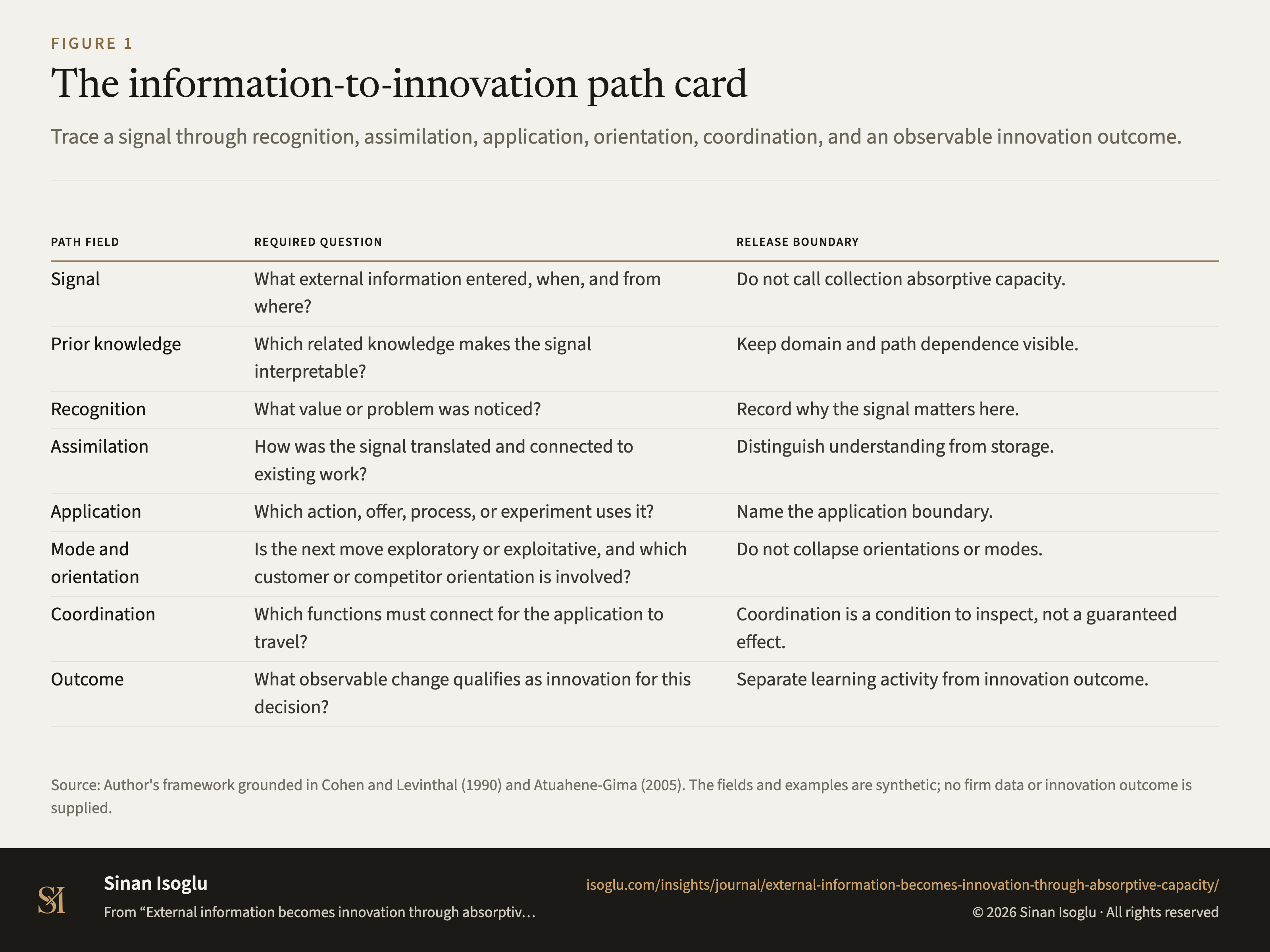
The information-to-innovation path card
Trace a signal through recognition, assimilation, application, orientation, coordination, and an observable innovation outcome.
Figure 1The information-to-innovation path card
| Path field | Required question | Release boundary |
|---|---|---|
| Signal | What external information entered, when, and from where? | Do not call collection absorptive capacity. |
| Prior knowledge | Which related knowledge makes the signal interpretable? | Keep domain and path dependence visible. |
| Recognition | What value or problem was noticed? | Record why the signal matters here. |
| Assimilation | How was the signal translated and connected to existing work? | Distinguish understanding from storage. |
| Application | Which action, offer, process, or experiment uses it? | Name the application boundary. |
| Mode and orientation | Is the next move exploratory or exploitative, and which customer or competitor orientation is involved? | Do not collapse orientations or modes. |
| Coordination | Which functions must connect for the application to travel? | Coordination is a condition to inspect, not a guaranteed effect. |
| Outcome | What observable change qualifies as innovation for this decision? | Separate learning activity from innovation outcome. |
Swipe or scroll horizontally if the table is wider than your screen.
Source: Author's framework grounded in Cohen and Levinthal (1990) and Atuahene-Gima (2005). The fields and examples are synthetic; no firm data or innovation outcome is supplied.
Source and evidence
Each line names a claim related to this exhibit, its source, and how it was checked.
- A CL90-C1 The definition, in the authors' words: "the ability of a firm to recog"nize the value of new external information, "assimilate it, and apply it to commercial ends is critical to its innovative capabilities", and "we label this capability a firm's absorptive capacity"Cohen & Levinthal. (1990)
- A CL90-C2 What it is a function of: absorptive capacity is "largely a function of the firm's level of prior related knowledge", whose cognitive basis is "prior related knowledge and diversity of background"Cohen & Levinthal. (1990)
- A CL90-C3 The path-dependence argument, in the authors' words: "which R&D contributes to a firm's absorptive capacity", and "the development of absorptive capacity, and, in turn, innovative performance are history- or path-depen"dent, so that a "lack of investment in an area of ex"pertise "early on may foreclose the future development of a technical capability in that area"Cohen & Levinthal. (1990)
- A ATU05-C1 The dilemma in the author's words: "how to exploit existing product innovation competencies competence exploitation while avoiding their dysfunctional rigidity effects by renewing and replacing them with entirely new competencies competence exploration"Atuahene-Gima. (2005)
- A ATU05-C2 The proposed resolution: "customer and competitor orientations ensure simultaneous investments in exploiting existing product innovation competencies and exploring new ones"Atuahene-Gima. (2005)
- A ATU05-C3 And the outcome side, including the moderator: "competence exploitation and exploration have opposing relationships with incremental and radical innovation performance", while "the relationship between competence exploration and radical innovation performance is positively moderated by interfunctional coordination"Atuahene-Gima. (2005)
Grades: A, verified against the printed page of the primary source · B, primary source, text layer only · C, authoritative secondary · D, reported.
From the essay
Growth that compounds
External information becomes innovation through absorptive capacity
More information is not more innovation: separate recognition, assimilation, application, prior knowledge, orientation, and coordination.
Read the essayThis exhibit belongs to an essay: the numbers live here, the argument lives there.
Cite or embed
Related exhibits
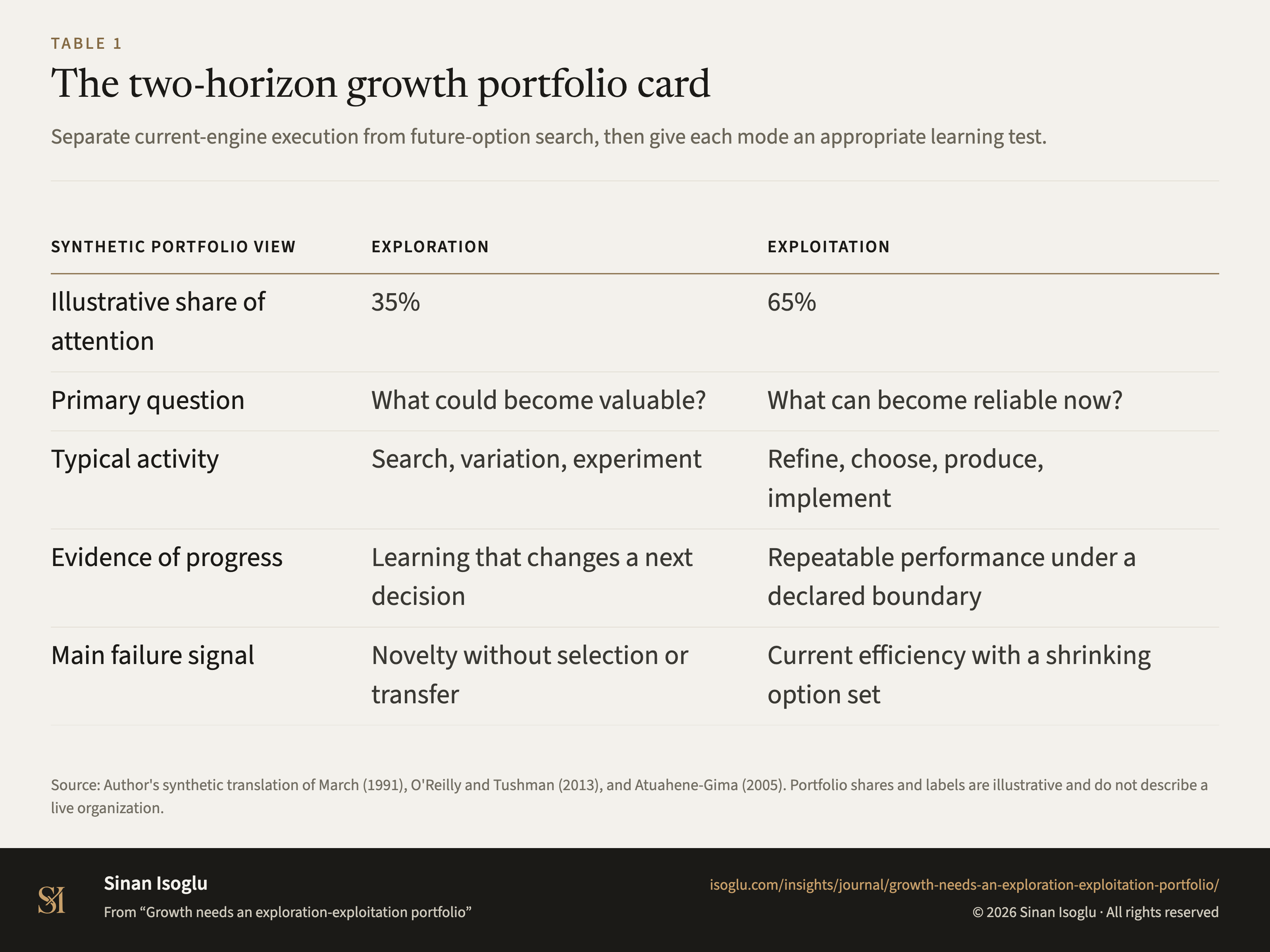
Table 1Table
The two-horizon growth portfolio card
Growth needs an exploration-exploitation portfolio
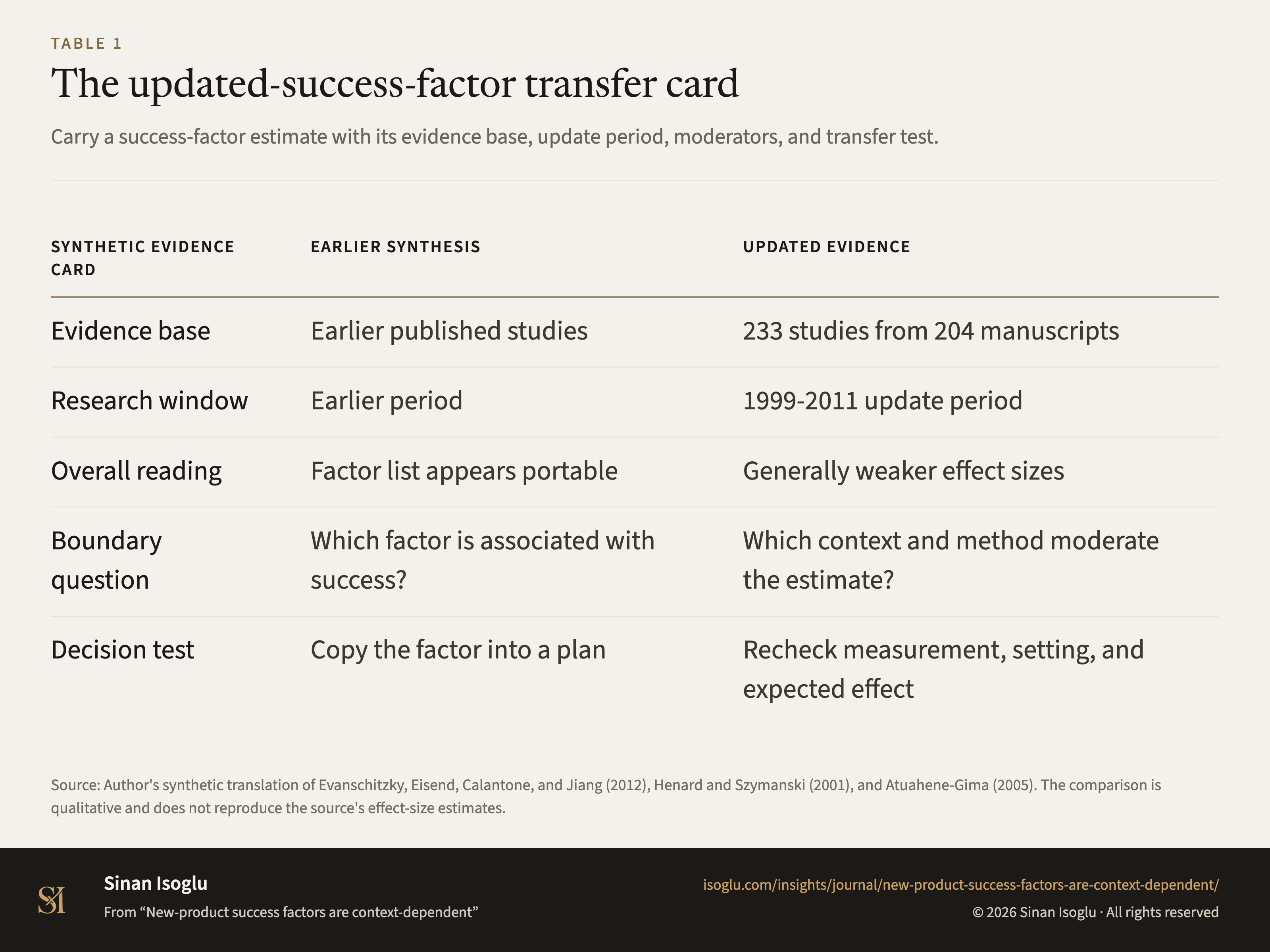
Table 1Table
The updated-success-factor transfer card
New-product success factors are context-dependent
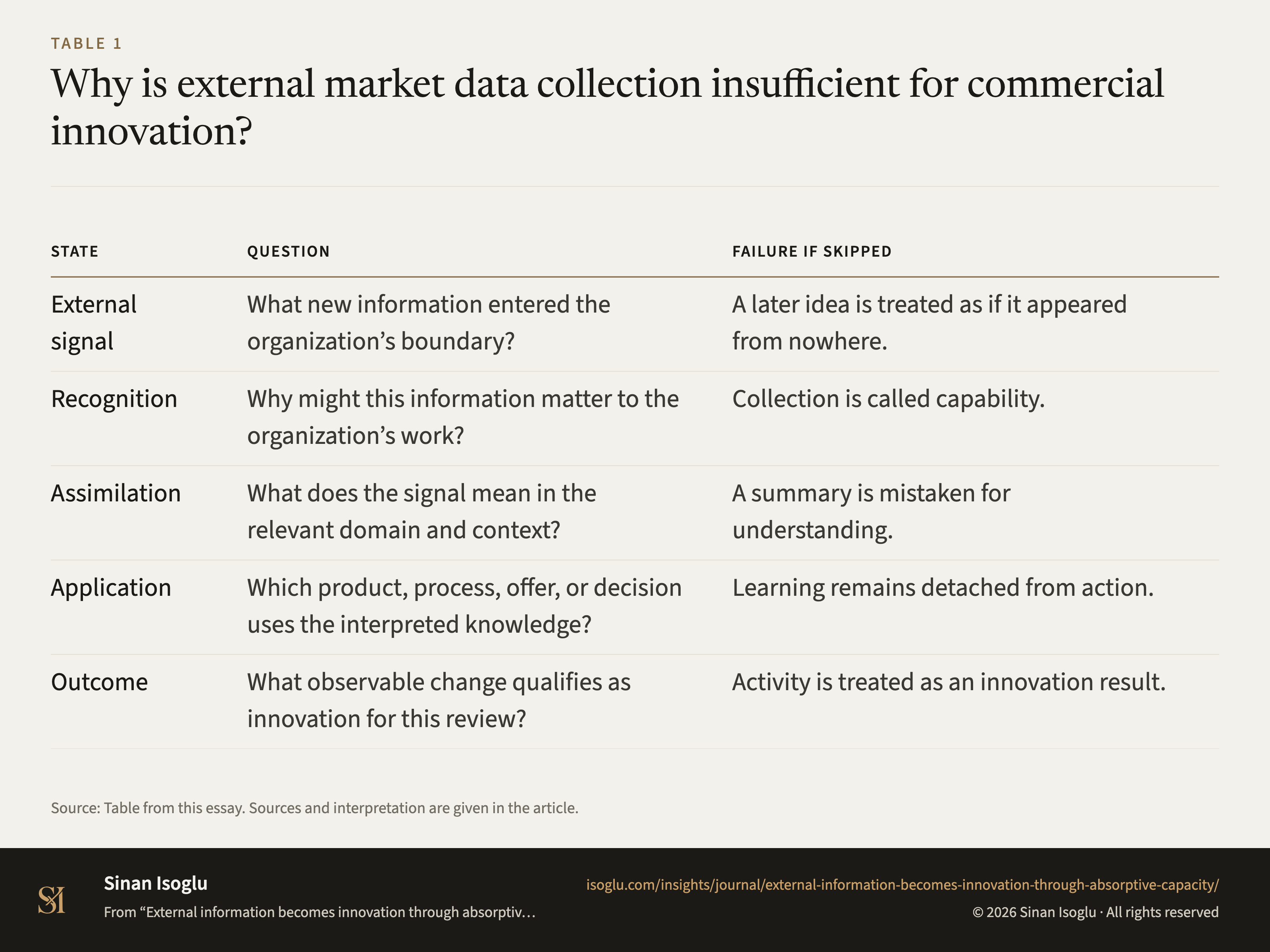
Table 1Table
Why is external market data collection insufficient for commercial innovation?
External information becomes innovation through absorptive capacity
Contact
Bring the question you're working on.
Research, a guest lecture, or a commercial question.