Abbildung 1Aus „Externe Information wird durch Absorptionsfähigkeit zu Innovation“
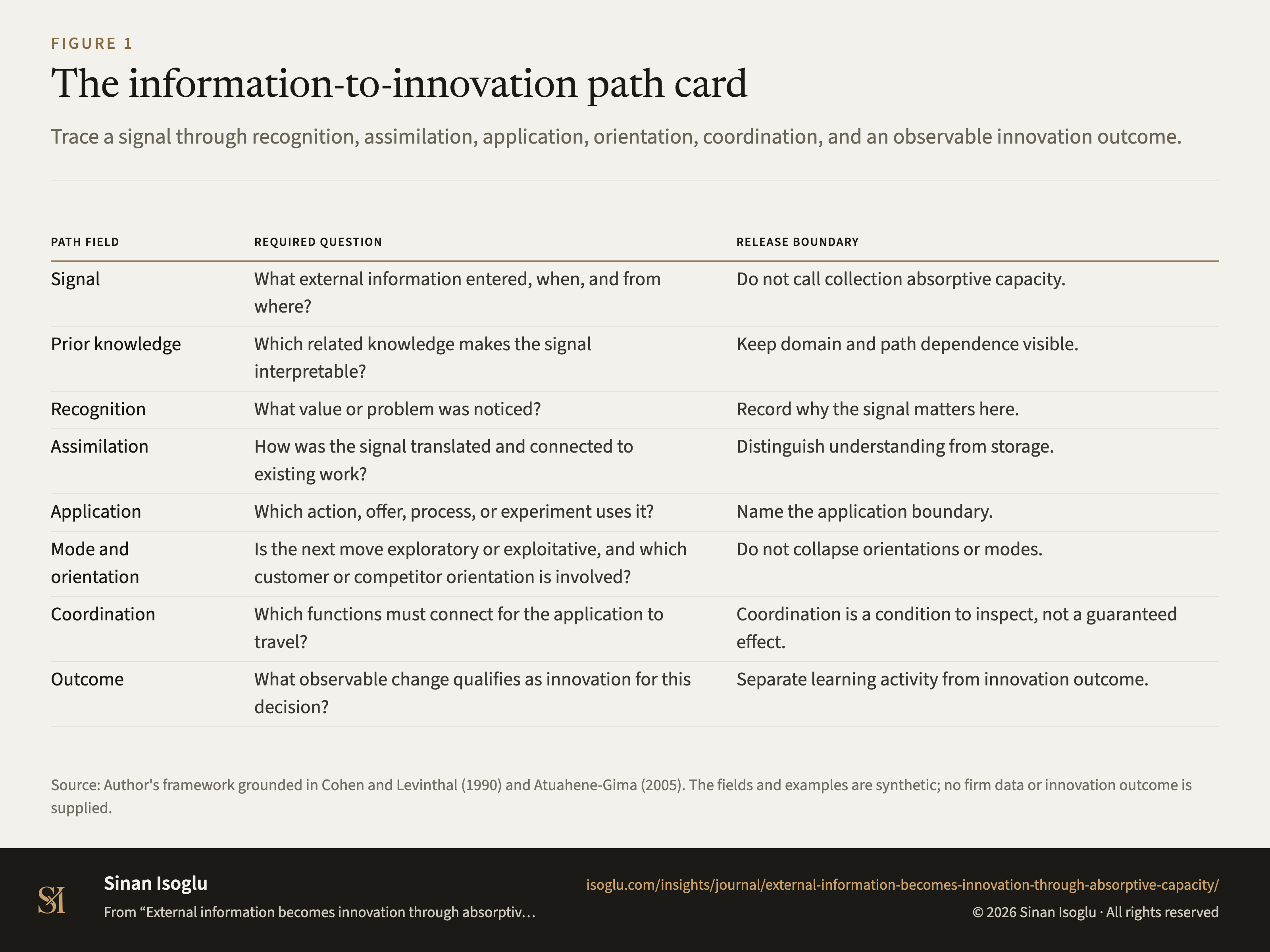
Die Informations-zu-Innovation-Pfadkarte
Verfolgen Sie ein Signal durch Erkennen, Assimilation, Anwendung, Orientierung, Koordination und ein beobachtbares Innovationsergebnis.
Abbildung 1Die Informations-zu-Innovation-Pfadkarte
| Pfadfeld | Erforderliche Frage | Freigabegrenze |
|---|---|---|
| Signal | Welche externe Information gelangte wann und von wo herein? | Sammlung nicht Absorptionsfähigkeit nennen. |
| Vorwissen | Welches verwandte Wissen macht das Signal interpretierbar? | Fach- und Pfadabhängigkeit sichtbar halten. |
| Erkennen | Welcher Wert oder welches Problem wurde bemerkt? | Festhalten, warum das Signal hier zählt. |
| Assimilation | Wie wurde das Signal übersetzt und mit bestehender Arbeit verbunden? | Verstehen von Speicherung trennen. |
| Anwendung | Welche Handlung, welches Angebot, welcher Prozess oder welches Experiment nutzt es? | Anwendungsgrenze benennen. |
| Modus und Orientierung | Ist der nächste Schritt explorativ oder exploitativ, und welche Kunden- oder Wettbewerbsorientierung wirkt? | Orientierungen und Modi nicht verschmelzen. |
| Koordination | Welche Funktionen müssen verbunden werden, damit die Anwendung weitergeht? | Koordination prüfen, nicht als Effekt versprechen. |
| Ergebnis | Welche beobachtbare Veränderung gilt für diese Entscheidung als Innovation? | Lernaktivität von Innovationsergebnis trennen. |
Bei breiten Tabellen horizontal wischen oder scrollen.
Quelle: Autorenrahmen auf Grundlage von Cohen und Levinthal (1990) sowie Atuahene-Gima (2005). Felder und Beispiele sind synthetisch; Unternehmensdaten oder Innovationsergebnisse sind nicht enthalten.
Quelle und Evidenz
Jede Zeile nennt eine Aussage zu dieser Abbildung, ihre Quelle und die Art ihrer Prüfung.
- A CL90-C1 The definition, in the authors' words: "the ability of a firm to recog"nize the value of new external information, "assimilate it, and apply it to commercial ends is critical to its innovative capabilities", and "we label this capability a firm's absorptive capacity"Cohen & Levinthal. (1990)
- A CL90-C2 What it is a function of: absorptive capacity is "largely a function of the firm's level of prior related knowledge", whose cognitive basis is "prior related knowledge and diversity of background"Cohen & Levinthal. (1990)
- A CL90-C3 The path-dependence argument, in the authors' words: "which R&D contributes to a firm's absorptive capacity", and "the development of absorptive capacity, and, in turn, innovative performance are history- or path-depen"dent, so that a "lack of investment in an area of ex"pertise "early on may foreclose the future development of a technical capability in that area"Cohen & Levinthal. (1990)
- A ATU05-C1 The dilemma in the author's words: "how to exploit existing product innovation competencies competence exploitation while avoiding their dysfunctional rigidity effects by renewing and replacing them with entirely new competencies competence exploration"Atuahene-Gima. (2005)
- A ATU05-C2 The proposed resolution: "customer and competitor orientations ensure simultaneous investments in exploiting existing product innovation competencies and exploring new ones"Atuahene-Gima. (2005)
- A ATU05-C3 And the outcome side, including the moderator: "competence exploitation and exploration have opposing relationships with incremental and radical innovation performance", while "the relationship between competence exploration and radical innovation performance is positively moderated by interfunctional coordination"Atuahene-Gima. (2005)
Prüfgrade: A, gegen die gedruckte Seite der Primärquelle geprüft · B, Primärquelle, nur Textebene · C, belastbare Sekundärquelle · D, berichtet.
Aus dem Beitrag
Wachstum, das sich potenziert
Externe Information wird durch Absorptionsfähigkeit zu Innovation
Mehr Information ist nicht mehr Innovation: Trennen Sie Erkennen, Assimilation, Anwendung, Vorwissen, Orientierung und Koordination.
Den Beitrag lesenDiese Abbildung gehört zu einem Essay: Die Zahlen stehen hier, das Argument dort.
Zitieren oder einbetten
Verwandte Abbildungen
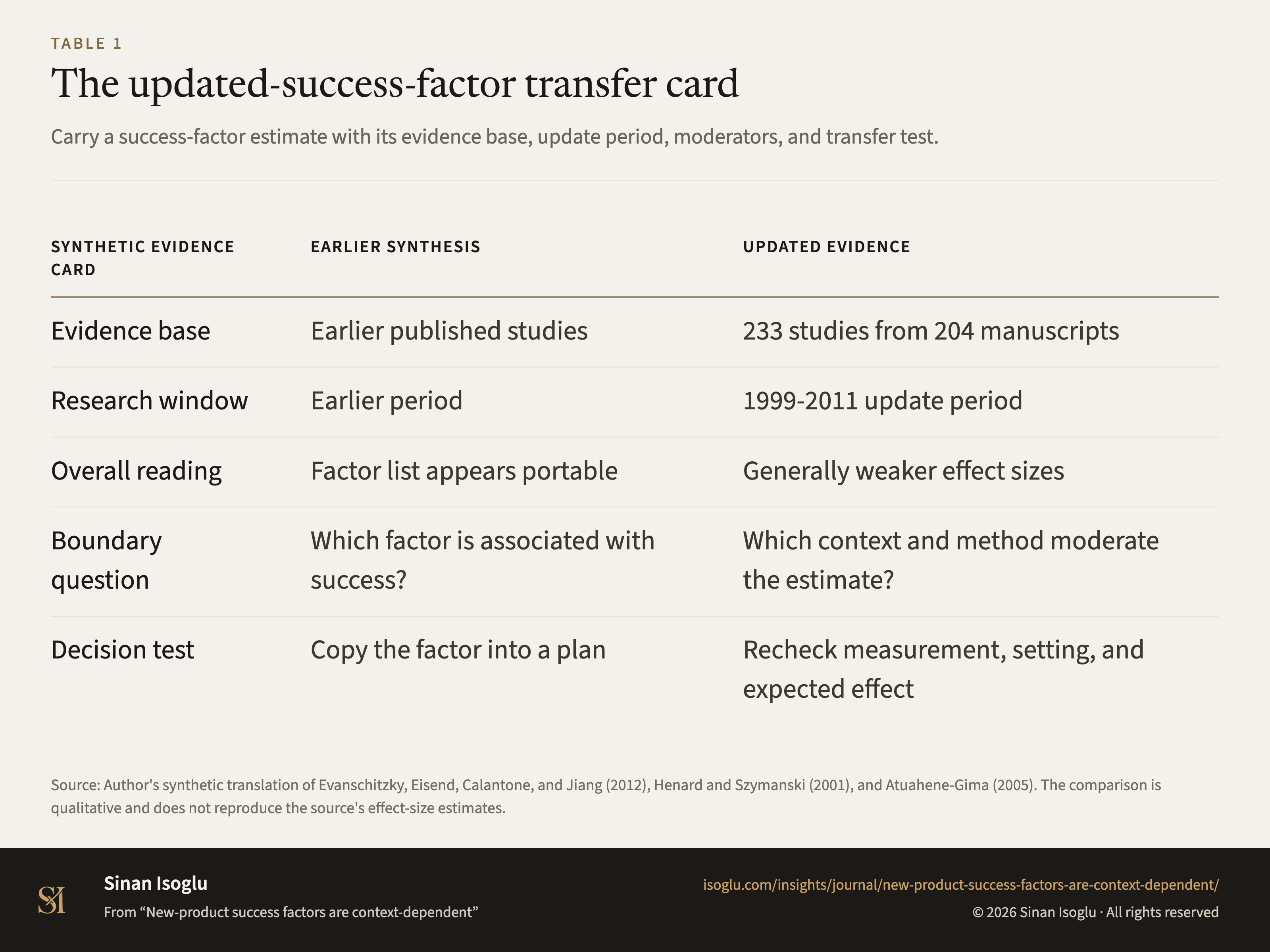
Tabelle 1Tabelle
Die Transferkarte für aktualisierte Erfolgsfaktoren
Erfolgsfaktoren neuer Produkte sind kontextabhängig
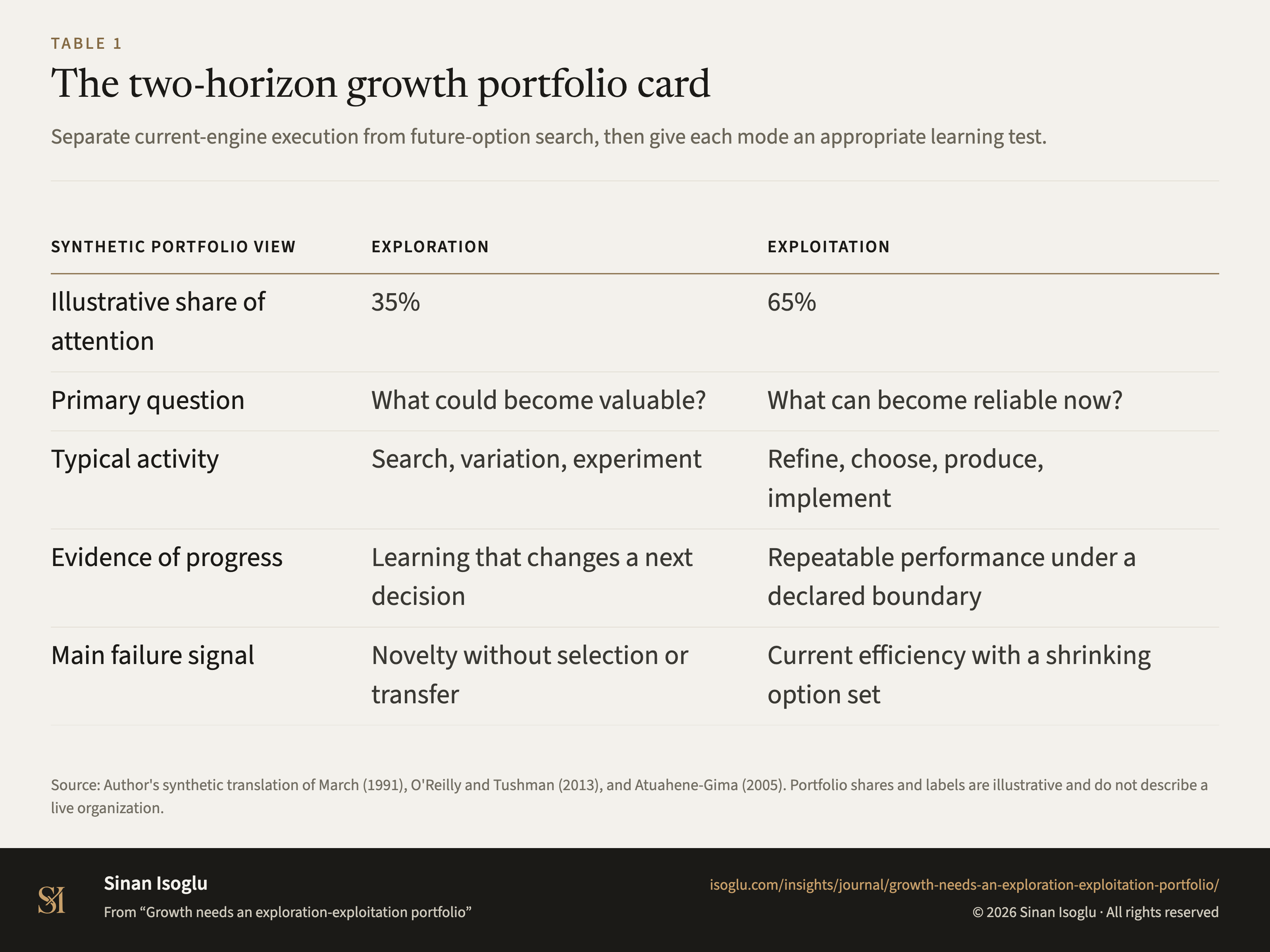
Tabelle 1Tabelle
Die Portfoliokarte für zwei Wachstumshorizonte
Wachstum braucht ein Explorations-Exploitation-Portfolio
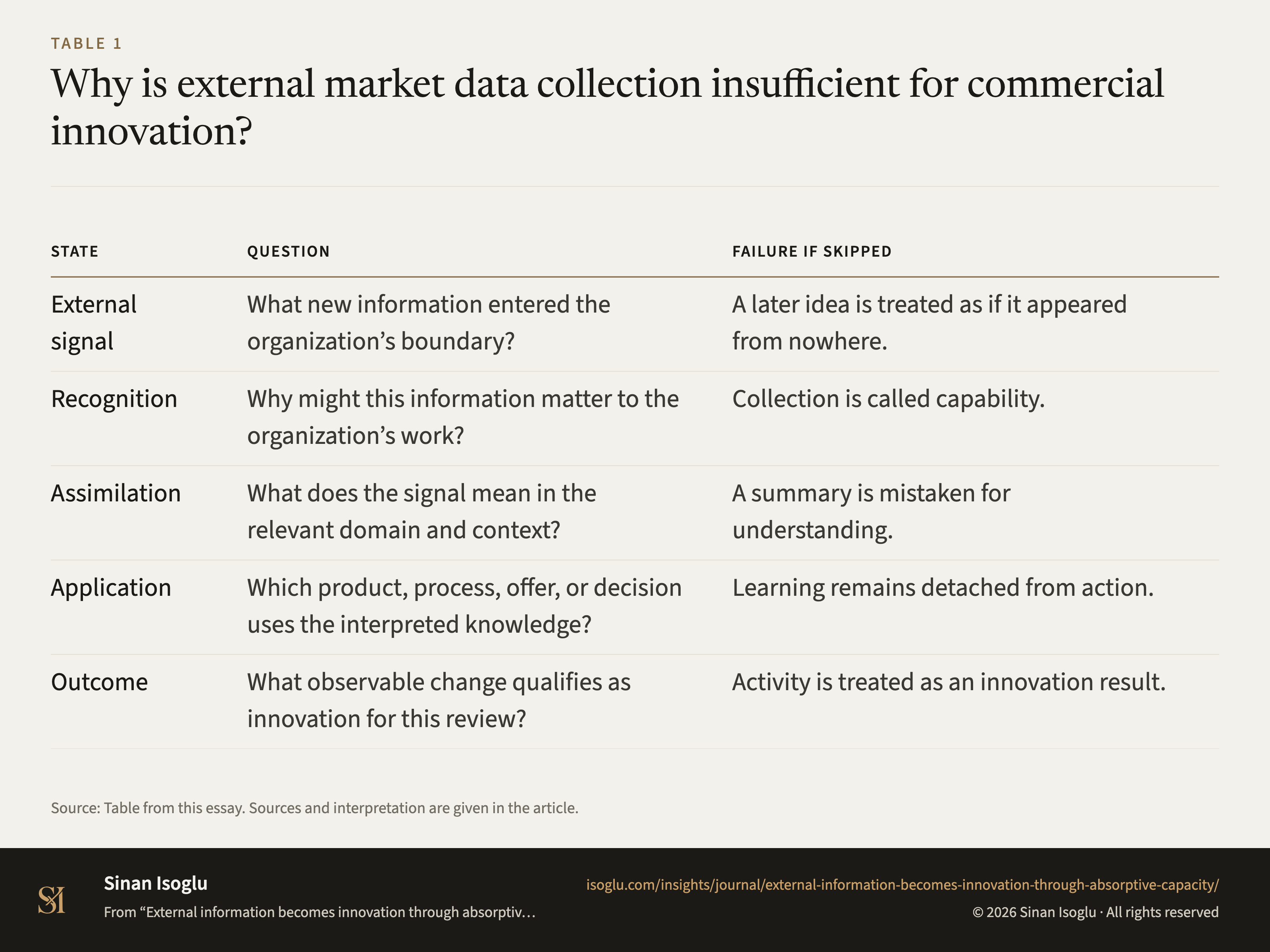
Tabelle 1Tabelle
Warum reicht reine Informationsbeschaffung für kommerzielle Innovationen nicht aus?
Externe Information wird durch Absorptionsfähigkeit zu Innovation
Kontakt
Schicken Sie die Frage, an der Sie arbeiten.
Forschung, ein Gastvortrag oder eine Frage aus der Praxis.