Table 1From “New-product success factors are context-dependent”
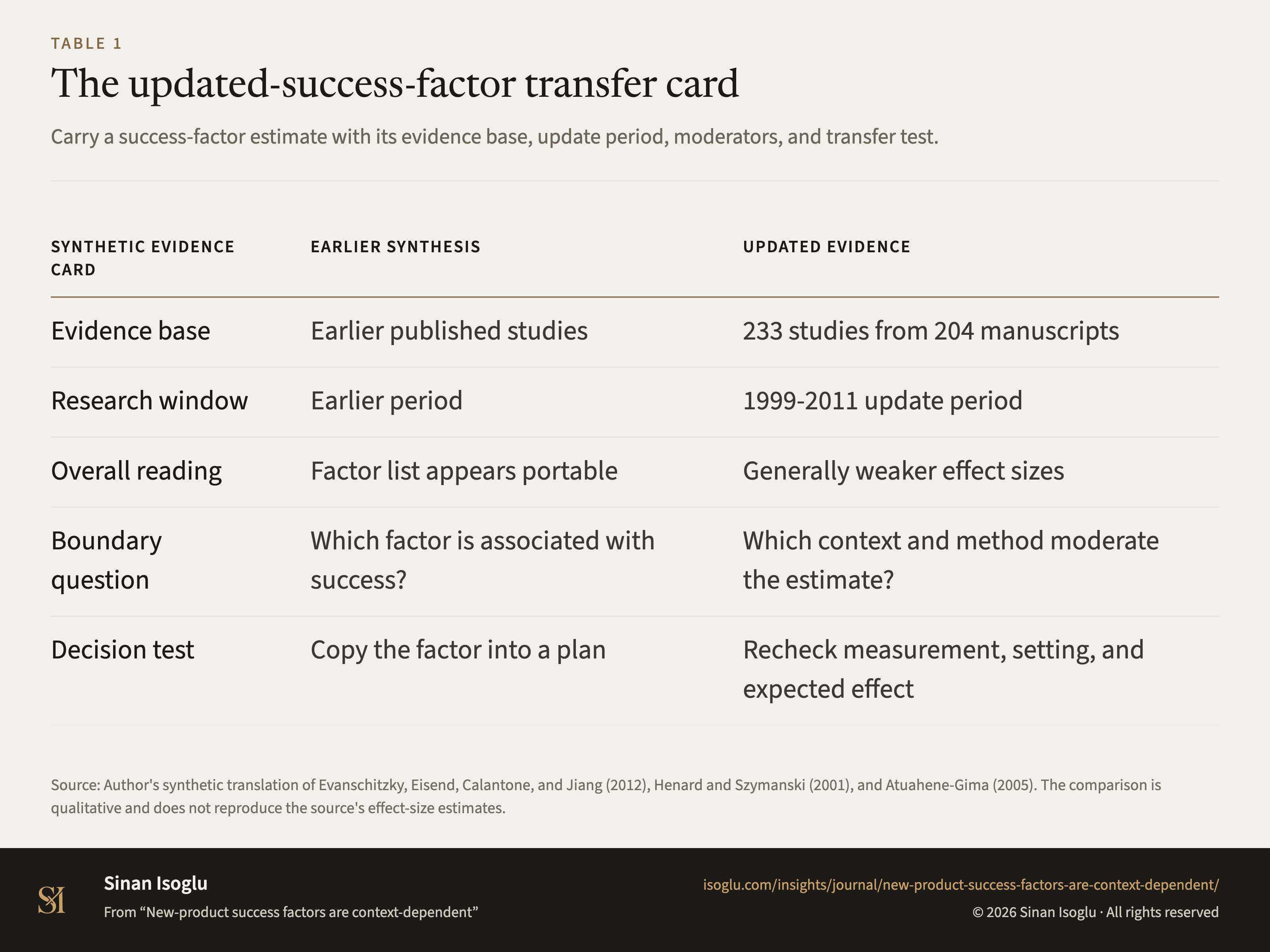
The updated-success-factor transfer card
Carry a success-factor estimate with its evidence base, update period, moderators, and transfer test.
Table 1The updated-success-factor transfer card
| Synthetic evidence card | Earlier synthesis | Updated evidence |
|---|---|---|
| Evidence base | Earlier published studies | 233 studies from 204 manuscripts |
| Research window | Earlier period | 1999-2011 update period |
| Overall reading | Factor list appears portable | Generally weaker effect sizes |
| Boundary question | Which factor is associated with success? | Which context and method moderate the estimate? |
| Decision test | Copy the factor into a plan | Recheck measurement, setting, and expected effect |
Swipe or scroll horizontally if the table is wider than your screen.
Source: Author's synthetic translation of Evanschitzky, Eisend, Calantone, and Jiang (2012), Henard and Szymanski (2001), and Atuahene-Gima (2005). The comparison is qualitative and does not reproduce the source's effect-size estimates.
Source and evidence
Each line names a claim related to this exhibit, its source, and how it was checked.
- A EEJ12-C1 The base, verbatim: "based on 233 empirical studies from 204 manuscripts on nps with a total 2618 effect sizes", re-estimated "employing a random effects model"Evanschitzky, Eisend, Calantone & Jiang. (2012)
- A EEJ12-C2 It updates the earlier synthesis and says how it differs: "using henard and szymanski s meta analysis as the most comprehensive recent summary of empirical findings this study updates their findings by analyzing articles published from 1999 through 2011", and "results reveal generally weaker effect sizes than those reported by henard and szymanski in 2001"Evanschitzky, Eisend, Calantone & Jiang. (2012)
- A EEJ12-C3 Culture is the moderator they add: "culture emerges as an important moderating factor weakening effect sizes for individualistic countries", and strengthening them where risk aversion is higherEvanschitzky, Eisend, Calantone & Jiang. (2012)
- A HS01-C1 A meta-analysis, and it says how many predictors: "of the 24 predictors of new product performance investigated", the strongest on average are "product advantage market potential meeting customer needs predevelopment task proficiencies and dedicated resources"Henard & Szymanski. (2001)
- A HS01-C2 The dimensions are the paper's own list, and so is the caveat that they vary: relationships "can vary by measurement factor" or "contextual factor"Henard & Szymanski. (2001)
- A HS01-C3 The named moderators are what make a factor table conditional: "the use of multi item scales subjective versus objective measures of performance senior versus project management reporting time elapsed since product introduction", and "services versus goods asian versus north american markets"Henard & Szymanski. (2001)
- A ATU05-C1 The dilemma in the author's words: "how to exploit existing product innovation competencies competence exploitation while avoiding their dysfunctional rigidity effects by renewing and replacing them with entirely new competencies competence exploration"Atuahene-Gima. (2005)
- A ATU05-C2 The proposed resolution: "customer and competitor orientations ensure simultaneous investments in exploiting existing product innovation competencies and exploring new ones"Atuahene-Gima. (2005)
- A ATU05-C3 And the outcome side, including the moderator: "competence exploitation and exploration have opposing relationships with incremental and radical innovation performance", while "the relationship between competence exploration and radical innovation performance is positively moderated by interfunctional coordination"Atuahene-Gima. (2005)
Grades: A, verified against the printed page of the primary source · B, primary source, text layer only · C, authoritative secondary · D, reported.
From the essay
Growth that compounds
New-product success factors are context-dependent
New-product success factors are not permanent coefficients: updated meta-analysis shows weaker effects and context and method moderators.
Read the essayThis exhibit belongs to an essay: the numbers live here, the argument lives there.
Cite or embed
Related exhibits
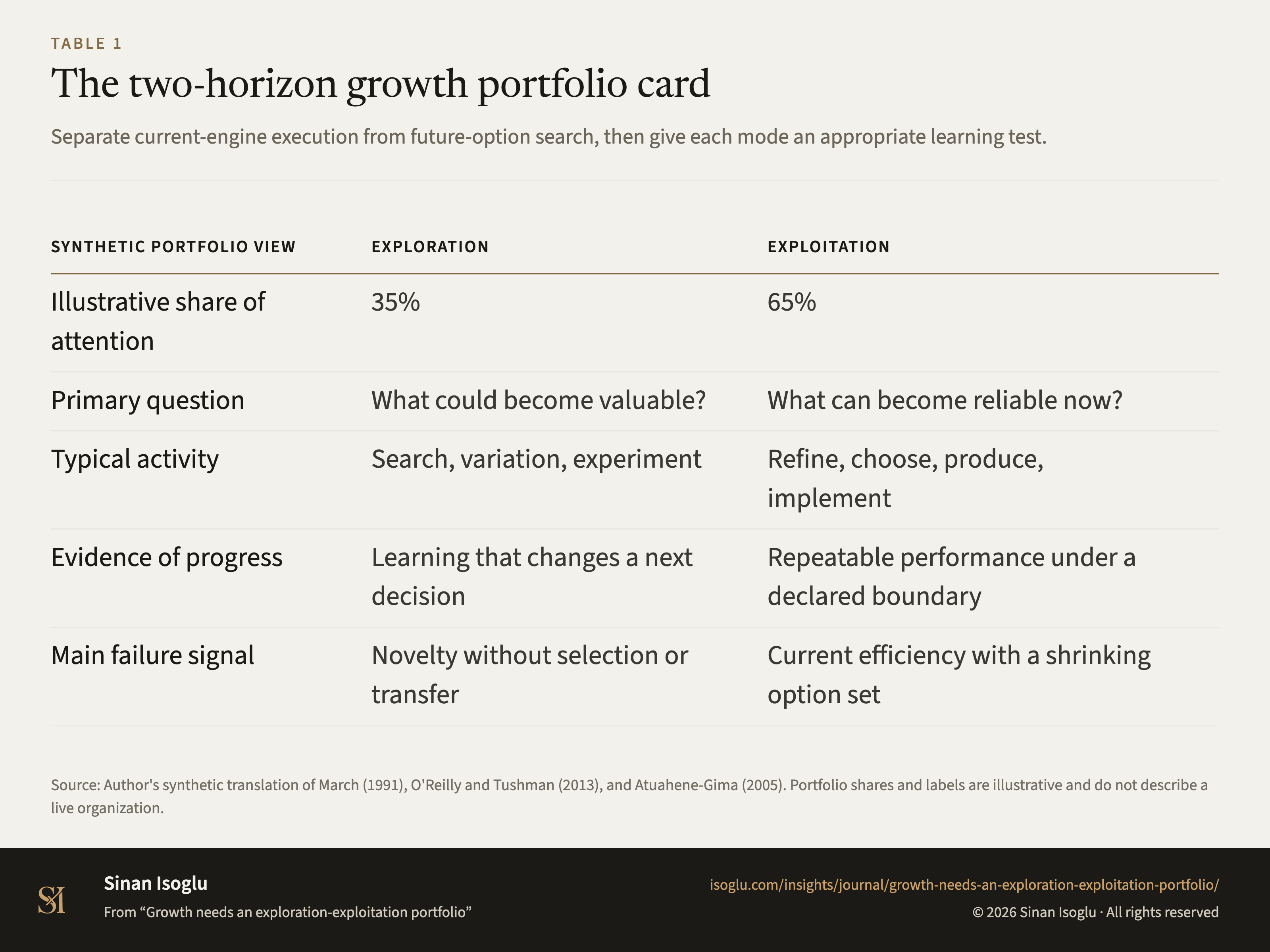
Table 1Table
The two-horizon growth portfolio card
Growth needs an exploration-exploitation portfolio
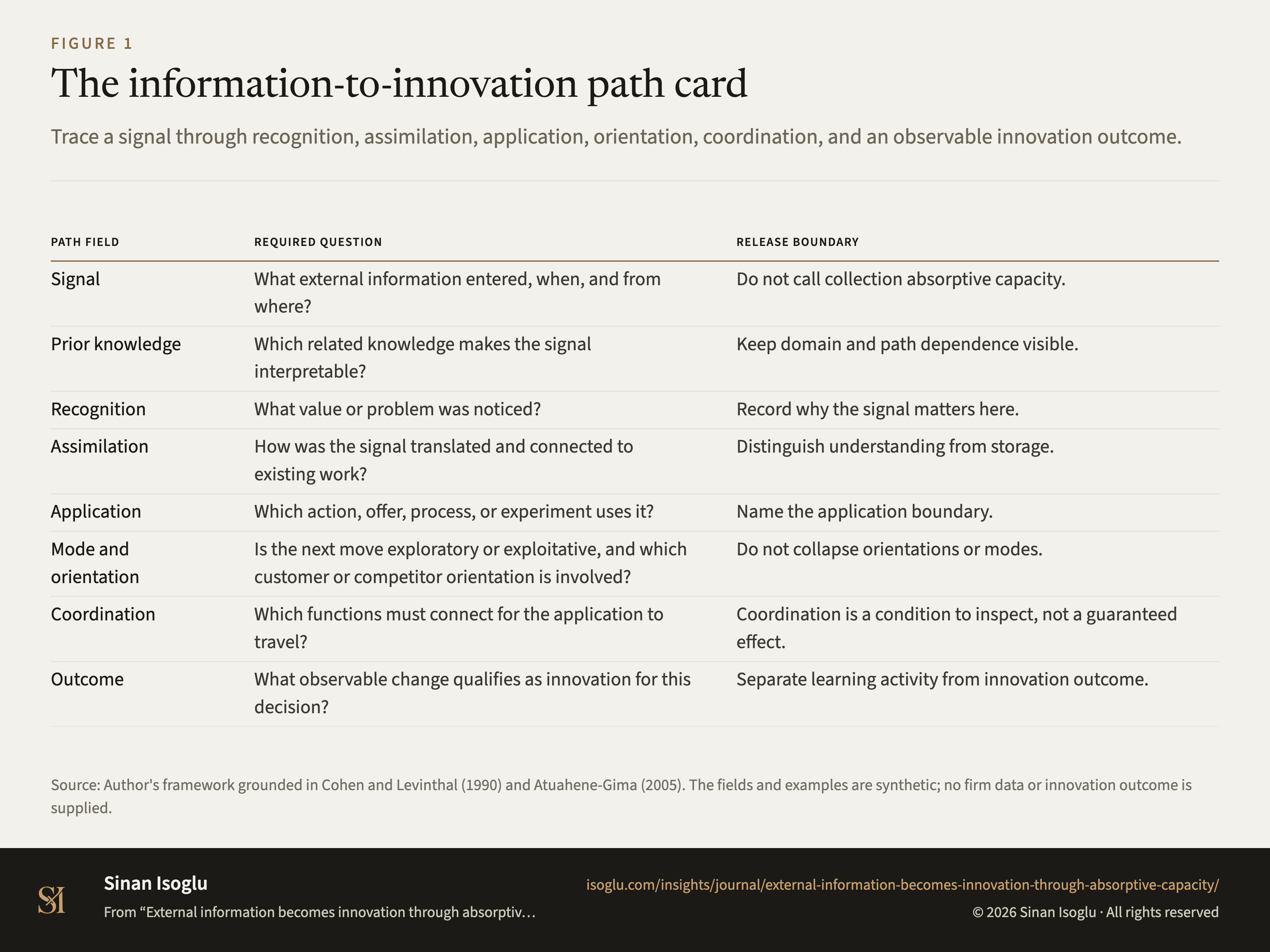
Figure 1Figure
The information-to-innovation path card
External information becomes innovation through absorptive capacity

Table 1Table
Why is an isolated new product success factor insufficient for commercial resource commitment?
New-product success factors are context-dependent
Contact
Bring the question you're working on.
Research, a guest lecture, or a commercial question.