Table 1From “Cultural distance is not a universal entry-mode rule”
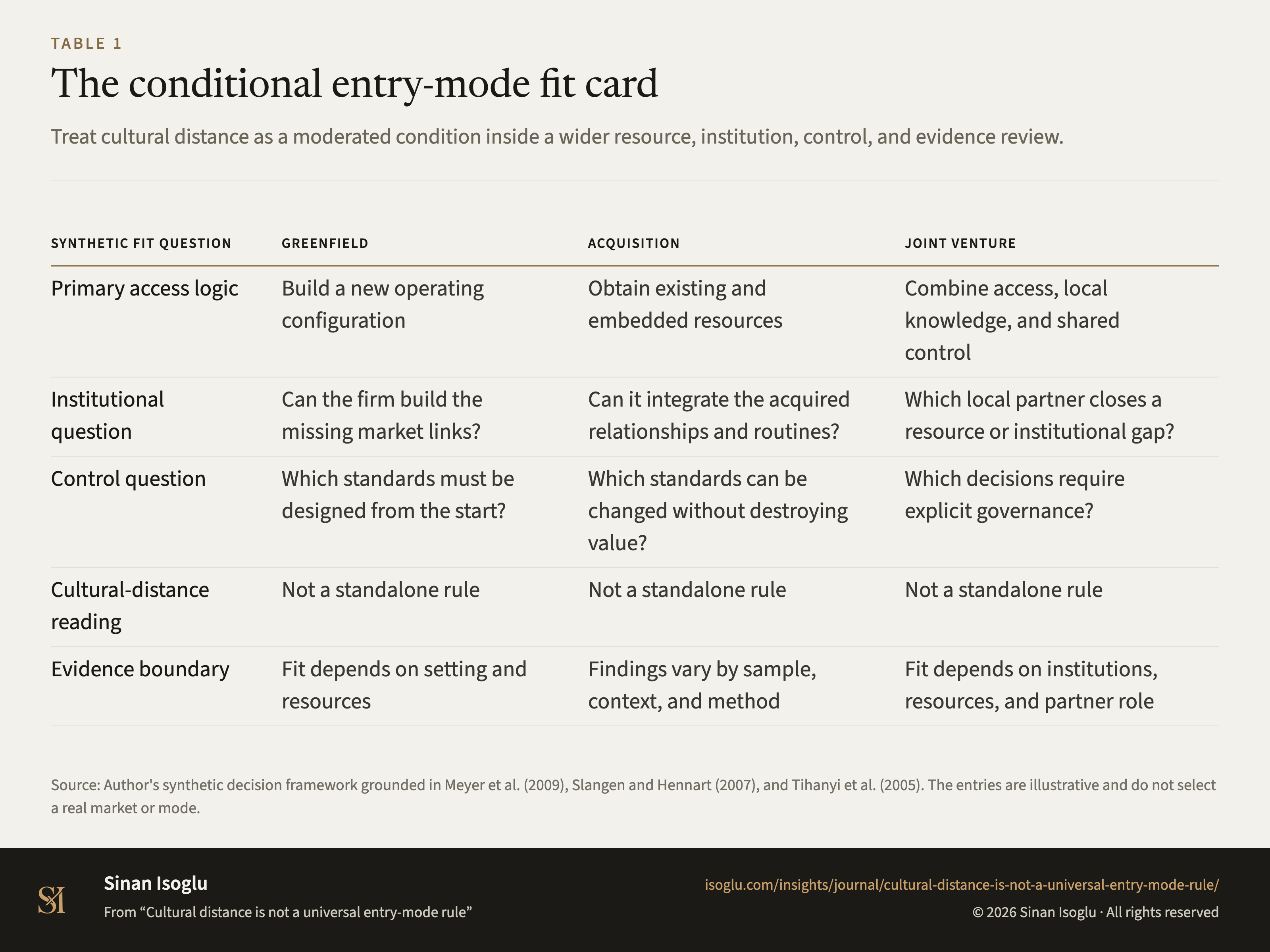
The conditional entry-mode fit card
Treat cultural distance as a moderated condition inside a wider resource, institution, control, and evidence review.
Table 1The conditional entry-mode fit card
| Synthetic fit question | Greenfield | Acquisition | Joint venture |
|---|---|---|---|
| Primary access logic | Build a new operating configuration | Obtain existing and embedded resources | Combine access, local knowledge, and shared control |
| Institutional question | Can the firm build the missing market links? | Can it integrate the acquired relationships and routines? | Which local partner closes a resource or institutional gap? |
| Control question | Which standards must be designed from the start? | Which standards can be changed without destroying value? | Which decisions require explicit governance? |
| Cultural-distance reading | Not a standalone rule | Not a standalone rule | Not a standalone rule |
| Evidence boundary | Fit depends on setting and resources | Findings vary by sample, context, and method | Fit depends on institutions, resources, and partner role |
Swipe or scroll horizontally if the table is wider than your screen.
Source: Author's synthetic decision framework grounded in Meyer et al. (2009), Slangen and Hennart (2007), and Tihanyi et al. (2005). The entries are illustrative and do not select a real market or mode.
Source and evidence
Each line names a claim related to this exhibit, its source, and how it was checked.
- A MEP09-C1 The two views are integrated rather than ranked: "We apply and advance the institution-based view of strategy by integrating it with resource-based considerations", on "Combining survey and archival data from four emerging economies, India, Vietnam, South Africa, and Egypt"Meyer, Estrin, Bhaumik & Peng. (2009)
- A MEP09-C2 The modes do different jobs: "Alternative modes of entry-greenfield, acquisition, and joint venture (JV)-allow firms to overcome different kinds of market inefficiencies" related to the resources and to the institutional contextMeyer, Estrin, Bhaumik & Peng. (2009)
- A MEP09-C3 And the institutional condition flips which mode helps: "In a weaker institutional framework, JVs are used to access many resources, but in a stronger institutional framework, JVs become less important while acquisitions can play a more important role"Meyer, Estrin, Bhaumik & Peng. (2009)
- A SH07-C1 The review's object, verbatim: "This paper reviews the empirical literature on the determinants of the choice by multinational enterprises between entering foreign countries through greenfields or acquisitions"Slangen & Hennart. (2007)
- A SH07-C2 And its diagnosis of the disagreement: the authors "examine why these findings have often been inconsistent, and offer theoretical and methodological suggestions to guide future research"Slangen & Hennart. (2007)
- A SH07-C3 The output is a research agenda, in the same sentence: the paper offers "theoretical and methodological suggestions to guide future research"Slangen & Hennart. (2007)
- A TGR05-C1 The meta-analysis, verbatim: "meta-analyzing data from 66 independent samples, with cumulative sample sizes ranging from 2,255 to 24,152"Tihanyi, Griffith & Russell. (2005)
- A TGR05-C2 The direct results are null: "Regression results failed to provide statistical evidence of significant relationships between cultural distance and entry mode choice, international diversification, and MNE performance"Tihanyi, Griffith & Russell. (2005)
- A TGR05-C3 What survives is conditional: "The examination of moderator effects, however, yielded important results", so the relationship varies with home-country context and study conditionsTihanyi, Griffith & Russell. (2005)
Grades: A, verified against the printed page of the primary source · B, primary source, text layer only · C, authoritative secondary · D, reported.
From the essay
Growth that compounds
Cultural distance is not a universal entry-mode rule
Cultural distance does not choose an entry mode: fit depends on institutions, resources, mode, sample, and the moderator behind the estimate.
Read the essayThis exhibit belongs to an essay: the numbers live here, the argument lives there.
Cite or embed
Related exhibits
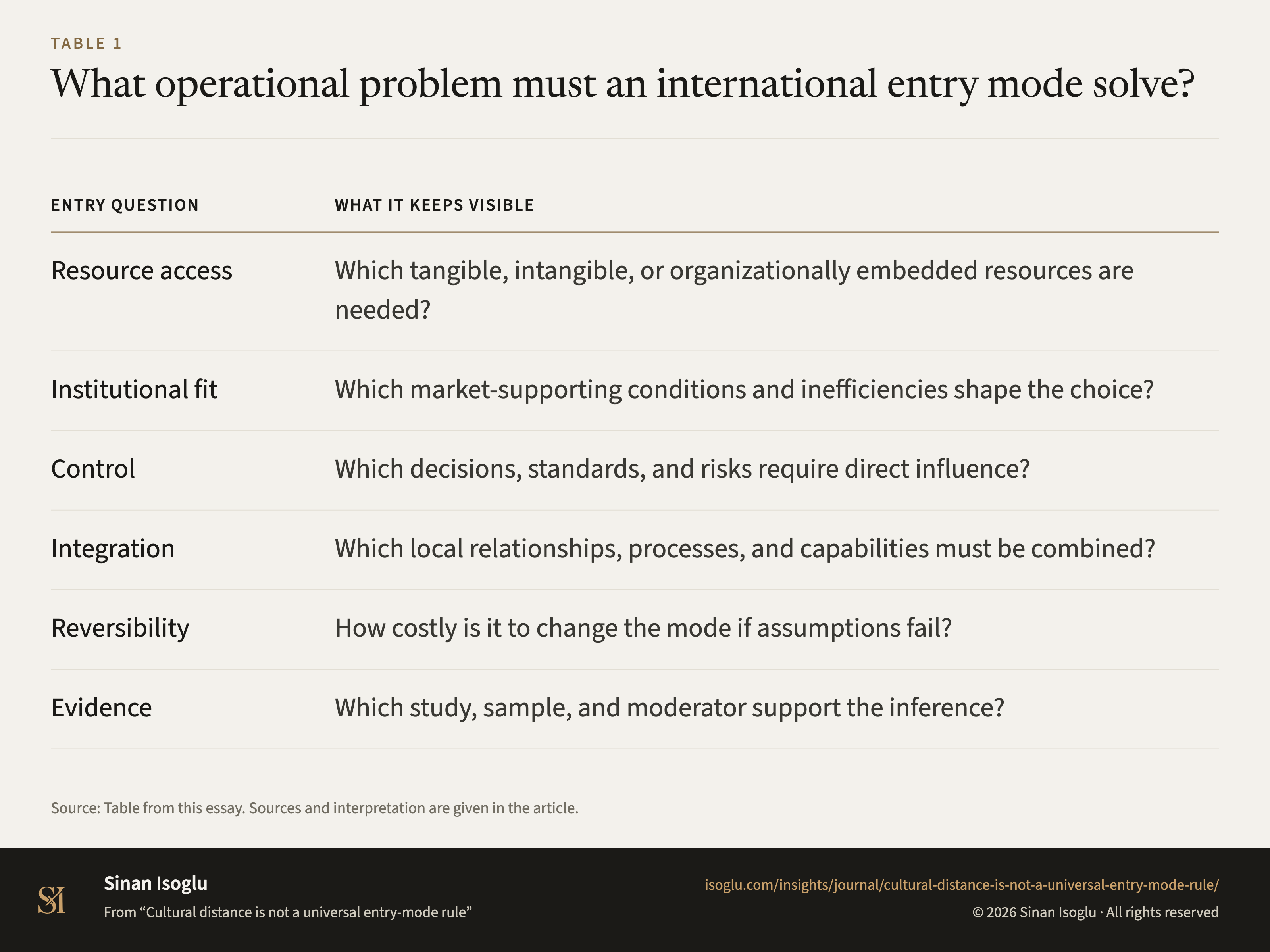
Table 1Table
What operational problem must an international entry mode solve?
Cultural distance is not a universal entry-mode rule
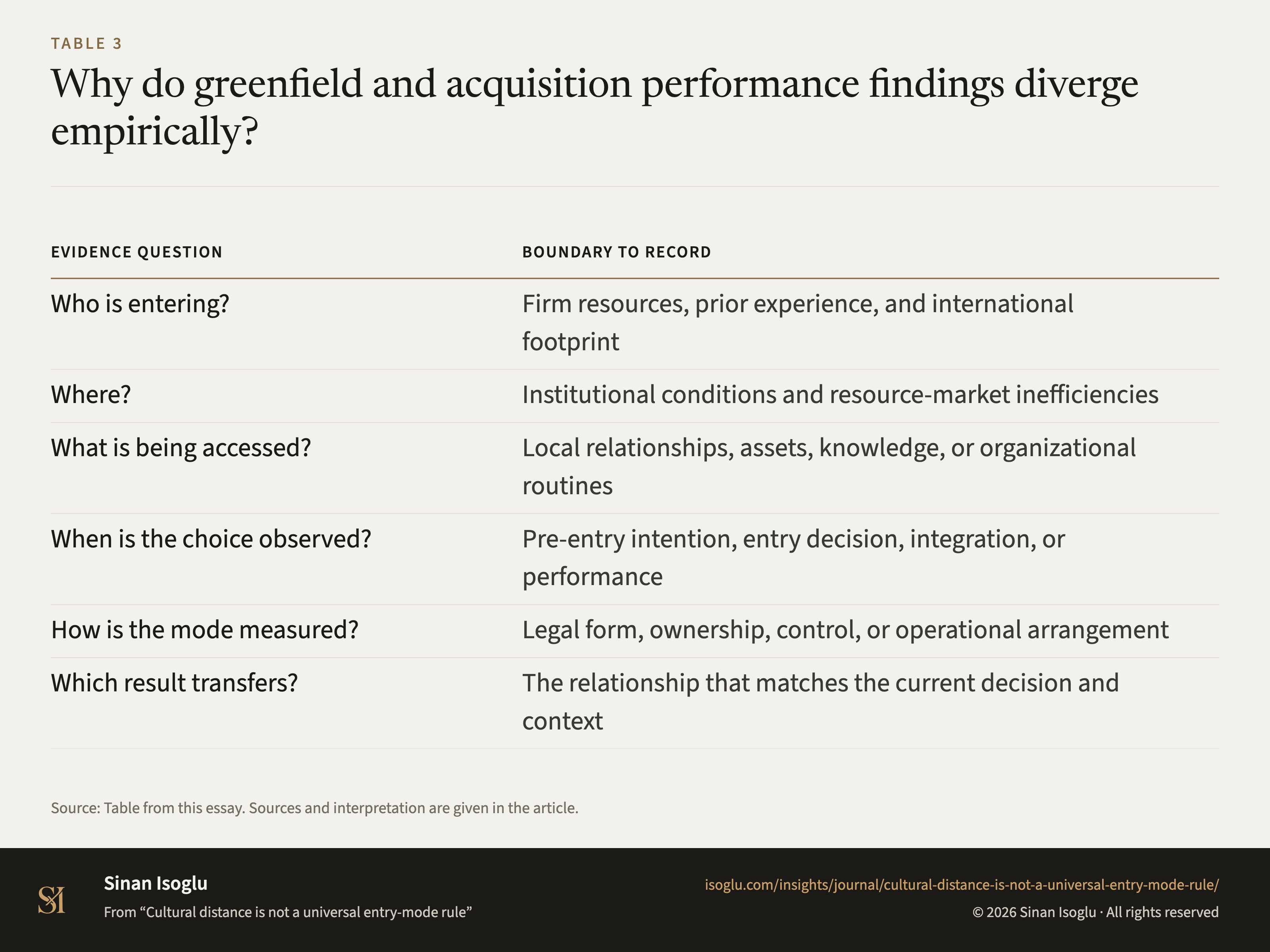
Table 3Table
Why do greenfield and acquisition performance findings diverge empirically?
Cultural distance is not a universal entry-mode rule
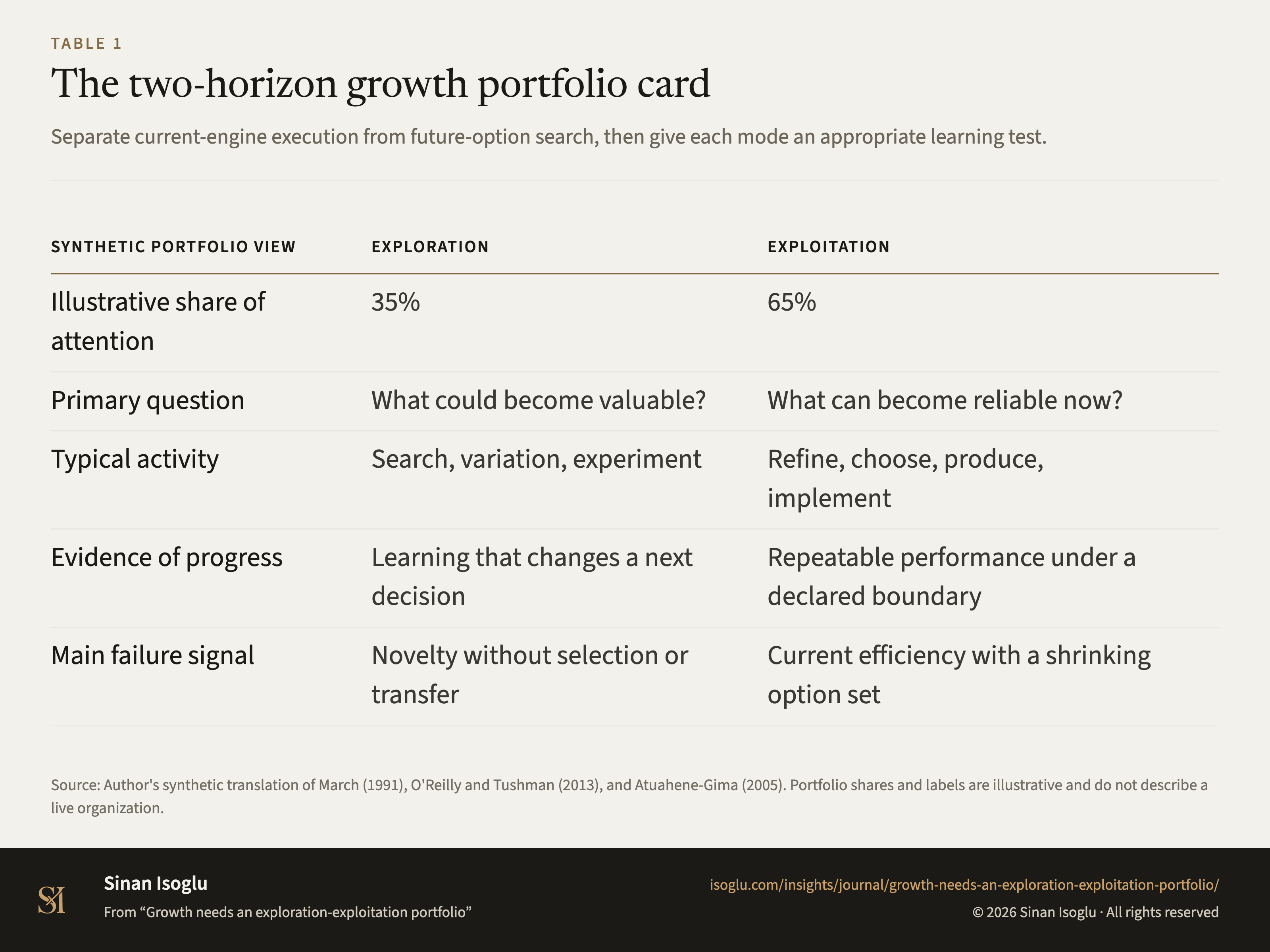
Table 1Table
The two-horizon growth portfolio card
Growth needs an exploration-exploitation portfolio
Contact
Bring the question you're working on.
Research, a guest lecture, or a commercial question.