Table 1From “Channel conflict is not one number”
The conflict-performance reading
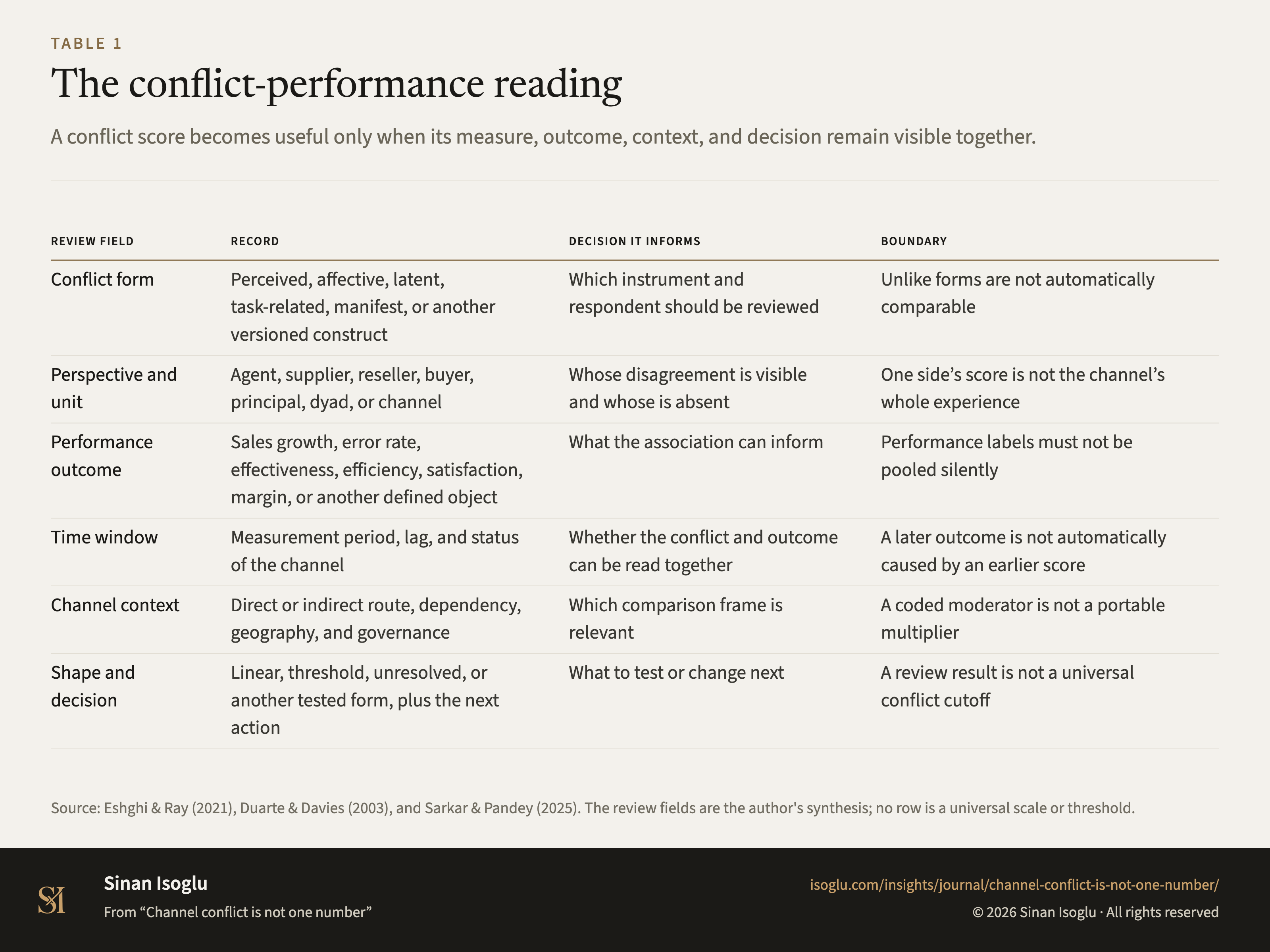
A conflict score becomes useful only when its measure, outcome, context, and decision remain visible together.
Table 1The conflict-performance reading
| Review field | Record | Decision it informs | Boundary |
|---|---|---|---|
| Conflict form | Perceived, affective, latent, task-related, manifest, or another versioned construct | Which instrument and respondent should be reviewed | Unlike forms are not automatically comparable |
| Perspective and unit | Agent, supplier, reseller, buyer, principal, dyad, or channel | Whose disagreement is visible and whose is absent | One side's score is not the channel's whole experience |
| Performance outcome | Sales growth, error rate, effectiveness, efficiency, satisfaction, margin, or another defined object | What the association can inform | Performance labels must not be pooled silently |
| Time window | Measurement period, lag, and status of the channel | Whether the conflict and outcome can be read together | A later outcome is not automatically caused by an earlier score |
| Channel context | Direct or indirect route, dependency, geography, and governance | Which comparison frame is relevant | A coded moderator is not a portable multiplier |
| Shape and decision | Linear, threshold, unresolved, or another tested form, plus the next action | What to test or change next | A review result is not a universal conflict cutoff |
Swipe or scroll horizontally if the table is wider than your screen.
Source: Eshghi & Ray (2021), Duarte & Davies (2003), and Sarkar & Pandey (2025). The review fields are the author's synthesis; no row is a universal scale or threshold.
Source and evidence
Each line names a claim related to this exhibit, its source, and how it was checked.
- B ER21-C2 The aggregate conflict-performance association is negative across individual and joint outcomes and across the study's relational model specificationsEshghi & Ray. (2020)
- B ER21-C3 The negative association is stronger in the coded high-dependency, international, and North American channel settingsEshghi & Ray. (2020)
- B ER21-C4 Measurement and sampling characteristics moderate the empirical conflict-performance links reported in the literatureEshghi & Ray. (2020)
- B ER21-C5 The meta-analysis is correlational and cannot supply a fine-grained causal inference about a named conflict interventionEshghi & Ray. (2020)
- B DD03-C2 The study measures effectiveness as sales growth and efficiency through error ratesDuarte & Davies. (2002)
- B DD03-C3 A linear model best fits the conflict-effectiveness relation in the tested data, with no statistically significant support for an inverted-U maximumDuarte & Davies. (2002)
- B DD03-C4 An S-shaped threshold relation generally fits the relation between perceived or affective conflict and efficiency, with rapid conflict growth after an observed error-rate thresholdDuarte & Davies. (2002)
- B DD03-C5 Conflict measures differ by form and perspective, including latent, perceived, affective, agent-only, and dyadic measuresDuarte & Davies. (2002)
- B SP25-C1 Sarkar and Pandey combine bibliometric analysis, literature review, and semi-structured interviews to study B2B channel conflictSarkar & Pandey. (2025)
- B SP25-C5 The paper's framework is derived from literature and interview themes and is not a causal estimate of a universal conflict thresholdSarkar & Pandey. (2025)
- B CCN27-C1 A channel-conflict label is incomplete until the measure, perspective, performance outcome, context, and time window are namedAuthor framework grounded in ER21, DD03, and SP25
- B CCN27-C2 The same conflict score can support different decisions when the outcome is effectiveness rather than efficiencyAuthor translation grounded in DD03
- B CCN27-C3 A threshold observed for one efficiency outcome is not a universal cutoff for every channel or performance measureAuthor boundary grounded in DD03 and ER21
- B CCN27-C4 A usable review record keeps the conflict measure, unit, outcome, time, context, observed shape, and decision togetherAuthor framework
- B CCN27-C5 A literature map can identify recurring questions without proving that collaboration or one governance action causes performanceAuthor boundary grounded in SP25
Grades: A, verified against the printed page of the primary source · B, primary source, text layer only · C, authoritative secondary · D, reported.
From the essay
Go-to-market strategy
Channel conflict is not one number
Channel conflict can harm performance, but evidence varies by measure, dependency, context, and threshold. Diagnose the slope before prescribing harmony.
Read the essayThis exhibit belongs to an essay: the numbers live here, the argument lives there.
Cite or embed
Related exhibits
Table 1Table
The objects behind preferred customer treatment
Preferred customer treatment is relative resource allocation
Figure 1Figure
The synthetic partner-route comparison
What is partner-led growth? A channel needs a counterfactual
Figure 1Figure
The synthetic product-led growth worksheet
What is product-led growth? Product usage is not a growth loop
Contact
Bring the question you're working on.
Research, a guest lecture, or a commercial question.