Table 1From “Preferred customer treatment is relative resource allocation”
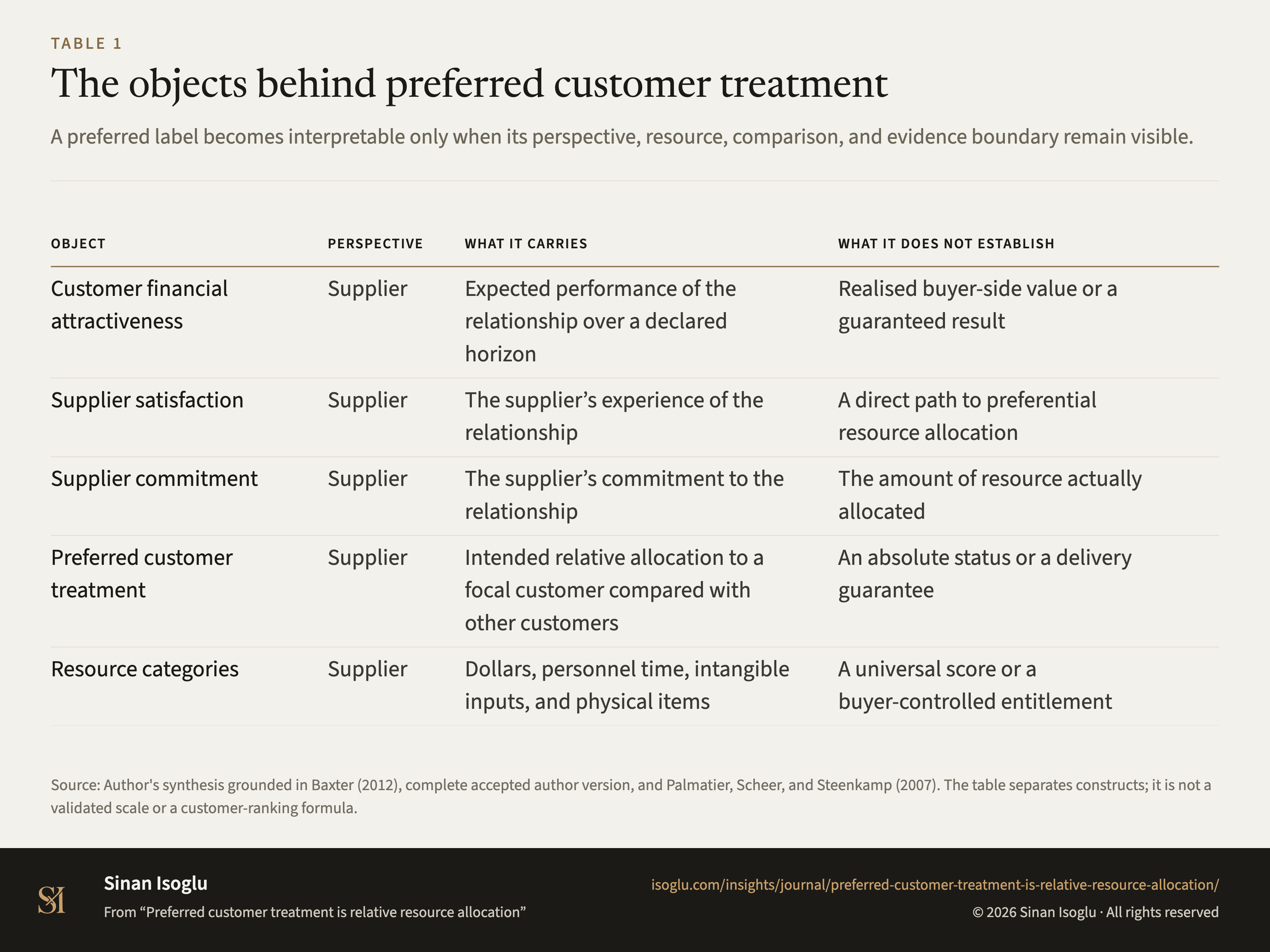
The objects behind preferred customer treatment
A preferred label becomes interpretable only when its perspective, resource, comparison, and evidence boundary remain visible.
Table 1The objects behind preferred customer treatment
| Object | Perspective | What it carries | What it does not establish |
|---|---|---|---|
| Customer financial attractiveness | Supplier | Expected performance of the relationship over a declared horizon | Realised buyer-side value or a guaranteed result |
| Supplier satisfaction | Supplier | The supplier's experience of the relationship | A direct path to preferential resource allocation |
| Supplier commitment | Supplier | The supplier's commitment to the relationship | The amount of resource actually allocated |
| Preferred customer treatment | Supplier | Intended relative allocation to a focal customer compared with other customers | An absolute status or a delivery guarantee |
| Resource categories | Supplier | Dollars, personnel time, intangible inputs, and physical items | A universal score or a buyer-controlled entitlement |
Swipe or scroll horizontally if the table is wider than your screen.
Source: Author's synthesis grounded in Baxter (2012), complete accepted author version, and Palmatier, Scheer, and Steenkamp (2007). The table separates constructs; it is not a validated scale or a customer-ranking formula.
Source and evidence
Each line names a claim related to this exhibit, its source, and how it was checked.
- A BX12-C1 Baxter takes the supplier's perspective and asks how a buyer can attract seller resources in a B2B relationship: "it investigates how the supplier perspective of customer financial attractiveness affects the attitudes and actions of the supplier towards the buyer, rather than taking the buyer’s perspective across the relationship"baxter-2012-preferred-customer-treatment
- A BX12-C2 Preferred customer treatment is the supplier's intended relative allocation of resources to a focal customer compared with other customers, in the paper's own definition: "This preferred customer treatment is a construct that describes the relative intended level of resource allocation by the supplier, compared to its allocations to other customers"baxter-2012-preferred-customer-treatment
- A BX12-C3 The preferred-treatment construct covers supplier dollars, personnel time, intangible inputs and physical items, named in the questionnaire itself: "Dollars your firm puts into the relationship", "Your intangible inputs, such as your knowledge, skills, ingenuity, relationships", and "Respondents to the survey report on the level of allocation of a set of typical resources, by their firm, to the customer that is the subject of the questionnaire"baxter-2012-preferred-customer-treatment
- A BX12-C4 Supplier commitment and preferred treatment are distinct constructs, and the paper says so: "The study further establishes that supplier commitment to a relationship and the preference given to attractive high-performing customers are two distinct relationship effects"baxter-2012-preferred-customer-treatment
- A BX12-C9 Supplier satisfaction has no significant direct path to preferred treatment and operates through supplier commitment: "The paths through supplier commitment fully mediate the H4 path, as the non-significant H4 path and a statistically significant bootstrapped indirect path through H6 and H2 of weight 0.19 shows"baxter-2012-preferred-customer-treatment
- A BX12-C10 Customer financial attractiveness is a forward-looking supplier judgement, not a buyer-side loyalty score: "The study conceptualizes the customer financial attractiveness construct as the supplier’s perspective of the likely performance of the subject relationship over the next three years"baxter-2012-preferred-customer-treatment
- A PSS07-C4 The paper reports measured firm and interface levers that alter salesperson-owned loyalty and firm-loyalty paths: "Increasing relationship-enhancing activities and value received by the customer builds both salesperson-owned loyalty and loyalty to the selling firm"; the impact is moderated by selling-firm consistency and loyalty-capturing strategiesPalmatier, Scheer & Steenkamp (2007), abstract and Tables 3 and 4
Grades: A, verified against the printed page of the primary source · B, primary source, text layer only · C, authoritative secondary · D, reported.
From the essay
Go-to-market strategy
Preferred customer treatment is relative resource allocation
Preferred customer treatment is a supplier-side resource decision. Separate attractiveness, satisfaction, commitment, and treatment before ranking.
Read the essayThis exhibit belongs to an essay: the numbers live here, the argument lives there.
Cite or embed
Contact
Bring the question you're working on.
Research, a guest lecture, or a commercial question.