Figure 5From “BANT vs MEDDIC: a qualification checklist is a hypothesis”
What a lead scorecard cutoff passed and rejected, in sample
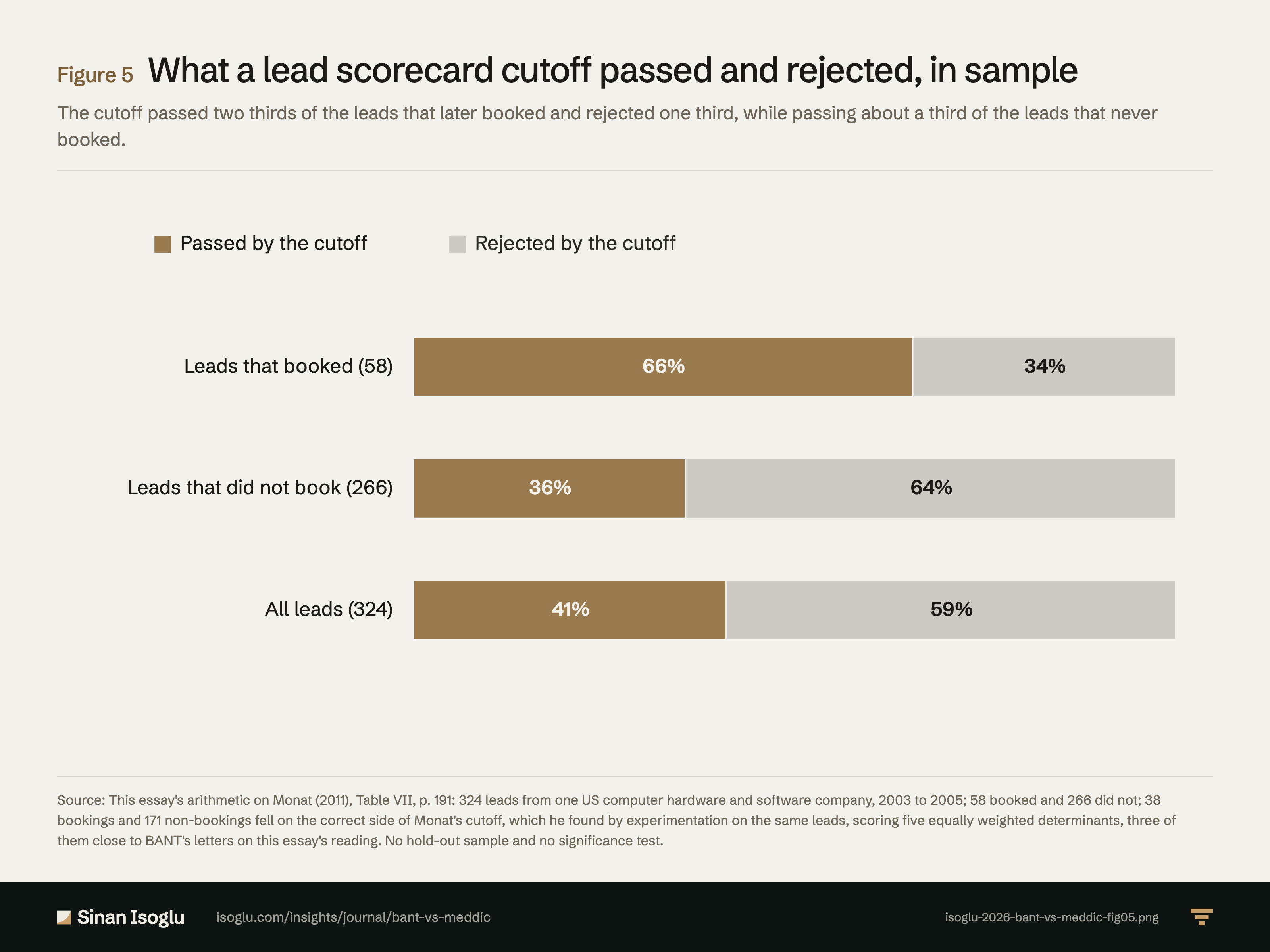
The cutoff passed two thirds of the leads that later booked and rejected one third, while passing about a third of the leads that never booked.
Figure 5What a lead scorecard cutoff passed and rejected, in sample
Source: This essay's arithmetic on Monat (2011), Table VII, p. 191: 324 leads from one US computer hardware and software company, 2003 to 2005; 58 booked and 266 did not; 38 bookings and 171 non-bookings fell on the correct side of Monat's cutoff, which he found by experimentation on the same leads, scoring five equally weighted determinants, three of them close to BANT's letters on this essay's reading. No hold-out sample and no significance test.
Source and evidence
Each line names a claim related to this exhibit, its source, and how it was checked.
- B A verified against the printed page of the primary sourceB primary source, text layer onlyC authoritative secondaryD reported Arithmetic on the outcome tests. Jolson, Table 2 and the results table: 32/104 = 30.8%, 48/622 = 7.7%, ratio 4.0; 48 − 32 = 16 more sales; $95,320 − $64,200 = $31,120; cost per lead $9,600/104 = $92.31 and $9,600/622 = $15.43 from the stated $4,800 per 10,000 mailers. Monat, Table VII read as correct predictions: passed leads = 38 + (266 − 171) = 133, of which 38 booked (28.6%); rejected leads = (58 − 38) + 171 = 191, of which 20 booked (10.5%); all leads 58/324 = 17.9%; 20 of 58 bookings rejected (34.5%); overall correct (38 + 171)/324 = 64.5%, below the 82.1% of a rule that calls every lead a non-booking, so the page reports the separation, not the accuracy. Three of Monat's five scored determinants (need, urgency, ability to purchase) read as close to BANT is this essay's mapping. Figure 5 (stack) shows the same Table VII counts as shares of each group: bookings 38 passed and 20 rejected (66 and 34 per cent), non-bookings 95 and 171 (36 and 64 per cent), all leads 133 and 191 (41 and 59 per cent); Figure 4 (mirror) shows Jolson's Table 2 sales per lead (30.8 and 7.7 per cent) against sales from leads ($64,200 and $95,320).Author arithmetic
- A A verified against the printed page of the primary sourceB primary source, text layer onlyC authoritative secondaryD reported The scorecard test: items include funding, decision authority, timeframe and an approved project; five of eight determinants scored (need, urgency, ability to purchase, trust in the vendor, competition), equally weighted and summed, with lead source and contact direction counting towards need and urgency; only the summed score is reported, so no separation can be credited to the BANT-like items; 324 leads drawn at random from about 750 at one US computer hardware and software company, 2003 to 2005, coded from archived e-mails by one analyst; 58 (17.9%) converted, 266 did not; Table VII (p. 191, page image): 38 of 58 and 171 of 266 correctly predicted (66% and 64%); cutoff found by experimentation on the same leads; no hold-out, no significance tests; three of eight determinants had no data; the model is not formally validated. The text says 264 non-converting leads, Table VII 266 (pp. 189 to 191): "five of the eight customer purchase decision determinants"; "Is the project funded?"; "Decision authority of the contact"; "Is there an approved project?"; "The 324 leads analyzed were selected at random from a total of"; "that sells computer hardware and software, covering the time period 2003-2005"; "a single analyst scrutinized the archived e-mails"; "Of the 324 leads analyzed, 58 (17.9 percent) eventually converted to bookings while 266 did not."; "Number of leads that developed into sales"; "By experimentation, a cutoff score of"; "It did not use hold-out samples for validation"; "no tests of statistical significance were performed"; "no data were available from the archived leads for any lead for the last three purchase determinants"; "The proposed model has not yet been formally field validated"Monat (2011)
From the essay
Revenue operations & AI
BANT vs MEDDIC: a qualification checklist is a hypothesis
BANT checks budget, authority, need and timing; MEDDIC maps how a buying group decides. In a 1988 field test, tight leads converted better and sold less.
Read the essayThis exhibit belongs to an essay: the numbers live here, the argument lives there.
Cite or embed
Related exhibits
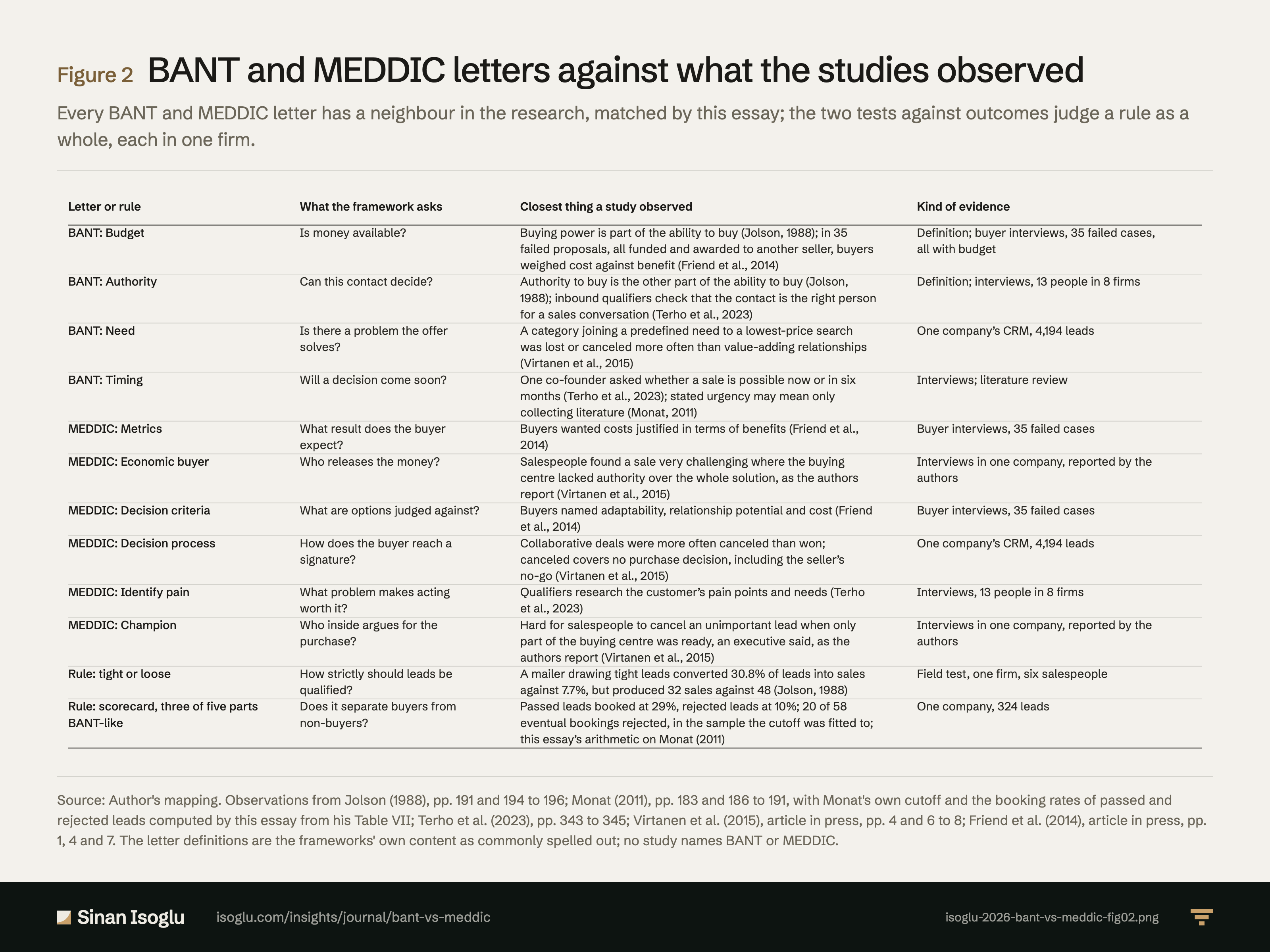
Figure 2Figure
BANT and MEDDIC letters against what the studies observed
BANT vs MEDDIC: a qualification checklist is a hypothesis
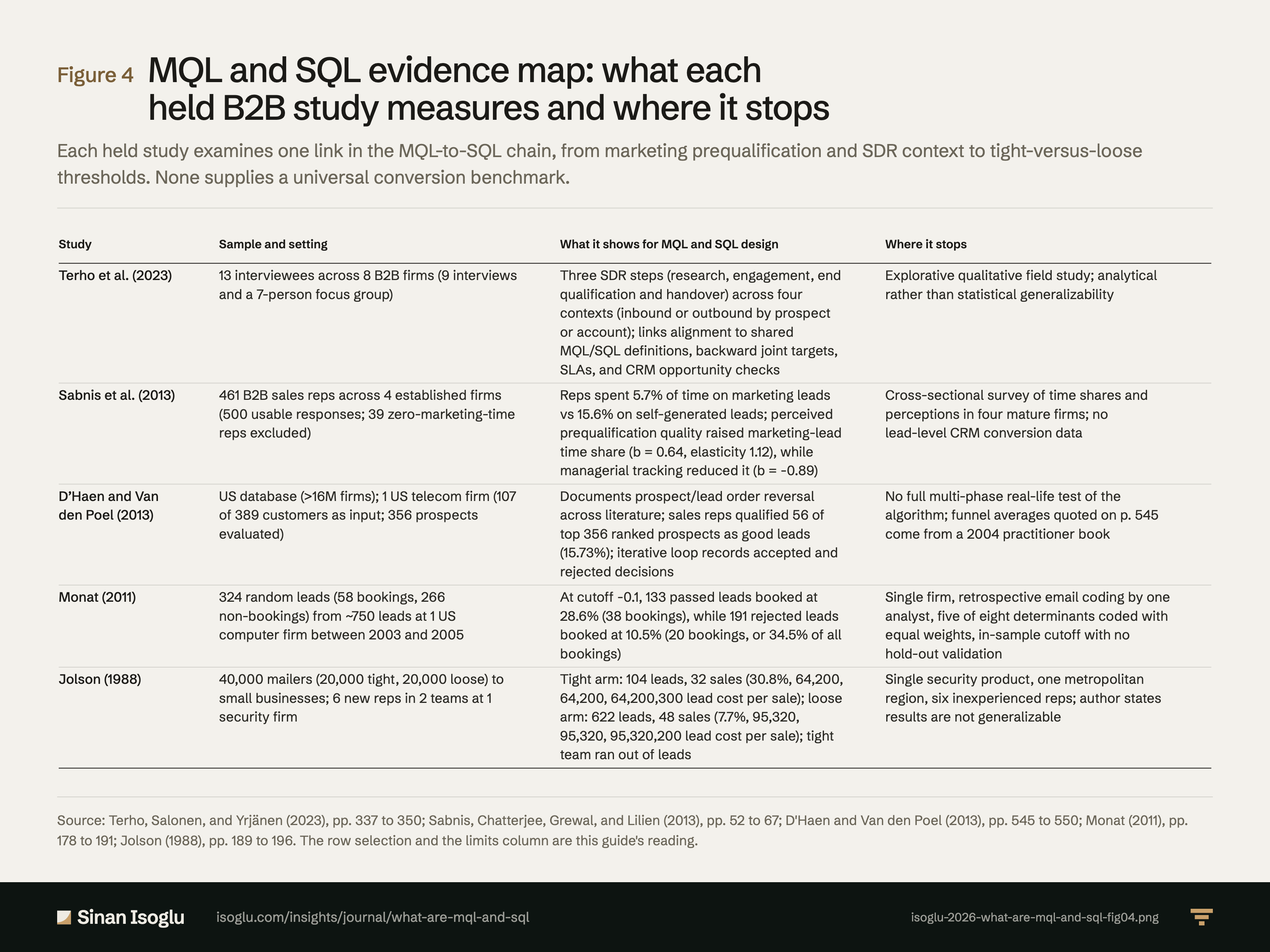
Figure 4Figure
MQL and SQL evidence map: what each held B2B study measures and where it stops
MQL and SQL: what are marketing- and sales-qualified leads?
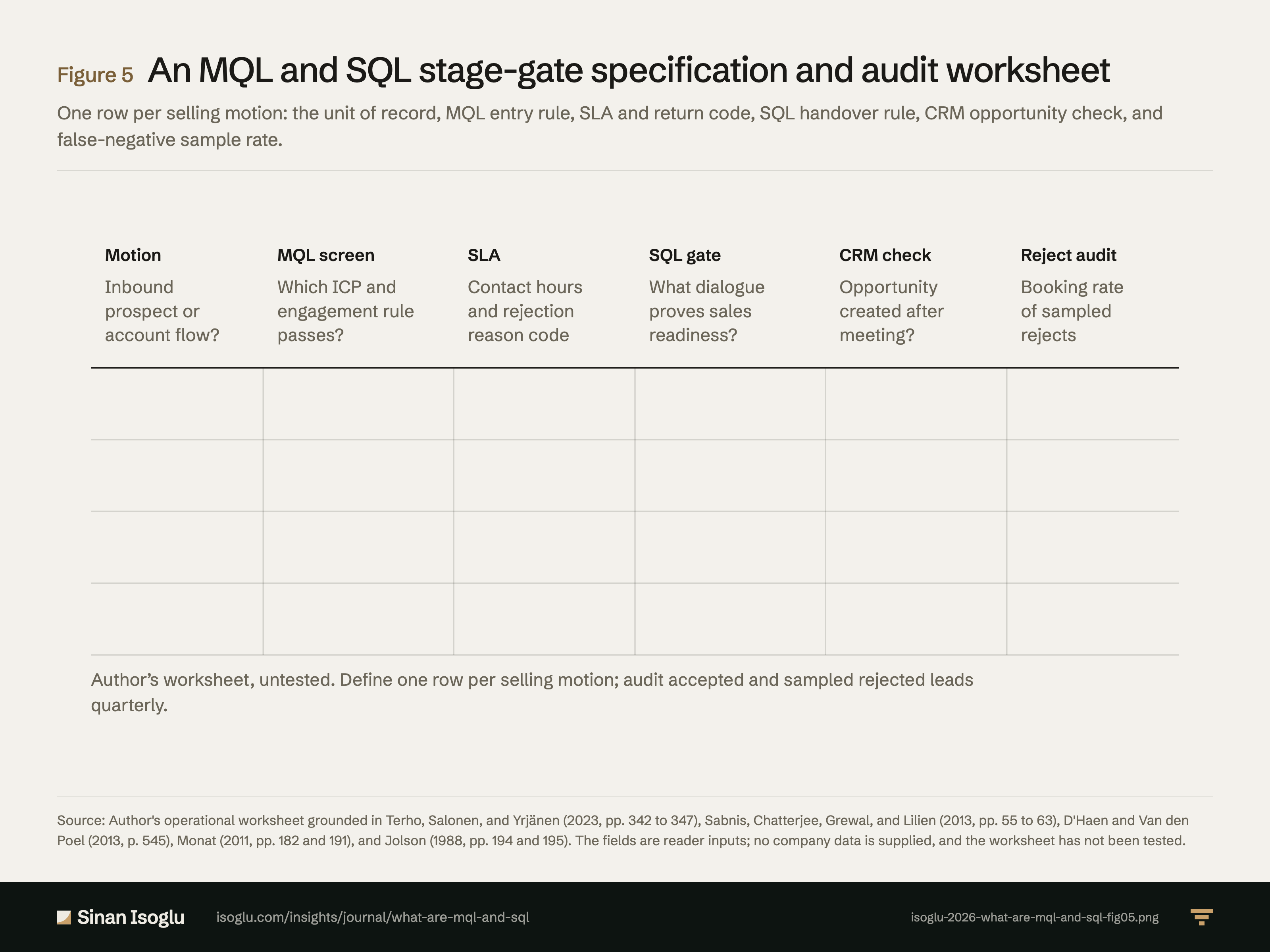
Figure 5Figure
An MQL and SQL stage-gate specification and audit worksheet
MQL and SQL: what are marketing- and sales-qualified leads?
Contact
Bring the question you're working on.
Research, a guest lecture, or a commercial question.