Figure 2From “BANT vs MEDDIC: a qualification checklist is a hypothesis”
BANT and MEDDIC letters against what the studies observed
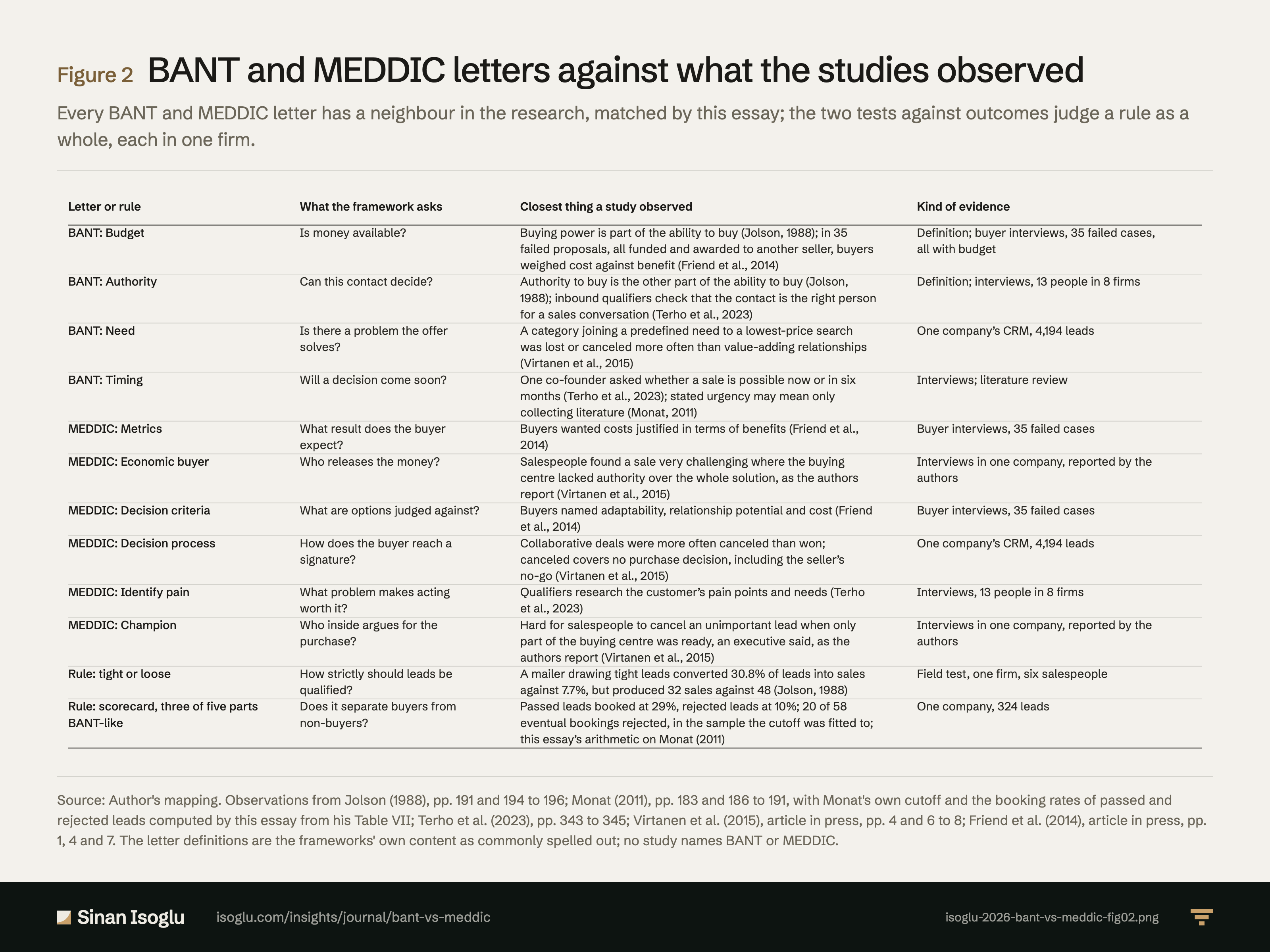
Every BANT and MEDDIC letter has a neighbour in the research, matched by this essay; the two tests against outcomes judge a rule as a whole, each in one firm.
Figure 2BANT and MEDDIC letters against what the studies observed
| Letter or rule | What the framework asks | Closest thing a study observed | Kind of evidence |
|---|---|---|---|
| BANT: Budget | Is money available? | Buying power is part of the ability to buy (Jolson, 1988); in 35 failed proposals, all funded and awarded to another seller, buyers weighed cost against benefit (Friend et al., 2014) | Definition; buyer interviews, 35 failed cases, all with budget |
| BANT: Authority | Can this contact decide? | Authority to buy is the other part of the ability to buy (Jolson, 1988); inbound qualifiers check that the contact is the right person for a sales conversation (Terho et al., 2023) | Definition; interviews, 13 people in 8 firms |
| BANT: Need | Is there a problem the offer solves? | A category joining a predefined need to a lowest-price search was lost or canceled more often than value-adding relationships (Virtanen et al., 2015) | One company's CRM, 4,194 leads |
| BANT: Timing | Will a decision come soon? | One co-founder asked whether a sale is possible now or in six months (Terho et al., 2023); stated urgency may mean only collecting literature (Monat, 2011) | Interviews; literature review |
| MEDDIC: Metrics | What result does the buyer expect? | Buyers wanted costs justified in terms of benefits (Friend et al., 2014) | Buyer interviews, 35 failed cases |
| MEDDIC: Economic buyer | Who releases the money? | Salespeople found a sale very challenging where the buying centre lacked authority over the whole solution, as the authors report (Virtanen et al., 2015) | Interviews in one company, reported by the authors |
| MEDDIC: Decision criteria | What are options judged against? | Buyers named adaptability, relationship potential and cost (Friend et al., 2014) | Buyer interviews, 35 failed cases |
| MEDDIC: Decision process | How does the buyer reach a signature? | Collaborative deals were more often canceled than won; canceled covers no purchase decision, including the seller's no-go (Virtanen et al., 2015) | One company's CRM, 4,194 leads |
| MEDDIC: Identify pain | What problem makes acting worth it? | Qualifiers research the customer's pain points and needs (Terho et al., 2023) | Interviews, 13 people in 8 firms |
| MEDDIC: Champion | Who inside argues for the purchase? | Hard for salespeople to cancel an unimportant lead when only part of the buying centre was ready, an executive said, as the authors report (Virtanen et al., 2015) | Interviews in one company, reported by the authors |
| Rule: tight or loose | How strictly should leads be qualified? | A mailer drawing tight leads converted 30.8% of leads into sales against 7.7%, but produced 32 sales against 48 (Jolson, 1988) | Field test, one firm, six salespeople |
| Rule: scorecard, three of five parts BANT-like | Does it separate buyers from non-buyers? | Passed leads booked at 29%, rejected leads at 10%; 20 of 58 eventual bookings rejected, in the sample the cutoff was fitted to; this essay's arithmetic on Monat (2011) | One company, 324 leads |
Swipe or scroll horizontally if the table is wider than your screen.
Source: Author's mapping. Observations from Jolson (1988), pp. 191 and 194 to 196; Monat (2011), pp. 183 and 186 to 191, with Monat's own cutoff and the booking rates of passed and rejected leads computed by this essay from his Table VII; Terho et al. (2023), pp. 343 to 345; Virtanen et al. (2015), article in press, pp. 4 and 6 to 8; Friend et al. (2014), article in press, pp. 1, 4 and 7. The letter definitions are the frameworks' own content as commonly spelled out; no study names BANT or MEDDIC.
Source and evidence
Each line names a claim related to this exhibit, its source, and how it was checked.
- B A verified against the printed page of the primary sourceB primary source, text layer onlyC authoritative secondaryD reported The mapping of study observations to letters (Figure 2 and the inline readings): inbound timing and authority checks to BANT (Terho); account-level stakeholder mapping to MEDDIC's economic buyer, decision process and champion (Terho, Virtanen); buyers' cost justification read as closer to MEDDIC's metrics, among funded deals only; the study cannot say what a budget check catches, since budget losses were excluded by design; the Virtanen low category read only as a buyer with a specified need shopping on price, not as a test of BANT's N; Jolson's ability to buy read as BANT's budget and authority, his readiness to buy as timing; Monat's funding, authority and timeframe items read as BANT-like. No study names a framework or tests a letterAuthor reading
- B A verified against the printed page of the primary sourceB primary source, text layer onlyC authoritative secondaryD reported Arithmetic on the outcome tests. Jolson, Table 2 and the results table: 32/104 = 30.8%, 48/622 = 7.7%, ratio 4.0; 48 − 32 = 16 more sales; $95,320 − $64,200 = $31,120; cost per lead $9,600/104 = $92.31 and $9,600/622 = $15.43 from the stated $4,800 per 10,000 mailers. Monat, Table VII read as correct predictions: passed leads = 38 + (266 − 171) = 133, of which 38 booked (28.6%); rejected leads = (58 − 38) + 171 = 191, of which 20 booked (10.5%); all leads 58/324 = 17.9%; 20 of 58 bookings rejected (34.5%); overall correct (38 + 171)/324 = 64.5%, below the 82.1% of a rule that calls every lead a non-booking, so the page reports the separation, not the accuracy. Three of Monat's five scored determinants (need, urgency, ability to purchase) read as close to BANT is this essay's mapping. Figure 5 (stack) shows the same Table VII counts as shares of each group: bookings 38 passed and 20 rejected (66 and 34 per cent), non-bookings 95 and 171 (36 and 64 per cent), all leads 133 and 191 (41 and 59 per cent); Figure 4 (mirror) shows Jolson's Table 2 sales per lead (30.8 and 7.7 per cent) against sales from leads ($64,200 and $95,320).Author arithmetic
- A A verified against the printed page of the primary sourceB primary source, text layer onlyC authoritative secondaryD reported Qualification as Jolson reports it from salespeople's judgment or intuition: needs or desires the seller can satisfy, a willingness or readiness to buy or at least to be exposed to the offer, and ability to buy as authority plus buying power, often dwarfed by the other two; not all highly qualified prospects show all three at once, so the dimensions are not a joint test; a lead is highly qualified only if the salesperson thinks it is; tight leads are high-probability prospects; in a hypothetical put to sales meetings (Jones and Smith, not the experiment), salespeople prefer high conversion rates because they bring more frequent reinforcement, which does not confirm that conversion rates track effectiveness and efficiency (pp. 191, 192): "Based on the judgment or intuition of the salespeople, qualified prospects are people or organizations with needs or desires that can be satisfied by the seller’s products or services"; "must exhibit a willingness or readiness to buy or at least a willingness to be exposed to the seller’s offer"; "consists of authority to buy and buying power in the form of cash or credit"; "often dwarfed by the other two"; "Yet, not all highly qualified prospects are described by a simultaneous desire for the seller’s product, receptiveness to a sales call, and buying power."; "A lead is highly qualified only if the salesperson thinks it is."; "where tight leads are considered to be high probability prospects"; "The author has introduced the following hypothetical situation at sales meetings"; "A higher conversion rate means more frequent reinforcement"; "but does not confirm the correlation of the conversion rates of leads and presentations with selling effectiveness and efficiency"Jolson (1988)
- A A verified against the printed page of the primary sourceB primary source, text layer onlyC authoritative secondaryD reported Results, read from the page images of pp. 194 and 195: leads returned 104 (tight) and 622 (loose), appointments 66 and 174, presentations 48 and 104, sales on leads 32 and 48, other sales 3 and 4; Table 2: sales from leads $64,200 and $95,320, salesperson earnings $10,144 and $12,761, sales per lead 30.8% and 7.7%, sales per presentation 66.7% and 46.2%, cost per lead $92.30 and $15.43, lead cost per sale $300.00 and $200.00; the tight team ran out of places to go; loose leads produced more volume, earnings and returns at lower cost per sale, tight leads a higher conversion rate and more motivation (pp. 194 to 196): "A Comparison of Tight vs. Loose Sales Leads"; "Almost one third of the T leads were converted into sales, whereas 13 loose leads were required for a sale."; "The sales emerging from tight leads cost 50% more."; "The T sales group seemed to run out of places to go and demonstrated little initiative and weak work habits in developing their own prospects."; "loose leads produced more sales volume, higher earnings for salespeople, a larger lead return rate, a lower lead cost per sale, and a lower compensation-cost ratio"; "Tight leads produced a higher conversion rate into sales and an increased level of motivation for sales force members."Jolson (1988)
- A A verified against the printed page of the primary sourceB primary source, text layer onlyC authoritative secondaryD reported Review of lead characterization models: several score need, timing, budget or authority, none has been validated; choosing characteristics is usually an educated guess; stated urgency may only mean collecting literature; good predictors vary by industry and company; no single model fits all companies (pp. 178, 182, 183, 191): "and budget (approved budget, budget requested but not approved, budget not requested)"; "believes that the prospect’s need and pain or discomfort level, timing, authority to make the purchase decision"; "although there are several models purported to characterize sales leads, none has been validated"; "determining which characteristics are important is usually an educated guess based upon the sales manager’s personal experience, gut feel, and the sales literature he/she has recently read"; "a prospect expressing great time urgency may in fact only be urgently collecting literature"; "exactly which independent lead characteristics are good conversion predictors varies from industry to industry and from company to company within industries"; "no single quantitative lead characterization model will be accurate for all companies"Monat (2011)
- A A verified against the printed page of the primary sourceB primary source, text layer onlyC authoritative secondaryD reported The scorecard test: items include funding, decision authority, timeframe and an approved project; five of eight determinants scored (need, urgency, ability to purchase, trust in the vendor, competition), equally weighted and summed, with lead source and contact direction counting towards need and urgency; only the summed score is reported, so no separation can be credited to the BANT-like items; 324 leads drawn at random from about 750 at one US computer hardware and software company, 2003 to 2005, coded from archived e-mails by one analyst; 58 (17.9%) converted, 266 did not; Table VII (p. 191, page image): 38 of 58 and 171 of 266 correctly predicted (66% and 64%); cutoff found by experimentation on the same leads; no hold-out, no significance tests; three of eight determinants had no data; the model is not formally validated. The text says 264 non-converting leads, Table VII 266 (pp. 189 to 191): "five of the eight customer purchase decision determinants"; "Is the project funded?"; "Decision authority of the contact"; "Is there an approved project?"; "The 324 leads analyzed were selected at random from a total of"; "that sells computer hardware and software, covering the time period 2003-2005"; "a single analyst scrutinized the archived e-mails"; "Of the 324 leads analyzed, 58 (17.9 percent) eventually converted to bookings while 266 did not."; "Number of leads that developed into sales"; "By experimentation, a cutoff score of"; "It did not use hold-out samples for validation"; "no tests of statistical significance were performed"; "no data were available from the archived leads for any lead for the last three purchase determinants"; "The proposed model has not yet been formally field validated"Monat (2011)
- A A verified against the printed page of the primary sourceB primary source, text layer onlyC authoritative secondaryD reported Inbound, prospect-level qualification as interviewees and authors describe it: lead quality judged against ideal customer profile fit; whether a sale is possible now or in six months; whether the contact is the right person; handover once the contact can carry a sales conversation; qualification criteria vary by company but should exist (pp. 343 to 345). The mapping to BANT's timing and authority is the essay's: "Respondents noted that the quality of a lead is typically assessed against fit with an ideal customer profile based on criteria such as the customer’s purchasing-related potential or fit with the seller’s offering."; "We tried to find out if it’s a case where we can sell something right now or maybe six months down the line"; "many leads that contact us are not the right persons from the perspective of sales"; "once the SDR verifies that the lead is a person who can carry out conversations with sales"; "What a sales qualified lead looks like can be customized for the company"; "but always have qualification criteria"Terho et al. (2023)
- A A verified against the printed page of the primary sourceB primary source, text layer onlyC authoritative secondaryD reported Complex, account-level qualification: research on the customer as a decision-making unit; prolonged engagement of many stakeholders at account level; stakeholder mapping; research on pain points and needs (pp. 343 to 345): "In more complex sales situations, the SDR proactively conducts deeper background research to understand the customer more fully as a decision-making unit"; "Complex purchase decisions require prolonged engagement of multiple and varied customer stakeholders at the account level rather than at the individual prospect level"; "map the key stakeholders in the customer’s decision-making unit"; "research also builds an understanding of customer pain points and their needs"Terho et al. (2023)
- A A verified against the printed page of the primary sourceB primary source, text layer onlyC authoritative secondaryD reported Outcomes and relational complexity in one IT solutions company: 4,194 leads; canceled means stopped with no purchasing decision, including a no-go decision from the supplier's side; relational complexity is a salesperson-reported CRM category, low meaning a predefined need and a lowest-price search; against medium, high raised the relative log odds of canceled versus won by 0.827 (and lost versus won by 0.398); low raised lost versus won by 0.301 and canceled versus won by 0.315, so medium was the least likely to be lost or canceled (held copy, article in press, pp. 4, 6; the low category joins a predefined need to a lowest-price search, so it does not test a need criterion alone): "The final dataset contains 4194 sales leads, and each lead is nested under a certain customer."; "leads are those of which have been stopped because the customer made no purchasing decision"; "The reason might be a no-go decision from the suppliers' side, or that the customer has expressed unwillingness to proceed further with that particular opportunity."; "The classification of the relational complexity is drawn from the sponsoring company's CRM database and it is a salesperson reported measure."; "When relational complexity is low, the customer has already predefined the need and is looking for the lowest price."; "this significantly increased the probability of leads to be canceled compared to the same probability with medium relational complexity"; "leads with medium relational complexity (value-added) were less likely to be lost or canceled compared to the sales leads with low relational complexity"Virtanen et al. (2015)
- A A verified against the printed page of the primary sourceB primary source, text layer onlyC authoritative secondaryD reported Interview material as the authors report it, in their words, not the informants': the salespeople mentioned that a sale is very challenging when the buying center lacks authority over the whole solution; the authors paraphrase a C-level executive (i16) that it would be hard for the salespeople to cancel an unimportant lead when only part of the buying center is ready (hard to cancel, not hard to close); the authors' example of a customer IT manager whose ideas other functions do not support; verifying the need is complicated with several influencers (held copy, article in press, pp. 7, 8): "sales situation becomes very challenging when the customer's buying center does not have the authority to decide from all the aspects of the solution"; "He adds that it would be hard for the salespeople to cancel a lead that is not important"; "it would be hard for the salespeople to cancel a lead that is not important, if only a part of the customer's buying center is ready to develop the idea further"; "the manager at the customer's IT department might want to explore several new ideas, yet not everything is put to practice, because other corporate functions do not support the initiative"; "Verifying the customer's correct need is complicated when buying units involve multiple influencers on purchasing decisions"Virtanen et al. (2015)
- A A verified against the printed page of the primary sourceB primary source, text layer onlyC authoritative secondaryD reported Design and bias: 35 interview cases with buying decision makers after failed key-account proposals, from two US Fortune 250 industrial service sellers; only proposals above $5 million, and in every case the buyer selected another seller, so no sale was lost for a discontinued budget or service requirement: the study cannot observe a deal lost for lack of budget; seller-side data can introduce attribution biases; buyer respondents may present survivor biases (held copy, article in press, pp. 1, 3, 4, 10): "Thirty-five semi-structured interview cases were conducted with buying decision makers following failed key account sales proposals."; "Only proposals in excess of $5 million dollars were included in the study"; "In both cases, the buyer did select another sales organization to supply the service"; "the sale was not lost as a result of a discontinued budget or service requirement"; "Another problem with this research stream is its reliance on data from the salesperson, sales manager, and/or selling firm, which can introduce attribution biases."; "Two U.S. Fortune 250 industrial service organizations are the focal sales organizations for this study"; "these respondents may present survivor biases"Friend et al. (2014)
- A A verified against the printed page of the primary sourceB primary source, text layer onlyC authoritative secondaryD reported The cost theme: greater costs, lack of cost justification and negative cost implications; costs need to be justified in terms of benefits; one buyer awarded to the lowest bidder; another asked how to accomplish the most within a budget. Adaptability and relationship potential are the other two drivers, paraphrased because the abstract breaks the second across a line (held pp. 1, 7): "Three themes identified within this category included: (1) Greater costs, (2) lack of cost justification, and (3) negative cost implications."; "Costs associated with the service proposal need to be justified in terms of benefits."; "We were charged to find the lowest cost for the highest quality provider."; "We awarded to the lowest price bidder."; "How can we accomplish the most within a certain budget?"Friend et al. (2014)
From the essay
Revenue operations & AI
BANT vs MEDDIC: a qualification checklist is a hypothesis
BANT checks budget, authority, need and timing; MEDDIC maps how a buying group decides. In a 1988 field test, tight leads converted better and sold less.
Read the essayThis exhibit belongs to an essay: the numbers live here, the argument lives there.
Cite or embed
Related exhibits
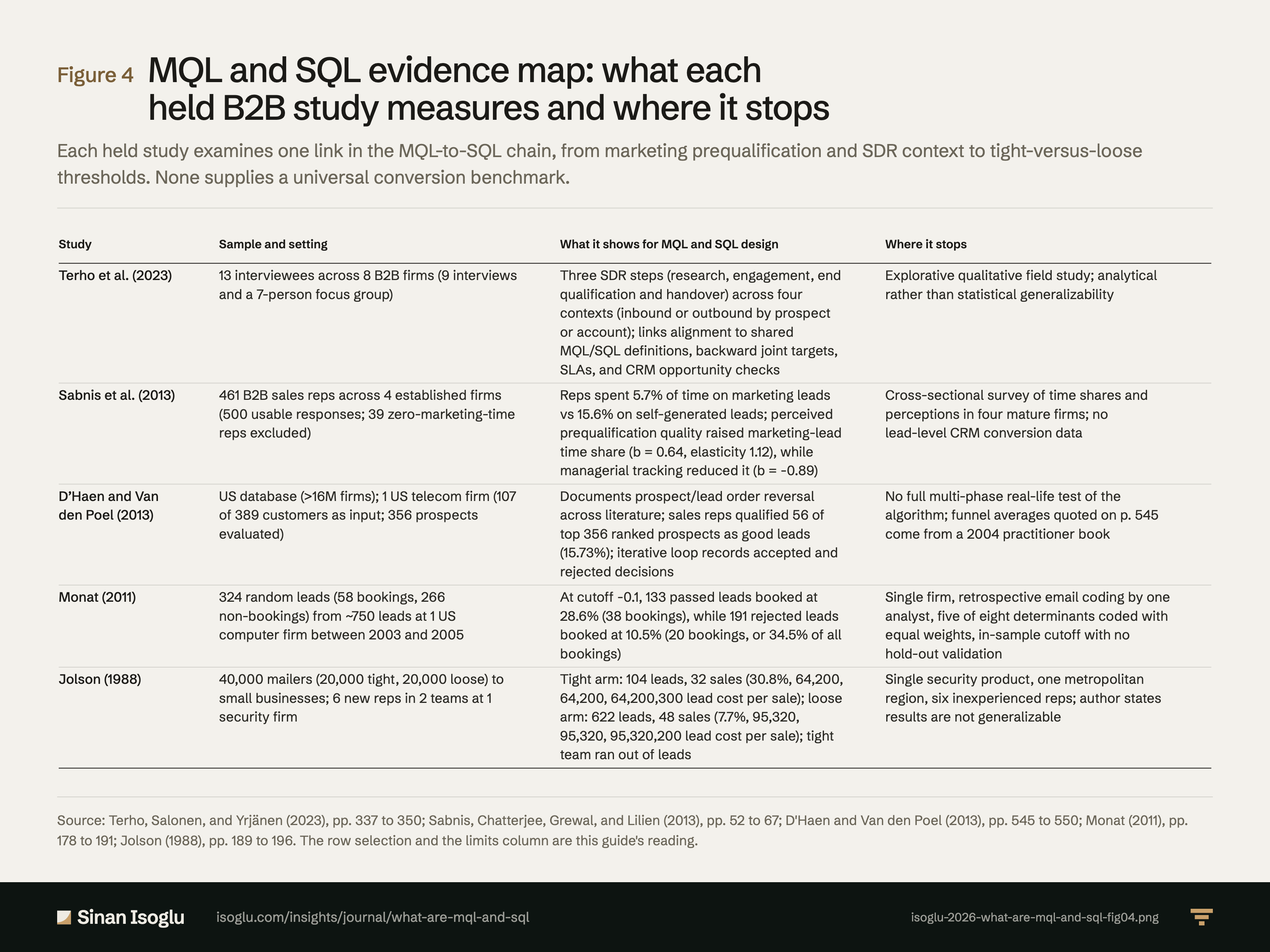
Figure 4Figure
MQL and SQL evidence map: what each held B2B study measures and where it stops
MQL and SQL: what are marketing- and sales-qualified leads?
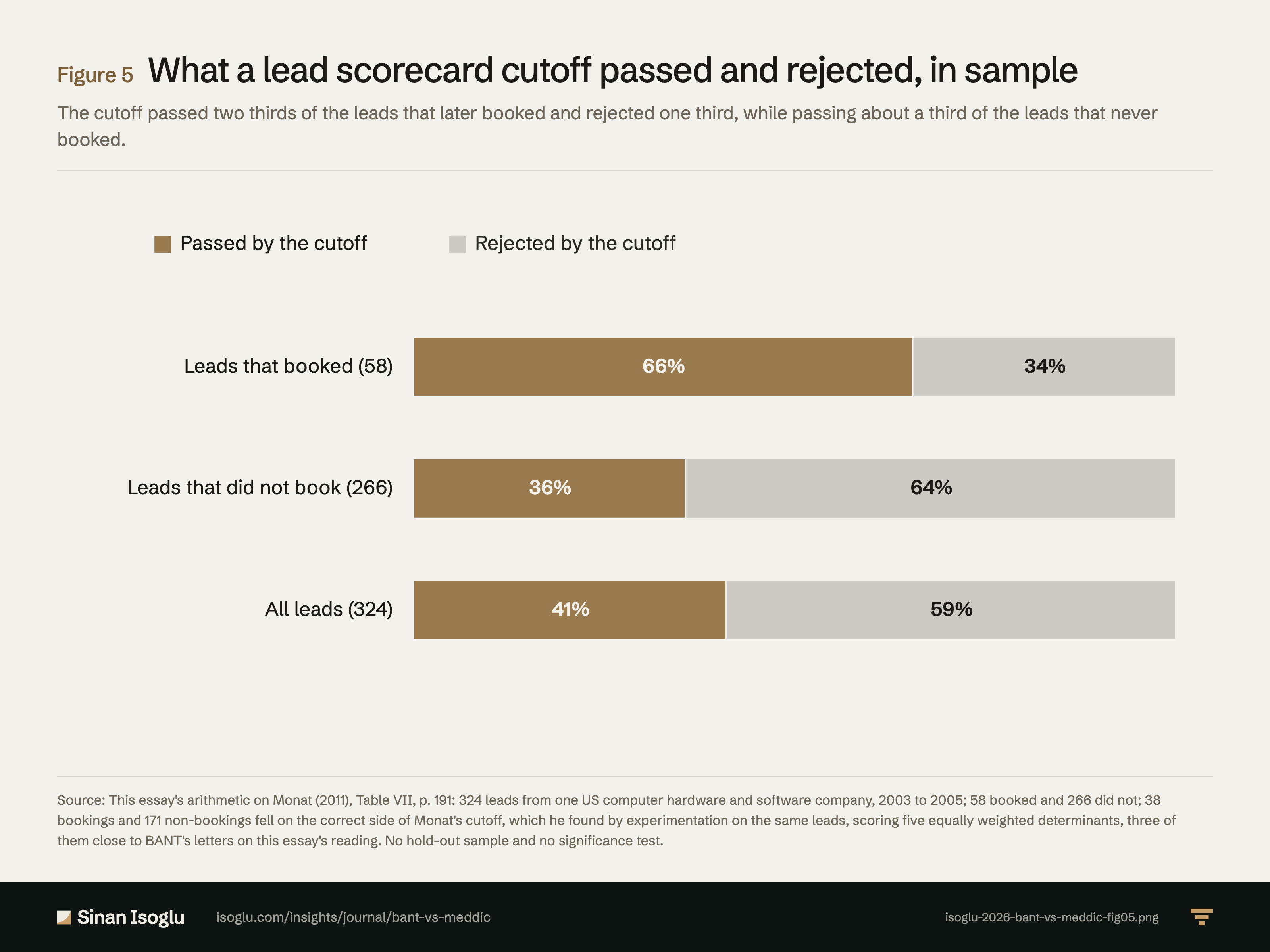
Figure 5Figure
What a lead scorecard cutoff passed and rejected, in sample
BANT vs MEDDIC: a qualification checklist is a hypothesis
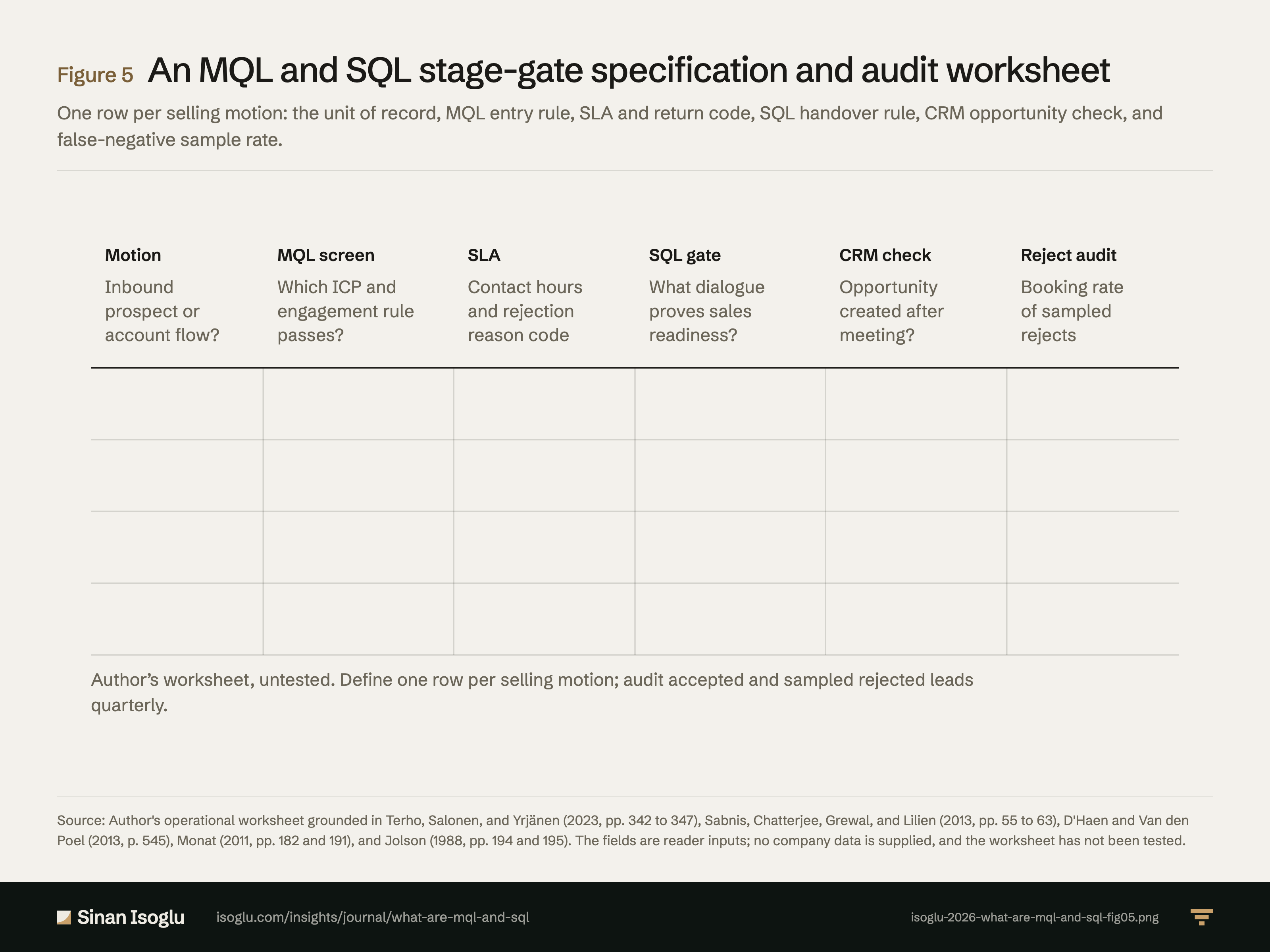
Figure 5Figure
An MQL and SQL stage-gate specification and audit worksheet
MQL and SQL: what are marketing- and sales-qualified leads?
Contact
Bring the question you're working on.
Research, a guest lecture, or a commercial question.