Abbildung 5Aus „BANT oder MEDDIC? Jede Qualifikationsregel ist eine Hypothese“
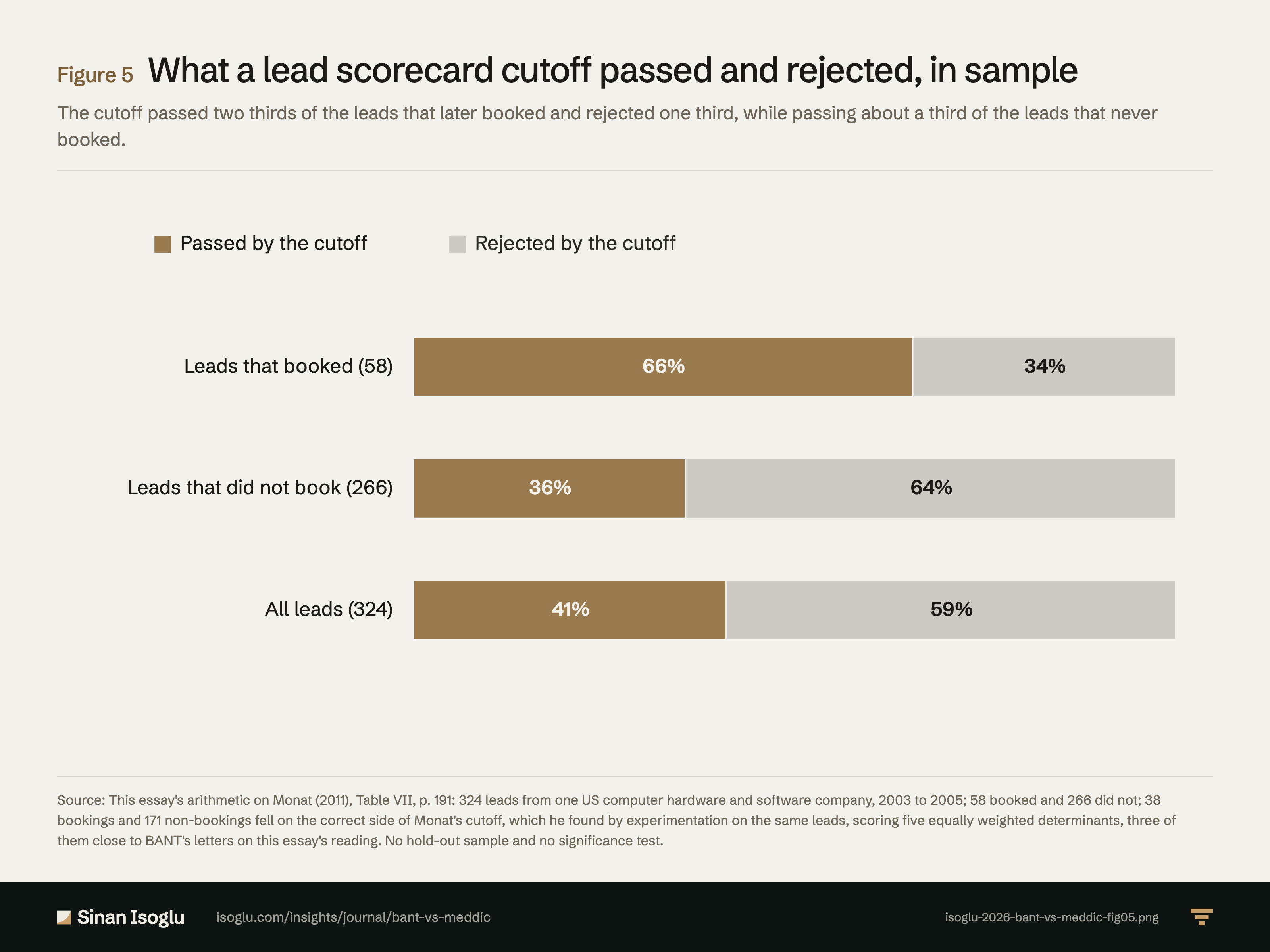
Was die Qualifikationsschwelle einer Lead-Scorecard durchließ und ablehnte, gemessen an denselben Leads, an denen sie festgelegt wurde
Die Schwelle ließ zwei Drittel der Leads durch, die später zum Auftrag kamen, lehnte ein Drittel ab und ließ etwa ein Drittel der Leads ohne Auftrag durch.
Abbildung 5Was die Qualifikationsschwelle einer Lead-Scorecard durchließ und ablehnte, gemessen an denselben Leads, an denen sie festgelegt wurde
Quelle: Rechnung dieses Beitrags aus Monat (2011), Tabelle VII, S. 191: 324 Leads eines US-Anbieters von Computer-Hardware und -Software, 2003 bis 2005; 58 kamen zum Auftrag, 266 nicht; 38 Aufträge und 171 Nicht-Aufträge lagen auf der richtigen Seite der Qualifikationsschwelle von Monat, die er durch Ausprobieren an denselben Leads fand, bei fünf gleich gewichteten Determinanten, von denen nach der Lesart dieses Beitrags drei nahe an den Buchstaben von BANT liegen. Keine zurückgehaltenen Daten, kein Signifikanztest.
Quelle und Evidenz
Jede Zeile nennt eine Aussage zu dieser Abbildung, ihre Quelle und die Art ihrer Prüfung.
- B A gegen die gedruckte Seite der Primärquelle geprüftB Primärquelle, nur TextebeneC belastbare SekundärquelleD berichtet Arithmetic on the outcome tests. Jolson, Table 2 and the results table: 32/104 = 30.8%, 48/622 = 7.7%, ratio 4.0; 48 − 32 = 16 more sales; $95,320 − $64,200 = $31,120; cost per lead $9,600/104 = $92.31 and $9,600/622 = $15.43 from the stated $4,800 per 10,000 mailers. Monat, Table VII read as correct predictions: passed leads = 38 + (266 − 171) = 133, of which 38 booked (28.6%); rejected leads = (58 − 38) + 171 = 191, of which 20 booked (10.5%); all leads 58/324 = 17.9%; 20 of 58 bookings rejected (34.5%); overall correct (38 + 171)/324 = 64.5%, below the 82.1% of a rule that calls every lead a non-booking, so the page reports the separation, not the accuracy. Three of Monat's five scored determinants (need, urgency, ability to purchase) read as close to BANT is this essay's mapping. Figure 5 (stack) shows the same Table VII counts as shares of each group: bookings 38 passed and 20 rejected (66 and 34 per cent), non-bookings 95 and 171 (36 and 64 per cent), all leads 133 and 191 (41 and 59 per cent); Figure 4 (mirror) shows Jolson's Table 2 sales per lead (30.8 and 7.7 per cent) against sales from leads ($64,200 and $95,320).Author arithmetic
- A A gegen die gedruckte Seite der Primärquelle geprüftB Primärquelle, nur TextebeneC belastbare SekundärquelleD berichtet The scorecard test: items include funding, decision authority, timeframe and an approved project; five of eight determinants scored (need, urgency, ability to purchase, trust in the vendor, competition), equally weighted and summed, with lead source and contact direction counting towards need and urgency; only the summed score is reported, so no separation can be credited to the BANT-like items; 324 leads drawn at random from about 750 at one US computer hardware and software company, 2003 to 2005, coded from archived e-mails by one analyst; 58 (17.9%) converted, 266 did not; Table VII (p. 191, page image): 38 of 58 and 171 of 266 correctly predicted (66% and 64%); cutoff found by experimentation on the same leads; no hold-out, no significance tests; three of eight determinants had no data; the model is not formally validated. The text says 264 non-converting leads, Table VII 266 (pp. 189 to 191): "five of the eight customer purchase decision determinants"; "Is the project funded?"; "Decision authority of the contact"; "Is there an approved project?"; "The 324 leads analyzed were selected at random from a total of"; "that sells computer hardware and software, covering the time period 2003-2005"; "a single analyst scrutinized the archived e-mails"; "Of the 324 leads analyzed, 58 (17.9 percent) eventually converted to bookings while 266 did not."; "Number of leads that developed into sales"; "By experimentation, a cutoff score of"; "It did not use hold-out samples for validation"; "no tests of statistical significance were performed"; "no data were available from the archived leads for any lead for the last three purchase determinants"; "The proposed model has not yet been formally field validated"Monat (2011)
Aus dem Beitrag
Revenue Operations & KI
BANT oder MEDDIC? Jede Qualifikationsregel ist eine Hypothese
BANT prüft Budget, Befugnis, Bedarf und Zeitpunkt, MEDDIC das Buying Center. 1988 konvertierten strenge Leads im Feldexperiment besser, bei weniger Umsatz.
Den Beitrag lesenDiese Abbildung gehört zu einem Essay: Die Zahlen stehen hier, das Argument dort.
Zitieren oder einbetten
Verwandte Abbildungen
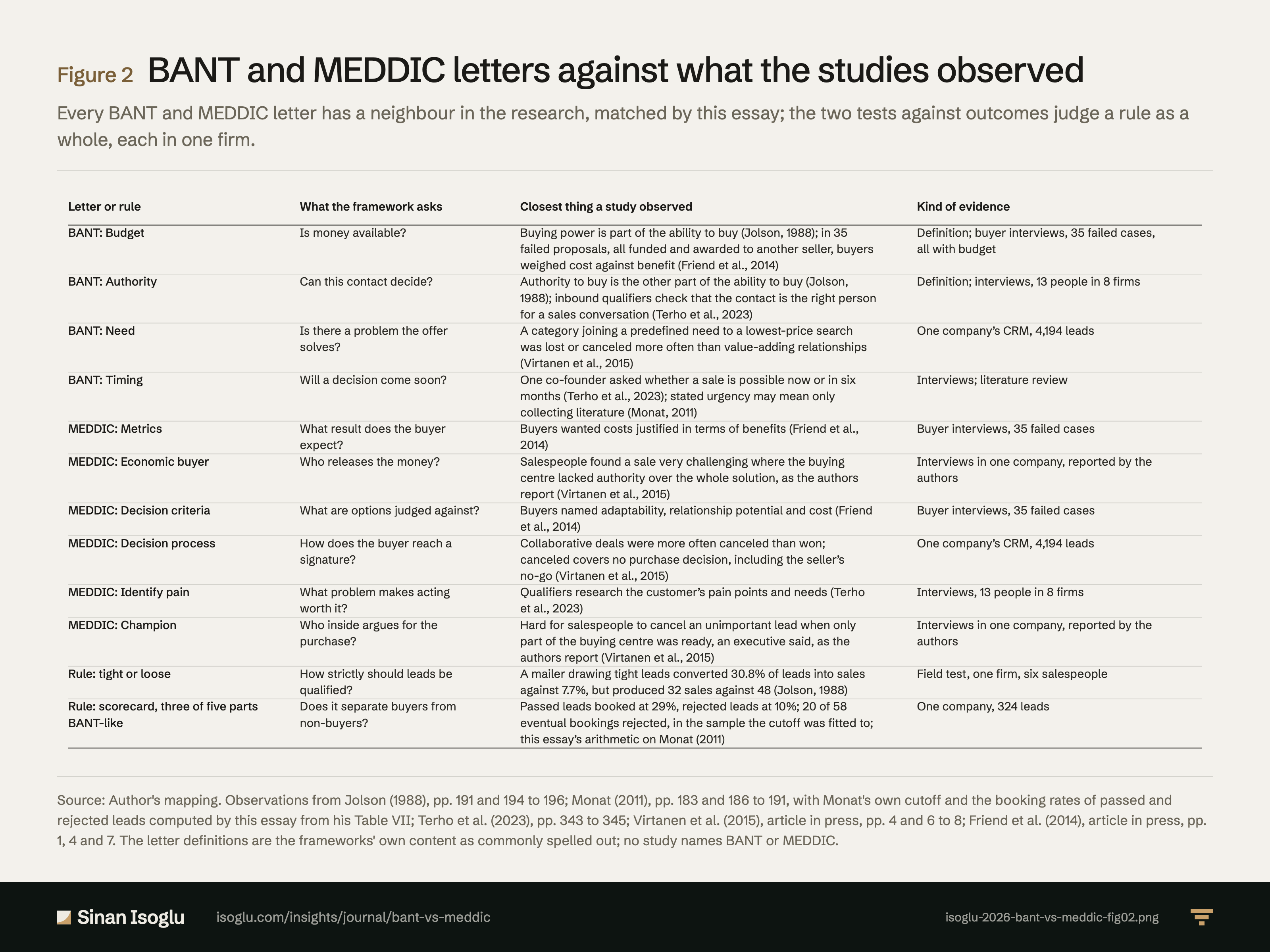
Abbildung 2Grafik
Buchstaben von BANT und MEDDIC und was die Studien beobachtet haben
BANT oder MEDDIC? Jede Qualifikationsregel ist eine Hypothese
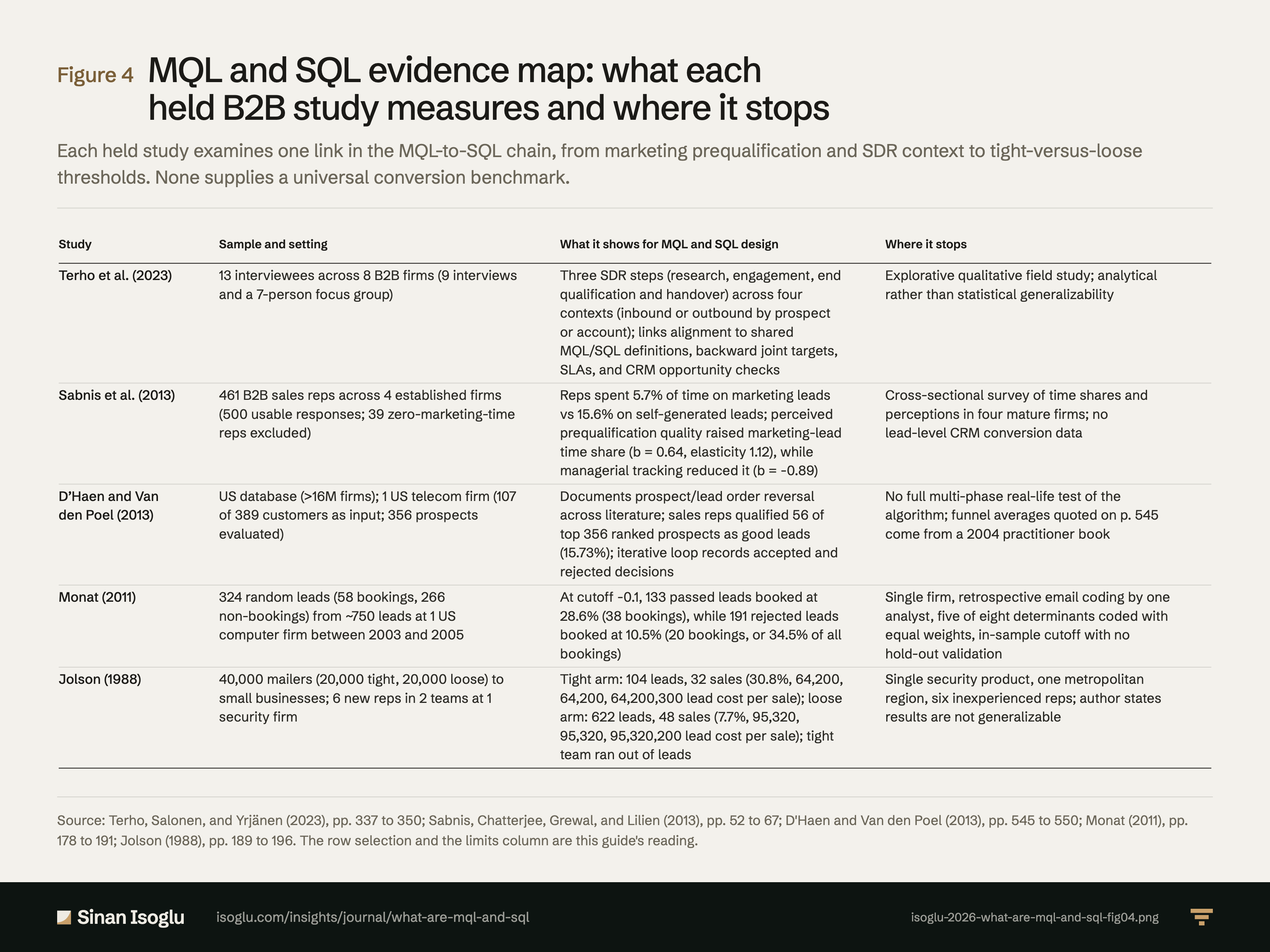
Abbildung 4Grafik
Evidenzkarte zu MQL und SQL: was jede der fünf B2B-Studien misst und wo sie endet
MQL und SQL: was sind Marketing und Sales Qualified Leads?
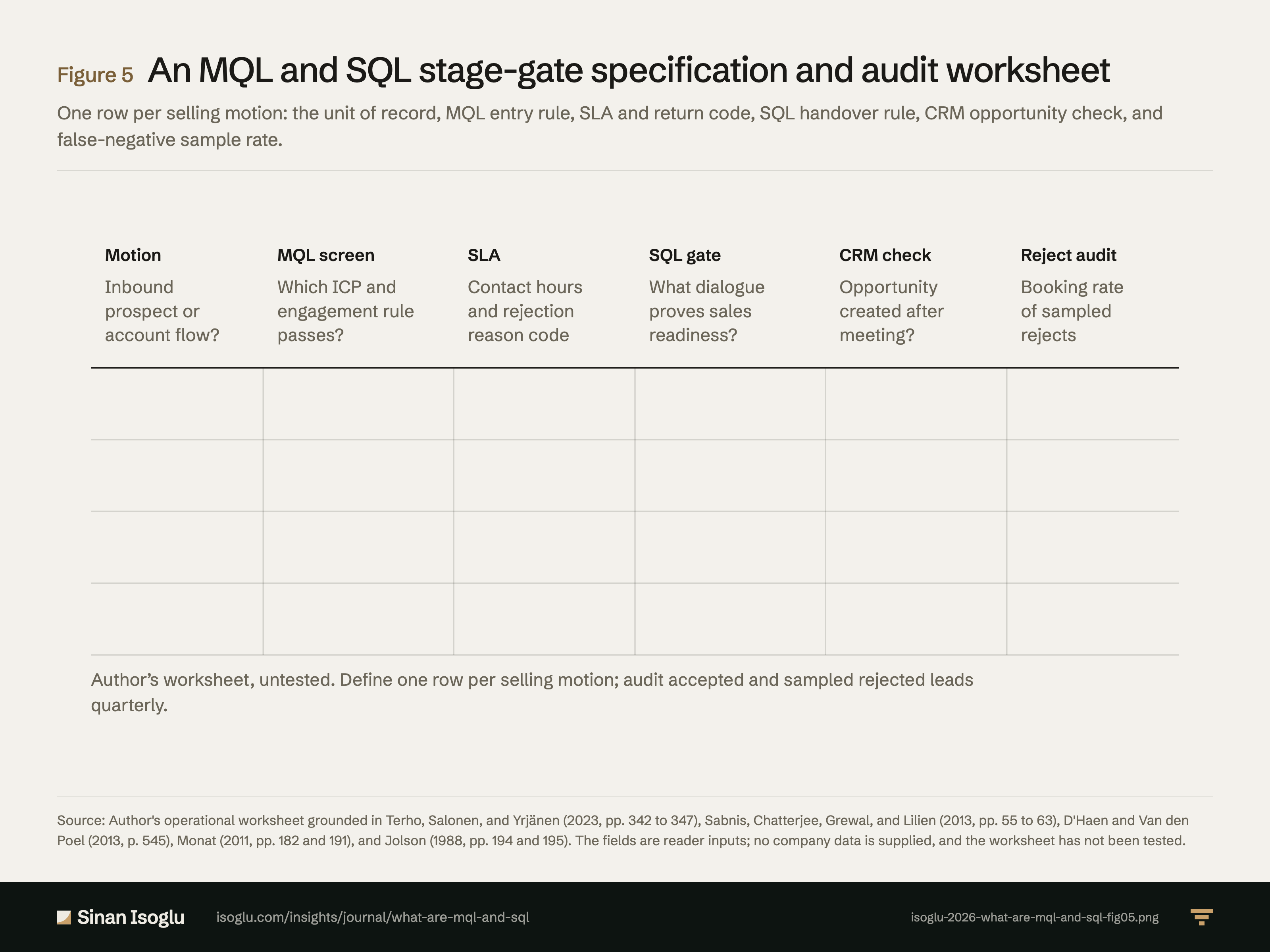
Abbildung 5Grafik
Spezifikations- und Prüfblatt für MQL- und SQL-Stage-Gates
MQL und SQL: was sind Marketing und Sales Qualified Leads?
Kontakt
Schicken Sie die Frage, an der Sie arbeiten.
Forschung, ein Gastvortrag oder eine Frage aus der Praxis.