Figure 1From “What is time series forecasting?”
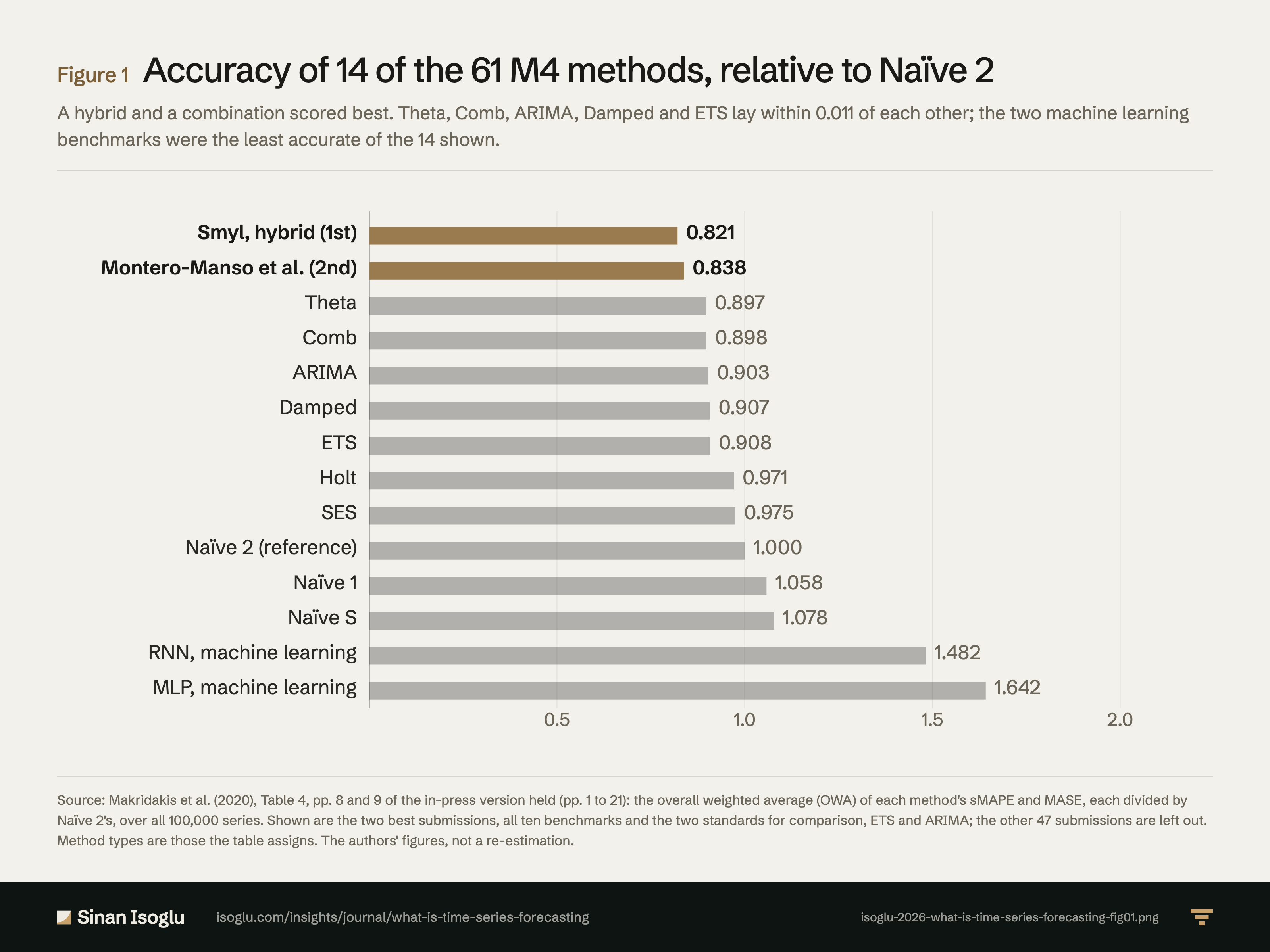
Accuracy of 14 of the 61 M4 methods, relative to Naïve 2
A hybrid and a combination scored best. Theta, Comb, ARIMA, Damped and ETS lay within 0.011 of each other; the two machine learning benchmarks were the least accurate of the 14 shown.
Figure 1Accuracy of 14 of the 61 M4 methods, relative to Naïve 2
Source: Makridakis et al. (2020), Table 4, pp. 8 and 9 of the in-press version held (pp. 1 to 21): the overall weighted average (OWA) of each method's sMAPE and MASE, each divided by Naïve 2's, over all 100,000 series. Shown are the two best submissions, all ten benchmarks and the two standards for comparison, ETS and ARIMA; the other 47 submissions are left out. Method types are those the table assigns. The authors' figures, not a re-estimation.
Source and evidence
Each line names a claim related to this exhibit, its source, and how it was checked.
- A MSA20-C4 Combining: all top-performing methods were combinations of mostly statistical methods and only one pure statistical method was in the top ten, while all of the ten least accurate were pure statistical or pure ML (six statistical, four ML in Table 4); the two least accurate of all 61, Dudek (OWA 2.561, rank 60) and Sirotin (4.387, rank 61), are statistical submissions that Figure 1 leaves out (Table 4, p. 9, read again from the page image after G5 F1); Table 4 (pp. 8 and 9, read from page images) classes the winner as a hybrid and ranks two to six as combinations, and gives OWA Theta 0.897, Comb 0.898, ARIMA 0.903, Damped 0.907, ETS 0.908, Holt 0.971, SES 0.975, Naïve 2 1.000, Naïve 1 1.058, Naïve S 1.078 (the same values for the seven methods of Table 6, p. 11); Theta, Comb, ARIMA, Damped and ETS are the five best of the twelve benchmarks and standards and lie within 0.011, and Table 4 classes Comb as a combination, not as a statistical method, so the page calls the five the best benchmarks and standards (G5 F1); Comb more accurate than each of its three components; combining does not guarantee beating single models, and Theta, a single method and the most accurate of M3, beat Comb, ARIMA and ETS; Damped, Comb and ARIMA very similar, with hardly any statistically significant differences by Fig. 1, a multiple comparisons with the best test on sMAPE ranks; ARIMA's edge over ETS small and not significant (pp. 7 to 9, 11, 12, 15, 16 and 18 of the in-press version): "all of the top-performing methods, in terms of both PFs and PIs, were combinations of mostly statistical methods"; "there was only one pure statistical method among the first ten most-accurate ones"; "while all of the ten least-accurate methods were either pure statistical or pure ML"; "The poor performances of pure statistical and ML methods"; "In this table, Comb provides more accurate PFs than the three individual methods being combined."; "combining does not guarantee that their forecasts will outperform single models"; "the most accurate method of the M3 Competition"; "Theta provides more accurate PFs than Comb, ARIMA and ETS, despite utilizing a simple approach to forecasting"; "The numerical accuracies of Damped, Comb and ARIMA are very similar in M4"; "Fig. 1 indicates that hardly any statistically significant differences among the methods can be found"; "multiple comparisons with the best (sMAPE used for ranking the methods)"; "Even though the improvement is small, and not statistically significant according to Fig. 1"Makridakis, Spiliotis & Assimakopoulos (2020) · Makridakis, Spiliotis & Assimakopoulos. (2020)
- A MSA20-C5 The winner (Smyl, OWA 0.821) mixes exponential smoothing formulas with a recurrent neural network, its parameters fitted together with the network weights; its improvement over Comb is close to 10% (Table 4: 9.4% on sMAPE, 8.6% on OWA); second (Montero-Manso et al., 0.838) is a combination of seven statistical methods and one machine learning method whose weights a machine learning algorithm set for each series; five machine learning methods were submitted (four pure, one combination), all less accurate than Comb and only one more accurate than Naïve 2; the RNN and MLP benchmarks scored 1.482 and 1.642 (Table 4); the authors' possible reasons are a conjecture (limited cross-learning, short series, over-fitting, non-stationarity), and they say the paucity of entries limits generalization (pp. 4, 8, 9, 11, 12 and 15 of the in-press version): "which mixes ES formulas with a recurrent neural network (RNN) forecasting engine"; "are fitted concurrently with the RNN weights by the same gradient descent method"; "The improvement of this method over that of Comb was close to an impressive 10%"; "The second most accurate method in terms of PFs was a combination of seven statistical methods and a ML one"; "being calculated by a ML algorithm that was trained to minimize the forecasting errors through holdout tests for each individual series"; "A total of five ML methods (four pure and one combination) were submitted in M4."; "All of them were less accurate than the Comb benchmark in terms of PFs, and only one was more accurate than the Naïve 2 method."; "could be the limited usage of cross-learning"; "the limited usage of cross-learning, i.e., using information from multiple series to predict individual ones, together with the limited sample sizes of the individual series, the effect of over-fitting and the non-stationarity of the data"; "given the paucity of entries in the ML category, more information might still be needed to make it safe to generalize this finding"Makridakis, Spiliotis & Assimakopoulos (2020) · Makridakis, Spiliotis & Assimakopoulos. (2020)
Grades: A, verified against the printed page of the primary source · B, primary source, text layer only · C, authoritative secondary · D, reported.
From the essay
Revenue operations & AI
What is time series forecasting?
A time series forecast extends a series from its own past. In the M4 competition, a hybrid and combinations led; pure methods trailed.
Read the essayThis exhibit belongs to an essay: the numbers live here, the argument lives there.
Cite or embed
Contact
Bring the question you're working on.
Research, a guest lecture, or a commercial question.