Figure 1From “What is the winner's curse?”
More bidders, higher winning estimates, a lower bid needed
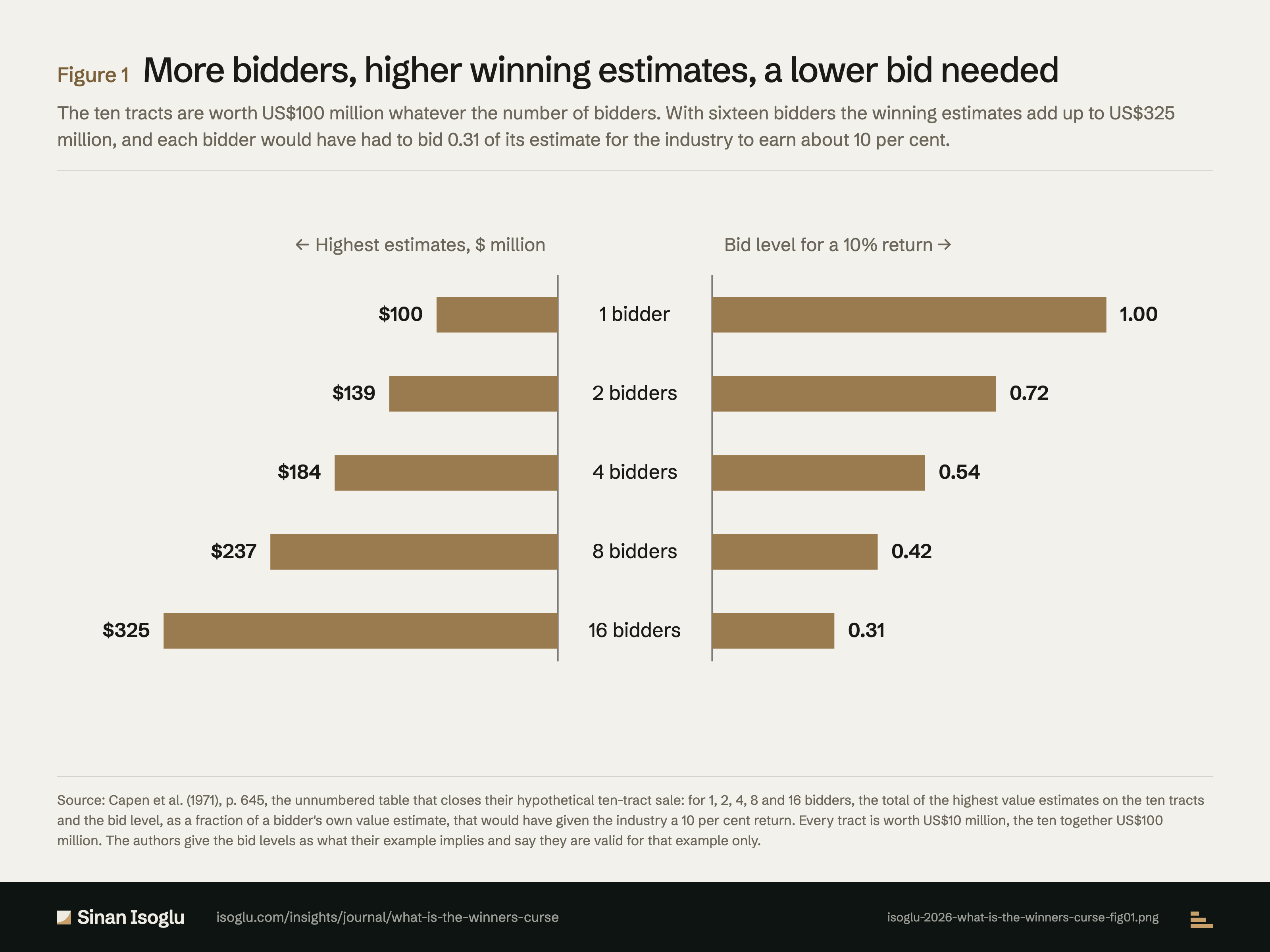
The ten tracts are worth US$100 million whatever the number of bidders. With sixteen bidders the winning estimates add up to US$325 million, and each bidder would have had to bid 0.31 of its estimate for the industry to earn about 10 per cent.
Figure 1More bidders, higher winning estimates, a lower bid needed
Source: Capen et al. (1971), p. 645, the unnumbered table that closes their hypothetical ten-tract sale: for 1, 2, 4, 8 and 16 bidders, the total of the highest value estimates on the ten tracts and the bid level, as a fraction of a bidder's own value estimate, that would have given the industry a 10 per cent return. Every tract is worth US$10 million, the ten together US$100 million. The authors give the bid levels as what their example implies and say they are valid for that example only.
Source and evidence
Each line names a claim related to this exhibit, its source, and how it was checked.
- A CCC71-C4 Hypothetical ten-tract sale: all tracts assumed productive, each worth US$10 million after exploratory drilling costs at a 10 per cent discount rate, every competitor estimating the total correctly but erring on single tracts and bidding half its estimate; return about 17 per cent after tax with one bidder, 14 per cent with two, about 11 per cent for the industry with four, about 8 per cent with eight and about 6 per cent with sixteen (US$162.6 million spent); the table on p. 645 gives the total of the highest estimates and the bid level for a 10 per cent return as US$100 million and 1.00, 139 and 0.72, 184 and 0.54, 237 and 0.42, 325 and 0.31 for 1, 2, 4, 8 and 16 bidders, the bid levels being what each competitor would have had to bid for the industry to make about 10 per cent while the bids in the example stay at half, valid only for the example, in which everyone uses the same return criterion and bidding strategy, and companies in the real world are not so inclined to play that way; the tracts' value does not change with more bidders, and falling returns as bidders are added appear to the authors a general rule of sealed bidding (pp. 644, 645): "of simplicity, let us assume that all tracts will be pro-"; "ductive and that after exploratory drilling costs, each"; "will be worth $10 million at a 10 percent discount"; "rate. Each competitor in this sale correctly estimates"; "each competitor chooses to bid one-half his value"; "17 percent after tax"; "His rate of return drops to 14"; "turn is about 11 percent"; "about 8 percent"; "The 16 bidders spent a total of $162.6 million for a"; "return of about 6 percent"; "What if the industry had wanted to make about"; "bid levels would have been something like this:"; "Total Value Estimates"; "for Highest Estimators"; "$100 million 1.00"; "$139 million 0.72"; "$184 million 0.54"; "$237 million 0.42"; "$325 million 0.31"; "valid for only the particular example we have just"; "Companies, in the real world, are not so inclined to"; "It is certainly true that the value of the tracts does"; "not change just because there are more bidders"; "bidders appears to us a general rule of sealed bidding"Capen, Clapp & Campbell (1971) · Capen, Clapp & Campbell. (1971)
Grades: A, verified against the printed page of the primary source · B, primary source, text layer only · C, authoritative secondary · D, reported.
From the essay
Pricing & revenue architecture
What is the winner's curse?
The winner's curse is the shortfall that can follow winning a bid on a common, uncertain value: the winning bid tends to rest on the largest overestimate.
Read the essayThis exhibit belongs to an essay: the numbers live here, the argument lives there.
Cite or embed
Contact
Bring the question you're working on.
Research, a guest lecture, or a commercial question.