Figure 2From “What is the winner's curse?”
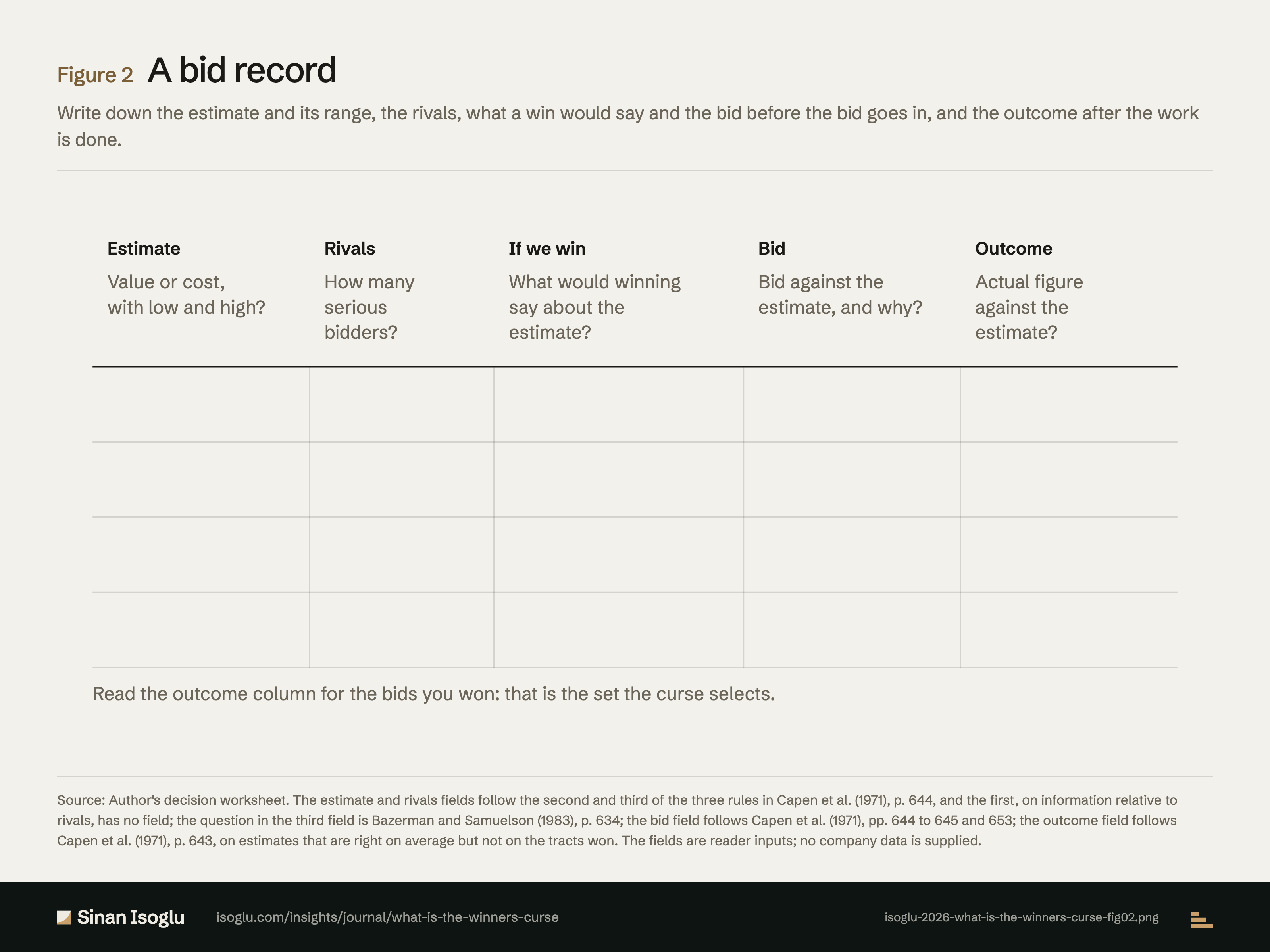
A bid record
Write down the estimate and its range, the rivals, what a win would say and the bid before the bid goes in, and the outcome after the work is done.
Figure 2A bid record
Source: Author's decision worksheet. The estimate and rivals fields follow the second and third of the three rules in Capen et al. (1971), p. 644, and the first, on information relative to rivals, has no field; the question in the third field is Bazerman and Samuelson (1983), p. 634; the bid field follows Capen et al. (1971), pp. 644 to 645 and 653; the outcome field follows Capen et al. (1971), p. 643, on estimates that are right on average but not on the tracts won. The fields are reader inputs; no company data is supplied.
Source and evidence
Each line names a claim related to this exhibit, its source, and how it was checked.
- B WCU-OWN-C4 Built from Bazerman and Samuelson's question and two of Capen et al.'s three rules (the uncertainty of one's estimate and the number of bidders; the first rule, information relative to rivals, has no field), a bid is recorded as one row: the estimate with its range, the number of serious rivals, what winning would say about the estimate, the bid against the estimate and, after the work, the outcome against the estimate, read for the bids won; illustrated with a hypothetical fixed-fee data migration bid against four rivals (1,200 hours, 800 to 2,000), priced from a higher point in the range or with a stated data assumption that reopens the scope, and reviewed after each won project; where the firm also works without competition, the same comparison there separates estimates that run low everywhere from estimates that run low only on bids won, Capen et al.'s contrast between competitive and noncompetitive settings.Author worksheet grounded in CCC71-C2, CCC71-C3, CCC71-C4 and BS83-C8; untested
Grades: A, verified against the printed page of the primary source · B, primary source, text layer only · C, authoritative secondary · D, reported.
From the essay
Pricing & revenue architecture
What is the winner's curse?
The winner's curse is the shortfall that can follow winning a bid on a common, uncertain value: the winning bid tends to rest on the largest overestimate.
Read the essayThis exhibit belongs to an essay: the numbers live here, the argument lives there.
Cite or embed

Contact
Bring the question you're working on.
Research, a guest lecture, or a commercial question.