Figure 1From “What is brand equity?”
Brand and price utilities for a medium-voltage switchgear panel
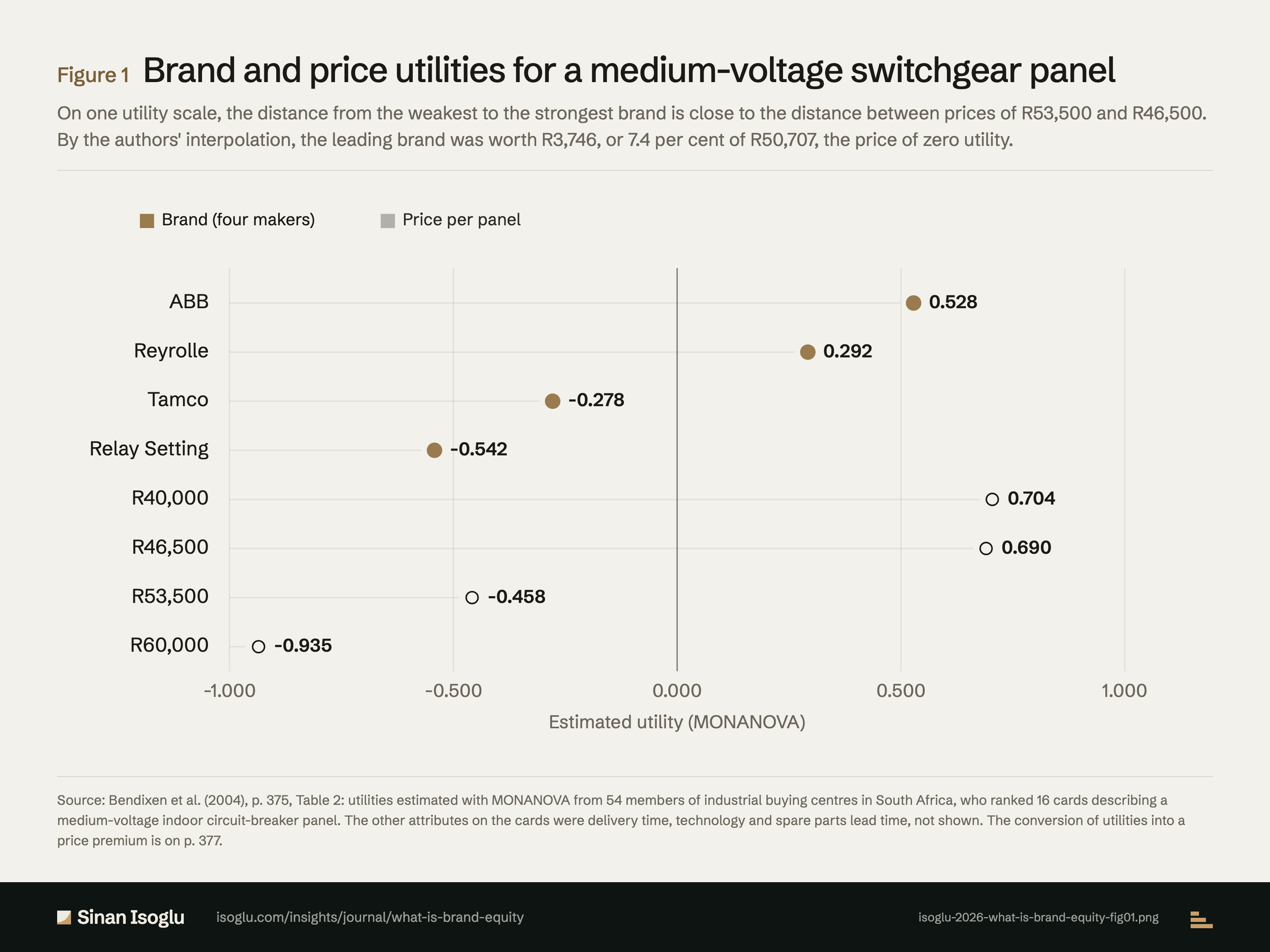
On one utility scale, the distance from the weakest to the strongest brand is close to the distance between prices of R53,500 and R46,500. By the authors' interpolation, the leading brand was worth R3,746, or 7.4 per cent of R50,707, the price of zero utility.
Figure 1Brand and price utilities for a medium-voltage switchgear panel
Source: Bendixen et al. (2004), p. 375, Table 2: utilities estimated with MONANOVA from 54 members of industrial buying centres in South Africa, who ranked 16 cards describing a medium-voltage indoor circuit-breaker panel. The other attributes on the cards were delivery time, technology and spare parts lead time, not shown. The conversion of utilities into a price premium is on p. 377.
Source and evidence
Each line names a claim related to this exhibit, its source, and how it was checked.
- A BBA04-C5 Table 2 utilities (p. 375, read from the page image): ABB +0.528, Reyrolle +0.292, Tamco -0.278, Relay Setting -0.542; R40,000 +0.704, R46,500 +0.690, R53,500 -0.458, R60,000 -0.935. By linear interpolation, other things equal, R50,707 has zero utility and a price utility of -0.528 sits at R54,453; the leading brand could command R3,746 or 7.4% over R50,707, which the authors call the average price, setting average in quotation marks, although it is the price of zero utility (the mean of the four price levels is R50,000), the least preferred would discount R3,305 to R47,402 or 6.5%, nearly 14% between them; the conclusions state 6.8% over the average brand and 14% over an unknown brand; buyers develop a sentimental relationship worth a premium even for a standard, interchangeable product (pp. 375, 377, 379): "Using linear interpolation, a price of R50,707 would have a utility of zero."; "assuming all other things being equal"; "would represent R54,453"; "price premium of R3746 or 7.4% relative to an ‘‘average’’ price of R50,707"; "the most preferred brand could command a price premium of R3746 or 7.4%"; "would have to discount its price by R3305 to R47,402 or 6.5%"; "the brand leader could afford a price premium of nearly 14% over relatively unknown brands on the market"; "could command a price premium of 6.8% over the average industrial brand and 14% over a new, unknown brand"; "even for a standard and interchangeable product"; "develop a sentimental relationship for which they are prepared to pay a price premium"Bendixen, Bukasa & Abratt (2004) · Bendixen, Bukasa & Abratt. (2004)
Grades: A, verified against the printed page of the primary source · B, primary source, text layer only · C, authoritative secondary · D, reported.
From the essay
Pricing & revenue architecture
What is brand equity?
Brand equity is what a brand adds to an offer beyond what the offer does. In one B2B study, rankings put the leading brand's premium at 7.4 per cent.
Read the essayThis exhibit belongs to an essay: the numbers live here, the argument lives there.
Cite or embed
Contact
Bring the question you're working on.
Research, a guest lecture, or a commercial question.