Figure 1From “What is selection bias? The sample can change the answer”
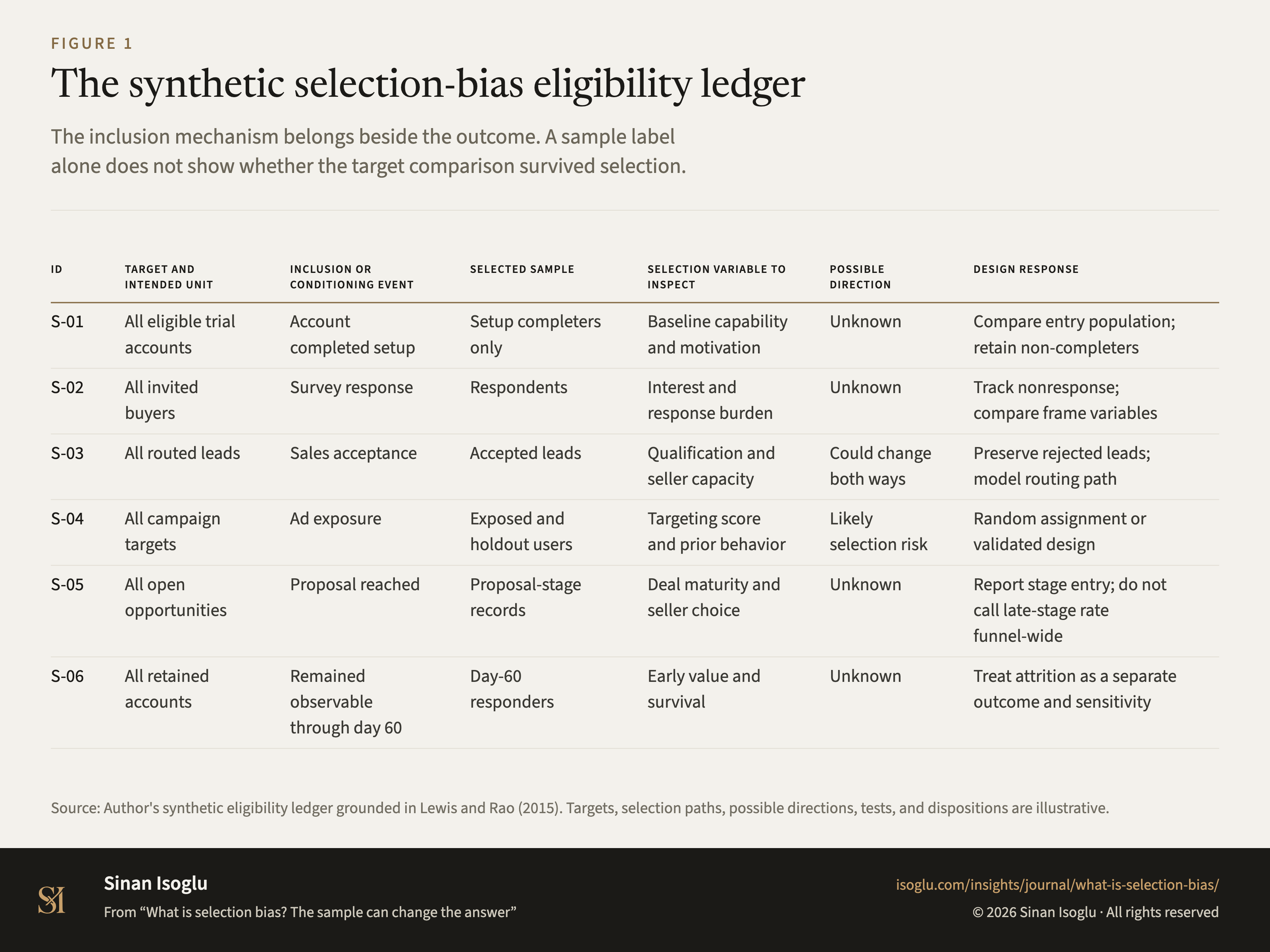
The synthetic selection-bias eligibility ledger
The inclusion mechanism belongs beside the outcome. A sample label alone does not show whether the target comparison survived selection.
Figure 1The synthetic selection-bias eligibility ledger
| ID | Target and intended unit | Inclusion or conditioning event | Selected sample | Selection variable to inspect | Possible direction | Design response |
|---|---|---|---|---|---|---|
| S-01 | All eligible trial accounts | Account completed setup | Setup completers only | Baseline capability and motivation | Unknown | Compare entry population; retain non-completers |
| S-02 | All invited buyers | Survey response | Respondents | Interest and response burden | Unknown | Track nonresponse; compare frame variables |
| S-03 | All routed leads | Sales acceptance | Accepted leads | Qualification and seller capacity | Could change both ways | Preserve rejected leads; model routing path |
| S-04 | All campaign targets | Ad exposure | Exposed and holdout users | Targeting score and prior behavior | Likely selection risk | Random assignment or validated design |
| S-05 | All open opportunities | Proposal reached | Proposal-stage records | Deal maturity and seller choice | Unknown | Report stage entry; do not call late-stage rate funnel-wide |
| S-06 | All retained accounts | Remained observable through day 60 | Day-60 responders | Early value and survival | Unknown | Treat attrition as a separate outcome and sensitivity |
Swipe or scroll horizontally if the table is wider than your screen.
Source: Author's synthetic eligibility ledger grounded in Lewis and Rao (2015). Targets, selection paths, possible directions, tests, and dispositions are illustrative.
Source and evidence
Each line names a claim related to this exhibit, its source, and how it was checked.
- A LR15-C3 Why observational methods fail here is an economics problem, in the authors' words: "The median confidence interval on return on investment is over 100 percentage points wide", so "informative advertising experiments can easily require more than 10 million person-weeks"Lewis & Rao (2015)
- B R09-OWN-C1 Selection bias arises when the mechanism that puts units into the observed or analyzed sample is related to variables relevant to the target questionAuthor framework grounded in LR15-C3
- B R09-OWN-C2 The target population, eligibility rule, observed sample, and conditioning event are different objects and must not be collapsed into one denominatorAuthor framework
- B R09-OWN-C4 Conditioning on a common consequence of exposure and outcome predictors can create collider bias even when the initial variables were not associatedAuthor causal framework
- B R09-OWN-C6 A selection review should name the target, inclusion path, excluded units, selection variables, expected direction if known, and design or sensitivity testAuthor operating framework
- B R09-OWN-C7 The six-row eligibility ledger is synthetic and contains no participant, customer, employee, or company sampleAuthor synthetic object
- B R09-OWN-C9 A changed eligibility rule can change the comparison set and raw rate without proving a change in the underlying outcome processAuthor negative boundary
Grades: A, verified against the printed page of the primary source · B, primary source, text layer only · C, authoritative secondary · D, reported.
From the essay
From the research bench
What is selection bias? The sample can change the answer
Selection bias begins with the inclusion mechanism. Name the target, eligibility rule, exclusions, and conditioning event before comparing outcomes.
Read the essayThis exhibit belongs to an essay: the numbers live here, the argument lives there.
Cite or embed
Related exhibits
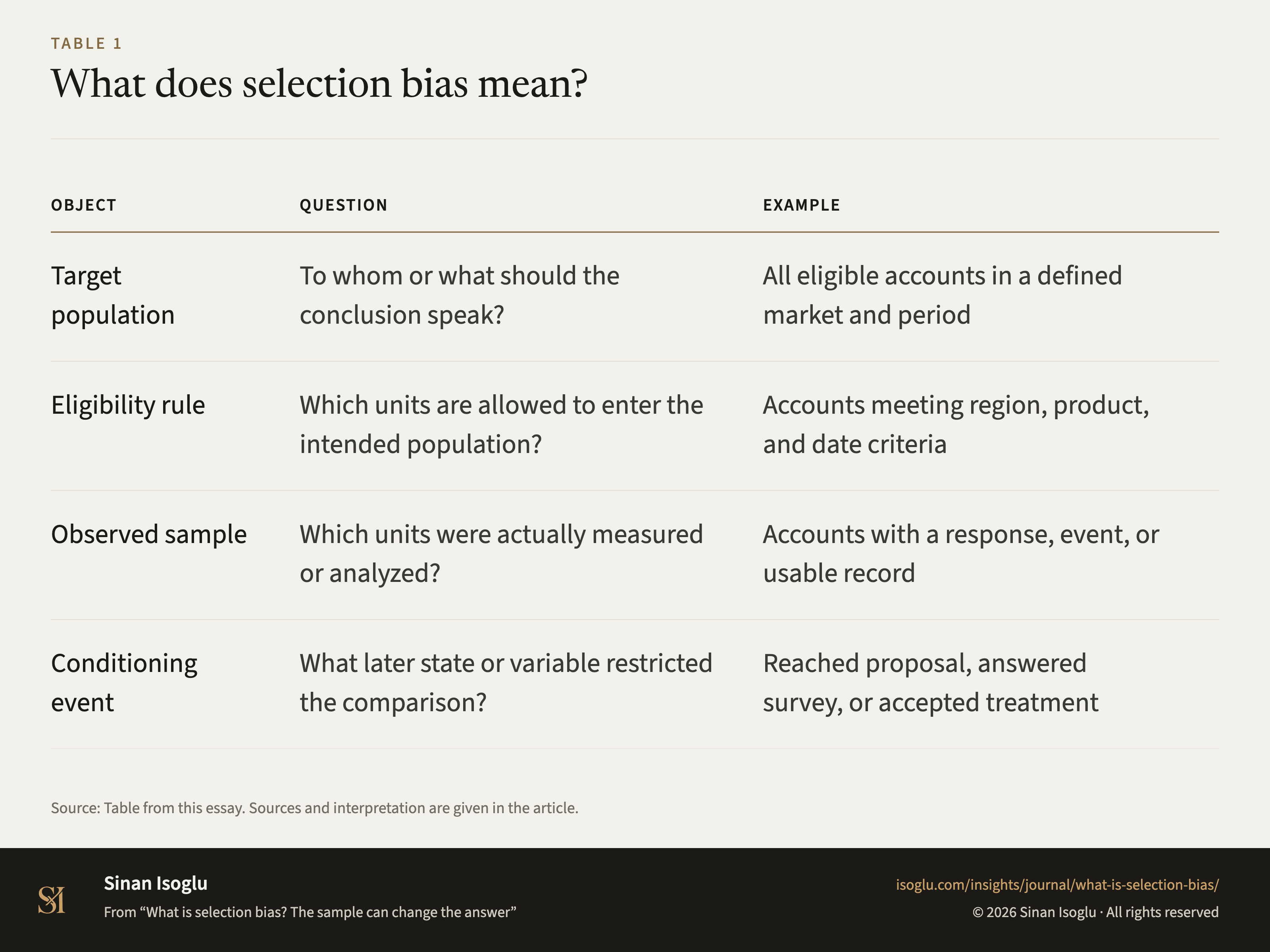
Table 1Table
What does selection bias mean?
What is selection bias? The sample can change the answer
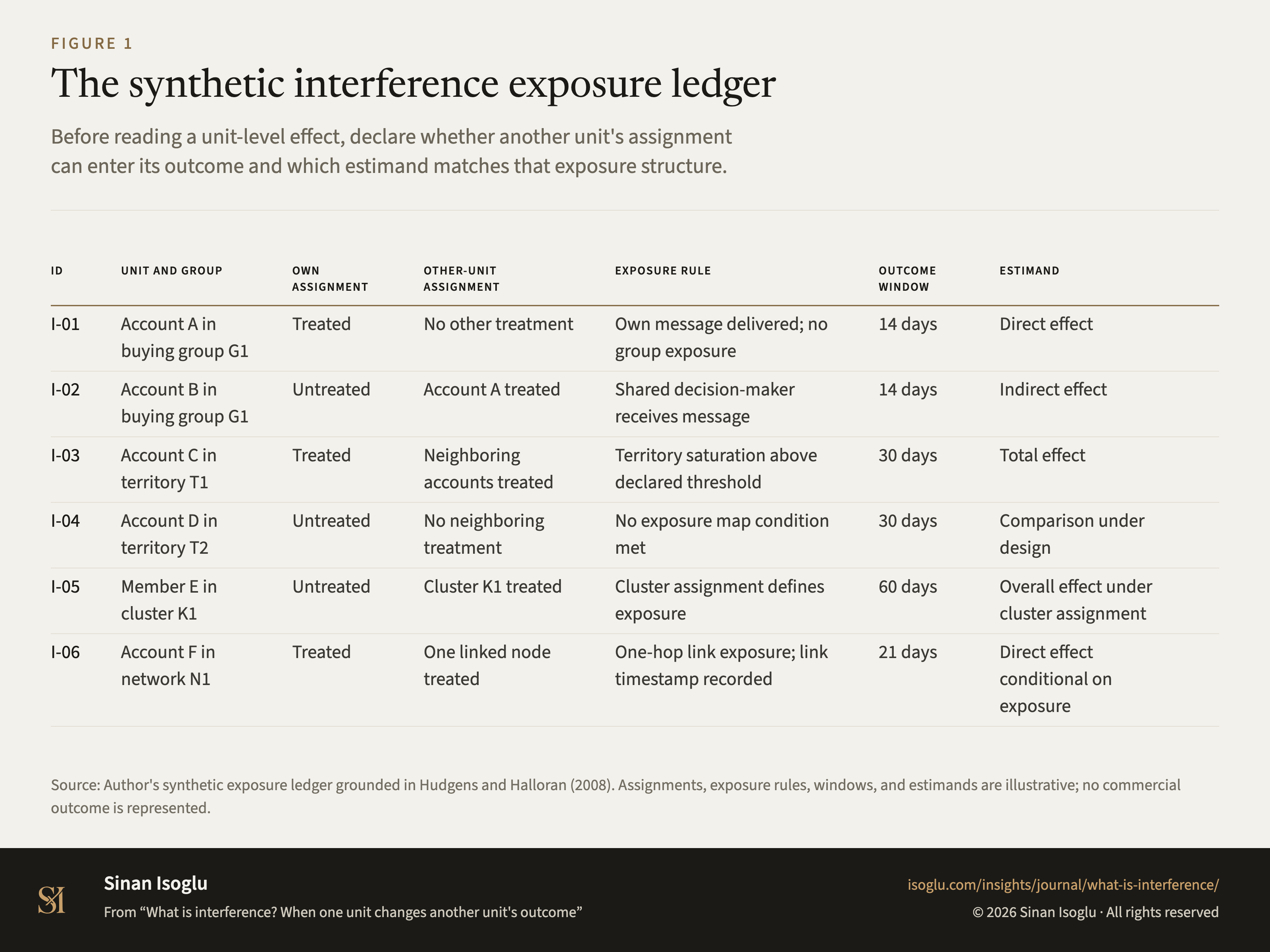
Figure 1Figure
The synthetic interference exposure ledger
What is interference? When one unit changes another unit's outcome
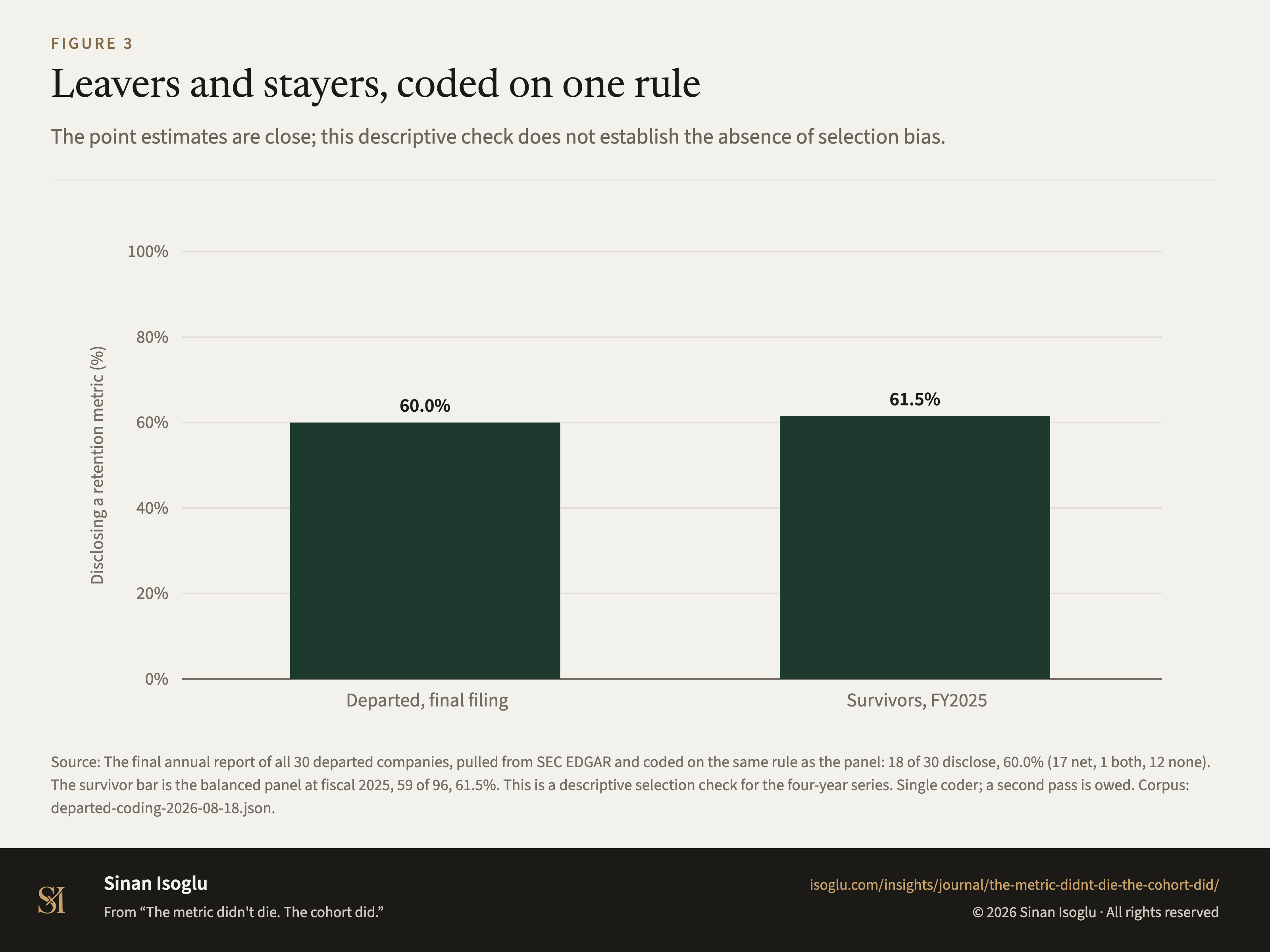
Figure 3Figure
Leavers and stayers, coded on one rule
The metric didn't die. The cohort did.
Contact
Bring the question you're working on.
Research, a guest lecture, or a commercial question.