Figure 1From “What is interference? When one unit changes another unit's outcome”
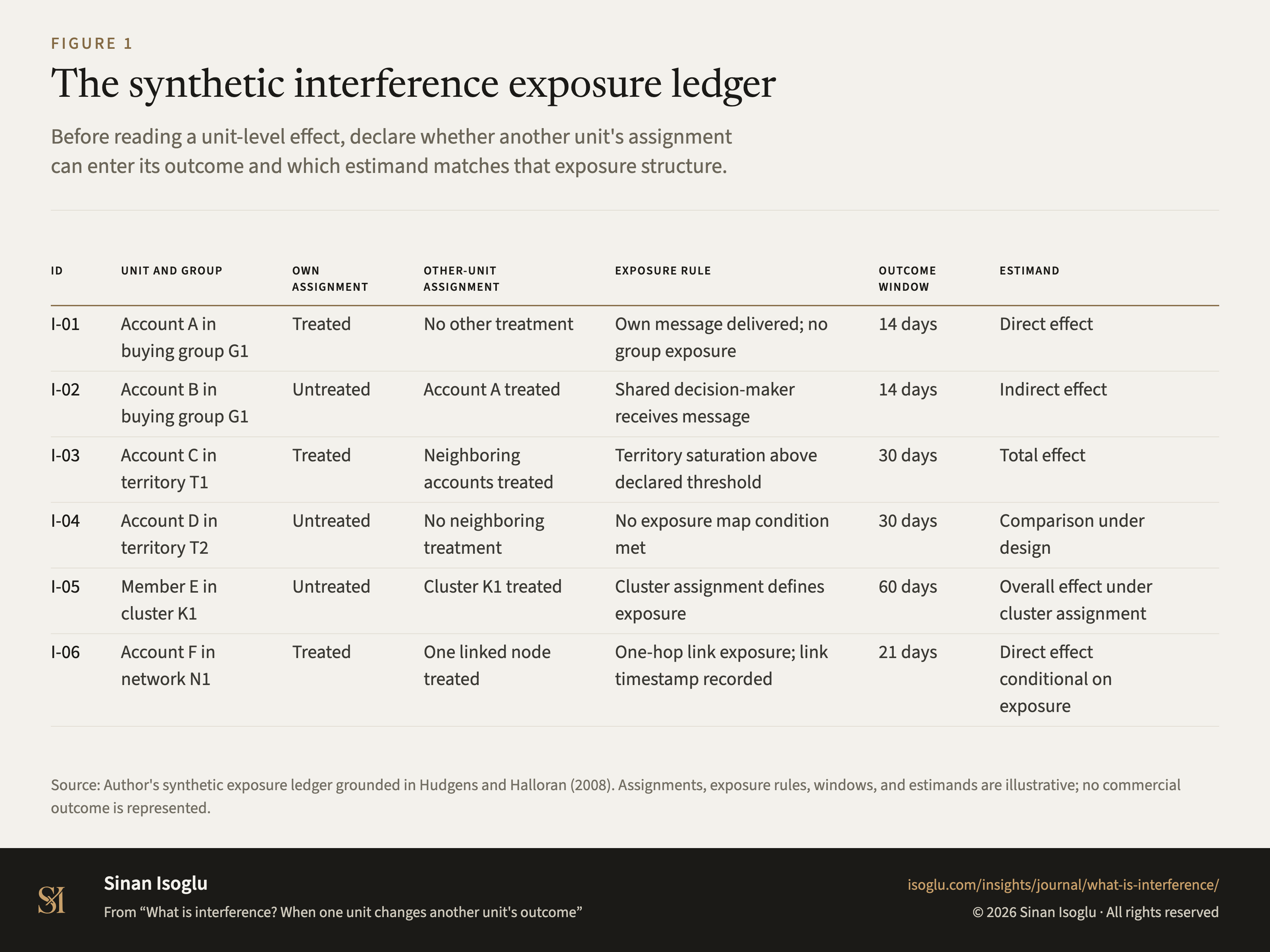
The synthetic interference exposure ledger
Before reading a unit-level effect, declare whether another unit's assignment can enter its outcome and which estimand matches that exposure structure.
Figure 1The synthetic interference exposure ledger
| ID | Unit and group | Own assignment | Other-unit assignment | Exposure rule | Outcome window | Estimand |
|---|---|---|---|---|---|---|
| I-01 | Account A in buying group G1 | Treated | No other treatment | Own message delivered; no group exposure | 14 days | Direct effect |
| I-02 | Account B in buying group G1 | Untreated | Account A treated | Shared decision-maker receives message | 14 days | Indirect effect |
| I-03 | Account C in territory T1 | Treated | Neighboring accounts treated | Territory saturation above declared threshold | 30 days | Total effect |
| I-04 | Account D in territory T2 | Untreated | No neighboring treatment | No exposure map condition met | 30 days | Comparison under design |
| I-05 | Member E in cluster K1 | Untreated | Cluster K1 treated | Cluster assignment defines exposure | 60 days | Overall effect under cluster assignment |
| I-06 | Account F in network N1 | Treated | One linked node treated | One-hop link exposure; link timestamp recorded | 21 days | Direct effect conditional on exposure |
Swipe or scroll horizontally if the table is wider than your screen.
Source: Author's synthetic exposure ledger grounded in Hudgens and Halloran (2008). Assignments, exposure rules, windows, and estimands are illustrative; no commercial outcome is represented.
Source and evidence
Each line names a claim related to this exhibit, its source, and how it was checked.
- A HH08-C1 "a fundamental assumption usually made in causal inference is that of no interference between individuals or units that is the potential outcomes of one individual are assumed to be unaffected by the treatment assignment of other individuals"Hudgens & Halloran. (2008). Toward Causal Inference With Interference captured 2026-09-06
- A HH08-C3 "we propose estimands for direct indirect total and overall causal effects of treatment strategies in this setting", with relations among them establishedHudgens & Halloran. (2008). Toward Causal Inference With Interference captured 2026-09-06
- A HH08-C4 The estimand follows the design: the paper considers "a population of groups of individuals where interference is possible between individuals within the same group" and proposes estimands for that settingHudgens & Halloran. (2008). Toward Causal Inference With Interference captured 2026-09-06
- A HH08-C6 Interference changes what the outcomes ARE, not merely their direction: "the potential outcomes of one individual are assumed to be unaffected by the treatment assignment of other individuals", and where that fails the comparisons must be respecifiedHudgens & Halloran. (2008). Toward Causal Inference With Interference captured 2026-09-06
- B R11-OWN-C1 Interference is a situation in which one unit's outcome depends on another unit's treatment or exposure under the declared windowAuthor framework grounded in HH08-C1 and HH08-C2
- B R11-OWN-C2 An exposure mapping translates own and other-unit assignments into the exposure condition used by the estimandAuthor framework grounded in HH08-C3 and HH08-C4
- B R11-OWN-C5 The six-row exposure ledger must preserve unit, own assignment, other-unit assignment, exposure rule, outcome window, and estimandAuthor operating framework
- B R11-OWN-C8 The illustrative ledger contains no campaign, customer, territory, or network outcome dataAuthor synthetic object
Grades: A, verified against the printed page of the primary source · B, primary source, text layer only · C, authoritative secondary · D, reported.
From the essay
From the research bench
What is interference? When one unit changes another unit's outcome
Interference occurs when one unit’s outcome depends on another unit’s treatment. Define exposure, groups, and estimands before reading spillover.
Read the essayThis exhibit belongs to an essay: the numbers live here, the argument lives there.
Cite or embed
Related exhibits
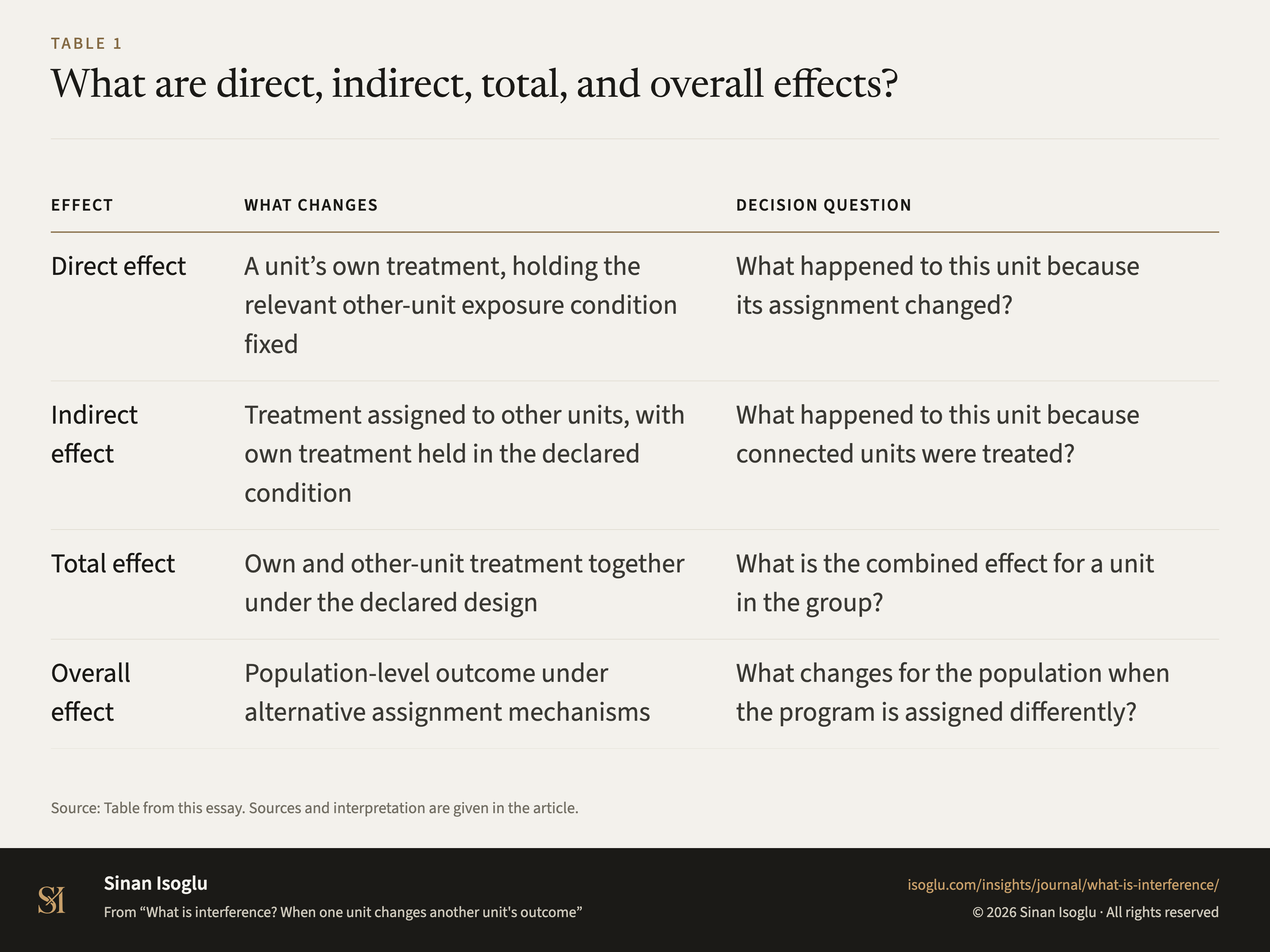
Table 1Table
What are direct, indirect, total, and overall effects?
What is interference? When one unit changes another unit's outcome
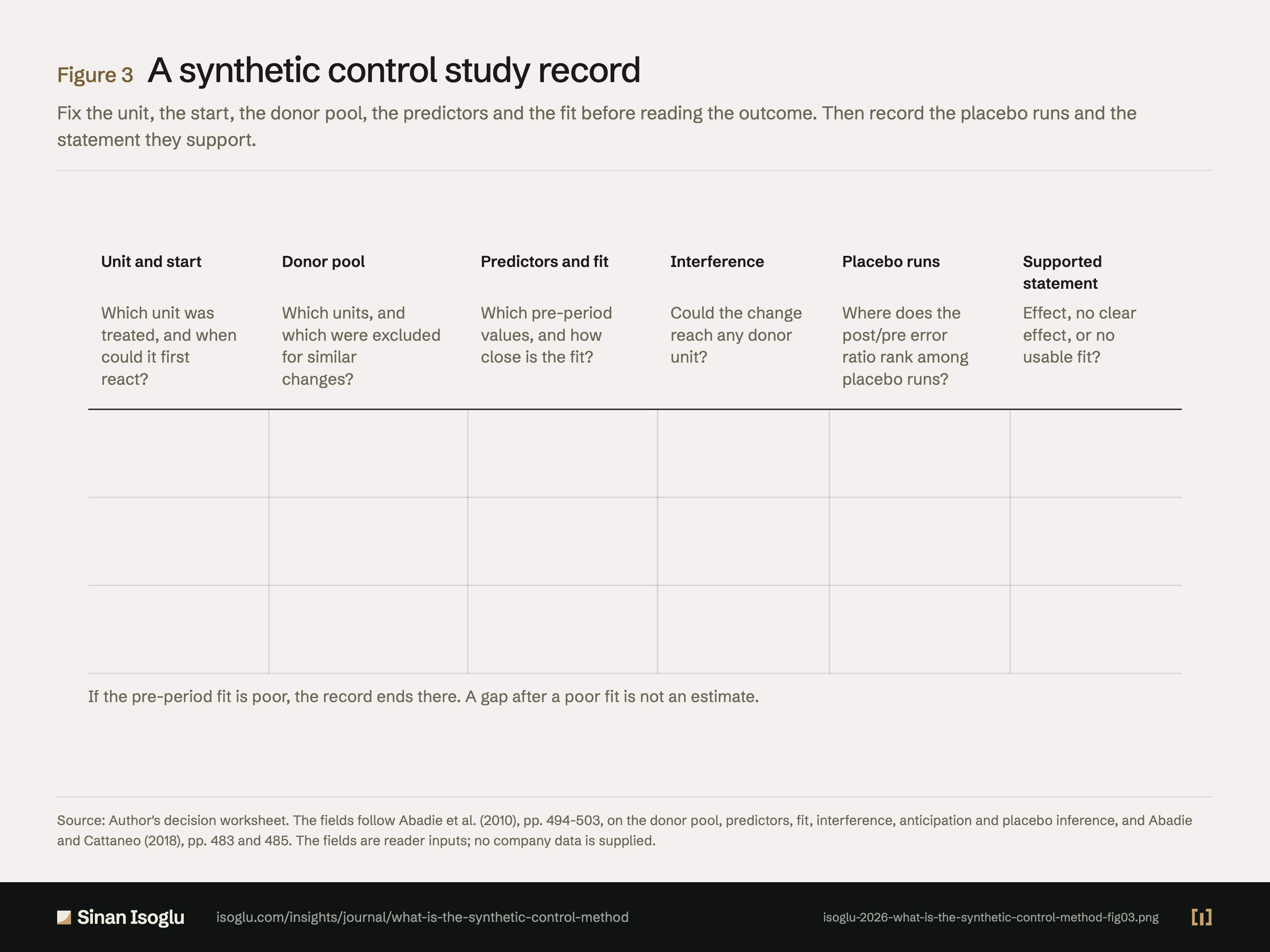
Figure 3Figure
A synthetic control study record
What is the synthetic control method?
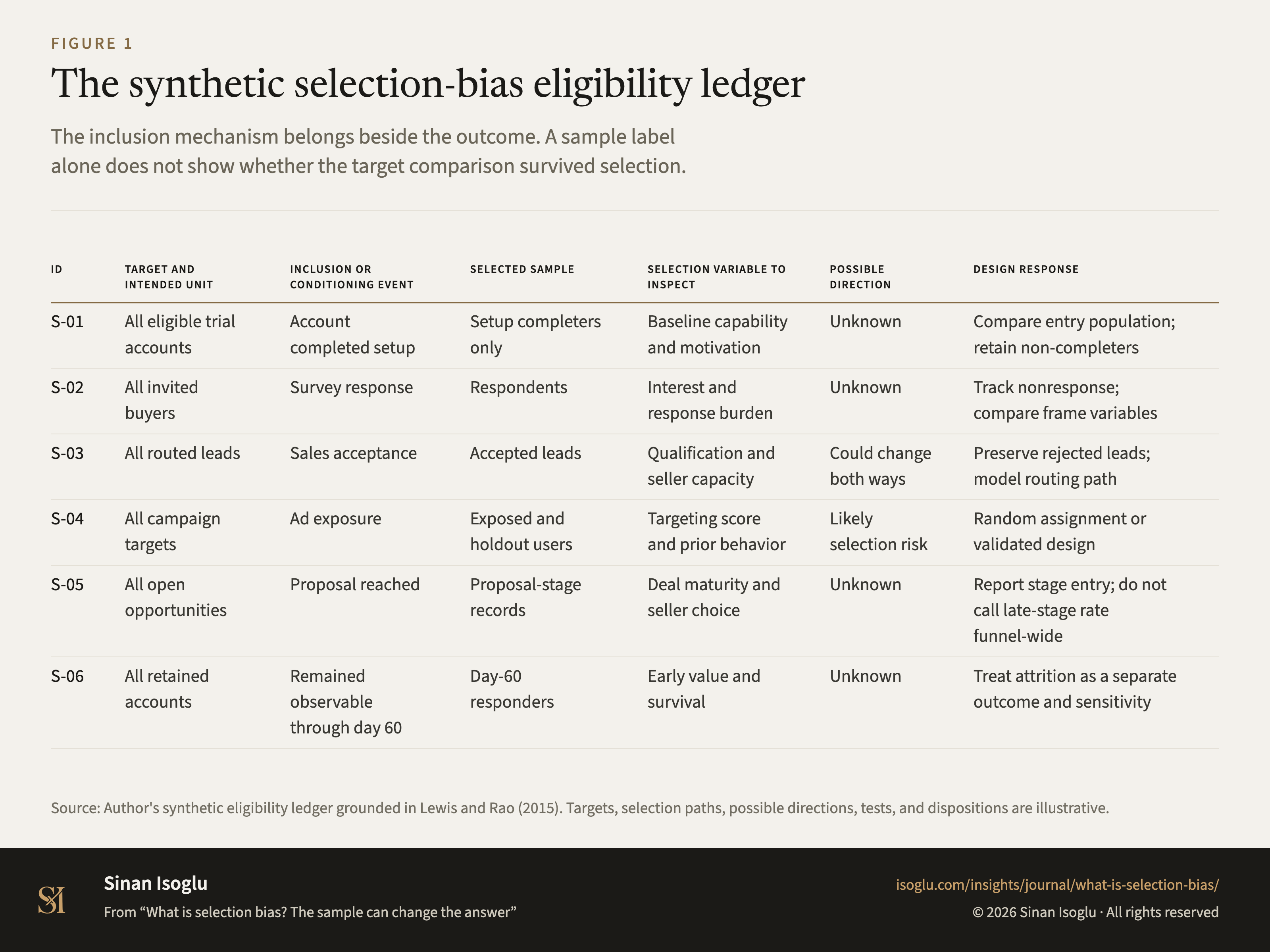
Figure 1Figure
The synthetic selection-bias eligibility ledger
What is selection bias? The sample can change the answer
Contact
Bring the question you're working on.
Research, a guest lecture, or a commercial question.