Figure 2From “What is dynamic pricing?”
A record for classifying a pricing rule
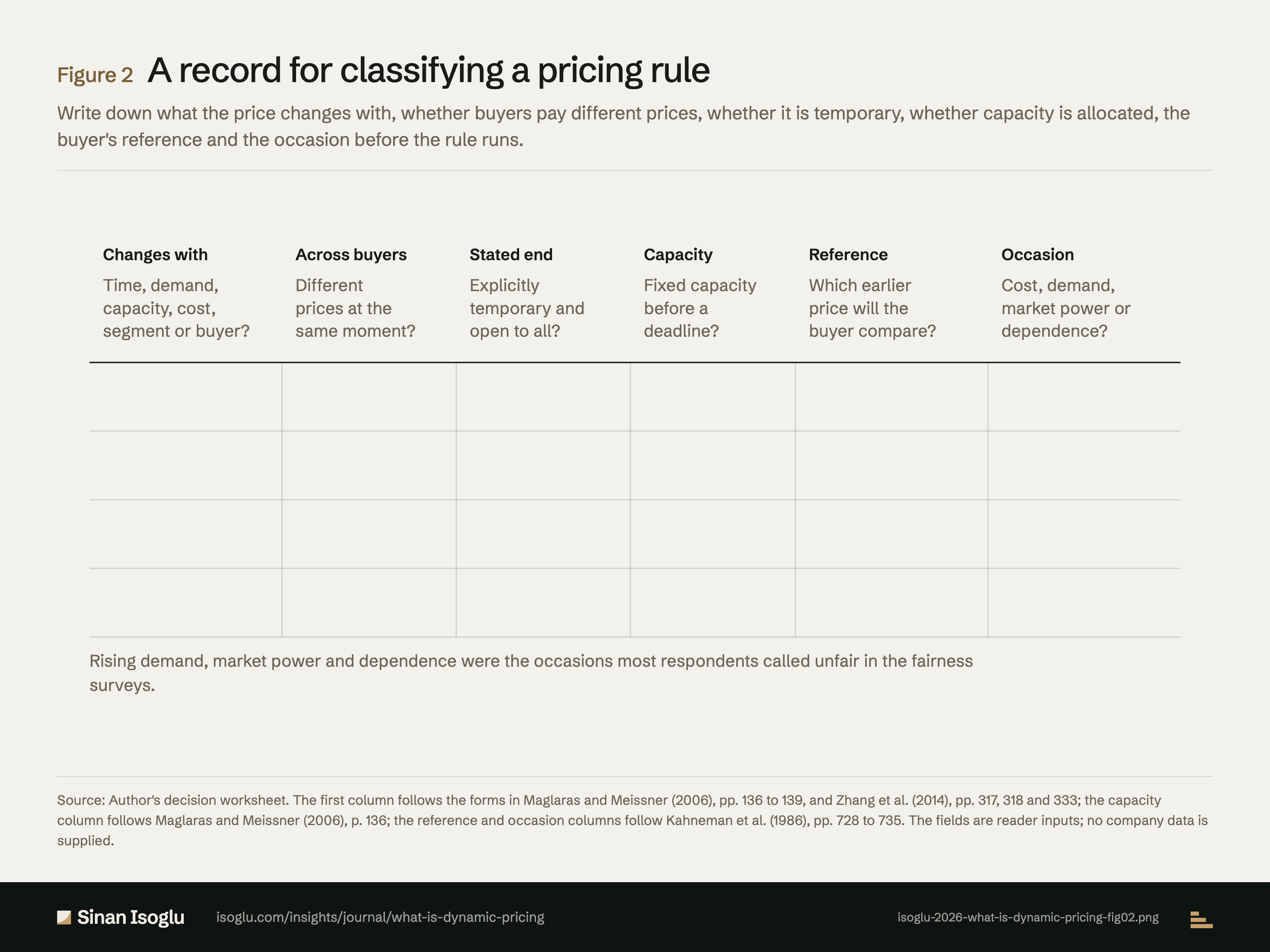
Write down what the price changes with, whether buyers pay different prices, whether it is temporary, whether capacity is allocated, the buyer's reference and the occasion before the rule runs.
Figure 2A record for classifying a pricing rule
Source: Author's decision worksheet. The first column follows the forms in Maglaras and Meissner (2006), pp. 136 to 139, and Zhang et al. (2014), pp. 317, 318 and 333; the capacity column follows Maglaras and Meissner (2006), p. 136; the reference and occasion columns follow Kahneman et al. (1986), pp. 728 to 735. The fields are reader inputs; no company data is supplied.
Source and evidence
Each line names a claim related to this exhibit, its source, and how it was checked.
- B DYNP-OWN-C4 A pricing rule is classified in six fields: what the price changes with, different prices across buyers at the same moment, a stated end and openness to all, fixed capacity before a deadline, the buyer's reference, and the occasion the buyer will see; illustrated with a hypothetical B2B software renewal price per account, higher where the account ran no tender and did not involve procurement, classified as personalized price discrimination with no stated end and no capacity, against last year's price, on an occasion, if the buyer learned it, close to dependence; the transition risk the model attaches to a higher price for relaxed buyers is one its simulated policy accepted because the higher price still paid in the model; the alternative ties the price to a stated cost index, a claim about judgements, not renewals (revised after G5 F2). Untested.Author worksheet grounded in MM06-C7, ZNA14-C6, ZNA14-C7, KKT86-C10, KKT86-C11 and KKT86-C12
Grades: A, verified against the printed page of the primary source · B, primary source, text layer only · C, authoritative secondary · D, reported.
From the essay
Pricing & revenue architecture
What is dynamic pricing?
Dynamic pricing sets the price of the same offer again as time, demand, capacity, cost or the buyer changes. In surveys, fairness turned on the reason.
Read the essayThis exhibit belongs to an essay: the numbers live here, the argument lives there.
Cite or embed
Contact
Bring the question you're working on.
Research, a guest lecture, or a commercial question.