Figure 1From “What is measurement error? The gap between a construct and its indicator”
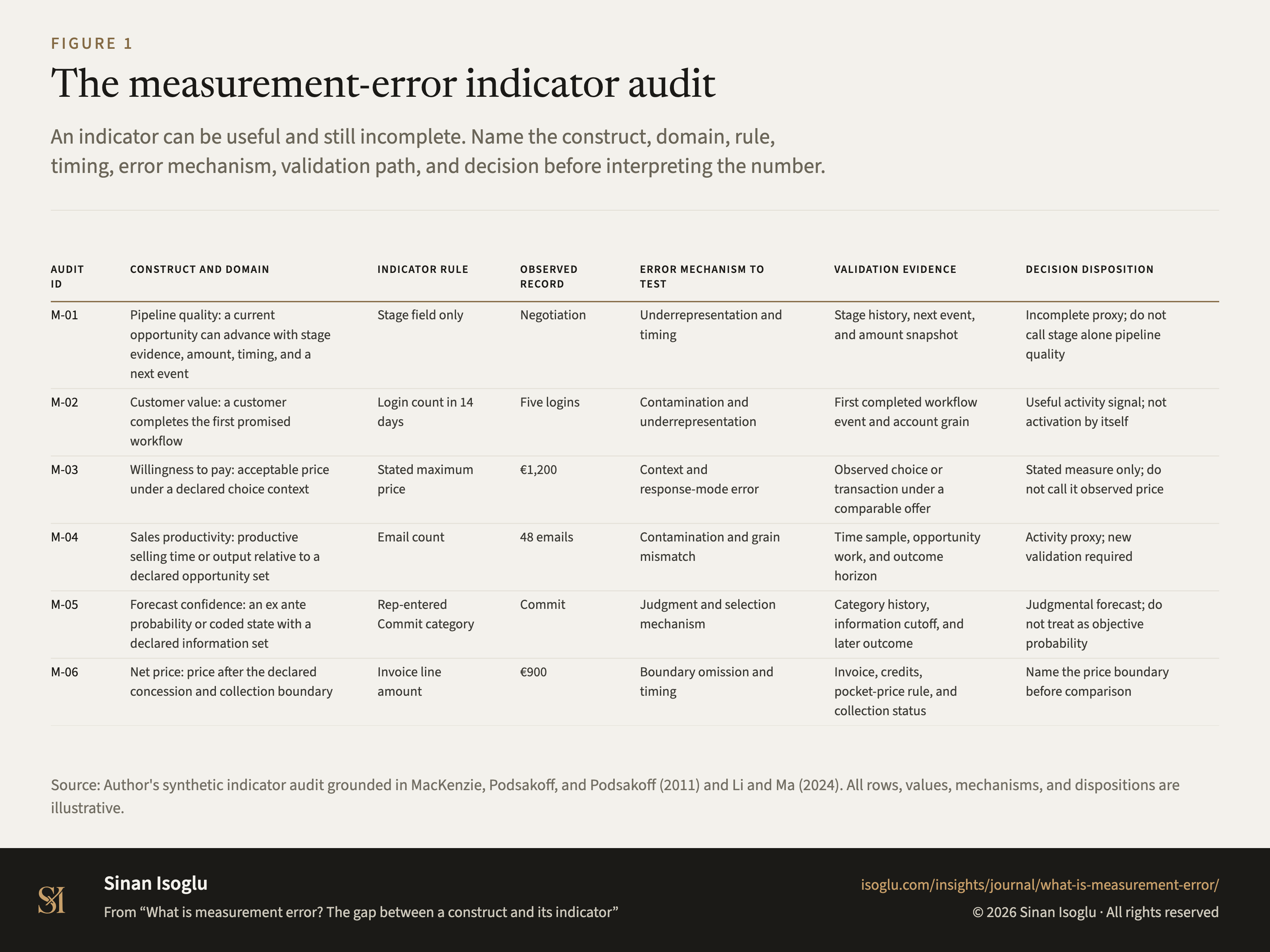
The measurement-error indicator audit
An indicator can be useful and still incomplete. Name the construct, domain, rule, timing, error mechanism, validation path, and decision before interpreting the number.
Figure 1The measurement-error indicator audit
| Audit ID | Construct and domain | Indicator rule | Observed record | Error mechanism to test | Validation evidence | Decision disposition |
|---|---|---|---|---|---|---|
| M-01 | Pipeline quality: a current opportunity can advance with stage evidence, amount, timing, and a next event | Stage field only | Negotiation | Underrepresentation and timing | Stage history, next event, and amount snapshot | Incomplete proxy; do not call stage alone pipeline quality |
| M-02 | Customer value: a customer completes the first promised workflow | Login count in 14 days | Five logins | Contamination and underrepresentation | First completed workflow event and account grain | Useful activity signal; not activation by itself |
| M-03 | Willingness to pay: acceptable price under a declared choice context | Stated maximum price | €1,200 | Context and response-mode error | Observed choice or transaction under a comparable offer | Stated measure only; do not call it observed price |
| M-04 | Sales productivity: productive selling time or output relative to a declared opportunity set | Email count | 48 emails | Contamination and grain mismatch | Time sample, opportunity work, and outcome horizon | Activity proxy; new validation required |
| M-05 | Forecast confidence: an ex ante probability or coded state with a declared information set | Rep-entered Commit category | Commit | Judgment and selection mechanism | Category history, information cutoff, and later outcome | Judgmental forecast; do not treat as objective probability |
| M-06 | Net price: price after the declared concession and collection boundary | Invoice line amount | €900 | Boundary omission and timing | Invoice, credits, pocket-price rule, and collection status | Name the price boundary before comparison |
Swipe or scroll horizontally if the table is wider than your screen.
Source: Author's synthetic indicator audit grounded in MacKenzie, Podsakoff, and Podsakoff (2011) and Li and Ma (2024). All rows, values, mechanisms, and dispositions are illustrative.
Source and evidence
Each line names a claim related to this exhibit, its source, and how it was checked.
- A MCK11-C1 The paper's own purpose: "to integrate new and existing techniques into a comprehensive set of recommendations that can be used to give researchers in mis and the behavioral sciences a framework for developing valid measures"MacKenzie, Podsakoff & Podsakoff. (2011)
- A MCK11-C2 The failure it targets: techniques that "provide evidence that the set of items used to represent the focal construct actually measures what it purports to measure" are underusedMacKenzie, Podsakoff & Podsakoff. (2011)
- A MCK11-C3 A sequence, not a checklist: "this process involves a series of steps beginning with construct conceptualization or reconceptualization of an existing construct" and ending in norms for the scaleMacKenzie, Podsakoff & Podsakoff. (2011)
- A LMA24-C1 A review, in its own words: "We review some of the classical methods in both density estimation and regression problems with measurement errors"Li & Ma. (2024). An Update on Measurement Error Modeling captured 2026-09-06
- A LMA24-C2 The error types it separates are its own keywords: "Berkson error, classical error, errors in variables"Li & Ma. (2024). An Update on Measurement Error Modeling captured 2026-09-06
- A LMA24-C3 "a completely unknown error distribution will lead to unidentifiability": without knowing something about the error, "there is no way to distinguish x and w"Li & Ma. (2024). An Update on Measurement Error Modeling captured 2026-09-06
- A LMA24-C4 The review's own scope names the trap: it considers "when the original error free model is parametric nonparametric and semiparametric in combination with different error types", so treating an observed variable as error-free is a modelling choice with consequencesLi & Ma. (2024). An Update on Measurement Error Modeling captured 2026-09-06
- B R07-OWN-C2 A construct, its domain, its indicator rule, and the recorded observation are different objects and should not be collapsed into one KPI label.Author synthesis
- B R07-OWN-C3 Construct underrepresentation, construct contamination, recording error, temporal misalignment, threshold misclassification, and missingness are distinct audit mechanisms.Author synthesis
- B R07-OWN-C4 A single indicator cannot identify its own error structure without assumptions or validation evidence.Author synthesis
- B R07-OWN-C7 A measurement audit should preserve the construct domain, unit, indicator rule, time boundary, missing and invalid states, validation path, error mechanism, and decision disposition.Author synthesis
- B R07-OWN-C8 An indicator can be operationally useful without being a complete measure of the construct it is named after.Author synthesis
- B R07-OWN-C12 The R-07 worksheet values and dispositions are synthetic and contain no customer, participant, product, or company data.Author synthesis
Grades: A, verified against the printed page of the primary source · B, primary source, text layer only · C, authoritative secondary · D, reported.
From the essay
From the research bench
What is measurement error? The gap between a construct and its indicator
Measurement error begins when an observed indicator is treated as the construct itself. Define the target, indicator, error mechanism, and validation path.
Read the essayThis exhibit belongs to an essay: the numbers live here, the argument lives there.
Cite or embed
Related exhibits
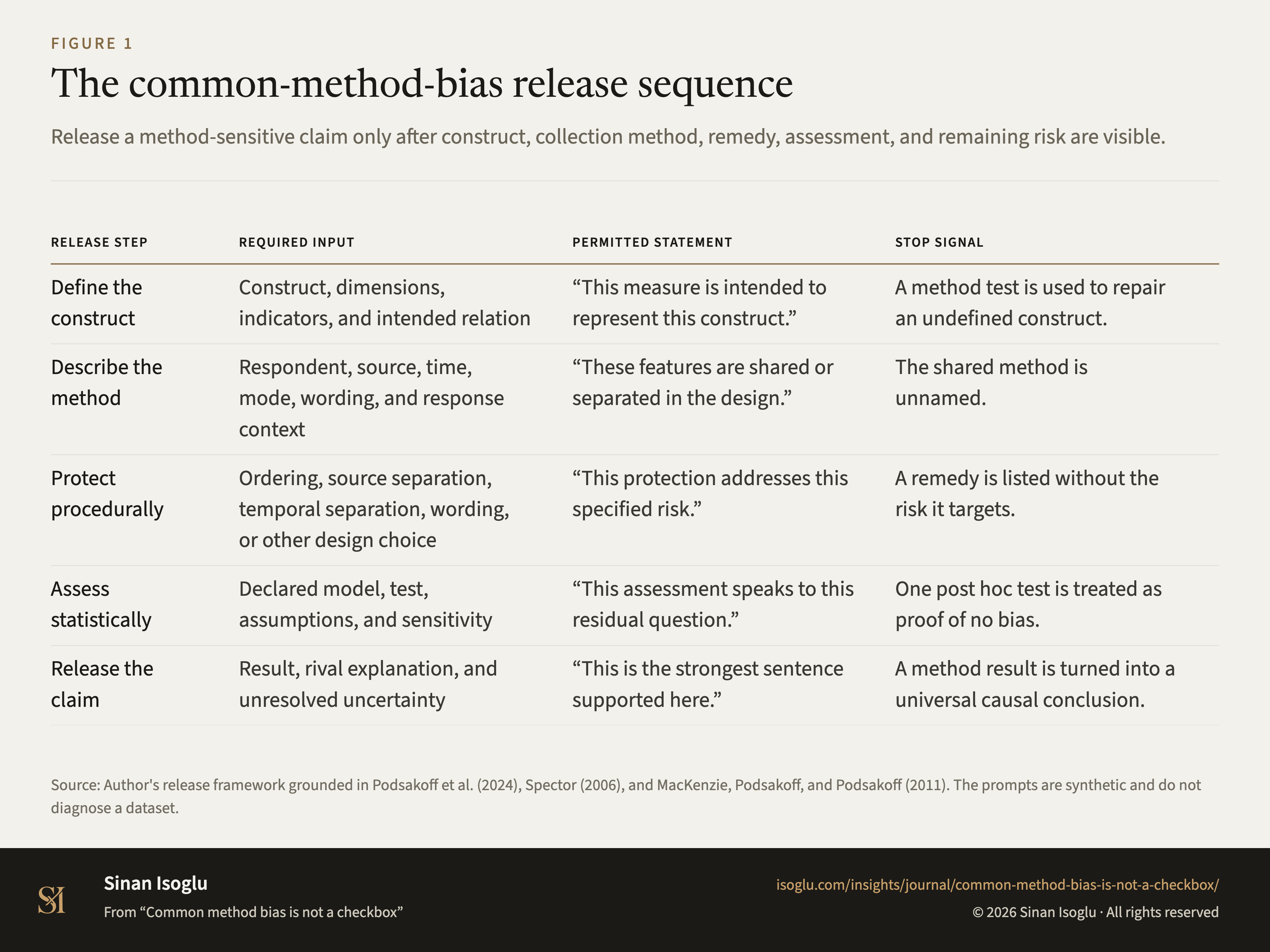
Figure 1Figure
The common-method-bias release sequence
Common method bias is not a checkbox
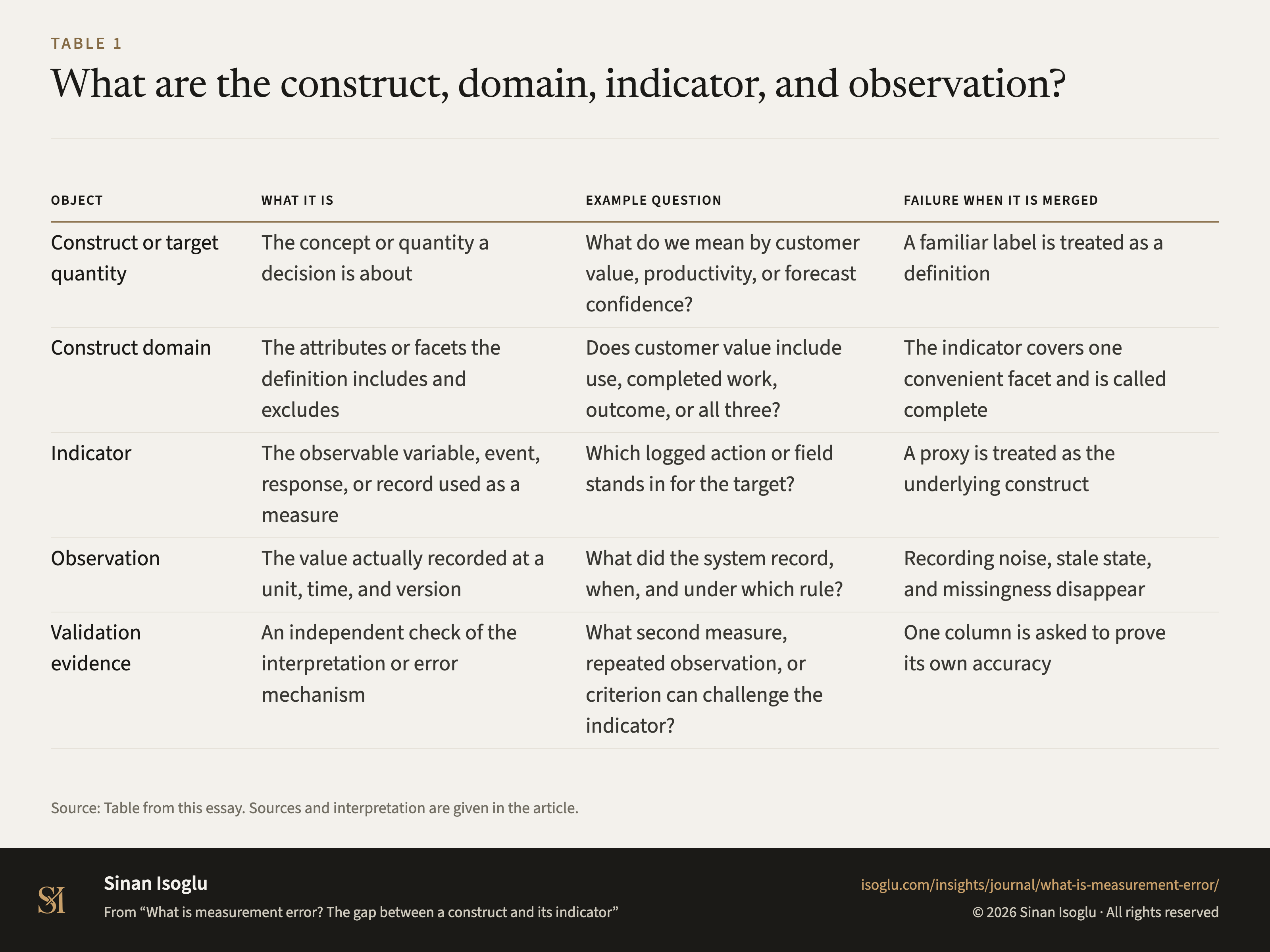
Table 1Table
What are the construct, domain, indicator, and observation?
What is measurement error? The gap between a construct and its indicator
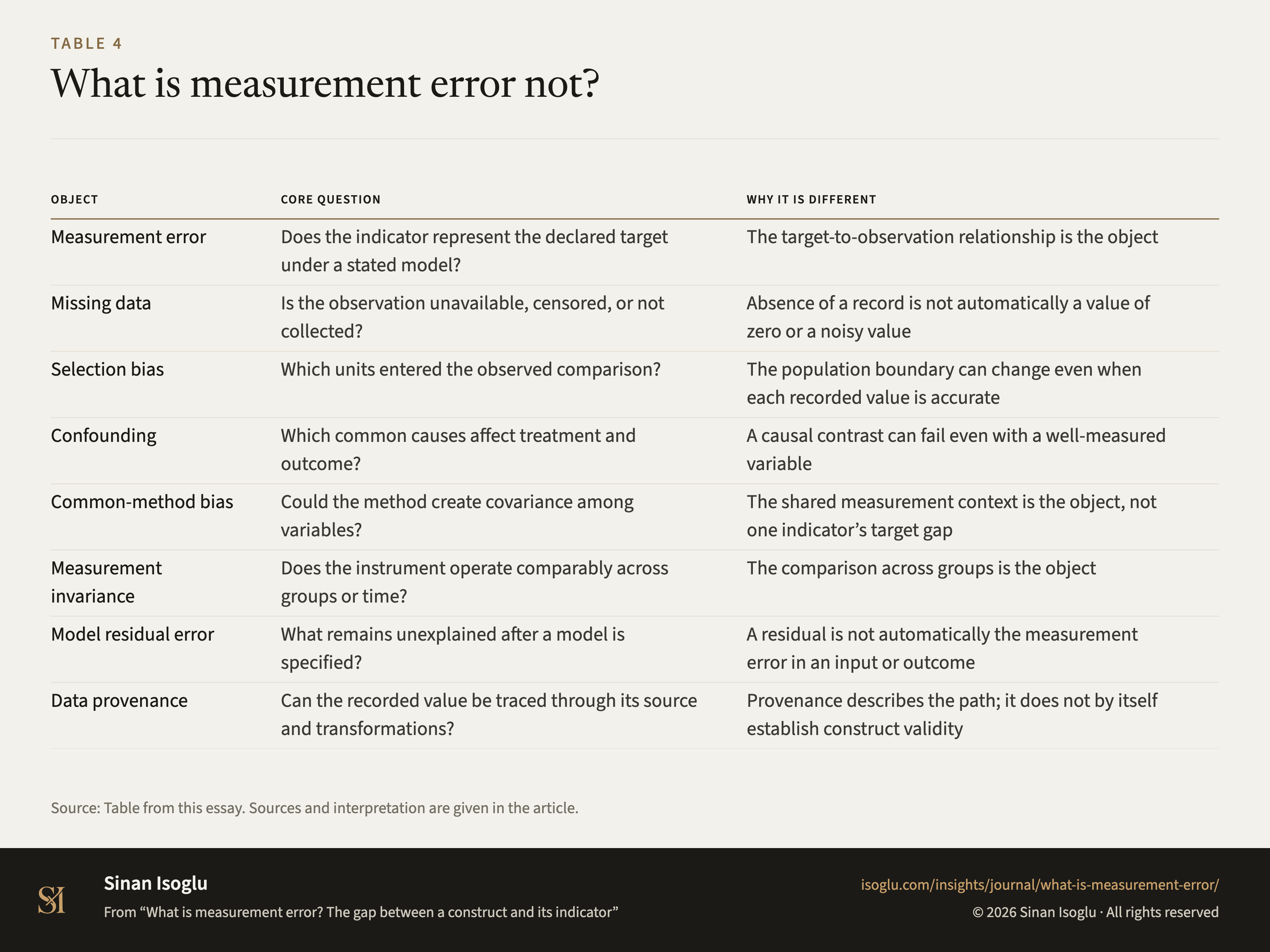
Table 3Table
What is measurement error not?
What is measurement error? The gap between a construct and its indicator
Contact
Bring the question you're working on.
Research, a guest lecture, or a commercial question.