Abbildung 1Aus „Was ist Messfehler? Die Lücke zwischen Konstrukt und Indikator“
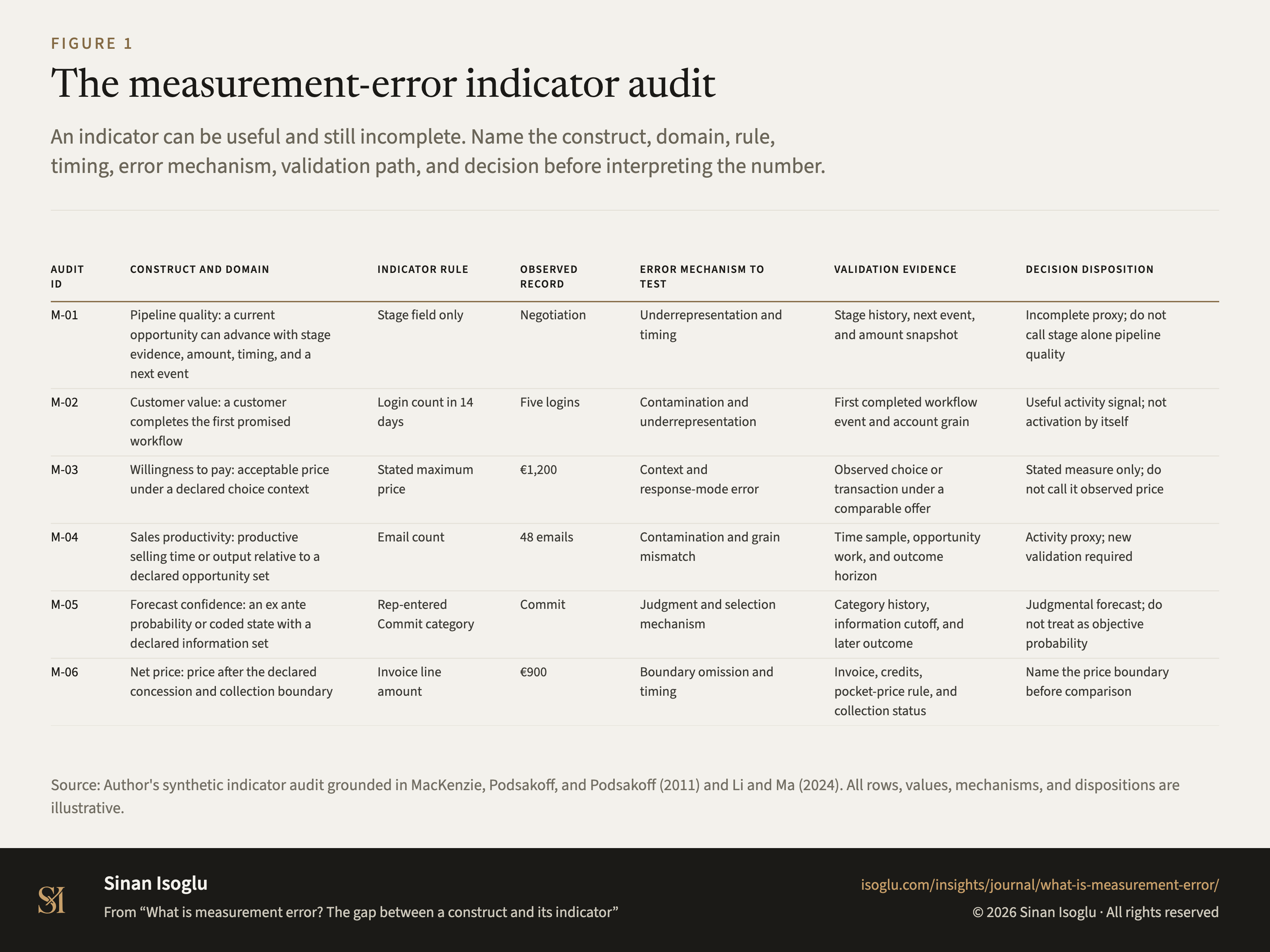
Das Prüfblatt für Messfehler und Indikatoren
Ein Indikator kann nützlich und trotzdem unvollständig sein. Benennen Sie Konstrukt, Bereich, Regel, Zeit, Fehlmechanismus, Prüfweg und Entscheidung, bevor Sie die Zahl interpretieren.
Abbildung 1Das Prüfblatt für Messfehler und Indikatoren
| Prüf-ID | Konstrukt und Bereich | Indikatorregel | Beobachteter Wert | Zu prüfender Fehlmechanismus | Validierungsevidenz | Entscheidungsstatus |
|---|---|---|---|---|---|---|
| M-01 | Pipelinequalität: Eine aktuelle Verkaufschance kann mit Phasenbeleg, Betrag, Zeit und nächstem Ereignis fortschreiten | Nur Phasenfeld | Verhandlung | Unterrepräsentation und Zeitbezug | Phasenhistorie, nächstes Ereignis und Betragssnapshot | Unvollständiger Proxy; Phase allein nicht Pipelinequalität nennen |
| M-02 | Kundenwert: Ein Kunde schließt den ersten versprochenen Workflow ab | Login-Zahl in 14 Tagen | Fünf Logins | Kontamination und Unterrepräsentation | Erstes abgeschlossenes Workflow-Ereignis und Kontokörnung | Nützliches Aktivitätssignal; nicht allein Aktivierung |
| M-03 | Zahlungsbereitschaft: Akzeptabler Preis in einem definierten Entscheidungskontext | Geäußerter Maximalpreis | 1.200 € | Kontext und Antwortmodus | Beobachtete Wahl oder Transaktion bei vergleichbarem Angebot | Nur geäußertes Maß; nicht beobachteten Preis nennen |
| M-04 | Vertriebsproduktivität: Produktive Verkaufszeit oder Leistung relativ zu einer definierten Chancenmenge | E-Mail-Zahl | 48 E-Mails | Kontamination und falsche Körnung | Zeitstichprobe, Verkaufschancenarbeit und Ergebnishorizont | Aktivitätsproxy; neue Validierung erforderlich |
| M-05 | Prognosevertrauen: Ex-ante-Wahrscheinlichkeit oder codierter Zustand mit Informationsstand | Von der Vertriebsmitarbeitenden gesetzte Commit-Kategorie | Commit | Urteil und Auswahlmechanismus | Kategoriehistorie, Informationsstichtag und späteres Ergebnis | Urteilsprognose; nicht objektive Wahrscheinlichkeit |
| M-06 | Nettopreis: Preis nach definierter Konzessions- und Vereinnahmungsgrenze | Rechnungszeilenbetrag | 900 € | Ausgelassene Grenze und Zeitbezug | Rechnung, Gutschriften, Pocket-Price-Regel und Zahlungsstatus | Preisgrenze vor dem Vergleich benennen |
Bei breiten Tabellen horizontal wischen oder scrollen.
Quelle: Synthetisches Indikator-Prüfblatt des Autors, gestützt auf MacKenzie, Podsakoff und Podsakoff (2011) sowie Li und Ma (2024). Alle Zeilen, Werte, Mechanismen und Entscheidungen sind illustrativ.
Quelle und Evidenz
Jede Zeile nennt eine Aussage zu dieser Abbildung, ihre Quelle und die Art ihrer Prüfung.
- A MCK11-C1 The paper's own purpose: "to integrate new and existing techniques into a comprehensive set of recommendations that can be used to give researchers in mis and the behavioral sciences a framework for developing valid measures"MacKenzie, Podsakoff & Podsakoff. (2011)
- A MCK11-C2 The failure it targets: techniques that "provide evidence that the set of items used to represent the focal construct actually measures what it purports to measure" are underusedMacKenzie, Podsakoff & Podsakoff. (2011)
- A MCK11-C3 A sequence, not a checklist: "this process involves a series of steps beginning with construct conceptualization or reconceptualization of an existing construct" and ending in norms for the scaleMacKenzie, Podsakoff & Podsakoff. (2011)
- A LMA24-C1 A review, in its own words: "We review some of the classical methods in both density estimation and regression problems with measurement errors"Li & Ma. (2024). An Update on Measurement Error Modeling captured 2026-09-06
- A LMA24-C2 The error types it separates are its own keywords: "Berkson error, classical error, errors in variables"Li & Ma. (2024). An Update on Measurement Error Modeling captured 2026-09-06
- A LMA24-C3 "a completely unknown error distribution will lead to unidentifiability": without knowing something about the error, "there is no way to distinguish x and w"Li & Ma. (2024). An Update on Measurement Error Modeling captured 2026-09-06
- A LMA24-C4 The review's own scope names the trap: it considers "when the original error free model is parametric nonparametric and semiparametric in combination with different error types", so treating an observed variable as error-free is a modelling choice with consequencesLi & Ma. (2024). An Update on Measurement Error Modeling captured 2026-09-06
- B R07-OWN-C2 A construct, its domain, its indicator rule, and the recorded observation are different objects and should not be collapsed into one KPI label.Author synthesis
- B R07-OWN-C3 Construct underrepresentation, construct contamination, recording error, temporal misalignment, threshold misclassification, and missingness are distinct audit mechanisms.Author synthesis
- B R07-OWN-C4 A single indicator cannot identify its own error structure without assumptions or validation evidence.Author synthesis
- B R07-OWN-C7 A measurement audit should preserve the construct domain, unit, indicator rule, time boundary, missing and invalid states, validation path, error mechanism, and decision disposition.Author synthesis
- B R07-OWN-C8 An indicator can be operationally useful without being a complete measure of the construct it is named after.Author synthesis
- B R07-OWN-C12 The R-07 worksheet values and dispositions are synthetic and contain no customer, participant, product, or company data.Author synthesis
Prüfgrade: A, gegen die gedruckte Seite der Primärquelle geprüft · B, Primärquelle, nur Textebene · C, belastbare Sekundärquelle · D, berichtet.
Aus dem Beitrag
Aus der Forschung
Was ist Messfehler? Die Lücke zwischen Konstrukt und Indikator
Ein Messfehler beginnt, wenn ein beobachteter Indikator mit dem Konstrukt gleichgesetzt wird. Definieren Sie Ziel, Indikator, Fehlermodell und Prüfweg.
Den Beitrag lesenDiese Abbildung gehört zu einem Essay: Die Zahlen stehen hier, das Argument dort.
Zitieren oder einbetten
Verwandte Abbildungen
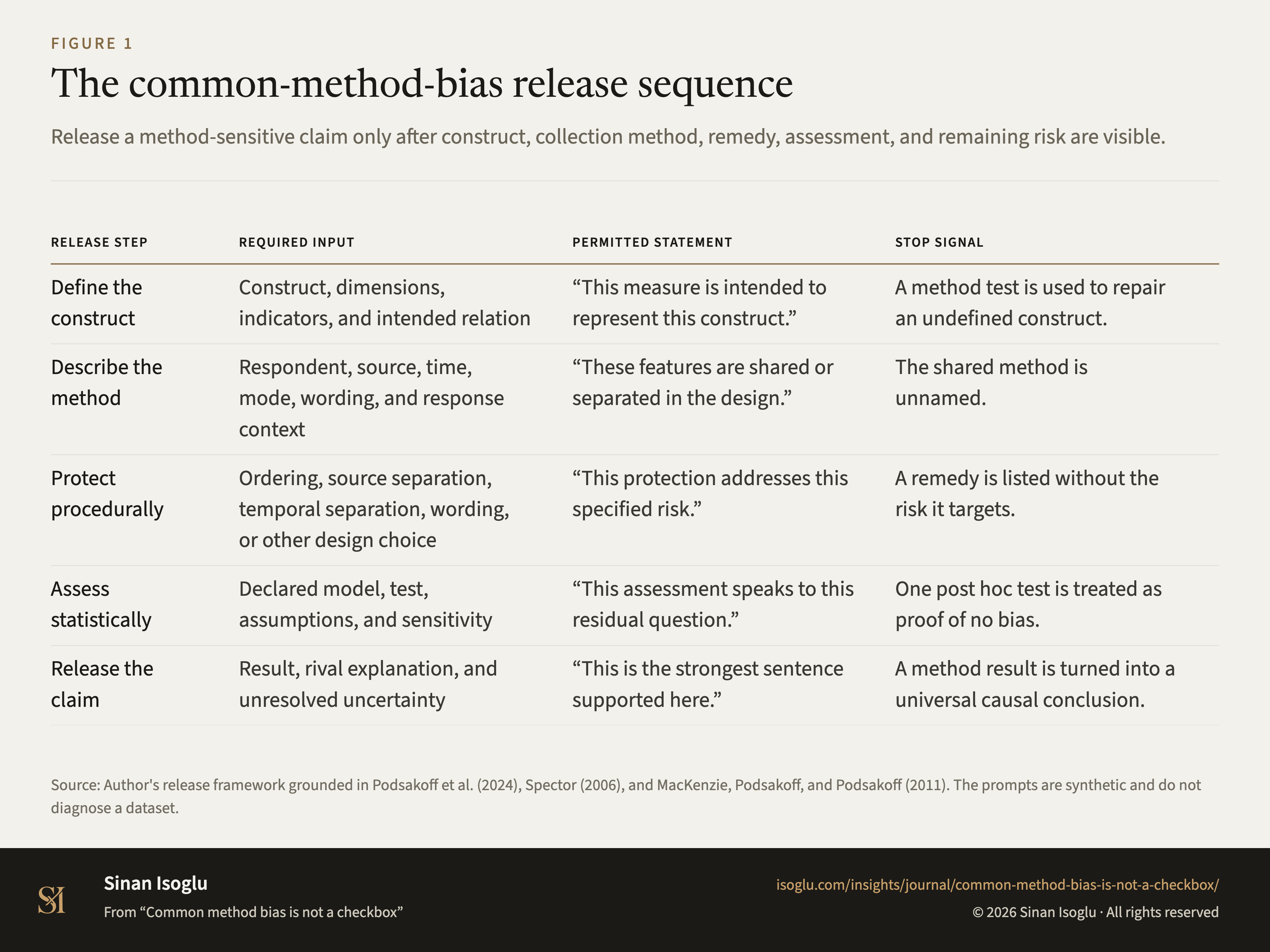
Abbildung 1Grafik
Die Freigabesequenz für Common Method Bias
Common Method Bias ist kein Häkchen
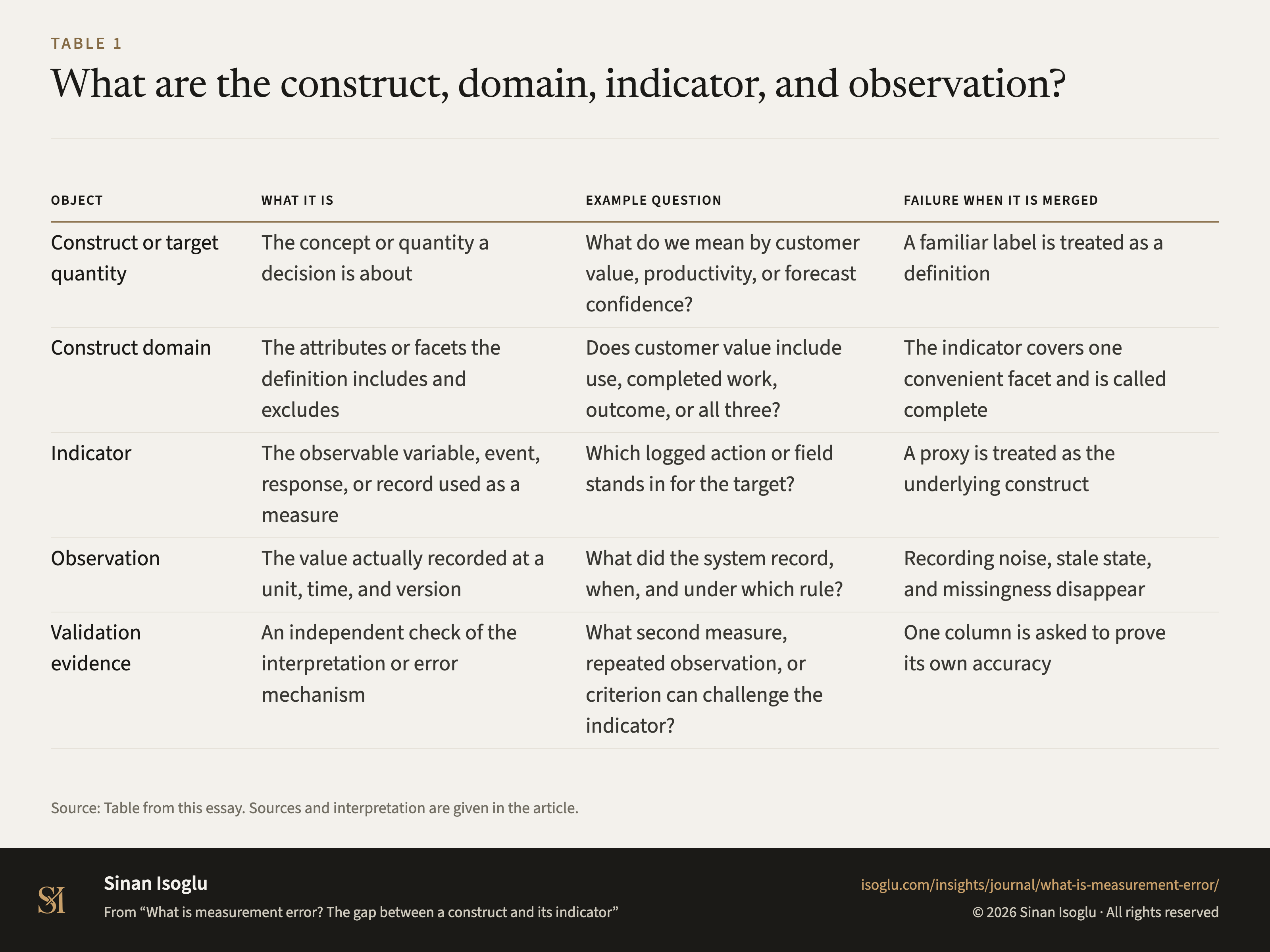
Tabelle 1Tabelle
Was sind Konstrukt, Konstruktbereich, Indikator und Beobachtung?
Was ist Messfehler? Die Lücke zwischen Konstrukt und Indikator
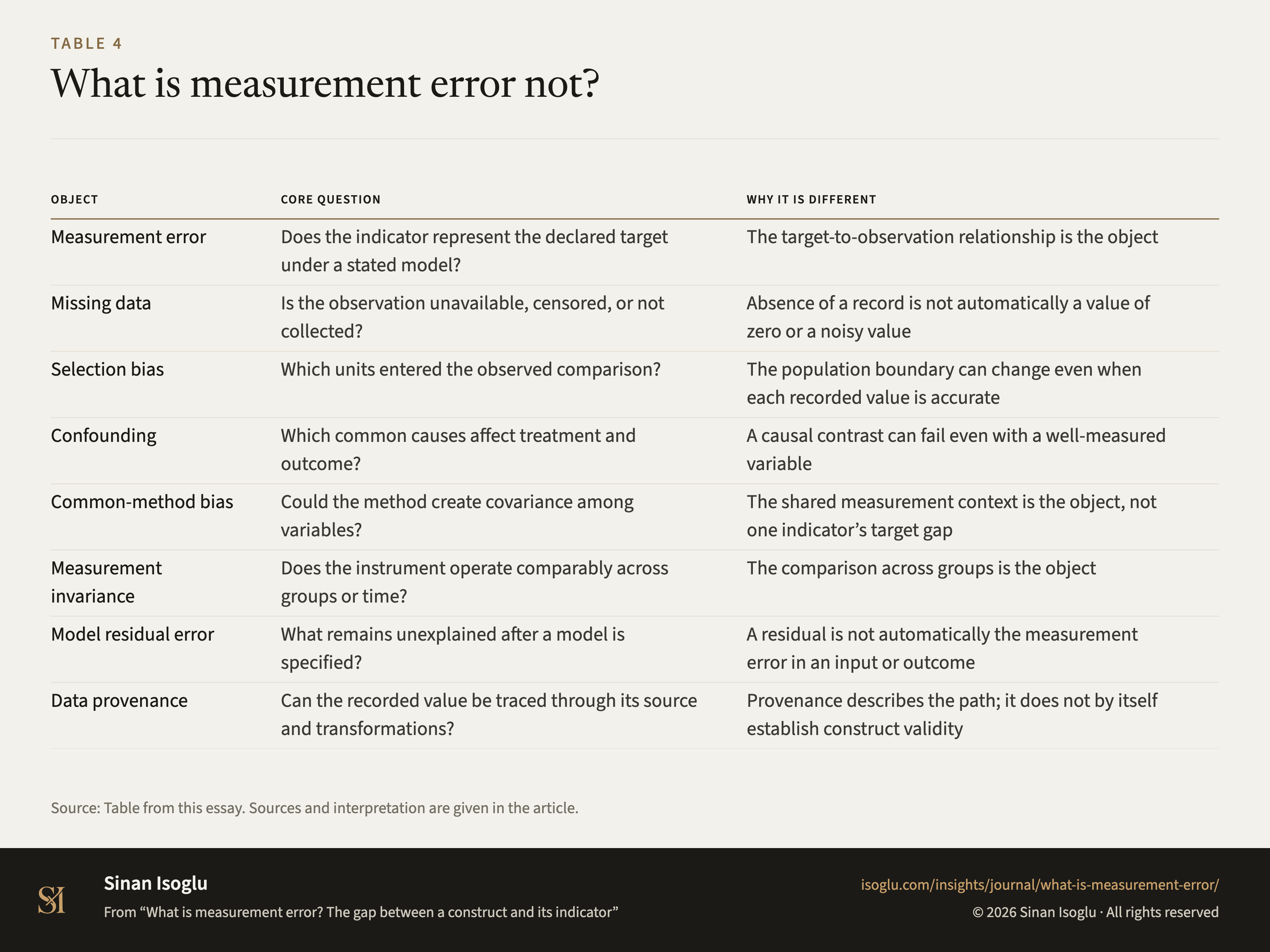
Tabelle 3Tabelle
Was ist Messfehler nicht?
Was ist Messfehler? Die Lücke zwischen Konstrukt und Indikator
Kontakt
Schicken Sie die Frage, an der Sie arbeiten.
Forschung, ein Gastvortrag oder eine Frage aus der Praxis.