Table 3From “What is measurement error? The gap between a construct and its indicator”
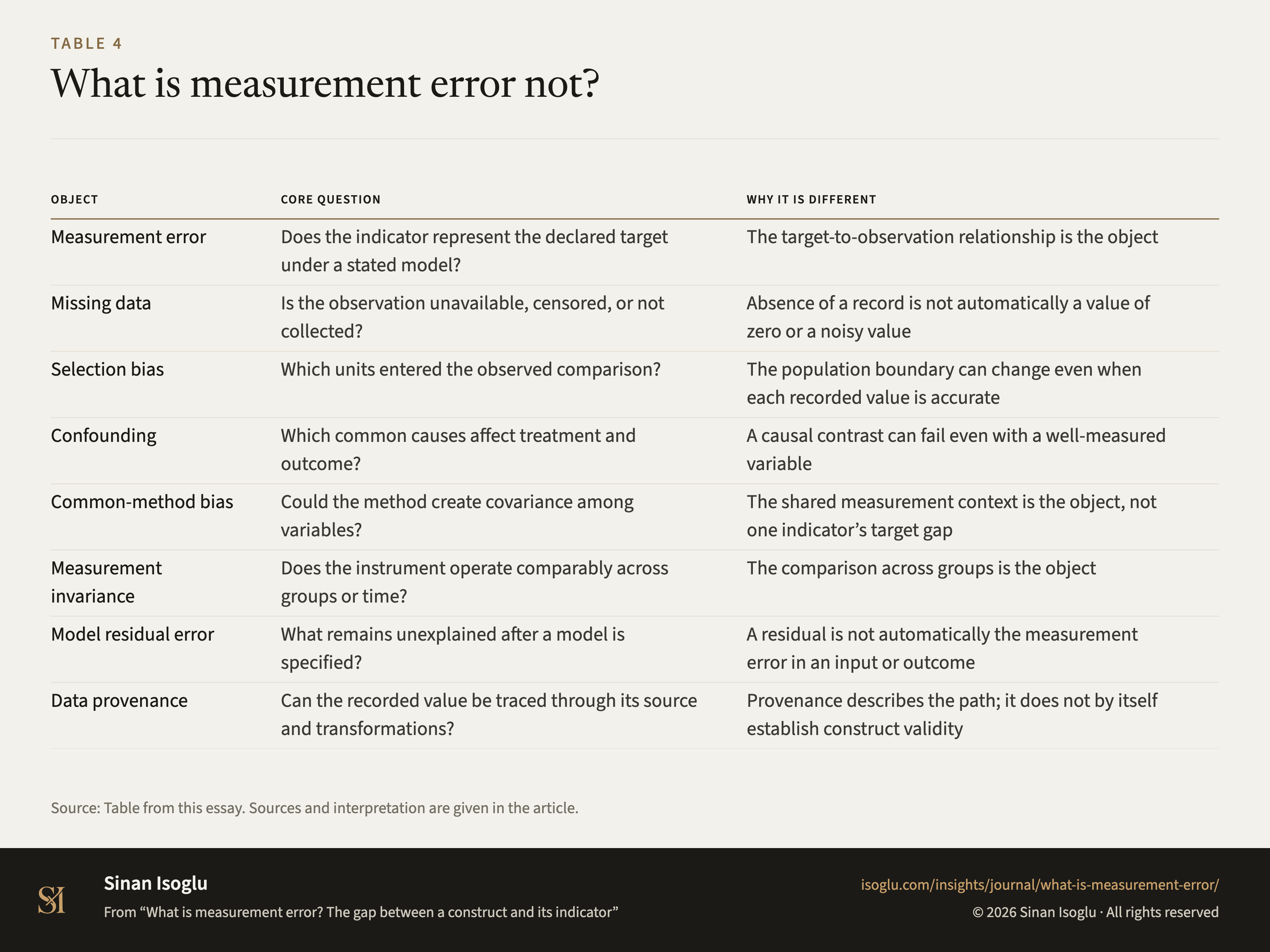
What is measurement error not?
Table 3What is measurement error not?
| Object | Core question | Why it is different |
|---|---|---|
| Measurement error | Does the indicator represent the declared target under a stated model? | The target-to-observation relationship is the object |
| Missing data | Is the observation unavailable, censored, or not collected? | Absence of a record is not automatically a value of zero or a noisy value |
| Selection bias | Which units entered the observed comparison? | The population boundary can change even when each recorded value is accurate |
| Confounding | Which common causes affect treatment and outcome? | A causal contrast can fail even with a well-measured variable |
| Common-method bias | Could the method create covariance among variables? | The shared measurement context is the object, not one indicator's target gap |
| Measurement invariance | Does the instrument operate comparably across groups or time? | The comparison across groups is the object |
| Model residual error | What remains unexplained after a model is specified? | A residual is not automatically the measurement error in an input or outcome |
| Data provenance | Can the recorded value be traced through its source and transformations? | Provenance describes the path; it does not by itself establish construct validity |
Swipe or scroll horizontally if the table is wider than your screen.
Source: Table from this essay. Sources and interpretation are given in the article.
From the essay
From the research bench
What is measurement error? The gap between a construct and its indicator
Measurement error begins when an observed indicator is treated as the construct itself. Define the target, indicator, error mechanism, and validation path.
Read the essayThis exhibit belongs to an essay: the numbers live here, the argument lives there.
Cite or embed
Related exhibits
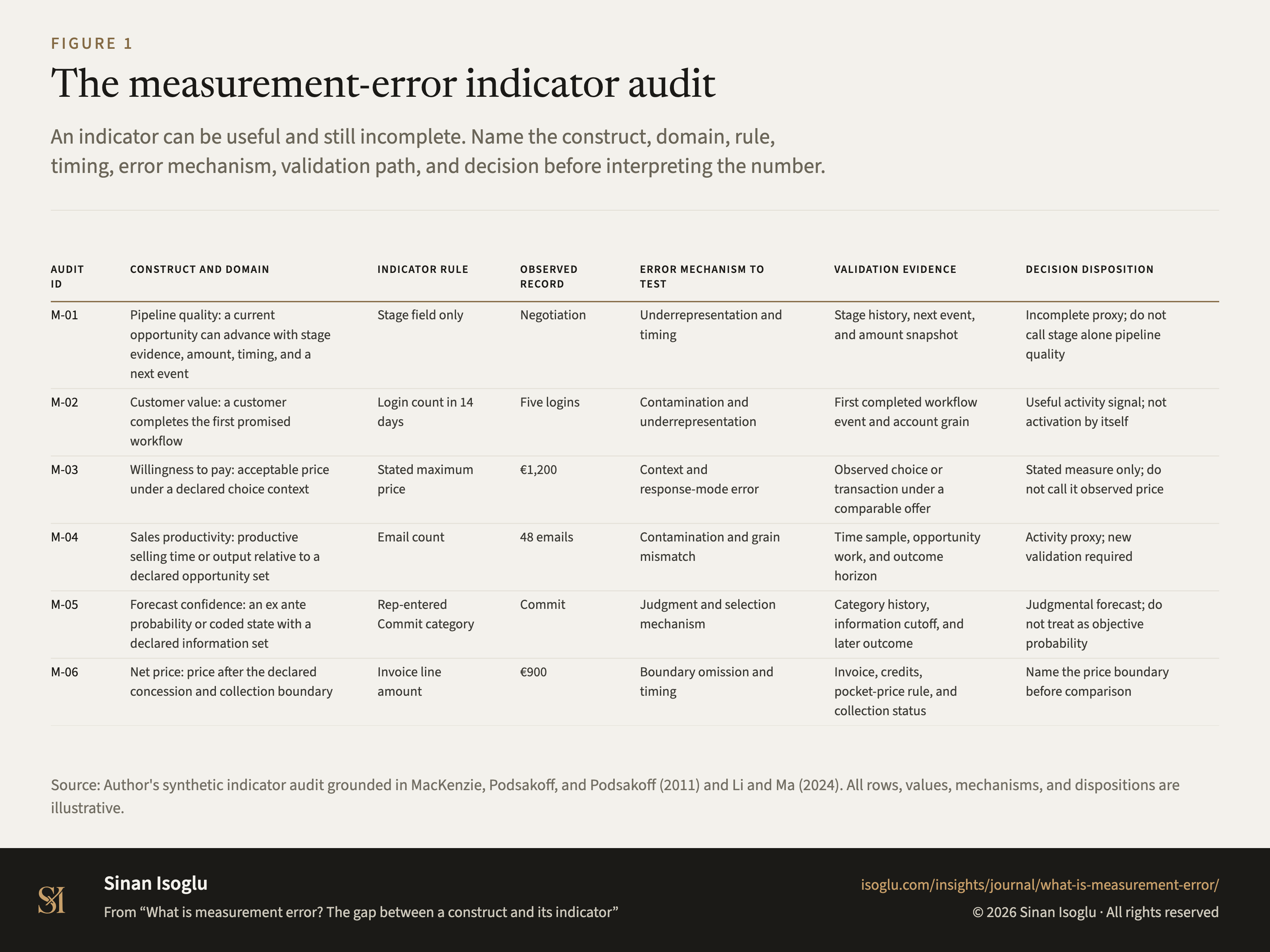
Figure 1Figure
The measurement-error indicator audit
What is measurement error? The gap between a construct and its indicator
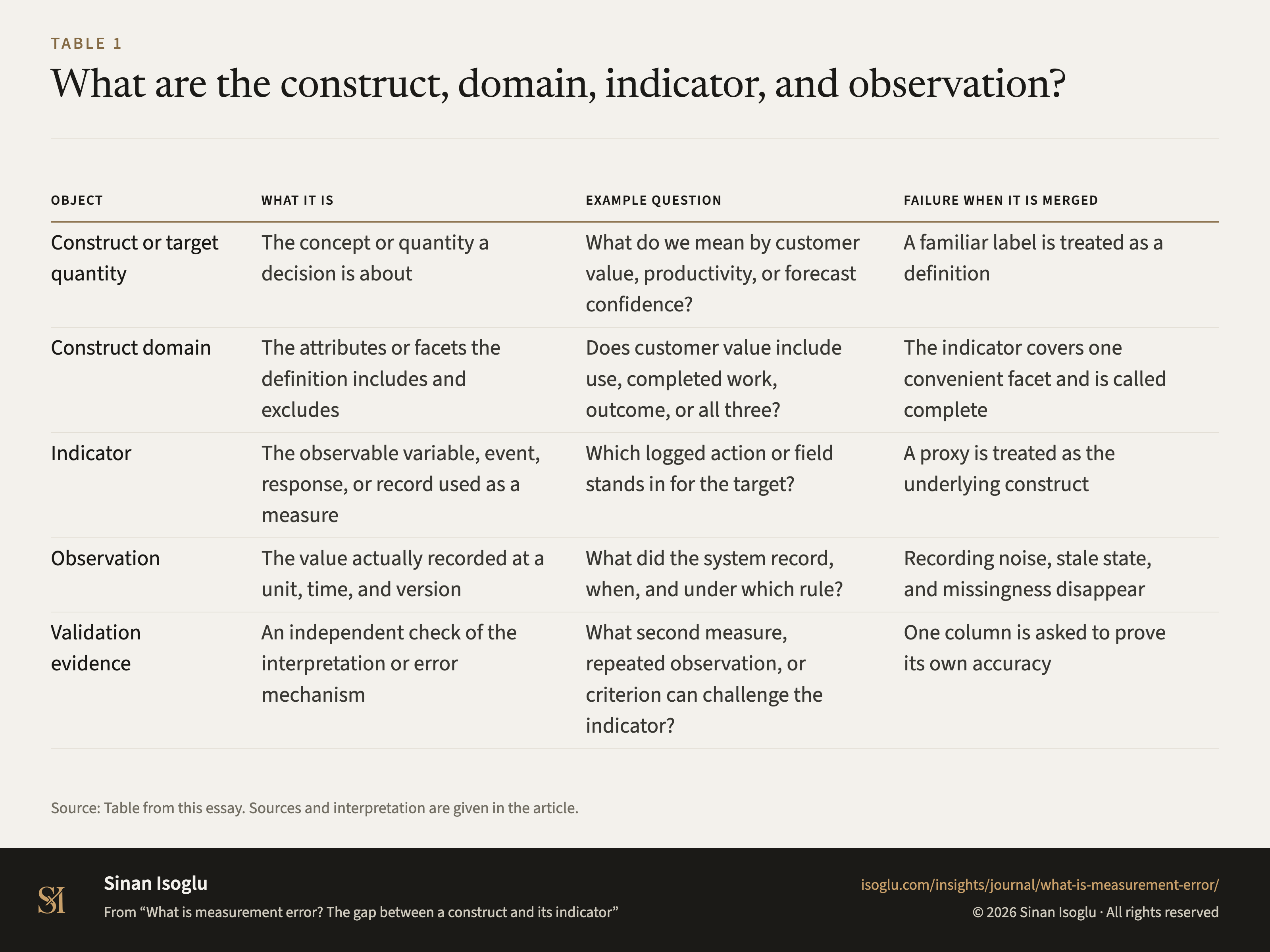
Table 1Table
What are the construct, domain, indicator, and observation?
What is measurement error? The gap between a construct and its indicator
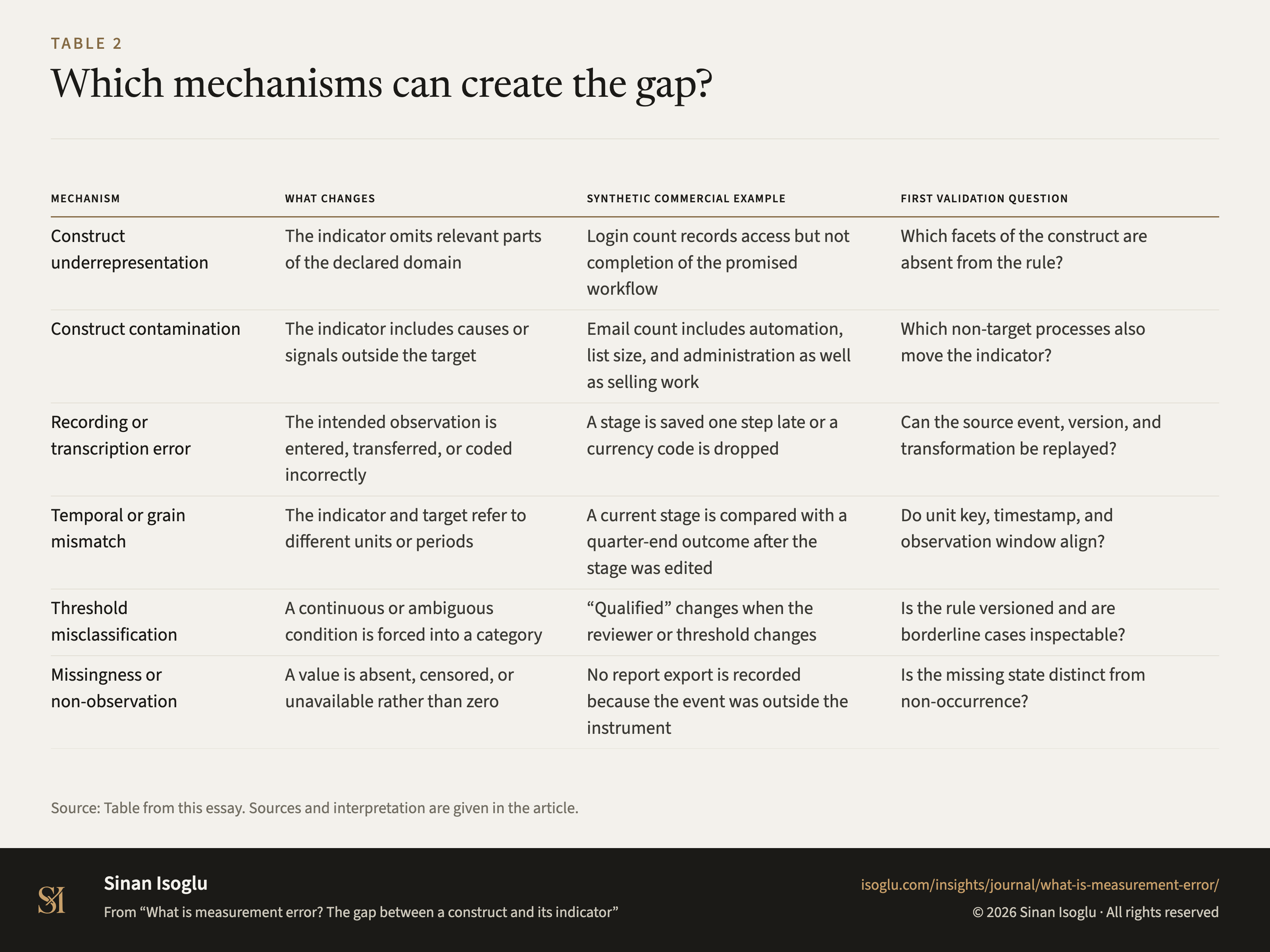
Table 2Table
Which mechanisms can create the gap?
What is measurement error? The gap between a construct and its indicator
Contact
Bring the question you're working on.
Research, a guest lecture, or a commercial question.