Figure 1From “Common method bias is not a checkbox”
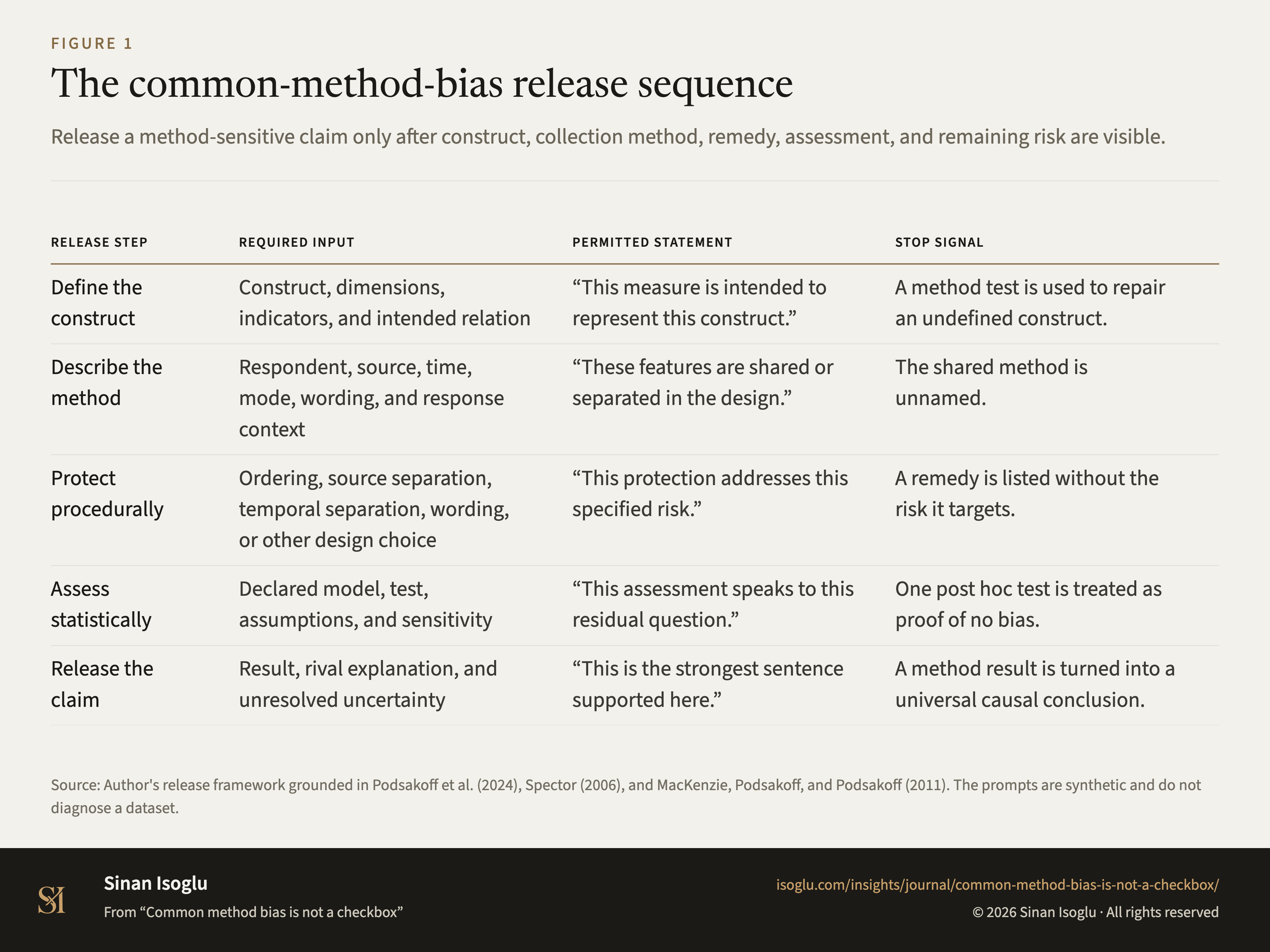
The common-method-bias release sequence
Release a method-sensitive claim only after construct, collection method, remedy, assessment, and remaining risk are visible.
Figure 1The common-method-bias release sequence
| Release step | Required input | Permitted statement | Stop signal |
|---|---|---|---|
| Define the construct | Construct, dimensions, indicators, and intended relation | “This measure is intended to represent this construct.” | A method test is used to repair an undefined construct. |
| Describe the method | Respondent, source, time, mode, wording, and response context | “These features are shared or separated in the design.” | The shared method is unnamed. |
| Protect procedurally | Ordering, source separation, temporal separation, wording, or other design choice | “This protection addresses this specified risk.” | A remedy is listed without the risk it targets. |
| Assess statistically | Declared model, test, assumptions, and sensitivity | “This assessment speaks to this residual question.” | One post hoc test is treated as proof of no bias. |
| Release the claim | Result, rival explanation, and unresolved uncertainty | “This is the strongest sentence supported here.” | A method result is turned into a universal causal conclusion. |
Swipe or scroll horizontally if the table is wider than your screen.
Source: Author's release framework grounded in Podsakoff et al. (2024), Spector (2006), and MacKenzie, Podsakoff, and Podsakoff (2011). The prompts are synthetic and do not diagnose a dataset.
Source and evidence
Each line names a claim related to this exhibit, its source, and how it was checked.
- A POD24-C1 The review's own four-part structure: "we explain the harmful effects of CMB (why it is bad)", then "there are multiple sources of CMB, several of which are likely to be present in any study", then "the conditions under which CMB is likely to occur are relatively widespread, and fourth, we explain why CMB is not easy to fix"Podsakoff et al. (2024)
- A POD24-C2 Multiple sources, and more than one likely at once: "there are multiple sources of CMB, several of which are likely to be present in any study"Podsakoff et al. (2024)
- A POD24-C3 And no single post hoc test is the remedy, because "the conditions under which CMB is likely to occur are relatively widespread, and fourth, we explain why CMB is not easy to fix"Podsakoff et al. (2024)
- A SPE06-C1 The paper's title is its claim: "Method Variance in Organizational Research: Truth or Urban Legend?", and it names the belief it disputes, that "Everything Measured With the Same Method Shares CMV"Spector. (2006)
- A SPE06-C2 The evidential basis for disputing it: "The reason this is legend is because there are few scientific data to unequivocally support this view and there are data to refute it"Spector. (2006)
- A SPE06-C3 So the argument is for design-sensitive reasoning rather than a blanket verdict: "The reason this is legend is because there are few scientific data to unequivocally support this view and there are data to refute it"Spector. (2006)
- A MCK11-C1 The paper's own purpose: "to integrate new and existing techniques into a comprehensive set of recommendations that can be used to give researchers in mis and the behavioral sciences a framework for developing valid measures"MacKenzie, Podsakoff & Podsakoff. (2011)
- A MCK11-C2 The failure it targets: techniques that "provide evidence that the set of items used to represent the focal construct actually measures what it purports to measure" are underusedMacKenzie, Podsakoff & Podsakoff. (2011)
- A MCK11-C3 A sequence, not a checklist: "this process involves a series of steps beginning with construct conceptualization or reconceptualization of an existing construct" and ending in norms for the scaleMacKenzie, Podsakoff & Podsakoff. (2011)
Grades: A, verified against the printed page of the primary source · B, primary source, text layer only · C, authoritative secondary · D, reported.
From the essay
From the research bench
Common method bias is not a checkbox
Common method bias is a design risk, not a single test: separate construct validity, method variance, procedural remedies, and residual uncertainty.
Read the essayThis exhibit belongs to an essay: the numbers live here, the argument lives there.
Cite or embed
Related exhibits
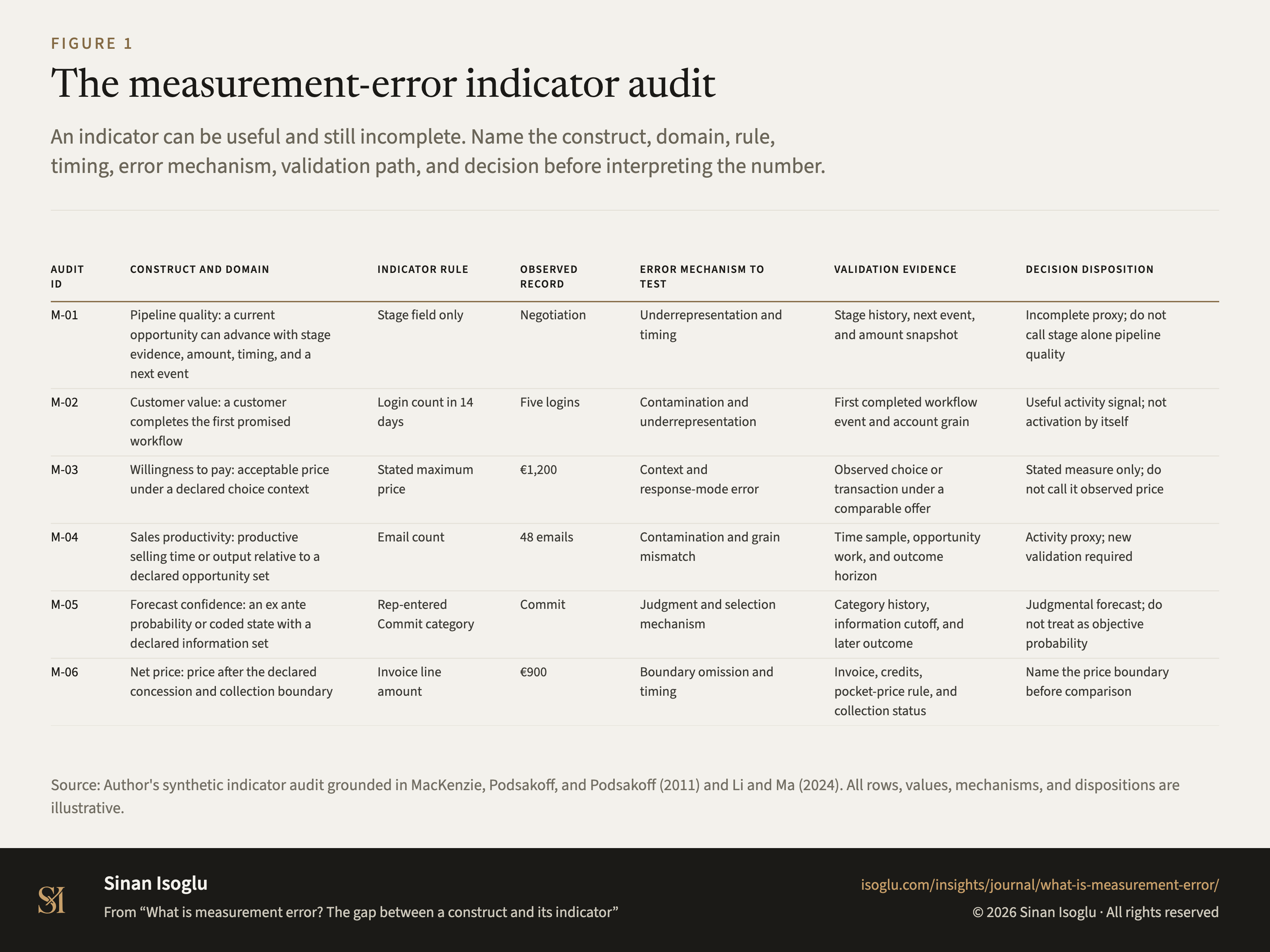
Figure 1Figure
The measurement-error indicator audit
What is measurement error? The gap between a construct and its indicator
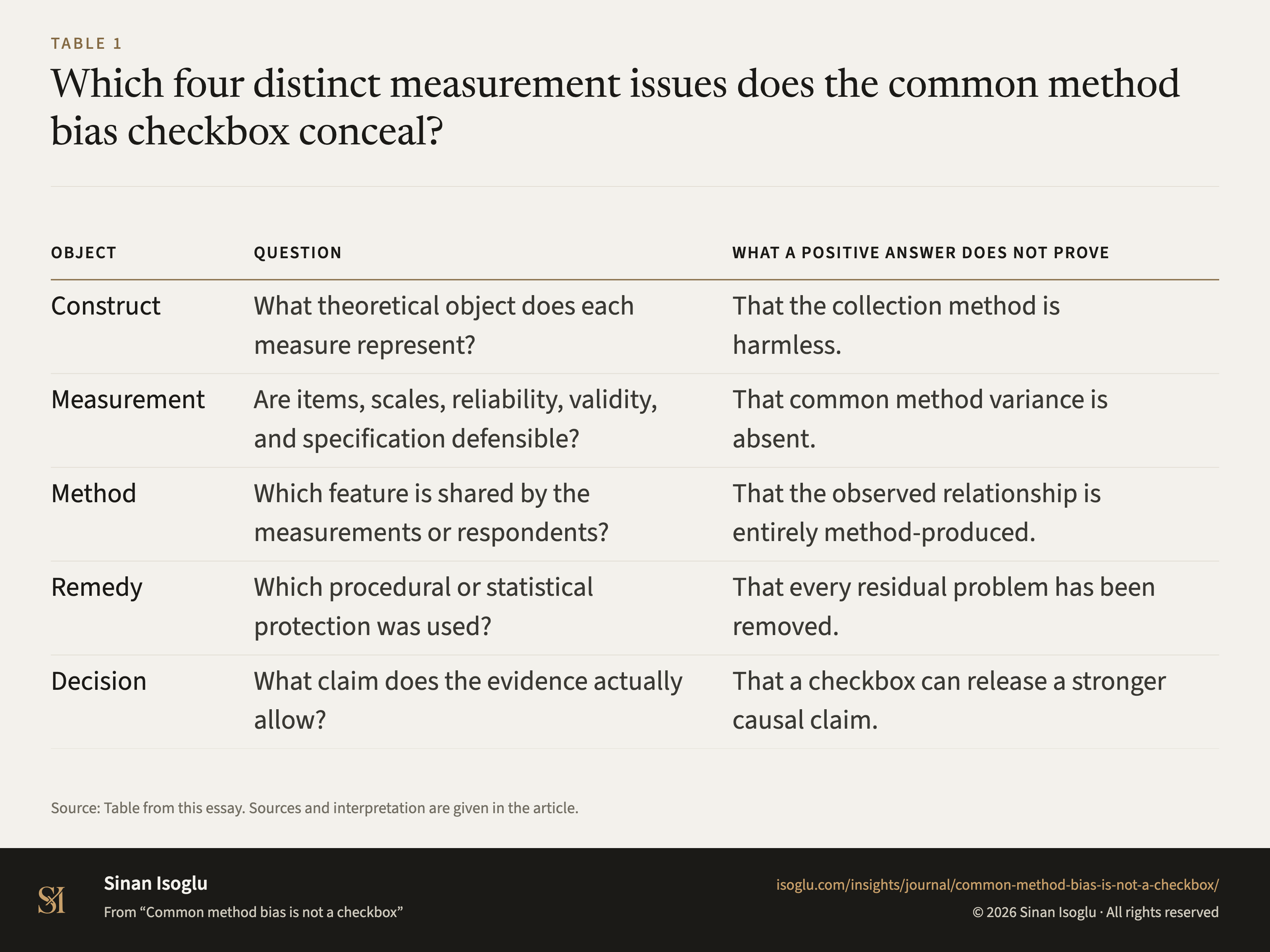
Table 1Table
Which four distinct measurement issues does the common method bias checkbox conceal?
Common method bias is not a checkbox
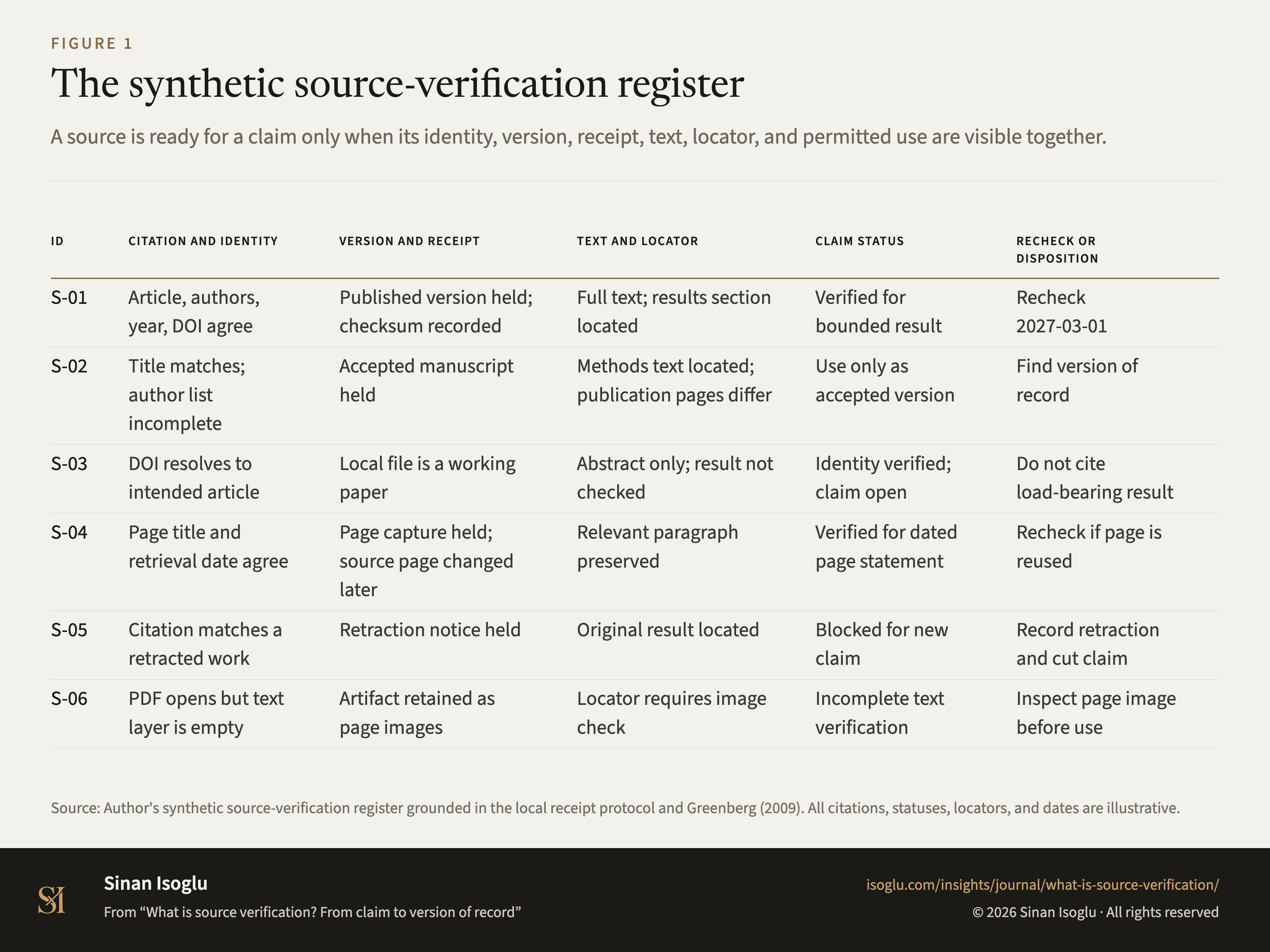
Figure 1Figure
The synthetic source-verification register
What is source verification? From claim to version of record
Contact
Bring the question you're working on.
Research, a guest lecture, or a commercial question.