Figure 2From “What is Little's law?”
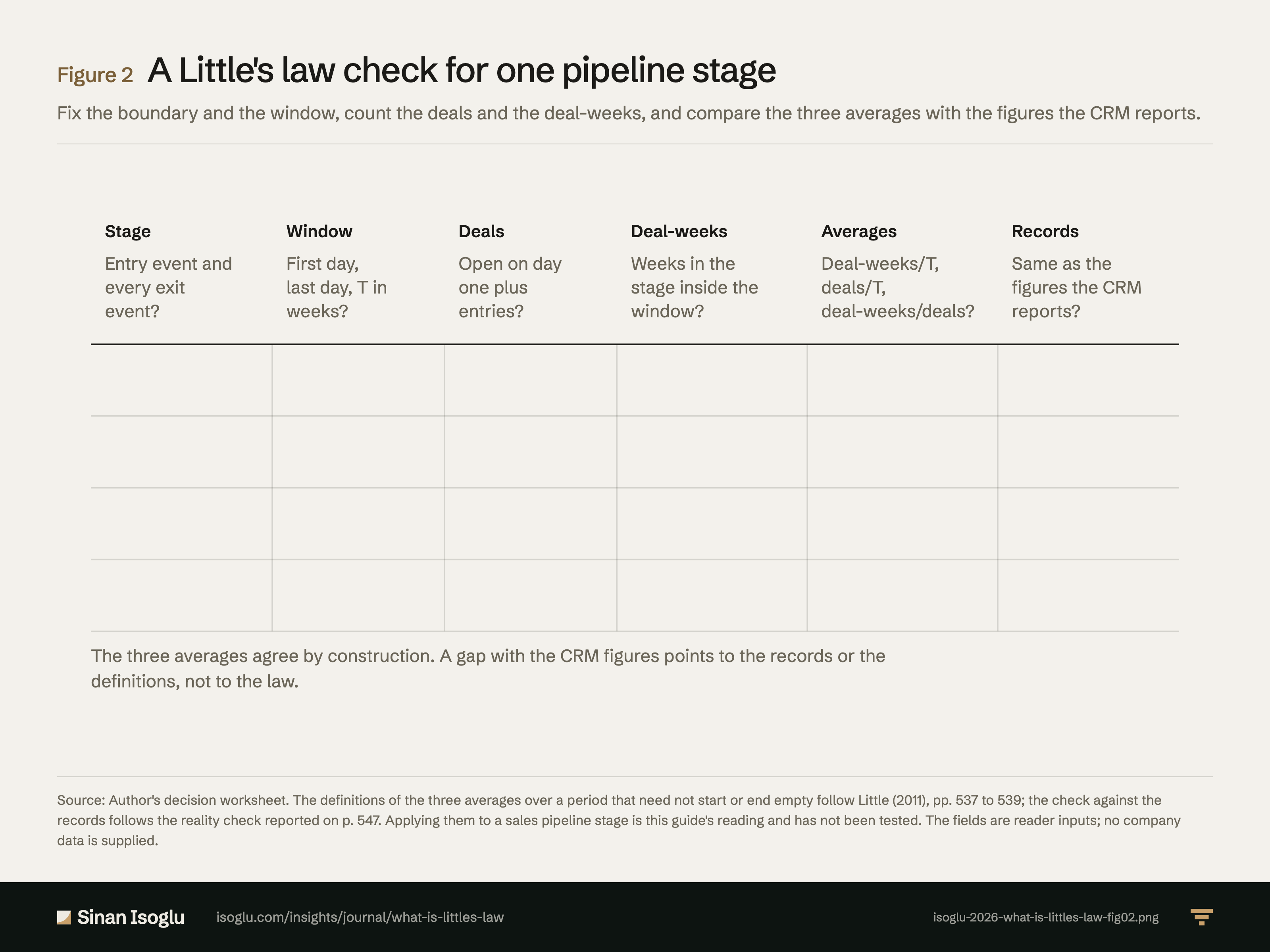
A Little's law check for one pipeline stage
Fix the boundary and the window, count the deals and the deal-weeks, and compare the three averages with the figures the CRM reports.
Figure 2A Little's law check for one pipeline stage
Source: Author's decision worksheet. The definitions of the three averages over a period that need not start or end empty follow Little (2011), pp. 537 to 539; the check against the records follows the reality check reported on p. 547. Applying them to a sales pipeline stage is this guide's reading and has not been tested. The fields are reader inputs; no company data is supplied.
Source and evidence
Each line names a claim related to this exhibit, its source, and how it was checked.
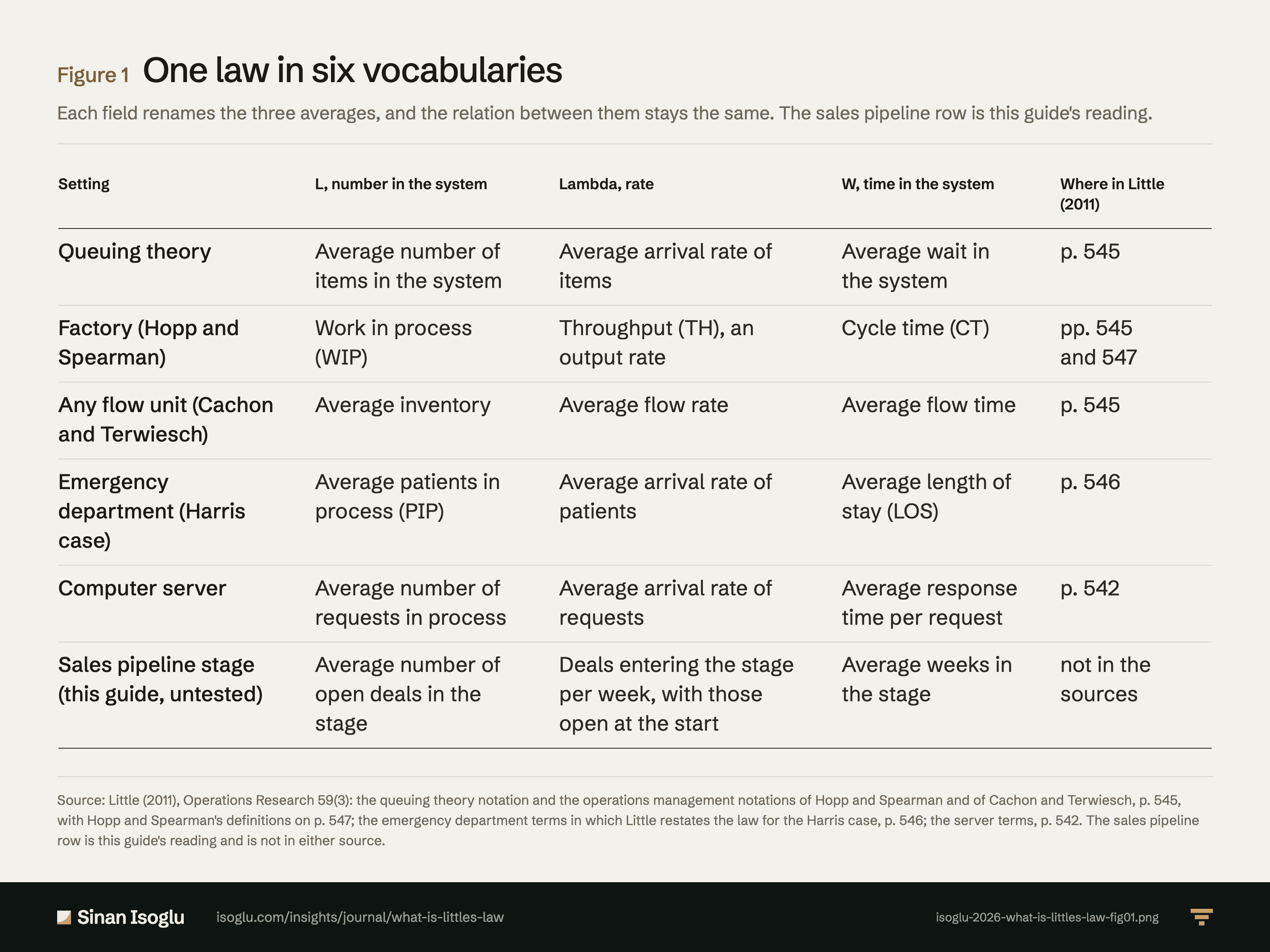
- B LLAW-OWN-C3 A pipeline stage read with the finite-period law (author's example, invented numbers, untested): the system is one stage bounded by its entry event and every exit (advanced, moved back to an earlier stage, won, lost, disqualified), a deal moved back into the stage counts as a new arrival; over 13 weeks, 120 deals open on day one and 270 entries give 390 deals, 1,560 deal-weeks give L = 120, λ = 30 per week, W = 4 weeks (day-one count revised after G5 N7, exits after N8); two of the three give the third; without dates, averaged weekly counts approximate L, and divided by λ, which includes the deals open on day one, they give W, while dividing by the entries alone gives a different number (5.8 weeks on these numbers), not the finite-period W (G5 F2); computed from one set of dates the three agree by construction; a gap with the CRM's own figures points to the records or the definitions (rewritten entry dates, a CRM time in stage taken only from deals that left), and lost deals left open show as a slower stage, not as a gap (revised after G5 F1); at a constant λ of 30 deals a week, a rise from 120 to 150 open deals means W rose from 4 to 5 weeks; the law cannot say why, nor give win rates, values or forecasts; Figure 1's last row and the Figure 2 worksheet.Author worksheet grounded in LIT61-C4, LIT11-C6, LIT11-C7 and LIT11-C10; untested
Grades: A, verified against the printed page of the primary source · B, primary source, text layer only · C, authoritative secondary · D, reported.
From the essay
Revenue operations & AI
What is Little's law?
Little's law, L = λW, ties three averages: items in a system, the rate they arrive and the time each spends inside. It measures and does not explain.
Read the essayThis exhibit belongs to an essay: the numbers live here, the argument lives there.
Cite or embed
Contact
Bring the question you're working on.
Research, a guest lecture, or a commercial question.